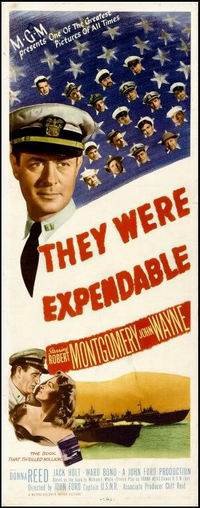
This is 11th anniversary of this blog. I wanted to do something special and I decided to return to my first review. I often think back to movies I have reviewed and wonder if I was right about my grade. This is because even though I have reviewed over 900 movies for this blog, I have seen many of them a second time since the review. Rarely do I change my mind about the movie now that I am a reviewer. This differs from my perceptions of some of my childhood favorites that I have reviewed and found to be less than I thought at the time. But what about a movie I reviewed eleven years ago? I’ve seen a lot of war movies since then and read a lot of books about war movies. Part of that reading is because I am a history buff and like to include back-stories for the films. “They Were Expendable” is a movie with a lot of back-story.
In 1942, William L. White wrote They Were Expendable: An American Torpedo Boat Squadron in the U.S. Retreat from the Philippines. It was excerpted in “Reader’s Digest” and “Life” and then became a bestseller. In 1945, MGM obtained the rights and wanted John Ford to direct it. Ford was serving with the Navy Field Photographic Unit and had famously filmed the Japanese attack on Midway for a documentary. He refused to leave the war to make the film. However, he met John Bulkeley (the hero of the book) when he spent five days on his PT-boat during D-Day. The experience convinced Ford to change his mind. This was ironic because Bulkeley felt White had exaggerated his actions and he did not deserve the Medal of Honor. Robert Montgomery’s casting as Bulkeley was brilliant. He had entered the American Field Service in London before Pearl Harbor. He was already a well-respected actor before that. He was President of the Screen Actors’ Guild and had been nominated for Best Actor. After driving ambulances in France before the fall, he returned to his day job in Hollywood. He was nominated for another Best Actor in 1941 and then enlisted in the Navy after Pearl Harbor. He served in PT-boats in the Solomons and served on the USS Barton, a destroyer that was at D-Day. He left the Navy as a Lt. Commander. “Expendable” was his first movie after his war service.
John Wayne was second-billed as Bulkeley’s exec Robert Kelly. Wayne’s WWII experience was almost the opposite of Montgomery’s. He was 34 at the beginning and classified 3-A (family deferment), but could have enlisted. He talked about it and wanted to join Ford’s unit, but Republic Pictures threatened to sue for breach of contract and Wayne kept postponing his defiance of Republic until after his next picture. That moment never came. Ironically, the epitome of cinematic war heroes was considered by some to be war avoider. Surprisingly, the problem on set was not with Montgomery. Ford, partly to suck up to Montgomery, treated Wayne like dirt, calling him “clumsy bastard” and “big oaf”. The snide comments continued until Montgomery intervened and told Ford to lay off. Another significant cast member was Ward Bond. Ford created the role of Mulcahey for his down on his luck player (he made 25 movies with Ford). The screenplay was by Frank “Spig” Wead who Wayne had played in “The Wings of Eagles” (“I’m gonna move that toe.”)
After wrapping, Ford returned to his unit in time to cross the Rhine with it. He did not like the finished product. He felt it was forced and claimed to not have watched it until an interviewer suggested it to him in 1950. Upon viewing, Ford admitted it was good. He may have avoided watching it because of bad memories. He fell off a scaffolding and broke his leg during production. He spent two weeks in traction. Montgomery took over directing. He was the logical choice since he had been treating the experience as an apprenticeship under Ford. At one point, Montgomery had suggested a different way to shoot a scene. Ford did it Montgomery’s way and then when it was finished, he asked Montgomery if he was satisfied. When he said yes, Ford opened the camera and gave the film to Montgomery saying “Here, take it home with you”. At the helm, Montgomery did a good job and went on to direct several films, including “The Gallant Hours”.
The movie is considered a classic example of the WWII films made during the war. Although the war was coming to an end, it still has a heavy whiff of patriotism and propaganda. It is an homage film to PT-boats in the darkest days of the war, specifically “in the year of Our Lord nineteen hundred and 41”. John Brickley (Montgomery) and his exec Rusty Ryan (Wayne) head a unit of PT-boats which they proudly show off for a visiting admiral. The admiral parts by proclaiming he prefers “something more substantial”. Rusty agrees and wants a transfer to a destroyer. (Way to think big!) Pearl what? Screw this transfer, I’d rather die in a “high-powered canoe”. The god of war is going to try to make that happen. It is going to be a bleak month or so. In between two attacks on Japanese cruisers, they are tasked with evacuating MacArthur from the Philippines. Through the whittling down of the boats moreso than the men, a romance between Rusty and a nurse (Donna Reed) is thrown in. There is some command dysfunction similar to a submarine movie.
Although made during the war, TWE is considered subgenre challenging. It appears to be different than films like “Bataan” and “Wake Island”. Both are grim depictions of the hopeless, yet hopeful, early days. Wayne does not get the girl, which is the only thing about the romance that is not cliche. There is a scene that perfectly contrasts with where war movies are today. Nurse Davis is invited to a dinner with the officers and is serenaded by some of the sailors. Imagine that in a modern movie. The two leaders accept abandoning their men. The enemy does not even appear (except in the form of T-6 Texans disguised as Zeros and dropping bombs they aren’t carrying). However, in most ways it is not groundbreaking. It has two heroes who butt heads. (By the way, although Wayne is second-billed, his role is more substantial than Montgomery’s.) The unit is heterogeneous. There is a redemption arc, for the boats. They have a mascot, the cat “Bad Luck”. There is a funeral. In some ways it is the combination of a small unit and a submarine movie.
The biggest problem with the movie and the thing that keeps it from being a great movie is its targets for adulation do not hold up. The central theme is that the PT-boats were an underestimated weapon and had a bright future after the Philippines fell. The whole point of Bulkeley and Kelly being evacuated is for them to help build the force. The movie has them sinking two Japanese cruisers and taking credit for an escort carrier, a tanker, and a freighter. By 1945 when the movie came out, it would have been very apparent that the boats, while glamorous, were light on successes and the successes shown in the movie were not based on facts. For instance, in the second cruiser attack the movie has most of the torpedoes hitting the Japanese warship with fireworks ensuing. In actuality, only one of eight torpedoes hit and it was a dud. (Clearly the movie was not interested in criticizing our abysmal early war torpedoes.) Perhaps the historical license is why the names of Bulkeley and Kelly were changed. More unpalatable is the movie’s treatment of the MacArthur evacuation. The general is treated like the god that the press had built him up as, so the movie was giving the audience what they expected. But to have the sailors fawn over him is laughable considering his reputation amongst the men he left behind.
It turns out that I have not changed my mind about the movie. I thought it was overrated in 2010 and I still do. It was a good movie for its time and is one of the best movies made during the war, but it feels stodgy today. The overly patriotic score and poorly written romance drag it down. It breaks some tropes, but overall it is pretty predictable.
GRADE = B-


