One
of the best books I have read is David Maraniss’ “They Walked into
Sunlight:War and Peace, Vietnam and
America, October 1967”.He follows two
events -the Battle of Ong Thanh and the
protests at the University of Wisconsin-Madison.I have been waiting for years for a movie to
be made about it.For now, I’ll just
have to settle for this documentary that covers the protests.
“The
War at Home” uses the standard documentary format of mixing interviews with
footage.It starts with an introduction
to the city of Madison, Wisconsin.It
was a typical college town, but in the late 60’s, like many other campuses, it
was roiled by student protests.The film
gives background leading to the 1967 protests.This includes the Gulf of Tonkin Incident, the daisy commercial, and
American troops arriving and fighting in South Vietnam.It does balance the pro and anti views.War footage is intermingled with protest
clips.By 1966, college students have
become impacted by the war.Yes, you had
a draft deferment, but sooner or later you would have to graduate.And if, like UMW, your school supported the
war effort with ROTC and military research, protesting could be justified as
not only for personal reasons, but for the greater good.
The
movie focuses on 1967. This is when a large number of students organized to
halt Dow Chemical (the makers of napalm) from recruiting on campus.The students responded with a sit-in which
attracted club-swinging police.Tear gas
was used.Although no one was killed
like at Kent State two years later, there were numerous students who were
injured.
Although
the movie interviews both hawks and doves, it is definitely slanted towards the
anti-war movement.There are three times
as many anti-war interviewees.There are
a lot of interviews and copious footage.What it lacks is a narrator to provide background and connections
between the war and the anti-war movement.Like other documentaries about the war, it assumes the audience is
familiar with the war.If it was up to
me, I would have included more anti-war songs for the soundtrack.
I’ve
seen better documentaries about the opposition to the Vietnam War.Movies like “Hearts and Minds” and “Sir! No
Sir!”“The War at Home” is a decent look
at the war in general and the protests at University of Wisconsin – Madison in
particular.It could have been better,
but if you are already familiar with the history of the war, you might be
interested in a movie that is chock full of archival footage and
interviews.And if you have teenagers
preparing for college or in college, it’s a curio of when college students
cared about something besides cramming and boozing.
“Born on the Fourth of July”
is the second in Oliver Stone’s Vietnam trilogy.It was released in 1989.It is sandwiched between “Platoon” and
“Heaven and Earth”.The film shares
eleven actors with “Platoon”.It is
based on the memoir by Ron Kovic who wrote the script with Stone. Kovic was on set to counsel Cruise.Interestingly, the two veterans (Kovic and Stone) both won
Bronze Stars and Purple Hearts. Kovic gave his Bronze Star to Cruise at the end of the film.Stone
also produced and directed the film.It
was a huge success at the box office and with critics.It was nominated for eight Oscars and won for
Director and Film Editing.
The
movie opens symbolically with a young Kovic playing war – an American rite of
passage.This flows into a Fourth
of July parade featuring crippled veterans (including the real Kovic).Next, he listens to an inspiring speech by JFK. This trio of images
establishes the template of pre-disillussioned ("Leave it to Beaver") America.
Kovic
is recruited by the Marines and seduced by the desire to “find out if you got
what it takes.”He doesn’t want to miss
the chance to go toe to toe with Communism.In a twist, his veteran father (Raymond Barry) is not thrilled, but his
mother (Caroline Kava) is supportive.
he's not playing war now
The
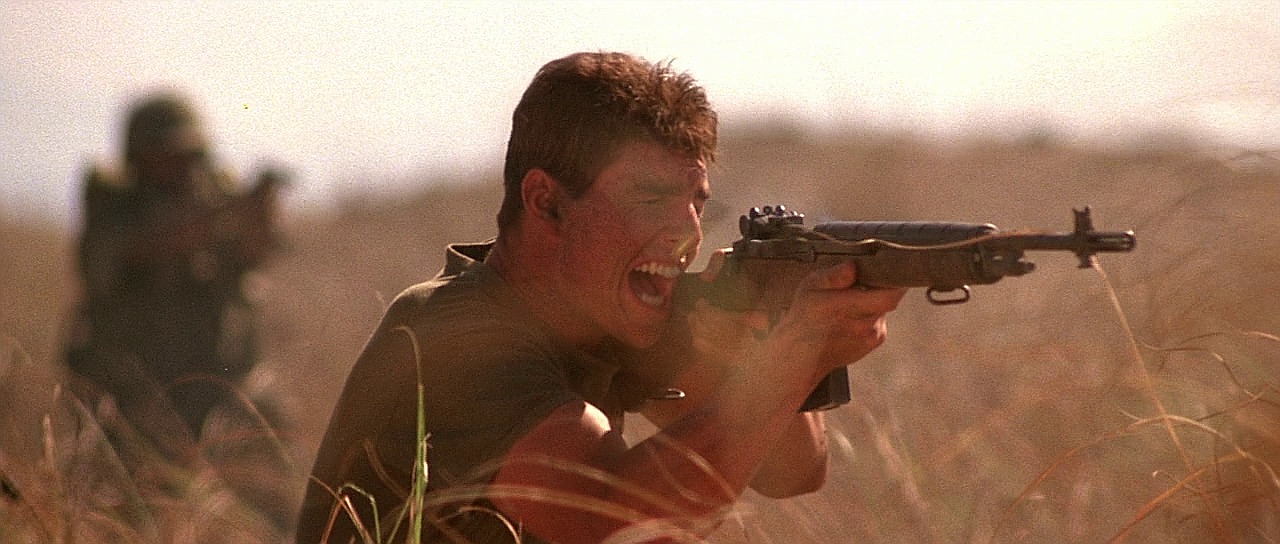
movie jumps abruptly forward to Kovic’s second tour in Vietnam. The viewer is wrenched out of their comfort zone as is Kovic.His unit is attacking a village and find a
whole family slaughtered accidentally by the Marines.The combat is
visceral and graphic.In the chaotic
retreat, Kovic kills one of his men named Wilson in a friendly fire incident.When he tries to accept responsibility, his
CO brushes the incident under the rug (standard operating procedure).This adds to Kovic’s anguish and creates an ominous vibe.Sure enough, in the next combat set piece,
Kovic is badly wounded in the assault on another ville.The action is intense and frenetic.Both scenes evidence the “fog of war”.Tragically, the military hospital is more
hellish than the front line.He is given last rites, but
survives to end up in the Bronx Veterans’ Hospital.
the tannish tinged lensing
The
hospital is like Purgatory.Viewers eyes
are opened to how our warriors were treated by the system they fought for.Rats, filth, uncaring staff, drug abuse,
faulty equipment.(This makes it even
more damning that some similar examples of mistreatment greeted veterans of
Iraq!)In spite of this, Kovic remains a
hawk and rails against anti-war protestors.“America, love it or leave it!”Kovic's athletic competitiveness makes him believe that he will walk again.A broken leg ends his optimism and begins his
descent into depression. He will be in a wheelchair the rest of his life.
His
return home does not slow the descent. The detached
atmosphere is similar to what faced Paul Baumer on leave in "All Quiet" and Michael coming home in "The Deer Hunter". He is full of self-pity. The America he was proud to fight for is indifferent to his sacrifice. He starts drinking heavily and who can blame him?The family is dysfunctional with an anti-war brother to quarrel with and
a mother who cannot deal with the broken copy of her golden boy.The movie comes full circle with another Fourth
of July parade.Although predictable
with its hippies causing trouble, the scene is a great bookend.Even the requisite PTSD flinching at the
fireworks and the failed speech with flashbacks do not feel clicheish.
The
worm turns when Kovic is caught up in a protest at Syracuse University.During a speech by Abbie Hoffman, the police
wade into the crowd with tear gas and billy clubs. This leads to a drunken rant
against his mother and the heart-rending “who’s gonna love me, dad?” This movie packs an emotional wallop.He has to leave home now.
The
third stage of his life takes him to a seedy town in Mexico inhabited by other mentally and physically damaged veterans.It’s a life of frustrated whoring and binge
drinking.Kovic poignantly falls in love
with a “whore with a heart of gold” only
to discover it’s just a job to her.He
leaves this “home” with his friend Charlie (Willem Dafoe) only to end up at
rock bottom in a wheel chair fight on a deserted highway.It’s more powerful than pathetic.
The
fourth stage begins with a soul-cleansing visit to Wilson’s family to tell them
the truth about their son’s death.Their
reaction is genuine and sincere and very Middle American. A weight has been lifted and Kovic begins his
career as afixture in the anti-war
movement.The climax of this evolution
from naïve patriot to patriotic dissenter comes at the 1972 Republican
Convention where Kovic and others disrupt Nixon’s speech and get violently
throw out of the hall.
Here’s
a cliché for you;“I’m not a big Tom
Cruise (Oliver Stone) fan, but…”How
often do you hear that?This is one of
those movies where both men are at their best.I had not seen it in years and did not look forward to reviewing it with
relish.I was wrong.It is a very impressive movie.There are few weaknesses.Stone controls himself (you know how he can
be) and deserved the Oscar as Best Director. It is astounding that the movie lost
to “Driving Miss Daisy”.You can
definitely argue that was more egregious than the infamous “Shakespeare in
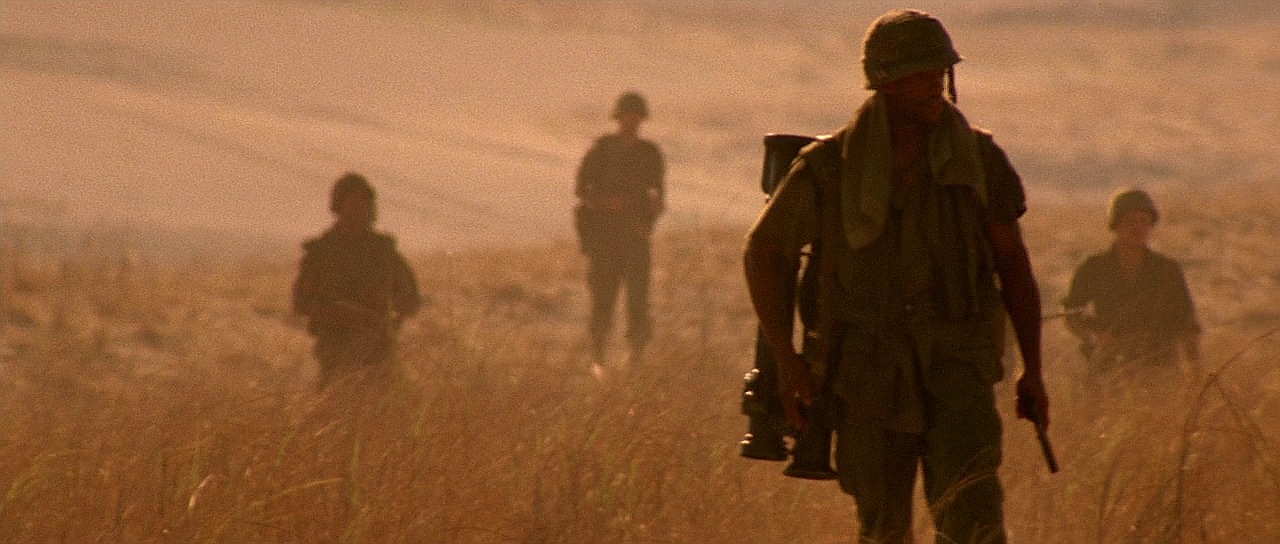
Love” win over “Saving Private Ryan”.The cinematography of Robert Richardson mixes chromes to match the
moods.For instance, the combat scenes
have a tannish tinge.(It lost to
“Glory”.)The two combat scenes stand
out for me, of course.Richardson uses a
hand-held and gets the you-are-there feel that has become common in modern war
films.The soundtrack by John Williams
was also nominated (losing to “The Little Mermaid”!). It matches the mood perfectly.
The
acting is outstanding.Cruise is amazing
and must have finished second to Daniel Day-Lewis.He is fully into a role that took great
physical commitment.Leave your feelings
about him at the door and admire his performance.The other standout is Defoe.Their scenes together are highlights. You can easily imagine Charlie as Elias from "Platoon" if he had survived the war.
In less capable hands, the movie could have
been maudlin and heavy-handed.Stone is
obviously sending a message, but he does not bludgeon us with it.The overall theme is simple: the evolution of a
patriotic warrior to a disillusioned pacifist.The arc is realistic mainly because it’s a true story.Kovic’s role in the production gives it
cred.It makes it difficult to doubt the
accuracy.However, the two protest
scenes (Syracuse and the Convention) are up-violenced for understandable
reasons.These are not major flaws.
Although Stone struck out with “Heaven and
Earth”, the first two in his trilogy are important films.“Platoon” has lost luster for many war movie
fans (not me), but the fact is that it opened the Vietnam combat experience to
many Americans for the first time. Its theme is the effects of war on the young and naive.On the other hand, “Born” opened people’s
eyes to the plight of the wounded veteran. Its theme is the effects of the post-war on the naively patriotic. This theme is rarer with the inferior “Coming Home” the obvious
competitor. "Birdy" is a similarly themed film that you might want to check out.The sad thing is the limited
impact it had on treatment of future veterans.It also should be mentioned that the movie did the service of bringing
Ron Kovic to public recognition.For the
Vietnam War, it is appropriate that we get a crippled, but resilient hero to
replace Col. Kirby of “The Green Berets” (a movie that is the polar opposite of
this movie).
Does it crack the 100 Best? Definitely! "Platoon" is #9 and although I still believe it is the better film, "Born on the Fourth of July" is not that far behind. It is hard to imagine how it did not make Military History magazine's Greatest 100 list.
Grade = A
the trailer
the wounding
TRAILER - Excellent. Great use of the song "Stop, Hey What's That Sound". Gives a clear impression of the plot arc. grade = A
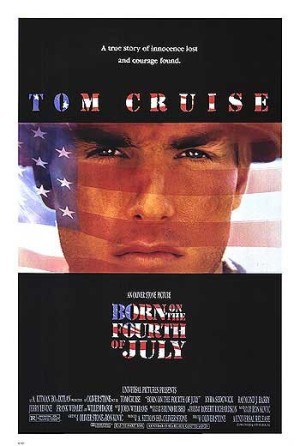
POSTER - A little too simplistic. Makes it look like a regular war movie. Does have the flag which appropriate because its a recurring motif in the film. grade = C