Friday, May 8, 2020

ANNIVERSARY: The Battle of the Coral Sea (1959)


                    This review is to honor the anniversary of the Battle of Coral Sea.  “The Battle of the Coral Sea” is a black and white war film directed by Paul Wendkos (“Tarawa Beachhead”, “Attack on the Iron Coast”).  It had technical advisers from both the Japanese navy and the American navy.   It got cooperation from the U.S. Navy and the Department of Defense.  Officers and men from several submarines participated in the production.

                    The movie begins on March 14, 1942, three days after the fall of Corregidor.  Capt. Conway (Cliff Robertson) surfaces the USS Dragonfish to pick up some men on rafts.  The sub barely survives an attack by Japanese planes.  Back at Sydney, the Dragonfish is equipped with a special camera that can take pictures through the periscope.  Conway remarks:  “Before the war, the Navy had all the time and no money.  Now it has all the money and no time.”  The camera is the key to Operation Fancy Free which involves reconnaissance of Japanese held islands and taking pictures of them.  The mission part of the movie includes a trek through a minefield, with the requisite scrapings along the hull.  We also get the required depth charging with rivets popping and leaks springing.  When the sub sits on the bottom of the very shallow ocean, the Japanese send divers using scuba gear (not yet invented) to put microphones on the hull to demand surrender!  I shit you not.  They are forced to surrender and end up in a prison camp.  The camp has a roundeye, blond nurse Peg (Patricia Cutts) and an interpreter named Karen (Gia Scala).  Two women for the poster!  The commandant is a Americanophile who is suave and cultured and who tries to convince Conway that the war is lost.  The torturing is lame and the work is not on a River Kwai level.  When a prisoner throws food on a guard, the punishment is to wrestle him.  The good Jap is replaced by a bad Jap, so escape becomes essential.  Plus they have information crucial to winning the war, so there’s that too.  The movie finally earns its title with a finale relying on a shaky blend of footage and models.  And lots of explosions.

                    Although the movie has pretensions of being a pseudo documentary, it is actually a fairly standard submarine/prison camp hybrid.  Although the plot is ridiculous, it does deserve some credit for originality.  For instance, although it has two hot females, there is no romance.  The two ladies are not just for window dressing.  They play key roles in the plot.  You also get the oddly benevolent commandant who appears to have wandered in from a European Theater war movie.  Even though he is replaced with a more standard villain, the movie is unrealistically lenient toward the Japanese captors.  The acting is above average with Robertson a good choice for the captain.  The dialogue is not muteworthy.  It’s the scenario that is laughable.  The only thing you will learn from the movie is there was a Battle of the Coral Sea and we won.  (That of course is debatable as most historians classify it as a tactical draw.)  The implication that a submarine played a crucial role in the victory is pure fantasy.  There are lots of “why?” moments in it.  Like, why did they fire the photos out in a torpedo when they were planning on blowing up the sub.  Why does one of the submariners get pneumonia when malaria would have been the obvious choice?  There are also some hilarious moments, like when they make arrows out of knives for their escape.

                    It’s a nice time waster if you don’t treat it as a true story or even based on a true story or even inspired by a true story.  It’s unclear what the technical advisers were paid for and how much cooperation from the Navy was worth since there is very little of sub interior in the film.  It is pretty much a forgotten film and that is no surprise as it is basically forgettable.

GRADE  =  C-

Tuesday, May 5, 2020

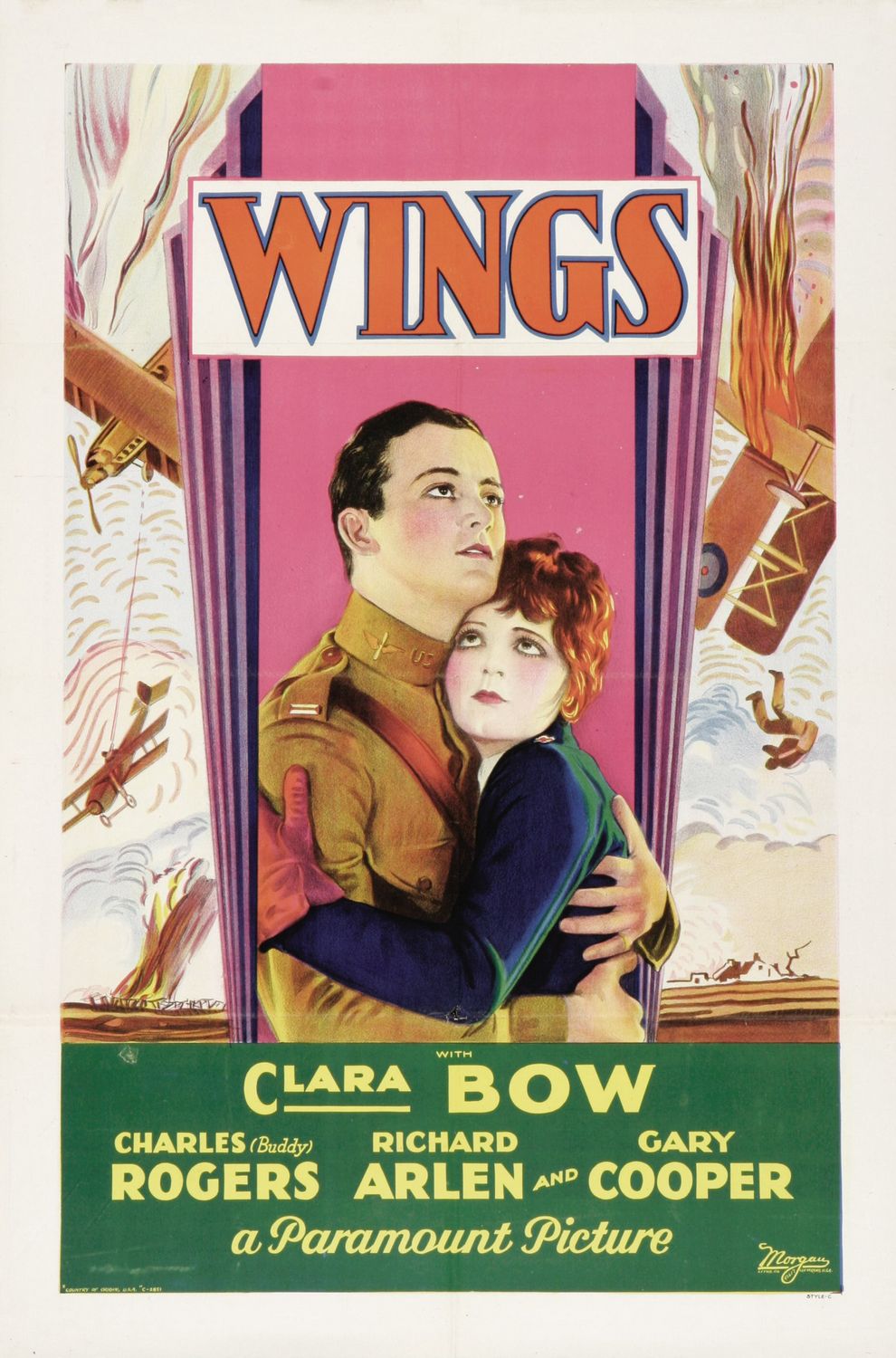
CONSENSUS #44 - Wings (1927)


SYNOPSIS:  "Wings" is the granddaddy of all aerial combat movies.  It is the tale of two Americans (Charles Rogers, Richard Arlen) who go off to the Western Front to become pilots.  They start off enemies, but that changes.  They are joined by the girl next door (Clara Bow) for a romantic subplot.  There is plenty of aerial derring do.

BACK-STORY:  “Wings” was a movie that was loaded with firsts.  First aerial combat movie.  First male kiss.  First Best Picture (and the only silent movie until “The Artist”).  It set the template for future air combat movies.  The director was William “Wild Bill” Wellman (“Beau Geste”, “The Story of G.I. Joe”, “Battleground”) who had been a pilot with the Lafayette Escadrille in WWI.  Sadly, he is one of the few directors who were not even nominated for his Best Picture efforts.  The movie was filmed at Kelly Field in San Antonio with full cooperation of the U.S. military.  The planes provided were mainly Thomas-Morse MB-3s and Curtiss PW-8s.  The German fighters were played by Curtiss P-1 Hawks.  One stunt flier broke his neck in a crash and another was a fatality.

TRIVIA:  wikipedia, imdb, TCM

1.  It was filmed at Kelly Field in San Antonio, Texas.

2.  Director William Wellman had been in the Lafayette Flying Corps in WWI.  He flew Nieuport 24’s and chalked up three confirmed kills and five probables.  He was shot down and had a permanent limp from the incident.  He was awarded the French Croix de Guerre.  His wife and daughter played the mother and daughter of the farmhouse where the crash occurs.  Wellman himself has a cameo as a doughboy and has the line:  “Atta boy!  Them buzzards are good after all!”  Wellman was notoriously anti-infantry.

3.  The Battle of St. Mihiel took ten days of rehearsing.  The Pentagon provided 3,500 soldiers and five tanks.  It also cooperated with over 100 planes for the production.  300 pilots were used.  An Army Air Corps pilot was killed in a crash during the production.

4.  The entire score was written, composed, and recorded on a Wurlitzer Pipe Organ.

5.  It won the first Oscar for Best Picture (called Best Production back then) and was the only silent movie to win until “The Artist”.  It also won for Engineering Effects.

6.  he script was adjusted for Clara Bow.  She did not like the movie.  She complained that her uniform did not show off her curves enough.  She does flash a bit of nudity, but you have to be very good at pausing.  She had recently gotten engaged, but that did not stop her from having an affair with Gary Cooper during the production.

7.  Cooper was launched to stardom by his small role.  He was distraught with his performance and went to Wyler to ask for a reshoot because he had picked his nose in the scene.  Wyler told him to keep picking his nose because he was going to be a star.

8.  Main actors Buddy Rogers and Richard Arlen are actually flying their planes for closeups.  Their kiss was one of the first male kisses in film history.

9.  It has one of the earliest product placements – Hershey’s Chocolate Bar.

Belle and Blade  =  N/A
Brassey’s              =  5.0
Video Hound       =  3.8
War Movies         =  N/A
Military History  =  #11
Channel 4             =  no
Film Site                =  yes
101 War Movies  =  yes
Rotten Tomatoes  =  no 

OPINION:  “Wings” probably deserved the Best Picture award.  It is epic in scale and execution.  Wellman had access to 60 planes and 3,500 extras.  He also had a bevy of intrepid stunt men who were willing to risk life and limb to depict the thrills of air combat.  The acrobatics of the doomed planes are particularly impressive.  In this film even the planes ham it up.  The acting is problematical.  Clara Bow dominates when she is on screen.  I know our perceptions of what is hot has changed greatly from the 1920s, but she has “it” even in today’s climate.  Rogers and Arlen give typical silent movie overemoting performances.  The movie is melodramatic and patriotic, especially in the title cards, but not overly propagandistic.  It does not demonize the enemy.  The movie is justifiably famous for its aerial sequences.  They are among the best from that era.  Better than most, but not superior to “Hell’s Angels” (which was greatly influenced by it).  Amazingly, the trench sequences are actually stronger than the air combat and they get much more coverage than in similar films.   In conclusion, it is certainly a very important film, but it is not worthy of being in the top 50 war movies.

Saturday, May 2, 2020

FINALLY – Ice Cold in Alex (1959)


                    “Ice Cold in Alex” appears on some lists of the best war movies of all time.  I have been wanting to see it for years as part of my project to come up with my 100 Best War Movies.  Although seen often on British TV, it is not well-known in America.  Possibly because it got off to a rough start in the States as it was cut to only 79 minutes and shown under the ridiculous title “Desert Command”.  It was a big hit in Great Britain and was nominated for BAFTA’s for Best Film (losing to “Ben Hur”), Best British Film (losing to “Room at the Top”), Best Supporting Actor (Anthony Quayle), and Best British Screenplay.  The screenplay was based on a novel by Christopher Landon.  It was directed by J. Lee Thompson (Guns of Navarone), mostly in Libya.  It was a difficult shoot for the actors with the desert playing the role intended for it in the screenplay.  The copious sweating is real.  There was also a fly problem which was solved by dousing the cast with DDT.  The title comes from the desire of Capt. Anson (John Mills) to have a cold lager when they reach Alexandria.  That scene took fourteen takes and Mills was drunk by the end.  The scene was used forty years later in a Carlsberg lager commercial.  The actors made more from the commercial than from the film.

                    The movie opens up with narration outlining the situation in North Africa between the British 8th Army and Rommel’s Afrika Korps.  “The Desert Rats” is a good companion movie.  Places like Tobruk “paid for their brief fame in piles of rubble and smoking ruins as the grim struggle surged to and fro…. This is one of two million stories -  it happens to be true.”  With Tobruk about to be besieged, Capt. Anson is ordered to evacuate most of his RASC Motor Ambulance Company.  He will take an ambulance (called a Katy) and is joined by Sergeant Major Pugh (Harry Andrews) and two nurses.  Denise is panicky and Diana (Sylvia Syms) is made of sterner stuff.   They pick up a South African solder named van der Poel (Quayle) who is charming, but suspicious.  Their trek to Alexandria and that cold brew will become an odyssey.  It’s them versus the desert.  The plot is a series of obstacles that they have to overcome.  These include two encounters with Germans, a trip through a minefield, a muddy quicksand scene, and the crossing of a depression.  Along the way, personalities are fleshed out and a mystery is solved.

                    There aren’t too many WWII movies giving credit to the ambulance corps, so “Ice Cold in Alex” is pretty unique.  However, it is not really about the ambulance corps, although a Katy plays a leading role.  It is more about a quartet who takes on the desert.  It fits firmly in the lost patrol subgenre, but avoids most of the well-worn clichés.  It manages to stay fresh by putting the lost group in some unique situations like the encounters with the Germans and the quicksand scene.  There are several edge of the seat moments enhanced by the “who will survive?” vibe you have in movies like this.  The main draw is the interaction between a fine ensemble.  While Syms is in over her head (her nicely coiffed head), the male leads are outstanding.  Mills is great as the burnt-out, alcoholic Anson.  He drinks six times in the first fifteen minutes.  Andrews is perfect as his level-headed exec.  But it’s Quayle who steals the show as the jolly giant Poel.  He has great fun with the role as Poel may be a spy, but he is still a valuable member of the quartet.

                    A strength of the film is its unpredictability.  It has the requisite romance for poster purposes, but the relationship between Anson and Diana is refreshingly mature.  The ending is satisfying (like the lager) and is partly responsible for the fondness the movie engenders in Brits.  As far as it being a true story, that certainly is artistic license as in reality they would not have survived the journey depicted in the movie.

                    The movie was worth the wait.  I had purposely avoided reading a lot about it and was unaware of even the basics of the plot.  I was surprised how different it was from most of the movies set in the North African campaign.  When you have seen as many war movies as I have, different is always welcome.  The unusual aspects of the plot and characters set it a cut above, but are not enough to propel it to greatness.  I would not place it among the 100 best war movies.  However, it is a must-see and justifiably well-loved.

GRADE  =  B

Wednesday, April 29, 2020

PICTURE, QUOTE, MOVIE #82


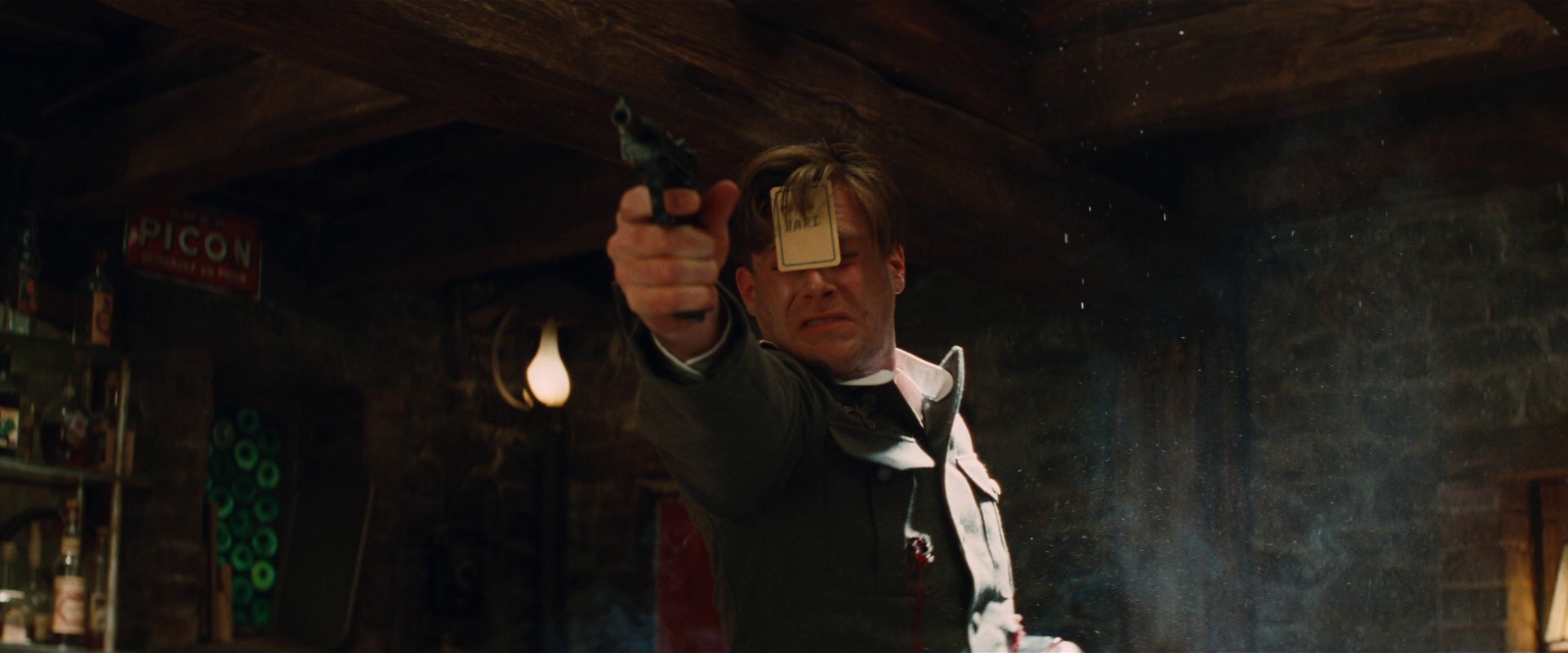
1.  What movie is the picture from?

2.  What movie is this quote from?

Pfc. Al Thomas: That’s war.
Pfc. Charlie Bass: What’s war?
Pfc. Al Thomas: Trading real estate for men.

3.  What movie is this?

The film is based on the book by the same name by William White.  The screenplay was written by Frank “Spig” Wead who war movie buffs will recognize as the hero of John Ford’s “Wings of Eagles” (“I’m gonna move that toe”) starring John Wayne.  Ford was good friends with the main character and spent five days with him during the Normandy invasion.  Ford had to step down from the director’s chair midway through shooting due to health reasons and surprisingly tapped Montgomery instead of Wayne to finish up.  In a side note, real-life nurse Beulah Greenwalt felt her portrayal “cheapened her character” and sued and won $290,000.  The movie was a hit and was praised for its authenticity.  It was nominated for Best Visual Effects and Best Sound Recording.