Showing posts with label Casablanca. Show all posts

Friday, January 19, 2024

THE 100 BEST WAR MOVIES - #77. (tie) Casablanca


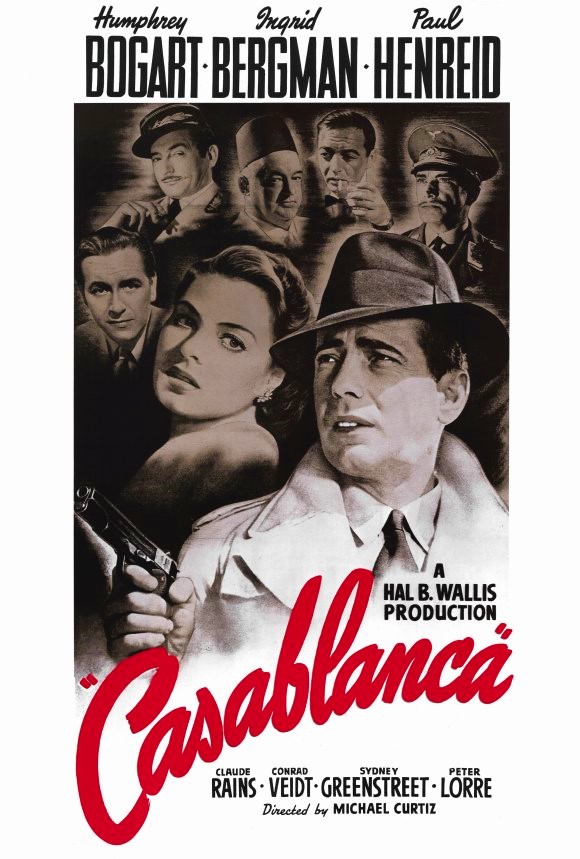
 “Casablanca” is a war movie released in 1942 to coincide with Operation Torch and the liberation of Casablanca that same year. It is based on an unproduced play entitled “Everybody Comes to Rick’s”. Shockingly, several writers adapted it which flies in the face of multiple writers signaling problems. It was directed by Michael Curtiz. It was Bogart’s first romantic role. In spite of the chemistry between him and Ingrid Bergman, they never made another film together. Only three American actors have roles. Many of the extras were Jewish refugees. It was filmed at the studio. The Production Code Administration had all direct references to sex removed from the script. (Note to current television writers, it is possible to be sexy without beating the audience over the head.) It won three Oscars (Picture, Director, Screenplay) and was nominated for Actor (Bogart – robbed by Paul Lukas (who?) in “Watch on the Rhine”!!), Supporting Actor (Rains – robbed by Charles Coburn in “The More the Merrier”!), Cinematography (how did it lose that one?), Editing, and Music.  There was only half-hearted talk of a sequel.  Times change.

The film opens with a narrator explaining the situation in Vichy-controlled Morocco. For those unfamiliar with World War II, when France fell to Germany in 1940, the southern part of the nation remained quasi-independent.  It had to be very Fuhrer-friendly or it would be his next meal.  Morocco was a colony of France.  It is a transit point for refugees hoping to get to Portugal and then to safety in America. Most are stuck and waiting…waiting…waiting… The search is on for the murderer of two Nazi couriers. The criminal has taken two “letters of transit” which will fetch a great price. Capt. Renaud (Rains as the local Vichy police chief) is rounding up the usual suspects.

At Rick’s CafĂ© Americain, the cynical expatriate Rick Blaine is visited by Ugarte (Peter Lorre) who is a petty criminal who has the two letters of transit for sale. Czech Resistance leader Victor Laszlo (Paul Henreid) arrives in Casablanca. He has escaped from a concentration camp and is on the lam. He is accompanied by his wife Ilsa (Bergman). He needs the letters of transit. The typically loathsome Nazi Maj. Strasser (Conrad Veidt – an anti-Nazi who had fled Germany) of the Gestapo is in town to get Laszlo, but cannot simply arrest him in Vichy jurisdiction. When Ilsa asks the house piano player Sam (Dooley Wilson – a drummer who could not play the piano) to play “As Time Goes By”, Rick realizes his ex-lover is in town.  Cue the romantic triangle wrapped in a lot of intrigue.          

ACTING:                      A

ACTION:                      N/A

ACCURACY:               N/A

PLOT:                           A

REALISM:                   B

CINEMATOGRAPHY:      B

SCORE:                        A


BEST SCENE:  the dueling anthems

BEST QUOTE:  Renault:   Carl, see that Major Strasser gets a good table, one close to the ladies.

Carl: I have already given him the best, knowing that he is German and would take it anyway.

ACCURACY: Accuracy is not really an issue. It does not claim to be based on a true story. The general outline is accurate. Morocco in 1941 was officially part of Vichy France and thus technically out of Nazi jurisdiction. Casablanca was a transit point for European refugees trying to get to Portugal and then to America. It seems likely that under real circumstances the Gestapo would have had less scruples about eliminating a resistance leader like Laszlo. The “letters of transit” were a fictitious plot device. In my opinion, one of the most accurate statements in the movie is made by Ferrari (Sidney Greenstreet) who is Rick’s shady-operator rival. He opines: “My dear Rick, when will you realize that in this world today, isolationism is no longer a practical policy?” The screenwriters obviously agreed with that sentiment, as did FDR who screened the movie in The White House (la casa blanca).

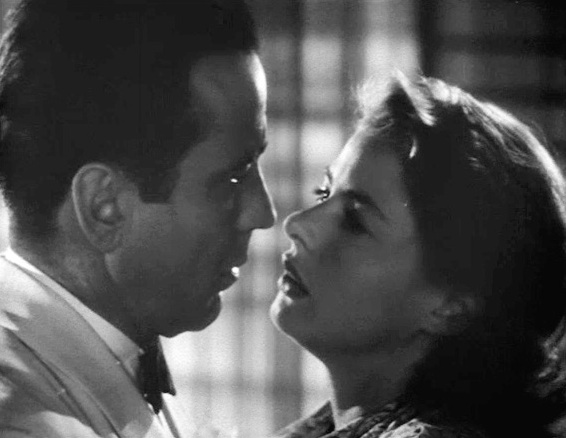
CRITIQUE: “Casablanca” is one of the top five movies of all time. It is one of the few “classics” that holds up for modern audiences. The dialogue is crackling. Numerous quotes are among the greatest in movie history. The acting is top notch. Bogart is at the top of his game and he is matched by Bergman. Rains is outstanding in the best performance of his career. The only downer is Henreid’s stiff performance, but that was partly due to the saintliness of the character. You throw in Strasser, Lorre, and Greenstreet and you have an amazing cast. The musical score keeps pace with the acting. The song “As Time Goes By” is justifiably one of the most memorable in cinema history. The cinematography is awesome. Bergman’s face is shot in such a way to highlight her conflicting emotions. The darkness and shadows give the film a film noir feel.  The theme of sacrifice resonated in WWII America, but can be understood at any time.  The cynic who does the right thing may be stereotypical, but Bogart set the template for it.  This is an adult movie for adults.

            The dilemma one faces in ranking “Casablanca” (and “The African Queen”) is whether to view it as a great movie or as a very good war movie.  I have chosen the second option.  Both the films deserve to be higher on a list of greatest movies, but I feel #77 seems appropriate if we are judging just war movies.  Keep in mind that when you compare it the poor quality of most WWII movies made during the war, it is one of the best.  It is not propaganda.  It is a story of humans dealing with the shifting sands that war causes.

Monday, November 16, 2020

CONSENSUS #11. Casablanca (1942)


SYNOPSIS: The super-famous film about Rick and Ilsa in Vichy Morrocco during WWII. Rick (Humphrey Bogart) runs a night club that is the center for intrigue and espionage. Ilsa (Ingrid Bergman) reenters his life on the arm of a Resistance leader who is on the lam from the Gestapo. Rick and Ilsa rekindle their romance, but the bigger picture intrudes.

BACK-STORY: Casablanca is a war movie released in 1942 to coincide with Operation Torch and the liberation of Casablanca. It is based on an unproduced play entitled Everybody Comes to Ricks. Shockingly, several writers adapted it which flies in the face of multi-writers signaling problems. It was directed by Michael Curtiz. It was Bogarts first romantic role. In spite of the chemistry between him and Ingrid Bergman, they never made another film together. Only three American actors have roles. Many of the extras were Jewish refugees. It was filmed at the studio. The Production Code Administration had all direct references to sex removed from the script. (Note to current television writers, it is possible to be sexy without beating the audience over the head.) It won three Oscars (Picture, Director, Screenplay) and was nominated for Actor (Bogart robbed by Paul Lukas (who?) in Watch on the Rhine!!), Supporting Actor (Rains robbed by Charles Coburn in The More the Merrier!), Cinematography (how did it lose that one?), Editing, and Music.

TRIVIA:

1.  It was Bogart’s first romantic role.  He was never comfortable with kissing on film.

2.   In spite of the chemistry between him and Ingrid Bergman, they never made another film together. 

3.  Only three American actors have roles. 

4.  Many of the extras were Jewish refugees.   

5.  The Production Code Administration had all direct references to sex removed from the script.  References to Renault selling visas for sex were removed and references to Rick and Ilsa having been lovers.  The line “What the --- are you playing?” was changed to “Sam, I told you never to play…”

6.  It was rushed to release to coincide with Operation Torch.  One of the landings was at Casablanca.

7.  An alternate ending was considered with Rich joining the Free French for the invasion of North Africa, but Claude Rains was unavailable.  David O. Selznick decided it would be a mistake to change the ending.

8.  Dooley Wilson was a drummer.  His piano playing was dubbed.

9.  It is a myth that Ronald Reagan was considered for Rick.  Bogart was the man from day one.

10.  It is also a myth that it was undecided until the last moment who Ilsa would go with.  The Production Code would not have permitted her leaving her husband for Rick.

11.  Bogart stood on two inch blocks for some scenes with Bergman because she was taller than him.

12.  The movie was not iconic until the 1960s when, after Bogart’s death, a theater in Connecticut began showing it for three weeks each year.  Fans came dressed in trench coats and snap-brim hats.

13.  When it won the Best Picture award, studio head Jack Warner rushed up to receive it.  Producer Hal Willis was blocked in his seat by the Warner family.

14.  It has the most quotes on the AFI list of best quotes.

                5 -  “Here’s looking at you, kid.”

                20 – “Louis, I think this is the beginning of a beautiful friendship.”

                28 -  “Play it, Sam.  Play ‘As Time Goes By’”

                32 -  “Round up the usual suspects.”

                43 -  “We’ll always have Paris.”

                67 -  “Of all the gin joints in all the towns in all the world, she walks into mine.”


Belle and Blade  =  N/A

Brassey’s              =  5.0

Video Hound       =  5.0

War Movies         =  5.0

Military History  =  #65

Channel 4             =  #30

Film Site                =  yes

101 War Movies  =  no

Rotten Tomatoes  =  #1 


ACCURACY: Accuracy is not really an issue. It does not claim to be based on a true story. The general outline is accurate. Morocco in 1941 was officially part of Vichy France and thus technically out of Nazi jurisdiction. Casablanca was a transit point for European refugees trying to get to Portugal and then to America. It seems likely that under real circumstances the Gestapo would have had less scruples about eliminating a resistance leader like Laszlo. The letters of transit were a fictitious plot device. In my opinion, one of the most accurate statements in the movie is made by Ferrari (Sidney Greenstreet) who is Ricks shady-operator rival. He opines: My dear Rick, when will you realize that in this world today, isolationism is no longer a practical policy? The screenwriters obviously agreed with that sentiment, as did FDR who screened the movie in The White House (la casa blanca).

OPINION: Casablanca is one of the top five movies of all time. It is one of the few classics that holds up for modern audiences. The dialogue is crackling. Numerous quotes are among the greatest in movie history. The acting is top notch. Bogart is at the top of his game and he is matched by Bergman. Rains is outstanding in the best performance of his career. The only downer is Henreids stiff performance, but that was partly due to the saintliness of the character. You throw in Strasser, Lorre, and Greenstreet and you have an amazing cast. The musical score keeps pace with the acting. The song As Time Goes By is justifiably one of the most memorable in cinema history. The cinematography is awesome. Bergmans face is shot in such a way to highlight her conflicting emotions. The darkness and shadows give the film a film noire feel.

In conclusion, Casablanca is one of the greatest movies of all time, but is it one of the greatest war movies? It certainly fits the 100 Greatest list better than Foreign Correspondent or The Third Man” or “Notorious”, for example. Although I have my qualms about it being part of the genre, clearly most experts think it fits.  With that said, it certainly deserves its placement at #11.  It clearly is better than two of the upcoming films.  You’ll know them when they appear. 

Saturday, May 21, 2011

#65 - CASABLANCA


BACK-STORY: “Casablanca” is a war movie released in 1942 to coincide with Operation Torch and the liberation of Casablanca. It is based on an unproduced play entitled “Everybody Comes to Rick’s”. Shockingly, several writers adapted it which flies in the face of multi writers signaling problems. It was directed by Michael Curtiz. It was Bogart’s first romantic role. In spite of the chemistry between him and Ingrid Bergman, they never made another film together. Only three American actors have roles. Many of the extras were Jewish refugees. It was filmed at the studio. The Production Code Administration had all direct references to sex removed from the script. (Note to current television writers, it is possible to be sexy without beating the audience over the head.) It won three Oscars (Picture, Director, Screenplay) and was nominated for Actor (Bogart – robbed by Paul Lukas (who?) in “Watch on the Rhine”!!), Supporting Actor (Rains – robbed by Charles Coburn in “The More the Merrier”!), Cinematography (how did it lose that one?), Editing, and Music.  There was only half-hearted talk of a sequel.  Times change.


OPENING: A narrator explains the situation in Vichy-controlled Morocco. It is a transit point for refugees hoping to get to Portugal and then to safety in America. Most are stuck and waiting…waiting…waiting… The search is on for the murderer of two Nazi couriers. The criminal has taken two “letters of transit” which will fetch a great price. Capt. Renaud (the local Vichy police chief) is rounding up the usual suspects.

Henreid, Bergman, Rains, and Bogart
SUMMARY: At Rick’s CafĂ© Americain, the cynical expatriate Rick Blaine is visited by Ugarte (Peter Lorre) who is a petty criminal who has two letters of transit for sale. Czech Resistance leader Victor Laszlo (Paul Henreid) arrives in Casablanca. He has escaped from a concentration camp and is on the lam. He is accompanied by his wife Ilsa (Bergman). He needs the letters of transit. The typically loathsome Nazi Maj. Strasser (Conrad Veidt – an anti-Nazi who had fled Germany) of the Gestapo is in town to get Laszlo, but cannot simply arrest him in Vichy jurisdiction. When Ilsa asks the house piano player Sam (Dooley Wilson – a drummer who could not play the piano) to play “As Time Goes By”, Rick realizes his ex-lover is in town. He gleefully greets her like a lovelorn schoolboy. Not really.

     A flashback reveals the reason for Rick’s bitterness. Rick and Ilsa had had a fling in Paris in 1940. They drove around in front of a movie screen and also boated in front of a screen (so much for 1940s special effects). We get a montage of romantic moments. We are left to wonder whether they had sex. It seems likely. They are scheduled to flee as Paris falls, but Ilsa does not show up at the train station. She leaves a note saying she loves him, but it’s over. She runs out of ink before she can explain why.

     We find out that Rick was a gun runner to Ethiopians fighting the Italian invasion and then later he fought in the Spanish Civil War. These are his bona vides as a cynical fascist hater. In the cafĂ©, “La Marseillaise” wins a duel with “Die Wacht am Rhein” (“Watch on the Rhine”). Movie audiences must have high-fived at this point.

Bergman preferred her left side
     Ilsa visits Rick to beg for the letters. He refuses. She pulls a gun, then cries. (Not realizing if she had done the crying first, the gun would have been unnecessary.) He cracks (he may be Bogart, but even he cannot withstand the ultimate female weapon). She explains why she left him in Paris (in an amazing coincidence, her assumed-to-be-dead husband showed up the day of the train rendezvous. Better late than never.) They rekindle their love. He promises to help Laszlo escape with the understanding that she will stay.

     Laszlo arrives to beg Rick to use the letters to escort Ilsa to safety. It turns out he figured out the love of Rick and Ilsa because of the steam. Laszlo is arrested on a trumped up charge before the conversation is over. Rick makes a deal with Renaud to entrap Laszlo on a more serious charge. Renaud releases Laszlo, and then Rick turns a gun on Renaud.

scenes from the satanic colorized  version
CLOSING: Come on, if you don’t know what happens you would not have read up to this point because either you don’t know how to read or you are a teenager (or both). Anyway, at the airport, Rick insists Ilsa leave with Laszlo because if she doesn’t she will regret it. “Maybe not today, maybe not tomorrow, but soon and for the rest of your life. Plus, the motion picture code will not allow you to stay because you are married.” (That last sentence was cut from the final version.) Rick says “Here’s looking at you, kid” for the fourth and last time. He kills Strosser and goes walking off with Renaud (who has ordered the rounding up of “the usual suspects”) and they plan to join the Free French. “Louis, I think this is the beginning of a beautiful friendship”. A friendship based on cynicism and back-stabbing.

RATINGS:

Acting - 10


Action - 5


Accuracy - N/A


Realism - 8


Plot - 10


Overall - 9

WOULD CHICKS DIG IT? Are you kidding? Bogart and Bergman. As they said about the Kennedy’s, every woman would want to be with Bogart and every woman would want to be Bergman. The chemistry between the two is sizzling. The romance is heart-tugging and realistic. Watch out guys, the movie could prompt disillusionment in your significant other. However, this should be cancelled out by the props you get for watching it with her. Also, you won’t have to talk her into watching a war movie because she won’t recognize it as such.

ACCURACY: Accuracy is not really an issue. It does not claim to be based on a true story. The general outline is accurate. Morocco in 1941 was officially part of Vichy France and thus technically out of Nazi jurisdiction. Casablanca was a transit point for European refugees trying to get to Portugal and then to America. It seems likely that under real circumstances the Gestapo would have had less scruples about eliminating a resistance leader like Laszlo. The “letters of transit” were a fictitious plot device. In my opinion, one of the most accurate statements in the movie is made by Ferrari (Sidney Greenstreet) who is Rick’s shady-operator rival. He opines: “My dear Rick, when will you realize that in this world today, isolationism is no longer a practical policy?” The screenwriters obviously agreed with that sentiment, as did FDR who screened the movie in The White House (la casa blanca).

CRITIQUE: “Casablanca” is one of the top five movies of all time. It is one of the few “classics” that holds up for modern audiences. The dialogue is crackling. Numerous quotes are among the greatest in movie history. The acting is top notch. Bogart is at the top of his game and he is matched by Bergman. Rains is outstanding in the best performance of his career. The only downer is Henreid’s stiff performance, but that was partly due to the saintliness of the character. You throw in Strasser, Lorre, and Greenstreet and you have an amazing cast. The musical score keeps pace with the acting. The song “As Time Goes By” is justifiably one of the most memorable in cinema history. The cinematography is awesome. Bergman’s face is shot in such a way to highlight her conflicting emotions. The darkness and shadows give the film a film noir feel.  The theme of sacrifice resonated in WWII America, but can be understood at any time.  The cynic who does the right thing may be stereotypical, but Bogart set the template for it.  This is an adult movie for adults.

CONCLUSION: “Casablanca” is one of the greatest movies of all time, but is it one of the greatest war movies? It certainly fits the 100 Greatest list better than "Foreign Correspondent" or “Notorious” (which incredibly is placed 8 slots higher than "Casablanca"!), for example. I am more comfortable with it being placed in that vague category of “movies set in war”. If you classify it as a war movie, how do you place it at only #65 when it is clearly superior as a movie to virtually every movie on the list? For that reason, although I love it, it will not be on my eventual 100 Best War Movies list. Watch it for the tenth time anyway.