Showing posts with label Humphrey Bogart. Show all posts

Friday, January 19, 2024

THE 100 BEST WAR MOVIES - #77. (tie) Casablanca


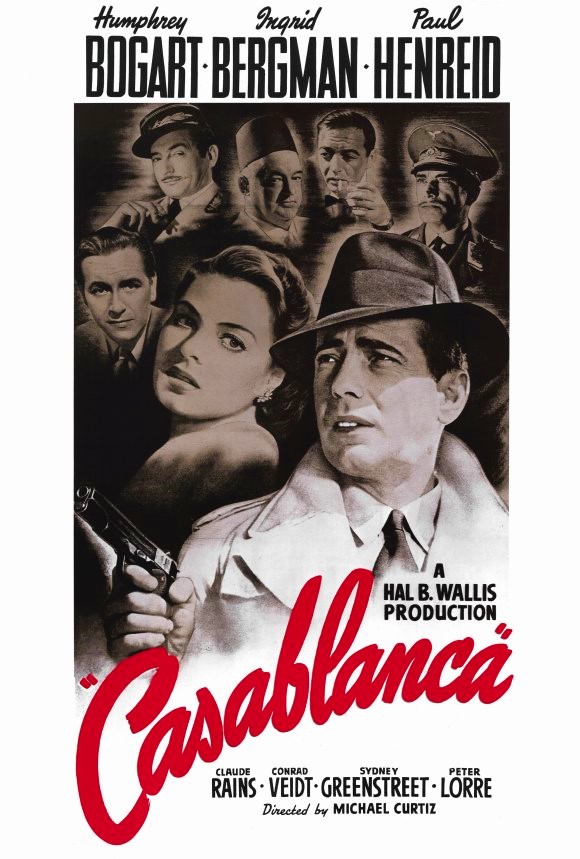
 “Casablanca” is a war movie released in 1942 to coincide with Operation Torch and the liberation of Casablanca that same year. It is based on an unproduced play entitled “Everybody Comes to Rick’s”. Shockingly, several writers adapted it which flies in the face of multiple writers signaling problems. It was directed by Michael Curtiz. It was Bogart’s first romantic role. In spite of the chemistry between him and Ingrid Bergman, they never made another film together. Only three American actors have roles. Many of the extras were Jewish refugees. It was filmed at the studio. The Production Code Administration had all direct references to sex removed from the script. (Note to current television writers, it is possible to be sexy without beating the audience over the head.) It won three Oscars (Picture, Director, Screenplay) and was nominated for Actor (Bogart – robbed by Paul Lukas (who?) in “Watch on the Rhine”!!), Supporting Actor (Rains – robbed by Charles Coburn in “The More the Merrier”!), Cinematography (how did it lose that one?), Editing, and Music.  There was only half-hearted talk of a sequel.  Times change.

The film opens with a narrator explaining the situation in Vichy-controlled Morocco. For those unfamiliar with World War II, when France fell to Germany in 1940, the southern part of the nation remained quasi-independent.  It had to be very Fuhrer-friendly or it would be his next meal.  Morocco was a colony of France.  It is a transit point for refugees hoping to get to Portugal and then to safety in America. Most are stuck and waiting…waiting…waiting… The search is on for the murderer of two Nazi couriers. The criminal has taken two “letters of transit” which will fetch a great price. Capt. Renaud (Rains as the local Vichy police chief) is rounding up the usual suspects.

At Rick’s CafĂ© Americain, the cynical expatriate Rick Blaine is visited by Ugarte (Peter Lorre) who is a petty criminal who has the two letters of transit for sale. Czech Resistance leader Victor Laszlo (Paul Henreid) arrives in Casablanca. He has escaped from a concentration camp and is on the lam. He is accompanied by his wife Ilsa (Bergman). He needs the letters of transit. The typically loathsome Nazi Maj. Strasser (Conrad Veidt – an anti-Nazi who had fled Germany) of the Gestapo is in town to get Laszlo, but cannot simply arrest him in Vichy jurisdiction. When Ilsa asks the house piano player Sam (Dooley Wilson – a drummer who could not play the piano) to play “As Time Goes By”, Rick realizes his ex-lover is in town.  Cue the romantic triangle wrapped in a lot of intrigue.          

ACTING:                      A

ACTION:                      N/A

ACCURACY:               N/A

PLOT:                           A

REALISM:                   B

CINEMATOGRAPHY:      B

SCORE:                        A


BEST SCENE:  the dueling anthems

BEST QUOTE:  Renault:   Carl, see that Major Strasser gets a good table, one close to the ladies.

Carl: I have already given him the best, knowing that he is German and would take it anyway.

ACCURACY: Accuracy is not really an issue. It does not claim to be based on a true story. The general outline is accurate. Morocco in 1941 was officially part of Vichy France and thus technically out of Nazi jurisdiction. Casablanca was a transit point for European refugees trying to get to Portugal and then to America. It seems likely that under real circumstances the Gestapo would have had less scruples about eliminating a resistance leader like Laszlo. The “letters of transit” were a fictitious plot device. In my opinion, one of the most accurate statements in the movie is made by Ferrari (Sidney Greenstreet) who is Rick’s shady-operator rival. He opines: “My dear Rick, when will you realize that in this world today, isolationism is no longer a practical policy?” The screenwriters obviously agreed with that sentiment, as did FDR who screened the movie in The White House (la casa blanca).

CRITIQUE: “Casablanca” is one of the top five movies of all time. It is one of the few “classics” that holds up for modern audiences. The dialogue is crackling. Numerous quotes are among the greatest in movie history. The acting is top notch. Bogart is at the top of his game and he is matched by Bergman. Rains is outstanding in the best performance of his career. The only downer is Henreid’s stiff performance, but that was partly due to the saintliness of the character. You throw in Strasser, Lorre, and Greenstreet and you have an amazing cast. The musical score keeps pace with the acting. The song “As Time Goes By” is justifiably one of the most memorable in cinema history. The cinematography is awesome. Bergman’s face is shot in such a way to highlight her conflicting emotions. The darkness and shadows give the film a film noir feel.  The theme of sacrifice resonated in WWII America, but can be understood at any time.  The cynic who does the right thing may be stereotypical, but Bogart set the template for it.  This is an adult movie for adults.

            The dilemma one faces in ranking “Casablanca” (and “The African Queen”) is whether to view it as a great movie or as a very good war movie.  I have chosen the second option.  Both the films deserve to be higher on a list of greatest movies, but I feel #77 seems appropriate if we are judging just war movies.  Keep in mind that when you compare it the poor quality of most WWII movies made during the war, it is one of the best.  It is not propaganda.  It is a story of humans dealing with the shifting sands that war causes.

Tuesday, October 15, 2013

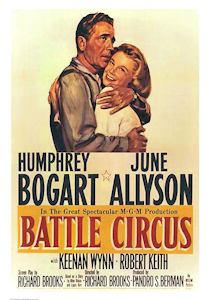
CLASSIC or ANTIQUE? “Battle Circus” (1953)


                “Battle Circus” is a Korean War movie released in 1953.  It was written and directed by Richard Brooks (“Take the High Ground”).  The movie is about a MASH unit and was originally entitled “MASH 66”.  The studio worried people would think it was about potatoes.  Instead a title was developed that reflected the circus atmosphere and tents of a Mobile Hospital.  The technical adviser had operated a MASH unit in Korea so the operation was accurate.  Humphrey Bogart was paid $250,000, but that princely sum did not keep him from regretting making the film.  The fact that he burned his thumb during a scene where he destroys papers before a retreat did not increase his enthusiasm.  The scene was left in the film.  At least he got decent reviews.  His co-star June Allyson was lambasted by the press.  So much for broadening her resume beyond “the girl next door”.

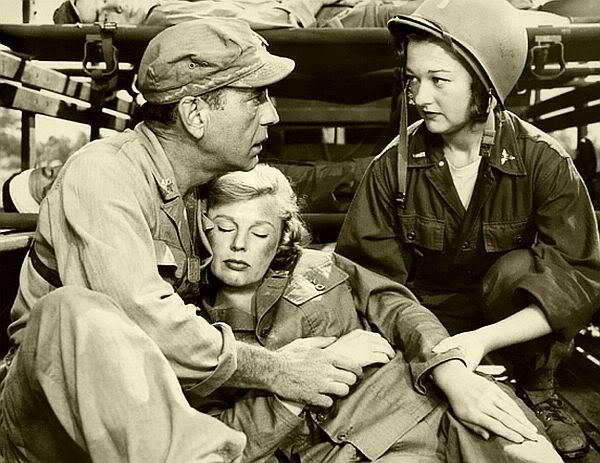
                “Battle Circus” is a “story about the indominable human spirit…”  It is set in an unspecified part of the Korean War, but based on the constant bugging out it would seem to be the first year.  The set looks like a MASH unit.  In other words, you’ll recognize “MASH” the movie and TV show.  There are the iconic tents and the helicopters bringing in the wounded (the movie was partly filmed at Camp Pickett, Virginia where the MASH units were trained).  We are introduced to the dangers of military medical care through a ridiculous strafing attack on the unit.  Using actual footage – of a USAF F-86!  Apparently the director did not give a crap about our intelligence level.  By the way, I would be surprised if there were any MIG strafings of hospitals in the entire war.

June finds out her make-up kit was left behind
                A cherry nurse arrives named Ruth (Allyson).  The hard drinking surgeon Maj. Webbe (Bogart) takes an immediate lusting for her.  They immediately begin the Hollywood process of hooking up.  This involves embarrassing pick-up lines by Webbe that would have Hawkeye Pierce gagging.  Plus Webbe is about as subtle as a kick in the stomach.  Ruth is very protective of her female virtue – for about five minutes.  That’s how long it takes the wolf in scrubs to get her to lower her surgical mask.  Soon she is the aggressor and madly (as in insanely) in love with him.

                It’s not all love in war.  Webbe saves a little Korean boys life by performing open heart surgery.  He is an ace surgeon and an ace drunk.  His drinking gets him in trouble with his superior.  In the obligatory carpet calling confrontation, Webbe makes a bizarrely contemporary comment about the “three world wars in our lifetime”.  How did I miss one?  I assume the screenwriters are referring to the Cold War as WWIII, but I thought that was only a recent bit of historical revisionism. 
looks just like a real war photo, doesn't it?

                Allyson gets to show off her serious acting chops (or lack thereof) in a silly scene where she talks down an enemy prisoner welding a grenade during an operation.  There are no subtitles but I’m pretty sure he is upset with the romance.  It appears that this naĂŻve newbie has developed into a battle-hardened caregiver.  The movie closes with one last bug-out as the unit has to escape through enemy lines under artillery fire.  The nurses get separated from the doctors.  I mean Bogart gets separated from Allyson.  Will they have a loving reunion?  You’ll have to watch the movie.

listen kid, I can get my make-up guy to
make you look like you're in a war,too
                This is a strange movie.  It is part sappy romance and part realistic depiction of the workings of a MASH unit.  The look of the unit is real and the activities seem authentic.  The bug-outs are appropriate for that stage of the war.  The use of helicopters is well done.  All this effort is diluted by the romance half.  It would be like MASH bombing in the comedy sphere.  The two leads have little chemistry.  Bogart looks too old for the role.  Their dialogue is cringe-worthy.  No couple talks like that in real life.  Plus the arc of the romance defies reality.  Ruth goes from skeptical to stalking in the bat of an eyelash.  Of course, the actors are not helped by the script.  There is a painful scene where they wallow in a mud puddle.  Hilarious not.  This is the only time in the film that Allyson is not well-dressed, well-made up, amd well-coiffed.  At least the doctors sweat a little in the operating room.

                In spite of my carping, the movie is not that bad.  Aside from the elephantine clichĂ© of a romance, the movie has some interesting twists.  The enemy is not demonized.  The movie is nurse-centric as oppsed to concentrating on the male doctors.  The film does a good job commemorating the role of the MASH units.

                Classic or antique?  Neither.

grade =  C 

Thursday, June 27, 2013

The Caine Mutiny (1954)


              “The Caine Mutiny” is based on Herman Wouk’s bestseller.  It was directed by Edward Dmitryk (“The Young Lions”) who had been one of the “Hollywood Ten” and had spent time in prison for refusing to answer questions posed by the House Un-American Activities Committee.  The film was almost not made due to concerns from the Navy.  However, the Navy eventually extended its cooperation after the filmmakers started the movie with the caveat “There has never been a mutiny in the USN”.  This is the only instance in war movie history where the makers insist it is not based on a true story.  The movie was a big hit with audiences and critics.  It received Oscar nominations for Best Picture,  Actor (Bogart lost to Brando in “On the Waterfront”),  Supporting  Actor (Tom Tully), Screenplay, Sound Recording, Editing, and Score (Max Steiner).
                The USS Caine is a destroyer minesweeper.  It is part of the Pacific Fleet during WWII.  Ensign Keith (Robert Francis) arrives on the undisciplined, but efficient rust bucket and is appalled by the lax attitude of Lt. Commander DeVriess (Tom Tully) who comments that the Caine is a “ship designed by geniuses to be run by idiots.”  Keith screws up in his first drill and is reprimanded by DeVriess prompting Keith to respond that the ship is slackly run.  Be careful what you wish for, kid.
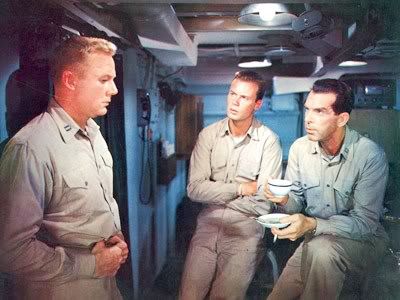
Keefer, Queeg, and Maryk
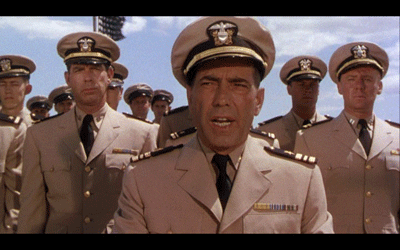
                DeVriess is replaced by Lt. Cmdr. Queeg (Humphrey Bogart).  Queeg is a lifer who is a veteran of the Battle of the Atlantic.  He is a “by the book” type who virtually holds his nose upon inspection of his new command.  In the first meeting with the officers,  he pulls out his marbles – oh, oh!  Keith is the only officer who is excited by the change in command.  Lt. Keefer (Fred MacMurray) immediately begins plotting and makes a reference to Capt. Bligh.  Executive Officer Maryk (Van Johnson) is concerned, but reserves judgment.

the mutineers
                The plot concentrates on three incidents that lay the groundwork for the climactic act of mutiny.  The first is the cutting of a target towing cable that shows Queeg to be an incompetent martinet.  The second is withdrawal under fire from escorting landing craft that suggests that Queeg is a coward or at least a PTSD casualty.  And then, of course, there is the strawberry incident.  Queeg insists on a full-blown investigation of the theft of some strawberries.  This insane obsession has Keefer pushing for consideration of Article 184 – removal of a captain due to mental illness.


                What muddies the waters is that after the second incident, Queeg vaguely admits maudlinly that he may need some help.  None of the officers respond.  Instead, Maryk begins to keep a journal to chronicle the montage of incidents leading up to the strawberries.  A trip by Keith, Maryk, and Keefer with the journal to see Adm. Halsey is aborted when Keefer gets cold feet.

                The last straw comes during a typhoon that threatens the whole fleet, but in particular the smaller ships like the Caine.  Ever the order-follower, Queeg refuses to change course even though survival depends on it.  When he compounds this stubbornness with a catatonic state, Maryk relieves him of command and saves the ship.  This seems to be a very reasonable act, but some would call it mutiny.  Like the Navy.  Sure enough, Keith and Maryk are brought before a court-martial.  They are represented by a very irascible lawyer named Greenwald (Jose Ferrer).  He is pessimistic and not at all sympathetic.  The trial will hinge upon the testimony of Queeg.  Will he lose his marbles?

                “The Caine Mutiny” is a highly regarded drama mainly because of the stellar acting.  Bogart gives his last great performance and several of his scenes are the work of a master.  The rest of the cast is strong.  I do not comprehend how Tully got an Oscar nod for a minor role and MacMurray was overlooked for playing against type and creating a loathsome character.  Ferrer is good as the lawyer, but the character is unrealistically belligerent toward his clients.  (See below for the trial.)

                The movie is technically sound.  The special effects in the typhoon are amazing.  However, the soundtrack is Max Steiner minor.  The typical old school mood music.  Sappy romance music for the sappy romance scene.  The cinematography is nothing special.

                The novel and movie grew from a seed of truth.  Wouk served on similar ships in the Pacific in WWII.  The inspiration for the story came from the USS Hull which sank in Typhoon Cobra.  The typhoon was a disaster that caused considerable damage and loss of life for Adm. Halsey’s fleet off the Philippines in December, 1944.  The Hull’s captain, Joseph Marks, was obviously the model for Queeg.  Marks was a veteran of the Atlantic convoys.  He was an incompetent tyrant who forbid conversations between officers and enlisted.  He deprived the crew of shore leave for minor infractions.  During the storm, the officers discussed removing him, but decided against it.  However, a court of inquiry after the ship sank found him too inexperienced for the safety of the ship.

                I have not read the book, but the movie follows it pretty closely.  The characters are essentially the same.  However, the book gives much more coverage to Keith before and after the incidents portrayed in the movie.  The novel is essentially a redemption tale of Keith who goes from an incompetent, clueless, callow, rich jerk to a mature, competent ship captain who learns from his mistakes.  The Keith character in the movie is not well developed.  The movie adds a schmaltzy romantic interlude between Keith and his girlfriend.  Considering the studio insisted the movie not go over two hours, these were wasted minutes.  This is a 1950s war movie so you have to shoe-horn in a romance.  Yucch!

                The movie is a must-see, but I found it to be overrated mainly because I could not buy the plot twist that the mutiny was unjustified.  The film makes too strong of a case that Maryk had to save the ship.  Also, the case against the mental stability of Queeg piles up to Olympian heights.  Sure, the officers should have been more sympathetic and taken up his vague plea for help, but the movie makes it apparent that Queeg was unlikely to change.  The movie (and novel) does a good job taking down the slippery Keefer, but it does not have to take down Maryk with him and there is little reason to rehabilitate Queeg in the post script.

           Will it crack my 100 Best War Movies?  Unlikely since I do not consider it to be clearly a war movie.

grade  =  B 
 
 
SPOILER ALERT:  The Trial
 
             Greenwald is pessimistic and not at all sympathetic.  Apparently every potential Navy defense attorney is extremely anti-mutiny no matter the circumstances.  However, although you might not want a pit bull in your cage, it is nice to sick him on your opponents.  In the trial, Keefer weasels out of complicity.  (I doubt he recounted this to "His Three Sons".)  Queeg is called to the witness stand and at first lies his ass off and tries to play it cool (which is unnatural for him).  Under sharp questioning by Greenwald he pulls out his marbles and becomes unglued in an iconic scene.  Acquittal accomplished.  The movie appends a scene that causes the audience to question the seemingly logical actions of the officers and the court.  Greenwald confronts the mutineers and makes it clear they were wrong and he loathes them.  Apparently he would have preferred they and their ship were resting at the bottom of the ocean.  I bet he felt bad when he saw the movie.
 

Thursday, July 26, 2012

#32 - The African Queen (1951)


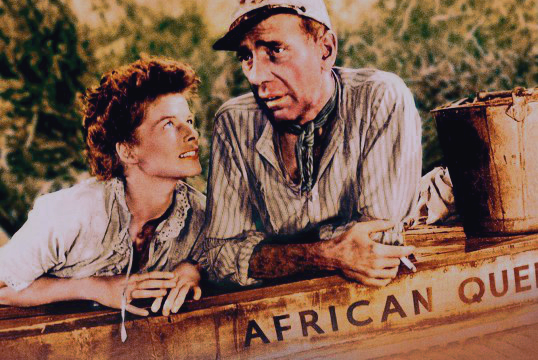
POSTER -  The central figures are straight off a Harlequin romance.  They must have posed on the first day of filming.  The rest of the poster is too busy and confusing.  Even if you've seen the movie, it's hard to tell what is being referred to.  If you haven't seen it, you would assume the movie is about a shipwreck.  Grade =  D

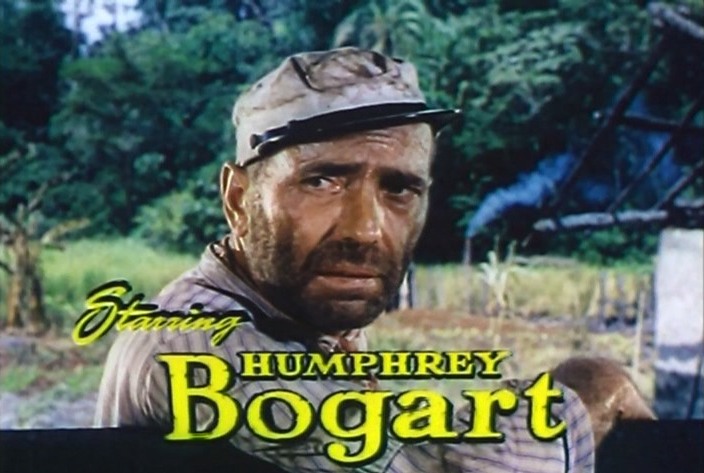
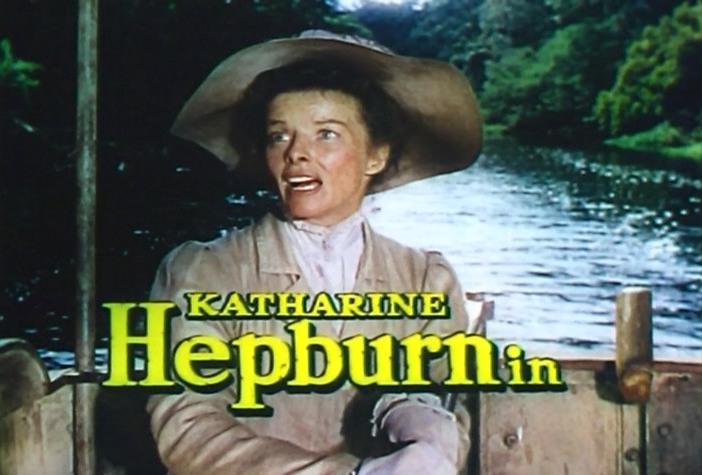
BACK-STORY:   “The African Queen” had one of the most famous productions in cinema history.  Director John Huston insisted on filming half the movie on location in Uganda and the Congo.  The production was beset by climate, critters, and diseases.  Virtually the entire cast and crew suffered from ill health (ex. dysentery) with the notable exceptions of Huston and Humphrey Bogart who inoculated themselves with copious amounts of alcohol.  The teetotaler Katharine Hepburn later wrote of enjoying the experience, but had to overcome dysentery, drunken pranks from Bogart and Huston, and Huston’s unique directing style.  (Clint Eastwood later made a film about the production entitled “White Hunter Black Heart”.)  The movie was a big hit with audiences and critics.  It turned out the suits that felt an action / romance about an older couple would be icky were wrong.  Bogart won his only Oscar and the film was nominated for Director, Adapted Screenplay, and Actress.  In the most recent AFI ranking of the best movies it placed #65.
OPENING:   The movie is set in German East Africa in 1914.  Missionary Samuel Sayer (Robert Morley) and his sister Rose (Hepburn) are conducting a mass for villagers when a rickety old boat captained by Charlie Allnut (Bogart) arrives.  The subsequent tea with the straitlaced Sayers is made more awkward by Allnut’s growling stomach.  Charlie informs them the war is on which they don’t seem concerned about until the Germans almost immediately arrive and conscript the villagers, burn the village, and beat up Samuel who suffers a nervous breakdown and dies soon after.  When Charlie returns he helps bury the missionary and puts Rose aboard.
SUMMARY:  It doesn’t take long for the feisty Rose to make the ridiculous suggestion they go down the river to the lake to attack the German warship Louisa.  Off the top of her head she comes up with a plan to turn the African Queen into a torpedo delivery system.  (Apparently even missionaries day dream during their brother's sermons.)  Charlie grudgingly gives in to her stronger personality and they start on their adventure.  He figures she will see reason when they run the first set of rapids, but they only exhilarate her.  Charlie reacts by getting drunk, but awakens to Rosie pouring out his entire stash (see the clip below) and reminding him that he promised her to give the mission a shot.  The silent treatment wears him down quickly and he cleans up his act.  A little too pat, but it’s a movie.
ladies, do you look at your man like this?  you should
                The next problem is passing by a German fort that frowns on the river.  They survive gunfire with minor damage to the boat.  (Later, the audience must survive Bogart mugging at various animals.  Comic relief from Bogie!)  Next are bigger rapids which results in an awkward kiss that when paired with the moony eyes (see above) and the schmaltzy music reminds us we are watching a 1950s movie.  Soon after Rose is butt naked and doing the nasty with Charlie (or at least that is what I was imagining during the fade).  They come out of the fade fully in love (see poster).
                Here comes a waterfall that for some reason riverboatman Charlie was not aware of.  The boat propeller and shaft are damaged.  There is a great conversation where they calmly discuss repairing the boat.  They are now partners.  They work together to do the repairs.  For a missionary's sister, Rose is very game.  She's like Ripley's grandma.
soon after the woman started steering, the boat crashed
                Pressing on, Charlie has to literally pull the boat through a marsh.  A leech-infested marsh!  Ewwww, says the audience.  Tragically, the movie ends with them running aground unable to move forward or backward.  Unless a sudden rainstorm raises the water level they will die in each other’s arms and become crocodile food.  Is that thunder?
                Hiding in the reeds they spot the Louisa and move on to the plan implementation stage.  They make the torpedoes out of oxygen cylinders.  It turns out Charlie has a green thumb for homemade ship killers.  They fix the boat so when it rams the Louisa it will take both ships down.  Piece of suicidal cake.
CLOSING:  Their night kamikaze mission is literally overturned by another storm and Rosie is drowned (or so the idiots in the audience are led to believe).  Charlie is captured and interrogated by the Germans on the Louisa.  Since he does not care to live now that Rosie is dead, he cops to everything and is sentenced to be hanged.  Rosie is then fished out and she defiantly corroborates the story.  Their last request is for the Captain to marry them (with the nooses in the background).  As they say “I do”, so does the African Queen as it resurfaces in the path of the Louisa.  The ships kiss too.  It’s explosive!  Charlie and Rosie go swimming off into wedded bliss (hopefully with no crocodiles involved).
RATINGS:
Acting -  A
Action -  6/10
Accuracy -  N/A
Realism -  B
Plot -  A
Overall -  A-

WOULD CHICKS DIG IT?   I would think so.  It’s not a testosterone fueled war movie.  It’s more of a romance with adventure thrown in.  The leads are amazing and the chemistry is great.  There is certainly nothing to turn anyone’s stomach.  (I did mention that Hepburn does not get naked, right?)  I must have been an almost perfect date movie for the 1950s.
HISTORICAL ACCURACY:  The film is not based on a true story.  There is a small seed that might have grown into C.S. Forester’s novel.  The Germans had a warship named the Graf Von Gotzen that dominated Lake Tanganyika until pressure from the British caused them to scuttle it.
                In comparing the movie to the book, it appears the plot of the movie improved on the book.  I have not read the book, but a summary of its contents finds that the film sticks close to the book.   The few changes enhance the story.  For instance, in the novel the Germans do not beat Rose’s brother so she has less reason for vengeance.  The ending is vastly improved.  Forester’s conclusion is weak and would definitely not have been crowd-pleasing.
CRITIQUE:  This is old fashioned entertainment.  It’s an almost perfect blend of adventure and romance.  There is suspense in each of the travails they go through and it builds to a surprising and satisfying ending.  Although a little stodgy, the plot holds up better than some other supposed classics.  The acting by the two leads could not be better.  This is probably Bogart’s best performance and Hepburn matches him.  In her book about the making of the movie, Hepburn tells that Huston felt that she was playing Rose as too serious.  He suggested she channel Eleanor Roosevelt and adopt her hopeful smile.  She admitted this was the best acting advice she ever got (and from a man she thought at the time was off his rocker).  Bogart and Hepburn appear to be having a lot of fun with their roles (although Bogart hated the comfortless African locales and couldn’t wait to get home).
                The plot has some refreshing unorthodoxy to it.  Rose and Charlie may have a disagreement about the wisdom of the mission at the beginning, but they are not at each other’s throats like in most romances of that (and this) era.  The opposites attract angle is there, but it’s not overemphasized.  The arc of the romance is a bit simplistic and speeded up, but it’s not mushy.  However, it does fit comfortably into the "shared hardships bring people together” school.  Making Rose the more dominant personality is a nice touch, but it is diluted a bit by the obvious Bible defeats booze theme.   The success of the mission, while predictable, takes some interesting turns that could not have been anticipated.  The theme of the movie is where there’s a will there’s a way.  Throw in a little "God helps them that help themselves".   
                The cinematography is not mesmerizing.  It’s adequate and some credit must go to the difficult conditions much of the movie was shot in.  The film does have more flora and fauna than your typical Tarzan movie.  You will see hippos, apes, elephants, crocodiles, giraffes, lions, and antelopes.  And, of course, leeches.  Surprisingly, there are no problems with animals (even when Charlie taunts them).  Charlie does not have to wrestle a crocodile.  They catch hell from the leeches and mosquitoes.  The scenery is beautiful, making the decision to shoot in Africa a wise one.  The one flaw is the pompous score.  It really is intrusive at times.  Give us a break, we know how to feel!
CONCLUSION:  While undoubtedly a classic, “The African Queen” does not sit comfortably at #32.  This is mainly because I am not sure it is a war movie.  Two of my three main sources (Video Hound and Freitas) do not have it.  I know it fits even my definition of a war movie, but there is just something about it that does not make me see it as a war movie.  By contrast, I would compare it to "Casablanca" .  While “Casablanca” has no warlike action like the sinking of a warship, it feels much more like a war movie.  To tell the truth, neither movie is solidly in the genre.  What’s puzzling is that Military History magazine determined both to be war movies and then put “Casablanca” at #65 and “The African Queen” at #32.  This is perplexing because not only is “Casablanca” more of a war movie, but it is clearly the better movie.  It is #3 on AFI’s latest list of the Top 100 of all time.  And if you are defining "greatest" as synonymous with "important", "Casablanca" would have to come before "Queen".  So once again, what was Military History thinking?

the trailer


TRAILER -  Definitely old school.  Does a good job on the relationship, but you get no idea of the mission to sink the Louisa.  You also get a taste of the score.  B+

Bogart acting (?) drunk