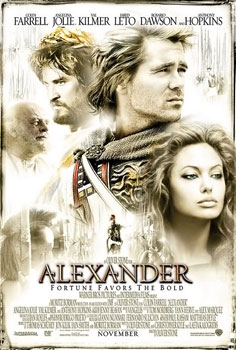
“Alexander” was Oliver Stone’s (“Platoon”) endeavor to
bring an epic biography of Alexander the Great
to the big screen. You have to
admire his commitment to the project. It
could be argued that there was no great demand for this biopic. The box office receipts tended to confirm
that. The movie cost a whopping $155
milllion and although it eventually covered them, it was not a box office
success. Stone was man enough to admit
that the finished product was flawed, so he made three more finished
products. First, there was the
“Director’s Cut” which amazingly was shorter than the original. Say what?!
The second was called “Alexander Revisited: The Final Unrated Cut”. The third is the one I am reviewing
here. It is entitled “The Ultimate
Cut”. It clocked in at 3:26 as opposed
to the original’s 2:55. I assume that
for the twentieth anniversary he will issue the “Absolutely Ultimate Final I’m
Not Kidding This Is Really the Last Cut Cut”.
The movie opens with a quote from Virgil: “Fortune favors the bold”. If you had to choose a quote to exemplify
Alexander (Colin Farrell), that is an appropriate one. Stone chooses to flashback from Alexander’s
death (a common biopic opening) so we immediately know that this is going to be
a tame Stone movie. Not the gonzo movie
maker that he sometimes is. He also uses
the narration technique with Ptolemy (Anthony Hopkins) reminiscing from
post-Alexander Alexandria. This is an
immediate clue that the movie will not be anti-Alexander. Ptolemy was a friend of Alexander and owed
him a lot. The flashing goes back to
Alexander’s childhood. Stone establishes
the dysfunctionality of Alexander’s family by portraying Philip (Val Kilmer)
and Olympias (Angelina Jolie) as two wolverines in a burlap sack. Oh, and the young Alex is in the sack,
too. Could this have affected his
personality? Stone thinks so.
Stone hops through key moments in Alexander’s life to
get to the Battle of Gaugamela. These
include his tutoring by Aristotle, his acquisition of his horse Bucephalus, and
his contretemps with his father at Philip’s wedding banquet. From that falling out, the movie makes an
eight-year leap to his last battle with the Persians. Gaugamela is the movie’s big set piece and it
is epic. Alexander and his generals
discuss the plan the night before. There
is a spirited debate on whether and when to attack. Alexander talks to individual soldiers before
the battle and then gives a Braveheartesque speech about free men versus
slaves. The battle itself is large scale
with graphic violence. The recreation is
simplistic, but satisfactory unless you are obsessed with accuracy. Stone uses an eagle eye’s view (literally) to
show the battlefield. However, for those
unfamiliar with the battle, there is a lot of “the fog of war”.
From Gaugamela, we return to some anecdotal hopping
to reach India and the last battle. Some
of the scenes are soap operaish as Alexander meets his wife Roxana (Rosario
Dawson), but does not completely jilt his longtime BFF Hephaestion (Jared
Leto). The film definitely come down on
the side of the historical debaters that argue that Alexander was
bisexual. Alexander and Roxana reenact
what Philip and Olympia’s wedding night must have been like. I guess you could make the case that the
movie has three battle scenes.
Meanwhile, outside the bedrooms, Alexander has to deal with dissension
amongst his men. Alexander is going
Persian on them and not everyone is obsessed with seeing what’s on the other
side of the next hill. For reasons that
defy the otherwise linear nature of the narrative, Stone throws in a flash back
to Philip’s death.
Since it’s time for more fighting, the movie suddenly
arrives at the Battle of Hydaspes in India.
There is not even enough time for the name of the battle or any other
background, for that matter. The money shot comes with Alexander and Bucephalus
facing off with a war pachyderm. Stone
uses a red tinge to the cinematography because a second battle needs to be
different. Hymnal music tells the uninformed
that the conquering is over. It’s full
circle back to the death scene.
“Alexander” deserves a better reputation. It did not
become this generation’s “Spartacus”, but it is superior to that film is some
ways. No doubt it does not have the
charisma of the earlier epic. This may
be due to the fact that Stone shows uncharacteristic restraint. The only pizazz is in the red-tinged
scene. Stone also does not dig deep into
the controversies of Alexander’s career and personality. He is timid on the homosexuality angle, but
he does take a firm position backing the bisexuality theory. Stone clearly means for the movie to present
the positive Alexander. The movie spends
little time on the ruthless Alexander.
This is not “Patton” where audience members left the theater arguing
over whether the director was pro or con toward his subject. Stone made a decision to come down on the
side of most historians.
The movie is epic in its casting. For the most part the actors do a fine
job. Jolie is stunt casting, but she
probably is the closest to an Olympia as Hollywood has. She does not get to do much. She reminded me of Marlon Brando in the first
“Superman”. By the way, she is about the
same age as Colin Farrell. Val Kilmer
chews scenery as Philip, but you get what you pay for. He gained 50 pounds for the role so kudos for
that. Farrell gets the personality
right, if not the accent. The character
development is commendable and considering the size of the cast an effort was
made to develop Alexander’s officers.
The movie is a blend of action, exposition, and
battles. The battles are well done. The combat is of the new variety. Frenetic mixed with slo-mo. The CGI is seamless and the elephants are
remarkable. Stone also took advantage of
many Moroccans to give the Persian army some size. The battles are the highlights and the other
scenes are a mixed bag. Most attempt to
reenact famous moments in Alexander’s life.
These are fun to watch if you are already familiar with the
stories. The dialogue does not stand
out, but the movie excels in the discussions between Alexander and his
generals.
The movie comes off as “Alexander’s Greatest Hits” as
it hits almost all the stories a teacher would tell to make a unit on Alexander
interesting. And the truth is that,
unlike Hannibal for instance, we have a trove of memorable anecdotes about
Alexander. It’s cool seeing them acted
out. Just covering those high spots took
over three hours of screen time. To
truly do Alexander’s life justice and not just cover the hits, the movie would
have to be mini-series size. As it is,
Stone has had to compress time and combine events. Some events and characters are out of place
in time. None of this is historical deal
breaking. The movie is actually above
average in accuracy for a biopic. Better
than its closest equivalent “Spartacus”.
The reason “Spartacus” is the superior film is partly due to the fact
that because we know so little about Spartacus, Dalton Trumbo could construct a
thoroughly entertaining epic. Plus he
had a cast that makes “Alexander” blush.
Alexander
is the most famous figure in Ancient History, so he certainly deserves a
movie. In fact, two. Considering that the Richard Burton 1956
movie did not do him justice, Stone was justified in revisiting him. Although his film is not perfect, it is as
good as we could expect in our modern cinema that is averse to historical
epics. Now let’s move on to “Hannibal”
please!
GRADE = B-
HISTORICAL
ACCURACY: “Alexander” was based on historian Robin Lane Fox’s
biography. His Alexander the Great is
considered one of the best. Lane acted as an uncredited advisor on the film and
was paid by being allowed to participate in the Companion cavalry charge in the
Battle of Gaugamela dressed as a Macedonian officer. Having read extensively on
Alexander (I role play him in my Western Civilization course), I feel I can
weigh in on the accuracy of the movie. I
have decided to take the major scenes and briefly critique them.
1.
Olympias was a
maenad which means she was a member of the female cult of Dionysus. The cult was associated with snakes so it is
appropriate to have her with one.
2.
Although the
relationship of Philip and Olympias was dysfunctional, it is a stretch to have
Philip trying to rape and strangle her.
3.
The line “It was
said later that Alexander was never defeated, except by Hephaestion’s thighs”
is attributed to Diogenes, but it may have been “fake news” from back
then. There is no proof that Alexander
and Hephaestion were lovers. I (and most
historians) personally think they were, so the movie is not out on a limb with
this depiction of their relationship.
4.
The movie has
Aristotle discouraging the conquest of Persia which is the opposite of the
truth. Alexander’s tutor, in fact, had a
grudge against Persia for the sacking of Athens and passed this on to his
student.
5.
The acquisition
of Bucephalus conforms to most versions of the story.
6.
The Battle of
Gaugamela is a blending of Issus and Gaugamela (with a bit of Granicus thrown
in). The numbers are acceptable. The debate between Alexander and his generals
is realistic. The battle was a complex
one that is adequately reenacted. Some
historians propose the mouse trap tactic for dealing with the scythed chariots,
but I am of the opinion that the phalanx opened lanes for the chariots to go
through and did not try to block their path.
The incident where Cleitus severed the arm of an enemy that was about to
kill Alexander actually happened in the Battle of Granicus. Alexander did not get off his horse and did
not hurl a spear at Darius III. The
chariot escape was from Issus. Alexander
did get a request for support from Parmenion.
Alexander was not wounded in this battle.
7.
Darius daughter
did mistake Hephaestion for Alexander.
8.
Roxana did do a
sexy dance that caught Alexander’s attention.
Most likely he married her out of lust rather than any political,
cultural, or heir reason. Their
relationship is not well chronicled so the movie is able to be
imaginative. It seems likely that she
was jealous of Hephaestion and that Alexander quickly lost interest in her.
9.
The Page Plot is
blended with the supposed plot by Philotas.
Philotas was executed for not revealing a plot and his father Parmenion
was murdered to avoid his attempting revenge.
Alexander’s resident historian Callisthenes was executed for encouraging
the page plot.
10. It is conjecture as to whether Alexander and Bagoas
were intimate. It is reasonable for the
movie to imply it.
11. The murder of Cleitus comes too late as he was killed
before the army reached India. The
circumstances and cause is accurate by most accounts.
12. Philip’s death is accurate.
13. The withdrawal from India combines two incidents. Both occurred after the Battle of Hydaspes,
not before. Alexander actually backed
down when his men mutinied and grudgingly returned home. Weirdly, the movie shows the monsoon, but
does not link it to the lowering of morale that contributed to the mutiny. The execution of the mutineers was a separate
incident.
14. The Battle of Hypaspes (hey movie, that was the name)
is poorly handled. It was not in a
forest but along a river on a plain. The
enemy was led by King Porus and did use war elephants, but Alexander’s infantry
was never in trouble. In fact, the
cavalry was troubled by the elephants so Alexander would not have ridden to the
rescue. It is debatable if Bucephalus
was still alive at this battle. Most
likely he was, but too old for Alexander to have ridden him in combat. He certainly was not wounded in the battle
and neither was Alexander and certainly not by Porus. That was a low moment in the movie. Then the movie doubles down by implying that
the reason for the return home was due to Alexander’s injury.
15. The crossing of the Gedrosian Desert is screwed
up. It was not the quickest way
home. Alexander choose this extremely
difficult route to punish his men for their mutiny.
16. Hephaestion did die of a fever, but Alexander did not
blame Roxana.
17. Alexander’s death is accurate. His last words are usually recorded as “to
the strongest”.
ACCURACY
GRADE =
C+