Showing posts with label James Coburn. Show all posts

Tuesday, July 9, 2019

BOOK/MOVIE: Cross of Iron


                This is another in my series informing you about how war movies differ from their source material.  I also take the liberty of comparing the two.  I have a belief that a movie should be better than the novel it is based on and most war movies are.  The screenwriter has the advantage of having the book as his foundation and he can make improvements to the plot and make it more entertaining.  The disadvantage is that the movie can not go into the detail that a  book can.  I am mainly arguing that movies should be more entertaining than the novel.  If you read on, be aware that I am assuming two things.  One, you have seen the movie already.  Two, you are not planning on reading the book, so you don’t care about spoilers.  I hope what you do care about is how the book differs from the movie and which is better, in my opinion.

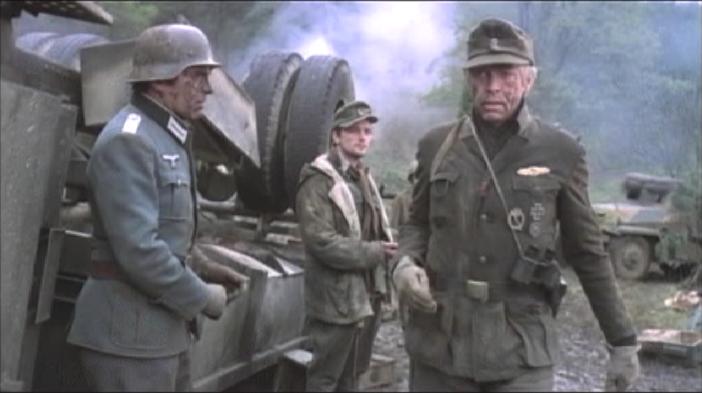
                “Cross of Iron” is a war movie directed by Sam Peckinpah.  It is set on the Eastern Front in WWII.  A platoon led by a Sgt. Steiner (James Coburn) is part of the perimeter defense of a German salient that is threatened by superior Red Army forces.  Steiner is a great soldier, but is anti-authority and cynical about the war and the army.  His new company commander Capt. Stransky (Maximilian Schell) has been transferred to Russia so he can win an Iron Cross.  He is a martinet who realizes Steiner will be a thorn in his side and Stransky is determined to eliminate Steiner as an obstacle to his medal.  Steiner and his men have to go on a trek behind enemy lines to get back to their lines after they are left behind in the army’s withdrawal.  The movie was based on the novel The Willing Flesh by Willi Heinrich.  Heinrich served on the Eastern Front and was wounded five times.  The screenplay was written by Julius Epstein, James Hamilton, and Walter Kelley.  They changed the chronology of the book, but adapted some of the key scenes and kept most of the characters.

                The novel opens with Steiner’s platoon in the front lines of the German perimeter.  We are introduced to his men, who have pretty much the same personalities as in the movie.  For example, Schnurrbart is a mustachioed rock, Kern is a slacker jerk, Kruger is a slob, Dietz is boyish, Zoll is a troublemaker (but not the resident Nazi like in the movie).  The book has a key character named Dorn who is an intellectual that Steiner likes to discuss philosophy with.  The movie Steiner is more laconic than philosophical.  When the German army pulls back, Steiner’s group is ordered to stay by his battalion commander (unlike in the movie where the nefarious Stransky purposely leaves them behind).  In the trek back to German lines, Steiner and crew (they start with eleven men) encounter the Russian female soldiers and the scene plays out similar to the movie except that at one point Steiner decides to go off on his own.  He changes his mind and returns after an escaping Russian runs into him.  This allows Steiner to avoid the difficult decision of killing the women to protect their continued journey.  Zoll’s rape and death are essentially the same, but Dietz is not killed until a little later when he runs into a Russian patrol.  Meanwhile, Stransky gets Triebig to admit he prefers men, but Keppler is not in the room.

                When Steiner and the others reach the Russian front lines, they assault some bunkers with extreme prejudice.  They capture a Russian officer and force him to radio that they are a Russian patrol going out.  They proceed into no man’s land and Steiner goes ahead to identify them and they successfully make it in.  Nine of the eleven make it back.  Steiner meets Stansky for the first time.  He offers to promote him to Sgt., but Steiner does not react.  The conversation enrages Stransky and it doesn’t help that when he snidely asks if Steiner was an actor before the war, Steiner responds:  “Not before the war”.  (How did that line not make it into the movie?)   Brandt gives Steiner two weeks R&R.  He meets a nurse who he had an affair with when he was convalescing in a hospital thirteen months before.  It turns out that she had seduced him and when he dumped her, she framed him for robbery which resulted in his being put in a penal battalion.  At the rest area, he has an affair with another nurse named Gertrud.  Steiner is not a ladies man and the romance is awkward.  While he is gone, Dorn and Anselm are killed by a random shell. 

                When he returns, Steiner catches Triebig and Keppler in bed and beats Triebig up because he had sided with Stransky in the chewing out of Steiner earlier.  The big Russian attack featuring tanks in the movie occurs at this point.  Steiner leads the counterattack with Kruger, Hollerbach, Kern. and Faber (recruited by Steiner after their return across no man’s land).  The Russians are caught between two forces and routed.  Steiner is wounded and on the way to the evacuation station, his companion Hollerbach is run over by a tank.  Steiner is away three months and returns to Schnurrbart, Kruger, Faber, and Maag.  He finds out that Stransky is claiming to have led the counterattack and needs Steiner to sign off on his Iron Cross.  The movie covers the meeting with the skeptical Brandt, but leaves out a central section where Keisel explains that Steiner wants time to think on it because Steiner does not want to be a witness in a court-martial.  Keisel convinces Brandt to drop the matter, but threaten Stransky with consequences if he doesn’t back off of Steiner.  Steiner has guilt feelings about how he did not appreciate all that Brandt had done for him, but he did not say he hates all officers, including Brandt. 

                The big set piece in the book is an attack on a Russian factory.  This is barely recognizable in the movie in the scene where the Russian tanks break into a building the platoon had taken refuge in.  Stransky plots with Triebig to kill Steiner in the factory.  When Brandt calls to cancel the attack, Stransky does not pass the word.  Steiner and the men negotiate the maze of corridors in the dark, eliminating the defenders.  Triebig shoots Schnurrbart, mistaking him for Steiner.  Steiner then insures that Triebig is killed by the Soviets.  Upon returning, Steiner sets up an ambush for Stransky.  Brandt is aware, but does nothing to stop this.  Steiner ends up not killing Stransky and soon after Steiner is wounded by an artillery round and Faber loses his eyes.  At the end of the book, Stransky is about to be transferred.  Keisel is still with Brandt but he has told him he will be saved to help start a new Germany.  The movie ending is not even remotely connected to the book.  And since it is a poor ending to a great movie, you have to wonder what the screenwriters were thinking.

                As you can read, the book has more scenes than in the movie.  It is unclear why the screenwriters changed the order of the ones they kept.  Subtracting scenes was inevitable, but resequencing was questionable. The movie jumps immediately into the Steiner/Stransky dynamic and structures the plot around it.  The book does not really kick into this until midway through, allowing for some vignettes that develop the whole squad instead of just Steiner.  The trek is pushed all the way to the last third of the book as a way to build to the confrontation between Stransky and Steiner.  The novel is a multi-layered story of a platoon fighting a losing war whereas the movie is boiled down to a lost patrol movie with an evil brass cliché.  Steiner completely dominates the movie, but in the book he is the main character and the rest of the unit get good coverage, too.  As you would expect, the novel fleshes out the characters quite a bit more than the movie.  The movie does borrow the basic personality traits, but the novel actually puts you into the characters’ heads and Heinrich gives each member of the platoon a chance to have their moment.  Most importantly, Steiner is a multi-dimensional character, unlike the simply cynical, laconic movie Steiner.  Heinrich’s Steiner is mercurial.  He even pouts occasionally.  He is quick-tempered and unstable.  Significantly, for those of you who care about motivation, we find out why Steiner is the way he is.  He lost his fiancé in mountain climbing accident that would scar anyone.  There was also that frame-up by the nurse.  Another difference between the movie platoon and the novel platoon is that in the book the men are much more dysfunctional.  They are far from a band of brothers.  Some of them hate each other and not all are enamored with Steiner, although all recognize that without him they are doomed.

                The movie does retain the Brandt/Keisel dynamic, but obviously the book includes much more of their interesting discussions.  Keisel is one of my favorite fringe characters in war movies and Brandt is a key figure in the theme that even some of the German leaders were cynical.  It was certainly unfair when Steiner lumped him in with all officers.  At least in the book, Steiner is remorseful.  Keisel is the conscience of the book (along with Dorn).  Keisel defines courage thus:  “In 99 out of 100 cases, courage is nothing more than expression of common politeness or sense of duty.  [The other 1%] is an expression of insanity.”  Keisel gets almost as much ink as Stransky, since Stransky is a smaller character than in the movie.  However, the movie does give us the full Stransky.  By the way, there is no Russian boy-captive in the book.  I would have to give the movie that one.

                I have mentioned that in most cases I believe that war movies based on novels are better than the novel.  However, “Cross of Iron” is not one of those movies.  The main reason why the book is superior is because it is able to flesh out all the characters.  Even the main character is more multi-dimensional and less mysterious.  Clearly, a book should do this better than any movie, but the main reason why the movie is inferior is the dubious decisions on changing the sequence of events in the book’s plot.  It would have been much smarter to use the novel as an outline and then eliminate scenes due to time pressures.  The movie wisely condenses the theme to glory-hunting (Stransky) versus cynical survival (Steiner) and focuses on that aspect from the get-go.  It is pretty effective in that single-mindedness, but blows it in the end with the ridiculously unrealistic ending that sees Steiner abetting Stransky.  To have the officer-hating Steiner kill Triebig for killing his men and then have him spare the much more odious Stransky is bizarre.  Heinrich’s Steiner also spares Stransky, but in a much more believable manner.  And having Stransky get his transfer hammers Heinrich’s own cynical attitude toward the war he fought in.

BOOK = A
MOVIE  =  B+

Saturday, March 30, 2013

CROSS OF IRON (7) vs. HELL IS FOR HEROES (10)

 
VS.
 
 
Cross of Iron (7) vs. Hell is for Heroes (10)
ACTING:


        “Hell is for Heroes” (1962) is a small unit movie with a good ensemble cast of solid actors. The film is dominated by Steve McQueen’s portrayal of the loner Pvt. Reese (broken down from Sergeant presumably for infractions outside of combat). It may have been method acting or his displeasure with involvement with the production, but McQueen is quite convincing as the dislikeable jerk. He also has the “thousand yard stare” down pat. The rest of the cast (James Coburn, Harry Guardino, Bobby Darin, Fess Parker, Nick Adams) are solid.

        “Cross of Iron” (1977) is anchored by James Coburn’s portrayal of Sgt. Steiner. He is outstanding as the cynical, anti-authority figure. It is one of his greatest performances. It is not a one-note performance like McQueen’s. He gives Steiner some humanity and compassion for his men. The other stars (James Mason, Maximilian Schell, and David Warner) do good work, but the unknowns who make up Steiner’s squad are only adequate.

FIRST QUARTER SCORE:
Cross of Iron             8
Hell is for Heroes      8


CLICHES:

        “Hell is for Heroes” is a typical small unit, “who will survive?” movie. The unit is heterogeneous as it consists of the surly Reese, the scrounger Corby, the mechanic Henshaw, the kid Cumberly, the no-nonsense Sergeant Larkin, the noncombatant clerk Driscoll, etc. There is a mascot-type in the Polish soldier-wanna-be Homer. These characters are not really developed and are not particularly stereotypes. Nobody is from Brooklyn. You do get the cliché of who will get killed next and how. The hero (actually anti-hero) Reese does have leadership thrust upon him, but rather than complain, uses it to launch an ill-conceived mission against a pill box. There is no real conflict within the group and no rituals. The movie falls nicely into the "last stand" subgenre. There is a redemption theme, but Reese’s climactic action is more to avoid another court-martial than to redeem himself.

        “Cross of Iron” is also a small unit movie, but it is much more complex. The final half of the movie has the standard hero leading his unit on a mission that involves making it back to friendly lines. The unit is heterogeneous, but the characters are given little back-story and only have small quirks to identify them. The clichés are mainly reserved for the officers. Steiner is the anti-hero, anti-establishment stereotype. Stransky is the cowardly, glory-hound. This movie’s mascot takes the form of a Russian boy taken prisoner and adopted by the squad.  The movie also throws in Steiner abandoning a comely nurse (Senta Berger) to return to his comrades because in war movies its always "bros before hoes".  There is no conflict within the group, but there is a major command conflict that is strangely left unresolved. There is no redemption. That would be an out of place theme in a movie that does not believe in redemption.

HALF TIME SCORE:
Cross        15
Hell           15


PLOT:

         “Hell is for Heroes” was written by Robert Pirosh who also did “Battleground” and went on to create the TV series “Combat!” (which has a very similar tone to the movie). The plot moves from the rest area to the combat zone pretty quickly. Enough time for the usual grousing about “why us?!” Reese arrives during the rest time and goes off with his new unit after making quite an impression as an ass hole. The rest of the plot involves the stretched thin squad’s attempt to defend an outpost on the Siegfried Line. There are plot contrivances like a German listening device that gives the producers the chance to shoe-horn a Bob Newhart telephone routine that is funny, but ridiculously out of place in a gritty combat film. It is not the only bit of comic relief as Corby fills the wisecracker role. From here it’s the plot’s job to kill off most of the squad in a variety of ways and then leave us with a big set piece.

        “Cross of Iron” is based on an excellent novel entitled The Willing Flesh by German WWII veteran Willi Heinrich. It follows the plot of the book closely. The movie opens and closes with battle. In between there is some good solders-in-the-bunker comradeship and some tense headquarters debates. A subplot involves whether Stransky lied about his bravery in battle in order to get the Iron Cross and his attempts to eliminate Steiner because Steiner could torpedo the decoration. The first half plays the Steiner/Stransky conflict out punctuated by desperate defense of the front line. The bridge between the first and second halves is Steiner’s often surrealistic stay in a hospital. The second half is more of a trek film as the survivors of Steiner’s unit work their way back to their own lines. A unique encounter with female Soviet soldiers highlights this section. This half of the movie also picks off the men as we near the climactic showdown between Stransky and Steiner.

THIRD QUARTER SCORE:
Cross        23
Hell           22


COMBAT:

         “Hell is for Heroes” has some pretty gritty combat for a 1962 film. The first is a German night raid that has Reese using his helmet and a bowie knife to kill a German and Henshaw roasting another with a flame-thrower and letting him burn. The next big scene is the attempt to crawl up on the German bunker at night through a mine field. It’s more suspenseful than violent. It takes an unexpected turn. Finally we get the frontal assault across no man’s land that ends with Reese literally take out the pill box by himself. That last scene is marred by some silly old school deaths. The combat is satisfactory for a low budget film.

         “Cross of Iron” is loaded with combat. I am hard pressed to think of another war movie that has a higher percent of actual fighting. (Actually, I just thought of “Black Hawk Down”.) The action is very Peckinpahish. It was his only war film and he basically channels “The Wild Bunch” in the cinematography. The big battle scenes are mixtures of explosions, slo-mo, quick cuts, chaos, and violence. The combat scenes also are more extended than in most war films. Pekinpah may abhor war, but he revels in the violence. Although not a big budget film, Pekinpah makes great use of his limited resources to deliver some large battle scenes. This is especially true in his use of the three Yugoslavian T-34 tanks. Seldom have tanks been used more effectively. There are two huge set pieces sandwiched by two more intimate combat episodes involving the squad by itself. Peckinpah’s way of composing the violence was to have an impact on war films for the next two decades (see “Hamburger Hill”, for instance).

FINAL SCORE:
Cross of Iron          33
Hell is for Heroes   29


COLOR ANALYSIS:

         This was an excellent match-up that came down to the last quarter. It was obvious that if "Cross" could hold off the game "Hell" until the combat section kicked in, "Cross" could cruise to victory. The surprising thing had to be the lack of advantage "Cross" had in the cliche sphere. It seems Peckinpah was not as iconoclastic in his characterizations and plotting as one might expect and "Hell" was less clicheish than one would expect from a glorified made-for-TV looking vehicle. In the match-up of the superstars, both performed well, but the edge has to go to Coburn (in Cross, not Hell).      

Saturday, May 28, 2011

#64 - CROSS OF IRON


BACK-STORY: “Cross of Iron” is a war movie set on the Eastern Front in World War II. It is told from a German point of view. The action takes place in the Taman Peninsula in the Caucasus in 1943. The Germans are in the midst of their retreat from Stalingrad. The film was Sam Peckinpah’s last great feature and his only war movie. He supposedly was heavily drinking during the shoot. The movie is based on the novel The Willing Flesh by Willi Heinrich. The movie follows the book fairly closely. The movie was filmed on location in Yugoslavia with the cooperation of the Yugoslavian army. Because the production ran out of money, the ending had to be improvised. The release met with mixed reviews and it did not do well at the box office. It’s reputation has been rising over the years, however.


OPENING: The opening credits roll over German war footage with a German children’s song in the background. Corporal Steiner (James Coburn) and his squad sneak up on a Russian mortar post and kill their opponents in the slow motion typical of a Peckinpah film. They capture a Russian boy and bring him back.

SUMMARY: Capt. Stransky (Maximilian Schell) arrives to take command of the battalion and meets with Gen. Brandt (James Mason) and Capt. Kiesel (David Warner). Stransky is an aristocratic Prussian who has requested a transfer from France specifically so he can win an Iron Cross. Brandt is disillusioned and points out that the German soldier is simply fighting for his life, not for medals. They recommend Stransky make use of Steiner. The cynical, embittered Keisel says “Steiner is a myth. Men like him are our last hope and in that sense he is truly a dangerous man.”

Stransky, Meyer, and Steiner
When Stransky meets Steiner, he is angered by Steiner’s lack of respect for his “superior” (in rank and social status) officer. Steiner simply tolerates Stransky as the latest in a long line of clueless officers. When Stransky insists the orders to take no prisoners be carried out by shooting the boy, Steiner refuses, but the confrontation is diffused when one of the squad members promises to do it. He lies and later Steiner releases the boy and points homeward. The boy is immediately killed by attacking Russians. Oh, the irony.

The attack is a major one with frantic battle action. There are more slow motion deaths and lots of explosions. There is hand-to-hand combat and Steiner is wounded. His respected platoon leader Lt. Meyer is killed leading a counterattack. Later, Stransky (who cowered in his bunker during the battle) claims he led the successful counterattack and deserves the Iron Cross.

Steiner ends up in a hospital which results in some surreal scenes as he hallucinates and sees old comrades. He has an affair with a nurse (Senta Berger). In a telling scene, a general arrives with propaganda film crew to show the wonderful treatment of the men, but once the shots are done the banquet is reserved for the visiting officers. When Steiner is recovered enough (in his opinion), he abandons the nurse in favor of a return to his unit (cliché alert).

When Steiner returns to the squad’s bunker, he finds some of his men are dead and they now have a Nazi Party member attached to them. In a great scene, Steiner is called before Brandt to verify Stransky’s leading the counterattack. Stransky has two eyewitnesses – Steiner and a homosexual adjutant named Treibig who he is blackmailing. Brandt suspects Stransky is lying and wants Steiner to confirm his suspicions. Steiner surprises him by asking for more time. Brandt peevishly points out that he has tolerated a lot of insubordination from Steiner, prompting an outburst from Steiner in which he proclaims that he does not care that Brandt is “enlightened”. He hates all officers and, in fact, the whole army.

The Germans are forced to retreat, but Stransky sees an opportunity to silence Steiner by not passing on the order. The Russians move in with tanks. The squad takes refuge in a factory, but a tank simply plows through the wall. They escape through a tunnel. The action is intense.

They are on the run and moving cross country to try to reach German lines. They reach a village and take a unit of Russian female soldiers captive. The Party worm attempts to rape one of the women, but gets his genitalia bitten off and kills her. The scene is unique in that the women are treated sympathetically. When they kill one of the Germans who was distracted, Steiner does not retaliate. They would have done the same, I suppose. Steiner even gives them the Party guy as a parting gift.

They reach the German lines but still have to cross no man’s land. They send a message warning the Germans not to shoot as they are coming in, but Stransky gets his toadie Treibig to open fire on these “Russians” coming through the wire. Several members are killed in graphic, slow motion deaths. Steiner guns down Treibig and goes looking for Stransky.

CLOSING: The Russians choose this moment to launch an attack. Lots of explosions and flying debris. It’s as though Peckinpah added an Indian attack to the showdown scene of a one of his westerns. Steiner tracks down Stransky amidst all the chaos, but decides not to kill him. Instead, they go out together to fight. Steiner has shamed Stransky into earning the Iron Cross. The movie ends with Stransky fumbling with reloading his machine gun and Steiner laughing at him.

RATINGS:

Action - 9


Acting - 9


Accuracy - 8


Realism - 8


Plot - 8


Overall – 8

WOULD CHICKS DIG IT? This is a very manly movie. It is unlikely your significant other will enjoy it. There is only one significant female character and she is treated like a piece of meat. The movie is very grimy and gritty. It pulls no punches. The scene with the Russian female soldiers is admirably nonsexist, but most women would find it discomforting. Besides, how many women are Sam Peckinpah fans?

ACCURACY: Willi Heinrich was a veteran of the Eastern Front and was wounded five times so he knew of which he wrote. The book is probably partly autobiographical. It is also claimed the book is based on the experiences of the decorated soldier Johannsch Werdfeger who won two Iron Crosses.

The movie does not claim to be a true story. The battles are generic and represent typical battles during the Taman Peninsula campaign. The fighting is realistic in a Hollywood sort of way. Peckinpah does stage chaos well. The sets are appropriately decimated. The deaths appropriately random.

The movie is helped in its realism by the authentic weapons. The Russian tanks are T34/85’s on loan from the Yugoslavian Army. I won’t quibble with the fact that that particular model was not in use in 1943. The small arms are accurate. One flaw is the use of F4U Corsairs to represent Russian fighter-bombers. Gull wings – did they think we would not notice?

The small unit dynamics of the squad, especially in the bunker scenes ring true. The soldier banter is realistic. The comradery is what you expect for a squad that had gone through all they went through. The attitudes of the enlisted and the officers in the German army circa 1943 are well displayed. The cynicism and defeatism is apparent.

CRITIQUE: “Cross of Iron” is a special movie. There is no other war movie quite like it. It has the Peckinpah touch throughout it – the trademark slow motion violence, the iconoclastic anti-hero, the lack of respect for authority. An American war movie concentrating on Germans on the Eastern Front is unique.

The movie is certainly action-packed with lots of explosions. It is a great combat movie and has several combat scenes that are among the best filmed. It does have its exposition parts (which are necessary to develop the conflict between Steiner and Stransky and to explain Brandt’s role in the triangle), but the movie is definitely not wordy.

The movie is an excellent depiction of small unit warfare, but it also gives a taste of command. Brandt is a sympathetic soldiers-general and Keisel represents another type – the cynical staff officer. Stransky is yet another type – the chicken-hearted glory hound. Steiner portrays the hardened NCO who cares more for the survival of his men than the “big picture”. The movie is refreshingly free of the stereotyped evil Nazis. Stransky is not a Nazi – he is an aristocrat who is fighting for his family honor, not Hitler.

The acting is outstanding. Coburn deserved an Academy Award nomination and has one of his best roles. He is perfect as Steiner. He is ably supported by Mason, Warner, and Schell. I especially enjoyed Warner’s cynical Keisel. He is riveting whenever he appears. Schell is appropriately loathsome. The unknown actors who make up the squad also do a good job.

The ending has drawn mixed reviews. I personally did not like it. I found it out of character that after killing Treibig, Steiner does not kill the more despicable Stransky. Why would he suddenly change his mind? Then Stransky in a character-flip does not kill Steiner when he turns his back on him. Either one of these character shifts would be hard to swallow, but both? I did not mind the abrupt halt to the movie.

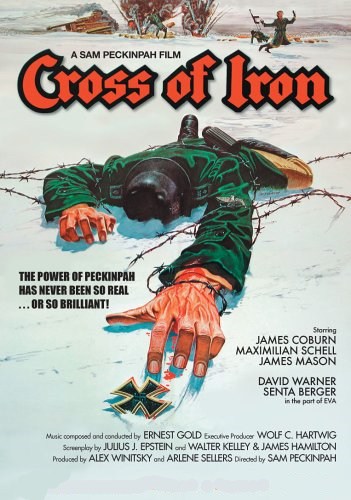
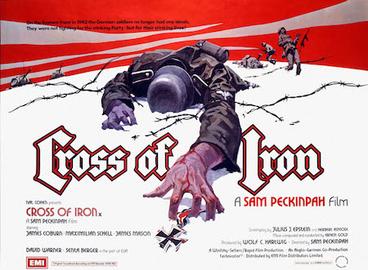
CONCLUSION: If you want a war movie that is adrenalin-fueled and well-acted, try “Cross of Iron”. It is not subtle, but it is not one-dimensional either. It is definitely underrated at #64. It seems incredible that it is only two places higher than “Castle Keep”! I feel confident it will be in the top fifty of my 100 Best War Movies list.  By the way, that is a great movie poster.


COMING UP:  I will be reviewing the History Channel special on "Gettysburg" on May 30 at 9 EST.