Showing posts with label Die Brucke. Show all posts

Sunday, December 20, 2020

SEMI-FINAL: The Bridge (2) vs. The Unknown Soldier (2017) (3)


EFFECTS:

                “The Unknown Soldier” is a modern combat movie.  It follows a Finnish company of soldiers in the Continuation War from 1941-1944.  It covers the unit from the early bloom of victory to the late bust of a retreat.  It was the most expensive Finnish production at the time of its release, so you would expect the effects to be good.  Although CGI could have been afforded, the movie eschews it.  The special effects coordinator was very good with explosions.  The artillery bombardments are top notch.  The bullet effects make full use of squib technology.  War movie lovers underestimate the development of squibs in the mid-50’s.  It gives movies like “The Unknown Soldier” an advantage in realistic wounds over old school movies like “The Bridge”.  “The Unknown Soldier” also throws in the more recent development of blood sprays.  The sound effects are great, too.   GRADE  =  B  (8)

                “The Bridge” is on the other end of the spectrum when it comes to budget.  This applies to its effects as well.  There was no CGI in 1959, but that is not a problem because it is a movie that is not trying to be grandiose.  It is more a character study with a battle as the big pay-off and theme punctuation.  There is an embarrassingly fake tank (look for the wheels) in that battle.  The explosions that result from tank rounds are not realistic.  And it appears that as the explosions occurred, someone would throw dirt on the actors.  There is a plane attack that could have used CGI.   The other weapons are authentic, including a panzerfaust and an MG42.  Even though squibs were first used in 1955, they are not used here.  It is a low budget film with low budget effects, but that is part of the charm.  GRADE  =  C  (7)  

STRATEGY AND TACTICS:

                One of the strengths of “Tuntematon Sotillas” is the realistic portrayal of the relationship between the enlisted and the officers.  The common soldiers, especially if influenced by a cynical veteran like Rokka, have a tendency to do what they think is right for survival.  This means it is hard to determine if the strategy and tactics are sound.  Often the unit does not do what it is ordered to do.  For instance, during the retreat they are ordered to make a stand.  It is unclear if the order is correct or insane.  The soldiers decide it is insane.  Their tactics indicate that the technical adviser was hands-on.  They dig in to hold.  They get flanked.  There are preliminary artillery bombardments before attacks (although too brief, as in all war movies).  They use covering fire.  A soldier takes out a bunker with an explosive.  In an assault on an enemy trench, they throw grenades before rounding corners.  Most refreshing, these men run when they are being beaten. GRADE  =  A  (9)

                “Die Brucke” probably did not have a military adviser.  It is not that kind of movie.  It aimed at a general audience and was not focused on a realistic depiction of a battle.  The main strategy is to slow down the American advance.  The tactic is to defend the bridge.  There are problems with this scene.  It is understood by the boys’ commanding officer that the defense is merely a sham to keep the boys out of action.  The actual plan is to blow up the bridge.  If so, the bridge would have been rigged for demolition long before a team shows up to set the explosives.  Their plan calls for letting American tanks cross the bridge before blowing it.  That would be a questionable tactic although the Germans might have planned on isolating the tanks and taking them out with panzerfausts.  There is no evidence they had a solution for tanks rampaging through the town.  And if infantry accompanied the tanks that would have been a big risk.  The final battle does have tanks cooperating with infantry.  The tanks do fire their machine guns (a pet peeve of mine), but the shells they fire have no rhyme or reason.  It’s just random blowing up of things.  Surprisingly, the boys put up a decent defense of the bridge.  One is in an observation post (their old tree fort).  They make use of trenches.  They flank the tanks.  Not bad for kids who were in English class the day before.    GRADE  =  C  (7)

DIALOGUE:

                “The Unknown Soldier” is a bit more talkie than many war movies.  The dialogue is not forced and since the movie is not patriotic, the soldiers don’t spout propaganda.  Their banter feels right.  Rokka gets some great cynical lines.  “We’re not here to die.  We’re here to kill.”  When asked by a superior about his recent experiences, he says:  “Nowadays I model for the gun industry.”  An anachronistic comeback, but still cool.  GRADE  =  B  (8)

                “The Bridge”, since it is a character study, has a lot of dialogue to sketch out the characters.  The boys talk like teenage boys.  No matter the country or the war.  The screenwriter does not give them flowery speeches to make.  Their parents don’t give them speeches, either.  The only stereotype is the general who gives the “battle, victory, or death” yada, yada, yada harangue.  “Forward for the Fuhrer, the people, and the Fatherland.”  But the other officers are more realistic about the war situation.  When the teenage recruits arrive, their sergeant comments:  “They belong in kindergarten, not the army.”  GRADE  =  A  (9)

AMOUNT OF COMBAT:

                “The Unknown Soldier” has 38 minutes of combat.  That’s a lot, but the movie is 179 minutes long, so that is 21%.  GRADE  =  A  (9)

                “The Bridge” saves its combat for the end.  The defense of the bridge lasts 15 minutes.  That is 14% if the running time.  GRADE  =  C  (7)

FINAL SCORE:  The Unknown Soldier  34

                           The Bridge  30

ANALYSIS:

                Like with the other two semi-finalists, I love both these movies.  And I am not the only one.  “The Bridge” was big hit in West Germany when it came out and got worldwide recognition.  It was nominated for Best Foreign Language Film by the Academy Awards.  “The Unknown Soldier” was the third movie based on a popular Finnish novel.  The other two movies were well-received, but the 2017 version is considered by most to be the best of the trio.  Although, I do think it is a better combat film than “Die Brucke”, I have to admit the categories hurt the German film.  I was uncomfortable assigning C’s to an A movie, but that’s the way it goes.  In a combat movie tournament, it is no shame for “The Bridge” to bow out right before the finals.  It’s proof that you don’t have to rely on combat to be a great combat movie.  However, in a tournament to determine the best non-English combat film, “The Unknown Soldier” belongs in the finals.

Monday, December 14, 2020

The Bridge (2) vs. Westfront: 1918 (10)


REALISM:

                “The Bridge” is based on a true story.  It is set in the closing days of WWII in Germany.  It reflects the desperate straits Germany was in.  However, the town is largely unaffected by the war.  A bomb dropping nearby is big news which implies the village has not been bombed.  This would have been true for a small population center with no war production.  The teenage boys go to school as though there is no war on.  They are clueless of the real military situation, but they do show on a map that they are aware that Germany is being squeezed between the Anglo-Americans and the Red Army.  The various parents represent different civilian perspectives.  For example, there is a Nazi official who is bugging out.  The boys are typical of most teenage boys in most countries at war.  They are thrilled with their draft notices.  They are disappointed when they are given what they think will be a boring mission.  Nothing happens in the movie that could not have happened.  GRADE  =  A (9)

                Ironically, “Westfront: 1918” takes place in the closing months of Germany’s losing effort in WWI.  In this case, the main characters are veteran soldiers.  They are war-weary, but resilient.  They sing a lot of songs.  Life in the trenches is realistically gross.  They pick lice and dig out from under bombardments.  In one indelible scene, a dugout collapses on some of the men.  There is a long scene where one of the men goes home on leave.  His mother is standing in a bread line.  His wife is shacking up with the butcher for the benefits.  The combat is depressingly real.  No man’s land is full of craters.  There are lots of dead bodies and the movie realistically eliminates several of the main characters.   There are a few head-scratching moments.  One of the men goes over the top for no apparent reason.  French attackers retreat because of poison gas because they don’t have gas masks.  GRADE  =  B (8)

CHARACTER DEVELOPMENT:

                “Die Brucke” focuses on seven teenage boys who are drafted together and are assigned the mission of defending a bridge on the outskirts of their town.  Each of the boys has a back-story representing a variety of typical situations for teenagers in war-torn Germany.  One is a rich kid whose father is in the army.  Another is the son of the local Nazi official.  There is the son of a laundress.  One has a crush on his father’s girlfriend.  One is an evacuee from a big city.  He is staying with another of the boys who is from a middle-class family.  And we have a boy who has a steady girlfriend.  Some of them are more developed than others.  The movie does a good job portraying the effects of their training and their responses to being thrust into combat.  GRADE  =  B (8)

                “Westfront: 1918” is more about the effects of the war on German soldiers than on particular German soldiers.  There are only three main characters and only Karl (who gets the home front leave) has a back-story.  The other two don’t even have names.  All three are stereotypes.  Karl is the level-headed veteran.  The Bavarian is comic-relief.  He does most of the singing.  The Student is the young, naïve soldier who thinks he has a future with a French girl.  We don’t get to know them well, but they are all appealing.  GRADE  =  C  (7)  

SOLDIER BEHAVIOR:

                The boys in “The Bridge” behave like teenage boys living peacetime lives.  They could be teenage boys in Great Britain during the war.  They are clueless as to what is actually happening.  They believe the propaganda.  They are intolerant of anyone who doesn’t.  They are all enthusiastic about joining the army and all have the bravado of young men who have not tasted war yet.  They are influenced by peer pressure.  They all defend the bridge when some have cold-feet.  But once the fighting begins, the adrenalin kicks in and they fight bravely.  The movie contrasts the septet’s eagerness with the cynicism of their officers and the defeatism of the retreating Germans.  GRADE  =  A (9)

                “Westfront: 1918” gets the camaraderie right.  In the opening scene, the men are enjoying themselves in a French café.  They flirt with the waitress (who is loose enough to become The Student’s girl).  Back at the front, it is a fight for survival, but they maintain their morale through joking and singing.  However, they are pessimistic, with good reason.  The movie is a bit weak in depicting the hardships German soldiers would have encountered at this stage of the war.  They don’t have to deal with rats or mud, but they do have to deal with the deaths of comrades.  GRADE  =  B (8)

ENTERTAINMENT VALUE:

                “The Bridge” was a success at the box office and achieved international acclaim.  It was nominated for the Best Foreign Language Film Oscar.  It was released in America.  It is the rare combat movie that has some appeal for females.  There are several female characters that can be related to. More importantly, mothers must find the scenario heart-tugging.  When the movie was released in 1959 there would have been plenty of parents who had experienced what the parents in the movie experienced.  For us today, the movie is a simple story of the way war corrupts.  It builds its theme effectively and then pays off with one of the better combat scenes in old school war movies.  It fits well into the “who will survive?” subgenre, but it has the added twist of asking the question “why?”  GRADE  =  A  (9)

                “Westfront: 1918” was received positively by critics.  It was overshadowed by “All Quiet…” and was considered more depressing than that film.  It certainly had no entertainment value as far as the Nazis were concerned.  Goebbels had it banned.  For a modern audience, it is one of the best of the early WWI talkies.  It is not an easy watch as the main characters all suffer in a manner appropriate for soldiers of a losing army.  You don’t have to be German to empathize with them.  There are several memorable scenes and the combat is strong, although there is not a lot of it.  GRADE  =  A  (9)

FINAL SCORE:  The Bridge  35 

                           Westfront:  1918  32

ANALYSIS: 
                “Westfront:  1918” is one of the great WWI movies.  It deserves to be mentioned with “All Quiet”, “Paths of Glory”, “Wooden Crosses”, and “The Big Parade”.  It is the best German film on the war and any film that aggravated Goebbels is special.  However, I think the tournament correctly reflects that “The Bridge” is the better film.  Although both are set at the end of German losing efforts, it manages to be more unique by concentrating on teenage soldiers as opposed to the much more common war-weary veterans we see in so many war movies.  The movie has fewer weaknesses than the 1932 film and was better received by audiences and critics alike.  It also has better combat than the earlier film.      

Saturday, June 6, 2015

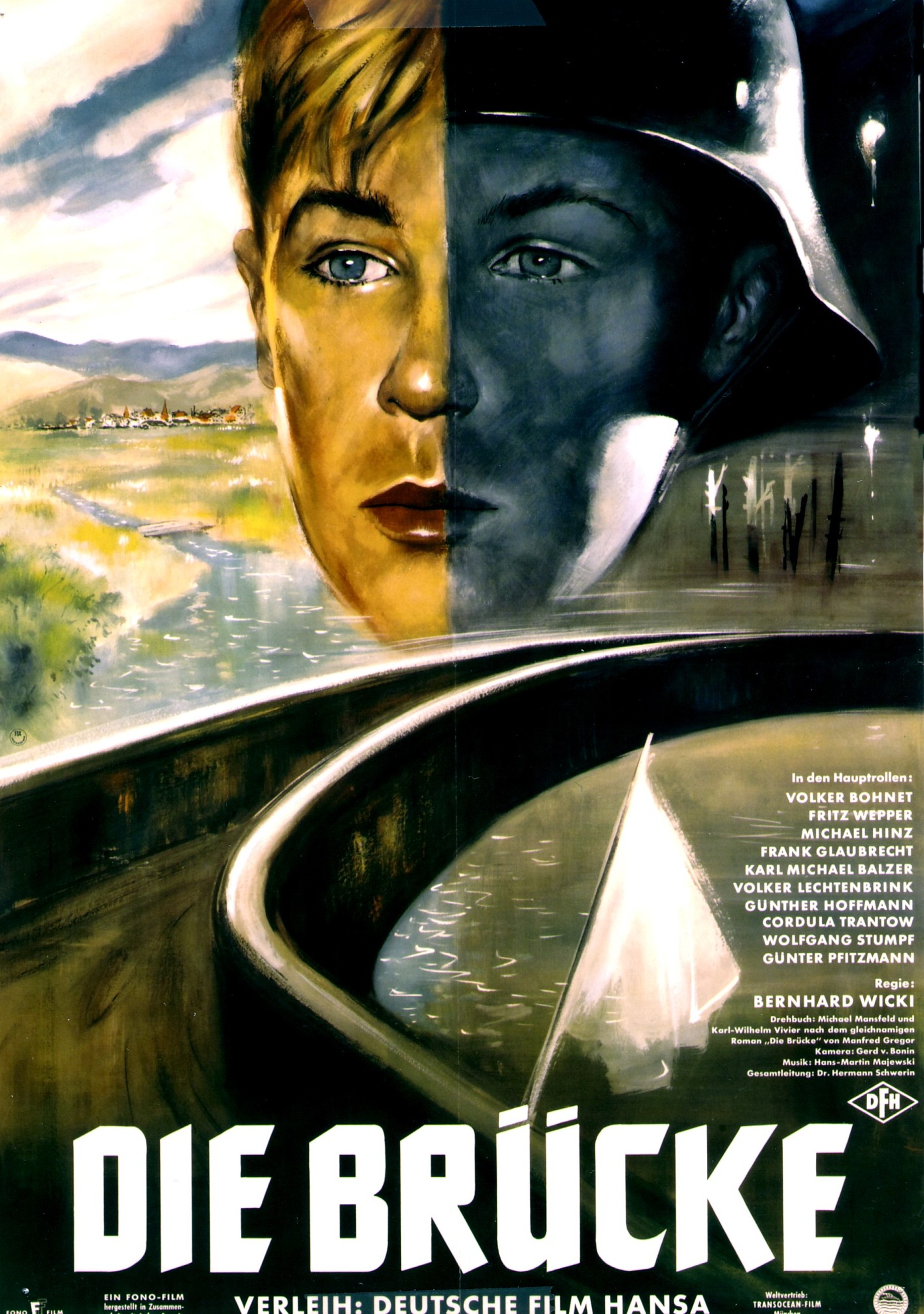
Die Brucke (The Bridge) (1959)


                “Die Brucke” is a German film that made quite a splash internationally when it was released.  It was nominated for the Oscar for Best Foreign Language Film and won the Golden Globe.  Its director Bernard Wicki went on to co-direct “The Longest Day”.  The movie was based on a novel by Gregor Dorfmeister who heard about the incident from a veteran. 

                The movie is set in the closing weeks of WWII in Europe.  The German town is so sleepy that a bomb hitting near the local bridge is all everybody is talking about.  The war has apparently not effected the town much, but that is about to change as the American army is fast approaching.  The movie concentrates on a group of high school chums and their families.  They are a varied lot and include one who is ashamed of his Nazi official father who is bugging out, one who is the son of a wealthy widow, one who is the son of a dead soldier, etc.  They have one thing in common – they are all excited about being called up to join the army.  This is one similarity to its obvious grandfather “All Quiet on the Western Front”.  Another is the training that consists of a lot of throwing yourself to the ground when ordered (like the “muddy field”).  One difference is the teacher of this group of naïve newbies goes to the training facility to talk the commander out of sacrificing them. 

                The very next day the unit is shipped to the front, but the commander shows some humanity by assigning the seven boys to defend the inconsequential bridge outside their town.  It’s scheduled to be blown up anyway.  A veteran corporal is put in charge of the teenagers, but he is not around for long and the boys are on their own.  Since they grew up looking at war as glamorous and have been indoctrinated into believing every inch of German soil must be defended by patriots, they assume their situation is not farcical and meaningless.  Even an obviously ass-whipped unit led by a dazed Iron Cross winner that comes limping through does not change their decision, although it is certainly sobering.  Peer pressure is not just for in school.  The movie becomes a “who will survive?” story when American M24 Chaffee tanks and infantry arrive.


                “Die Brucke” is a must see for war movie lovers.  It makes for a nice companion to “All Quiet”, although it lacks the depth of that classic.  The scenario is similar.  A group of teenage boys go off to war with no real conception of what war is like.  To this group, war is a game and their combat experience does bring some exhilarance.  The excited looks on their faces when they feel the vibration of their weapons on their shoulders are part of the head-shaking anti-war theme the movie is intent on conveying.  War is serious business as they learn and it is a tragedy when young people are the pawns in a doomed and corrupt cause.  The movie also makes clear the effects war has on the mothers of these pawns.  They are helpless to prevent the state from circumventing their protective rearing of their children.  Not only do wars take advantage of the youthful impression that you will come out a hero and not a dead hero, but adults in charge take advantage of this naivete.  However, the movie carves out its own niche by having no major character pushing the young men to be cannon fodder.  Their desire to prove themselves is engendered by the nebulous state indoctrination that has fed them for six years.  But mostly it comes from the common boyhood fantasy that war will be fun.

                The acting is amateurish as the boy actors are unpolished.  But so are high school boys.  This is not a major drawback for a movie that is an anti-epic.  The movie is predictable with no twists, but it does not bludgeon you with its theme.  The set-up for the climactic set piece is plausible, although having a German town untouched by war at this stage of the war is highly unlikely.  Having all seven called up on the same day is a plot device that could be sniffed at.  The big pay-off is worth the wait.  The defense of the bridge is twenty minutes of consistent action.  The MG-42s and MP-40s are authentic looking, but the tanks are wooden mock-ups.  The deaths are as memorable as they are inevitable.  For those who sneer at black and white movies, this is one movie that would not have nearly the impact if it was in color.

                Does the movie belong in my 100 Best War Movies list?  Probably.   It is not a great movie. The low budget nature and the predictability of the plot prevent this, but it is a worthy addition to the genre and deserves to be better known than it is.

GRADE =  B