Showing posts with label Westfront 1918. Show all posts

Friday, June 28, 2024

100 BEST WAR MOVIES - # 53 (tie) Westfront 1918 (1930)


“Westfront 1918” (“Vier von der Infanterie”) is a German war film that came out the same year as “All Quiet on the Western Front”.  It has been overshadowed by that behemoth, but they are both great war films.  “Westfront” was directed by the renowned Georg Pabst.  He was the leading practitioner of the New Objectivity style of filmmaking in Germany.  The style was noted for its sober realism.  Its bleak, down-to-earth take on trench warfare got the film labeled “cowardly defeatism” by Josef Goebbels and it was one of two dozen films banned by the Nazis.  Another was “All Quiet”.  The movie was an adaptation of the novel by Ernst Johannsen.  The cast included several well-respected German actors including Gustav Diessl who was held prisoner for a year during the war.

            “Westfront 1918” follows four soldiers in the closing days of WWI.  They are the Student (Hans-Joachim Moebis), Karl (Gustav Diessl), Bayer (Fritz Kampers), and the Lieutenant (Claus Clausen).  This is not a heterogeneous small unit movie.  None of the four has a memorable personality or background.  Pabst is profiling the war, not the soldiers.  The movie is a series of episodes that could have happened to any soldiers, but specifically to these four.  Only the Student and Karl get arcs and they are romances that cover the two extremes of male/female relationships in a war.

            The movie opens with the core group in an inn enjoying some time away from the front.  Note the tilted portrait of Jesus.  There is a saucy serving girl named Jacqueline (Jackie Monnier).  This is the first inkling that this movie established some standard tropes of WWI movies.  One of the soldiers refers to coffee as “Negro sweat”!  A character develops as the Student falls in love with Jacqueline.  It is his first experience with love, so he is all in.  They will get married after the war, if all goes well.  All does not go well.  Their rest is interrupted by orders to the front.  There they undergo a bombardment that features Karl, Bayer, and the Lieutenant having to hold up the ceiling of their dugout with their heads and hands.  The Student digs them out when the roof collapses.  Ironically, they are being bombarded by their own artillery.

            As is realistic for this war, combat is followed by down-time.  The men attend a stage show that includes a girl leading a singalong to a risqué song, a comedy routine, and a brass band.  (This scene has the only appearance of a xylophone that I have seen in a war movie.)  The scene will influence the famous cabaret scene in “Paths of Glory”.  Karl gets his first leave in eighteen months.  On the home front, civilians are forced to wait in long lines for food.  When his mother sees him, she decides not to lose her place in line.  This is not the clueless home front that Paul Baumer returns to in “All Quiet”.  Karl’s wife is not having to wait in line at the butcher shop because he catches her in bed with the butcher.  Awkward!  She begs forgiveness (“It’s not my fault”), but Karl is stoically unforgiving.  There is a definite chill for the whole of his leave and he returns to his real home with his marriage on the rocks.  The whole trip home is totally believable.

            It’s time to get some characters (and a messenger dog) killed and the rest of the movie is bleak and bleaker.  One of the quartet drowns in a shell hole. There is a great long combat scene that includes lots of grenade throwing, poison gas, and some really cool tanks lumbering toward the German lines.  The movie has some of the best bombardment effects of any war movie.  One character gets shell shock.  25% seems about right.  Three of them end up in a charnel house of a hospital.  An indelible image is of a damaged crucifix in the midst of the horrific wounds.  Karl summarizes the theme of the film when he says “It’s everyone’s fault”.

ACTING:                            C  typical silent movie histrionics

ACTION:                            B    7/10 in quantity

ACCURACY:                     N/A

PLOT:                                 B

REALISM:                         A

CINEMATOGRAPHY:     B

SCORE:                              N/A

QUOTE:  Karl:  It's not you. It's everything! It's everyone! We are all - guilty.

BEST SCENE:  Karl finds his wife cheating on him

                This is an amazing movie.  The film is a technical marvel for an early talkie.  Pabst uses tracking shots (one of soldiers moving through the trench inspired a similar shot in “Paths of Glory”), but also allows the French soldiers to move across the face of a stationary camera for the big battle scene.  The tanks come to the camera for a striking effect.  It contrasts well with the modern style of making the camera part of the action.  It is one of the great combat scenes in war movie lore.  The action is realistic, as are the sets.  No man’s land, the dugouts, and the trenches are well constructed.  There are nice little touches that you will see in few if any WWI movies.  A message is sent by a dog.      Since the movie is not character driven, the acting does not stand out.  In a sense that is a compliment because the actors do not overact like you see so often in the early talkies.  There are no scene-chewing moments like in “All Quiet”.  Even the shell-shocked Lieutenant is effectively played based on actual cases.  Needless to say, the movie is strongly anti-war.  There are no heroics in the film.  The violence is not exhilarating like in other so-called anti-war movies.

            In comparison to “All Quiet”, “Westfront 1918” covers some of the same ground but in a more depressing way.  Keep in mind that the time frame for the two are very different.  Paul and his comrades go to war in the naïve early days and gradually learn that war is hell.  The home front does not reach that point at all.  In “Westfront”, the war is already lost and the home front is suffering as evidenced by Karl’s wife and mother.  Another way to see the different perspectives is to compare the two hospital scenes.  The hospital in “Westfront” is a horrific and not orderly with nice rows of cots.  Also note that in “All Quiet”, the dugout roof does not collapse.  On the other hand, “Westfront” has four songs including two in a row!   Both movies have powerful scenes, but “All “Quiet” is more epic in scope.  It has more of a flow to its plot and this is mainly due to it following the Baumer character.  None of the characters in “Westfront” are memorable, but that was not Pabst’s goal.

            “Westfront 1918” is probably the second best WWI movie.  It is obviously a must see. I have to admit I am embarrassed to admit it took me this long to watch it.  In my defense, it is not an easy movie to find and is criminally underappreciated.  I found little information on it from my usual sources.  At least the readers of this post will now know a bit about it.  My work is done.


Monday, December 14, 2020

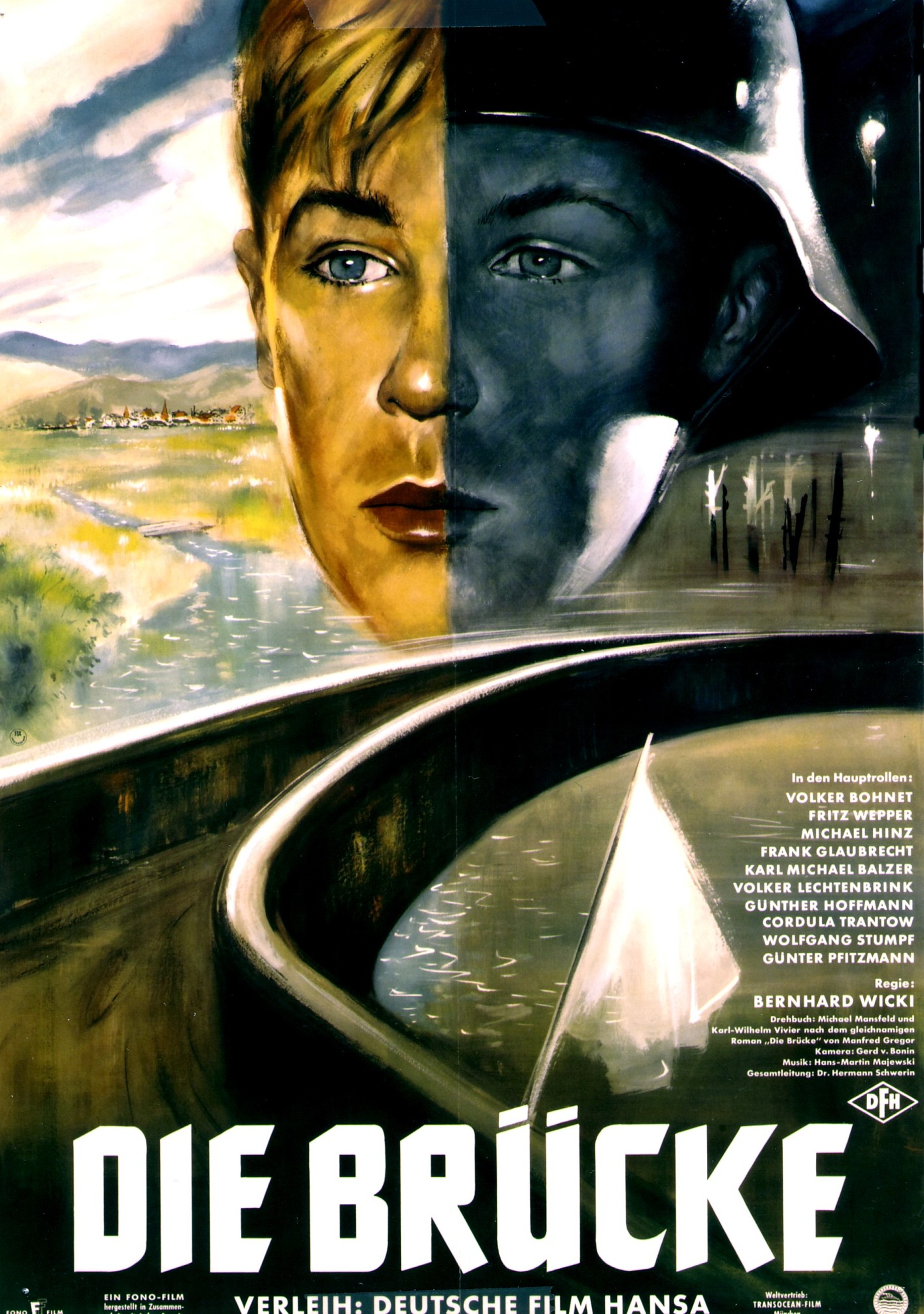
The Bridge (2) vs. Westfront: 1918 (10)


REALISM:

                “The Bridge” is based on a true story.  It is set in the closing days of WWII in Germany.  It reflects the desperate straits Germany was in.  However, the town is largely unaffected by the war.  A bomb dropping nearby is big news which implies the village has not been bombed.  This would have been true for a small population center with no war production.  The teenage boys go to school as though there is no war on.  They are clueless of the real military situation, but they do show on a map that they are aware that Germany is being squeezed between the Anglo-Americans and the Red Army.  The various parents represent different civilian perspectives.  For example, there is a Nazi official who is bugging out.  The boys are typical of most teenage boys in most countries at war.  They are thrilled with their draft notices.  They are disappointed when they are given what they think will be a boring mission.  Nothing happens in the movie that could not have happened.  GRADE  =  A (9)

                Ironically, “Westfront: 1918” takes place in the closing months of Germany’s losing effort in WWI.  In this case, the main characters are veteran soldiers.  They are war-weary, but resilient.  They sing a lot of songs.  Life in the trenches is realistically gross.  They pick lice and dig out from under bombardments.  In one indelible scene, a dugout collapses on some of the men.  There is a long scene where one of the men goes home on leave.  His mother is standing in a bread line.  His wife is shacking up with the butcher for the benefits.  The combat is depressingly real.  No man’s land is full of craters.  There are lots of dead bodies and the movie realistically eliminates several of the main characters.   There are a few head-scratching moments.  One of the men goes over the top for no apparent reason.  French attackers retreat because of poison gas because they don’t have gas masks.  GRADE  =  B (8)

CHARACTER DEVELOPMENT:

                “Die Brucke” focuses on seven teenage boys who are drafted together and are assigned the mission of defending a bridge on the outskirts of their town.  Each of the boys has a back-story representing a variety of typical situations for teenagers in war-torn Germany.  One is a rich kid whose father is in the army.  Another is the son of the local Nazi official.  There is the son of a laundress.  One has a crush on his father’s girlfriend.  One is an evacuee from a big city.  He is staying with another of the boys who is from a middle-class family.  And we have a boy who has a steady girlfriend.  Some of them are more developed than others.  The movie does a good job portraying the effects of their training and their responses to being thrust into combat.  GRADE  =  B (8)

                “Westfront: 1918” is more about the effects of the war on German soldiers than on particular German soldiers.  There are only three main characters and only Karl (who gets the home front leave) has a back-story.  The other two don’t even have names.  All three are stereotypes.  Karl is the level-headed veteran.  The Bavarian is comic-relief.  He does most of the singing.  The Student is the young, naïve soldier who thinks he has a future with a French girl.  We don’t get to know them well, but they are all appealing.  GRADE  =  C  (7)  

SOLDIER BEHAVIOR:

                The boys in “The Bridge” behave like teenage boys living peacetime lives.  They could be teenage boys in Great Britain during the war.  They are clueless as to what is actually happening.  They believe the propaganda.  They are intolerant of anyone who doesn’t.  They are all enthusiastic about joining the army and all have the bravado of young men who have not tasted war yet.  They are influenced by peer pressure.  They all defend the bridge when some have cold-feet.  But once the fighting begins, the adrenalin kicks in and they fight bravely.  The movie contrasts the septet’s eagerness with the cynicism of their officers and the defeatism of the retreating Germans.  GRADE  =  A (9)

                “Westfront: 1918” gets the camaraderie right.  In the opening scene, the men are enjoying themselves in a French café.  They flirt with the waitress (who is loose enough to become The Student’s girl).  Back at the front, it is a fight for survival, but they maintain their morale through joking and singing.  However, they are pessimistic, with good reason.  The movie is a bit weak in depicting the hardships German soldiers would have encountered at this stage of the war.  They don’t have to deal with rats or mud, but they do have to deal with the deaths of comrades.  GRADE  =  B (8)

ENTERTAINMENT VALUE:

                “The Bridge” was a success at the box office and achieved international acclaim.  It was nominated for the Best Foreign Language Film Oscar.  It was released in America.  It is the rare combat movie that has some appeal for females.  There are several female characters that can be related to. More importantly, mothers must find the scenario heart-tugging.  When the movie was released in 1959 there would have been plenty of parents who had experienced what the parents in the movie experienced.  For us today, the movie is a simple story of the way war corrupts.  It builds its theme effectively and then pays off with one of the better combat scenes in old school war movies.  It fits well into the “who will survive?” subgenre, but it has the added twist of asking the question “why?”  GRADE  =  A  (9)

                “Westfront: 1918” was received positively by critics.  It was overshadowed by “All Quiet…” and was considered more depressing than that film.  It certainly had no entertainment value as far as the Nazis were concerned.  Goebbels had it banned.  For a modern audience, it is one of the best of the early WWI talkies.  It is not an easy watch as the main characters all suffer in a manner appropriate for soldiers of a losing army.  You don’t have to be German to empathize with them.  There are several memorable scenes and the combat is strong, although there is not a lot of it.  GRADE  =  A  (9)

FINAL SCORE:  The Bridge  35 

                           Westfront:  1918  32

ANALYSIS: 
                “Westfront:  1918” is one of the great WWI movies.  It deserves to be mentioned with “All Quiet”, “Paths of Glory”, “Wooden Crosses”, and “The Big Parade”.  It is the best German film on the war and any film that aggravated Goebbels is special.  However, I think the tournament correctly reflects that “The Bridge” is the better film.  Although both are set at the end of German losing efforts, it manages to be more unique by concentrating on teenage soldiers as opposed to the much more common war-weary veterans we see in so many war movies.  The movie has fewer weaknesses than the 1932 film and was better received by audiences and critics alike.  It also has better combat than the earlier film.