VS.
.jpg)
*** THIS MATCH SLIPPED THROUGH THE CRACKS. I BET EVERYONE WAS WONDERING WHO HAD WON THIS MATCH.
ACTING
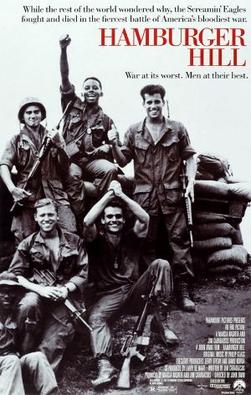
“Hamburger Hill” has a cast of actors who were unknown at the time, but some were at the start of significant careers. The cast is likeable and does not perform like a bunch of rookies. They are a bit too sincere in spots and their line readings sometimes indicate they do not understand the slang they have memorized. Although there was no Dale Dyeish “boot camp”, they do not look like actors playing soldier. Dylan McDermott is good as the sergeant who leads by example on and off the battlefield. His contract specifically mentioned “don’t touch the hair”. The standout in the cast is Courtney Vance as Doc. He chews a little, but it is a memorable performance. It was the first significant film role for both as well as the underused Don Cheadle. The only weak performance is Steven Weber as the platoon sergeant. B
“Under Heavy Fire” has a similar cast of unknowns, but they will remain that way. The “big” star is Casper Van Dien as the troubled, but ruggedly handsome Capt. Ramsey. You know you are in trouble when you wish that Casper would have given the others acting lessons. Carre Otis, as a documentary film bunny, succumbs to his charms. She is also ruggedly handsome. The rest of the cast should have gone to acting camp. They are typically sincere, but fortunately they save the foaming for the end. D
FIRST QUARTER SCORE
Hamburger Hill = 8
Under Heavy Fire = 6
PLOT
HH is a battle film that has two distinct parts. The first half deals with character development and tutoring the audience on what the soldiers had to go through. We are supposed to relate to the five FNGs and empathize with them. The second half is the payoff with the battle. Intense action interspersed with soldier campfire banter and bitching. The expository moments advance the theme that the home front can kiss these soldiers’ asses. The movie is clearly anti-anti-Vietnam War (as opposed to pro-war). The plot is the standard “who will survive?” variety. Don’t get too attached to the men. B
UHF has a daring plot. It starts twenty years after the war with a group of vets returning to Vietnam with a documentarian in tow. Meeting them there is their ex-commander who went from “Most Likely to Succeed” to “Most Likely to Make Us Bleed” during their time together. The first scene introduces us to a friendly fire episode for which Ramsey is blamed. The film effectively uses flashbacks to gradually flesh out the arc that led to the unit dysfunctionality. This builds to … a reenactment of the friendly fire incident! The movie closes poorly. B
HALF TIME SCORE
Hamburger Hill = 16
Under Heavy Fire = 14
COMBAT
HH has a high quantity of combat. It reminds a lot of “Pork Chop Hill”. There is an intense opening combat scene and then a patrol mission, but the core of the movie is the sequence of frontal assaults up the titular hill. The violence is graphic and the deaths are random and unpredictable. There is some pretty gory stuff, including decapitations. The film manages to avoid being repetitive. Probably only “We Were Soldiers” has higher quality and that could partly be explained by the higher budget. A
UHF does a good job with combat considering the production values. One thing you can be sure of – if it’s a flashback, there is going to be some action. The incidents portrayed are a greatest hits compilation. For instance, there’s a patrol with the trio of mortars incoming, spider holes, and a sniper. There is a briskly paced tunnel scene. The big set piece is in Hue during the Tet Offensive. The urban combat is pretty good and leads to an atrocity that sets up the full circle return to the friendly fire incident. There is little shooting from the hip and few hands thrown up in the air deaths. B
THIRD QUARTER SCORE
Hamburger Hill = 25
Under Heavy Fire = 22
REALISM
HH is one of the more realistic Vietnam War movies. The soldier behavior and camaraderie is on target for the army midway through the war. The bonding versus racial tensions is well played. The only discordant note comes from the dialogue put in the actors’ mouths. The screenwriter uses every slang term ever uttered in the Nam to the point that the dialogue feels forced. The battle is one of the more famous ones from the war and the movie is solid in its realistic depiction of it. One could complain about the exaggerated mortality rate, but that’s a war movie sort of thing that will always be with us. Besides, the actual battle did have a high casualty rate (just not Hollywood high). B
UHF has some problems with reality. Some of the combat scenes evidence either an ignorance of combat or more likely a disregard of reality for entertainment purposes. For example, when confronted by an NVA tank, Ramsey calls for a Skyraider to drop its fuel tank which the unit fires at causing an explosion that destroys the target! The behavior of the main characters both in the war and upon their return is the biggest problem. They are too melodramatic and one dimensional in response to the stresses they encounter. This leads to the laughable reenactment scene which degenerates into a cartoonish standoff. By the way, when you are shot an inch above the heart, you don’t run around unaffected like Ramsey does. D
FINAL SCORE
Hamburger Hill = 33
Under Heavy Fire = 28
ANALYSIS
This match was a lot closer than I anticipated. I had never seen “Under Heavy Fire” before and assumed that it’s seeding at #16 meant it was the worst movie in the tournament. It by no means is a good movie, but it does take a different approach to the war. Unfortunately, friendly fire was a fact of life in Vietnam (“Hamburger Hill” has a scene where American helicopters fire on their own men) and to use an incident as the framework for a military mystery was intriguing. Of course, with the low budget and the poor actors, the idea did not match the execution, but it was a nice try. The categories used for this match-up did not lend itself to the strength of UHF. It uses a lot of POV footage which is overdone, but still effective. As far as HH, it may not deserve the #1 seed (which is based on generic movie reviewers), but it is still one of the more highly thought of Vietnam War movies. It has no spectacular elements like “Apocalypse Now”, “Full Metal Jacket”, or “Platoon”, but it also does not have some glaring weaknesses. It is a balanced movie overall.
“Hamburger Hill” has a cast of actors who were unknown at the time, but some were at the start of significant careers. The cast is likeable and does not perform like a bunch of rookies. They are a bit too sincere in spots and their line readings sometimes indicate they do not understand the slang they have memorized. Although there was no Dale Dyeish “boot camp”, they do not look like actors playing soldier. Dylan McDermott is good as the sergeant who leads by example on and off the battlefield. His contract specifically mentioned “don’t touch the hair”. The standout in the cast is Courtney Vance as Doc. He chews a little, but it is a memorable performance. It was the first significant film role for both as well as the underused Don Cheadle. The only weak performance is Steven Weber as the platoon sergeant. B
“Under Heavy Fire” has a similar cast of unknowns, but they will remain that way. The “big” star is Casper Van Dien as the troubled, but ruggedly handsome Capt. Ramsey. You know you are in trouble when you wish that Casper would have given the others acting lessons. Carre Otis, as a documentary film bunny, succumbs to his charms. She is also ruggedly handsome. The rest of the cast should have gone to acting camp. They are typically sincere, but fortunately they save the foaming for the end. D
FIRST QUARTER SCORE
Hamburger Hill = 8
Under Heavy Fire = 6
PLOT
HH is a battle film that has two distinct parts. The first half deals with character development and tutoring the audience on what the soldiers had to go through. We are supposed to relate to the five FNGs and empathize with them. The second half is the payoff with the battle. Intense action interspersed with soldier campfire banter and bitching. The expository moments advance the theme that the home front can kiss these soldiers’ asses. The movie is clearly anti-anti-Vietnam War (as opposed to pro-war). The plot is the standard “who will survive?” variety. Don’t get too attached to the men. B
UHF has a daring plot. It starts twenty years after the war with a group of vets returning to Vietnam with a documentarian in tow. Meeting them there is their ex-commander who went from “Most Likely to Succeed” to “Most Likely to Make Us Bleed” during their time together. The first scene introduces us to a friendly fire episode for which Ramsey is blamed. The film effectively uses flashbacks to gradually flesh out the arc that led to the unit dysfunctionality. This builds to … a reenactment of the friendly fire incident! The movie closes poorly. B
HALF TIME SCORE
Hamburger Hill = 16
Under Heavy Fire = 14
COMBAT
HH has a high quantity of combat. It reminds a lot of “Pork Chop Hill”. There is an intense opening combat scene and then a patrol mission, but the core of the movie is the sequence of frontal assaults up the titular hill. The violence is graphic and the deaths are random and unpredictable. There is some pretty gory stuff, including decapitations. The film manages to avoid being repetitive. Probably only “We Were Soldiers” has higher quality and that could partly be explained by the higher budget. A
UHF does a good job with combat considering the production values. One thing you can be sure of – if it’s a flashback, there is going to be some action. The incidents portrayed are a greatest hits compilation. For instance, there’s a patrol with the trio of mortars incoming, spider holes, and a sniper. There is a briskly paced tunnel scene. The big set piece is in Hue during the Tet Offensive. The urban combat is pretty good and leads to an atrocity that sets up the full circle return to the friendly fire incident. There is little shooting from the hip and few hands thrown up in the air deaths. B
THIRD QUARTER SCORE
Hamburger Hill = 25
Under Heavy Fire = 22
REALISM
HH is one of the more realistic Vietnam War movies. The soldier behavior and camaraderie is on target for the army midway through the war. The bonding versus racial tensions is well played. The only discordant note comes from the dialogue put in the actors’ mouths. The screenwriter uses every slang term ever uttered in the Nam to the point that the dialogue feels forced. The battle is one of the more famous ones from the war and the movie is solid in its realistic depiction of it. One could complain about the exaggerated mortality rate, but that’s a war movie sort of thing that will always be with us. Besides, the actual battle did have a high casualty rate (just not Hollywood high). B
UHF has some problems with reality. Some of the combat scenes evidence either an ignorance of combat or more likely a disregard of reality for entertainment purposes. For example, when confronted by an NVA tank, Ramsey calls for a Skyraider to drop its fuel tank which the unit fires at causing an explosion that destroys the target! The behavior of the main characters both in the war and upon their return is the biggest problem. They are too melodramatic and one dimensional in response to the stresses they encounter. This leads to the laughable reenactment scene which degenerates into a cartoonish standoff. By the way, when you are shot an inch above the heart, you don’t run around unaffected like Ramsey does. D
FINAL SCORE
Hamburger Hill = 33
Under Heavy Fire = 28
ANALYSIS
This match was a lot closer than I anticipated. I had never seen “Under Heavy Fire” before and assumed that it’s seeding at #16 meant it was the worst movie in the tournament. It by no means is a good movie, but it does take a different approach to the war. Unfortunately, friendly fire was a fact of life in Vietnam (“Hamburger Hill” has a scene where American helicopters fire on their own men) and to use an incident as the framework for a military mystery was intriguing. Of course, with the low budget and the poor actors, the idea did not match the execution, but it was a nice try. The categories used for this match-up did not lend itself to the strength of UHF. It uses a lot of POV footage which is overdone, but still effective. As far as HH, it may not deserve the #1 seed (which is based on generic movie reviewers), but it is still one of the more highly thought of Vietnam War movies. It has no spectacular elements like “Apocalypse Now”, “Full Metal Jacket”, or “Platoon”, but it also does not have some glaring weaknesses. It is a balanced movie overall.