Showing posts with label Burt Lancaster. Show all posts

Friday, July 4, 2014

4TH OF JULY: The Devil’s Disciple (1959)


                “The Devil’s Disciple” was based on the George Bernard Shaw play.  The play was a strange choice for a movie considering Shaw did not like the play and never staged it in England.  Considering the Irishman’s view toward England, Shaw probably would have appreciated the movie.  The film was directed by Guy Hamilton and stars Burt Lancaster, Kirk Douglas, and Laurence Olivier (billed in that order).  Olivier did not enjoy the experience and did not get along with his co-stars.  He would purposely get their names mixed up.  The movie was not a success.  Possibly because of the egregious tag line:  “Burt, Kirk, and Larry are coming – by George!”

                The movie opens with a nifty animated map explaining Burgoyne’s campaign to separate New England from the rest of the colonies by invading New York.  It summarizes the Revolutionary War as the “suppression of a rebellion” versus “the pursuit of liberty”.  Reverend Anderson (Lancaster) attempts to prevent the execution of a rebel and then is prevented from giving the victim a Christian burial.  That night the rebel's son Richard Dudgeon (Douglas) steals the body.  He’s a rogue who dresses like a dandy.  The title refers to him.  He is the opposite of the pacifist, moral Anderson.  Anderson’s wife Judith (Janette Scott) is repelled, yet intrigued by this bad boy.  When Gen. Burgoyne arrives, he insists on arresting Anderson for burying the rebel.  Dudgeon claims to be the Reverend and is found guilty in a trial.  Anderson leads the militia in an assault to rescue him.  Judith is torn between the two.

You have violated the law against colonists
being more handsome than Banastre Tarleton
                This is not your typical war movie.  However, it is certainly more warlike than the play.  The movie does  a good job fitting some action in that the play did not have.  The movie is undoubtedly better than the play.  The acting is stellar as can be expected.  Lancaster and Douglas made seven movies together and it looks like they are enjoying themselves.  While Olivier may not have enjoyed the experience, his mood was perfect for Burgoyne.  He probably found a kindred spirit in “Gentelman Johnny”.  He is snarky (a word not yet in use back then).  Janette Scott is in over her head and if the movie was remade today, Lancaster and Douglas would go riding off into the sunset at the end.  The plot is fine even if Shaw was not proud of it.  Even lesser Shaw is still pretty darn good.  It is a bit predictable and simplistic.  When Anderson changes his personality to action hero, he also changes his clothes to buckskin.  The dialogue is outstanding, of course.  At the end of the film, someone asks Burgoyne what history will say about the events and he responds with:  “History will tell lies, as usual.”  Dudgeon gets some great lines in the trial.  The movie is a deft blend of romance, comedy, and action.  The action is surprisingly vigorous.   The rebel assault includes some effective cannon fire. 

                The movie is appropriate viewing for the 4th of July.  John Burgoyne was an actual figure and his personality is portrayed based on his reputation.  The Anderson character finds a loose equivalency in Peter Muhlenberg – the “Fighting Pastor of the Revolution”.  Muhlenberg was an Anglican minister who left his pulpit to command the 8th Virginia Regiment.  Muhlenberg had been active in rebel politics before this so he did not have the transformation that Anderson undergoes.  The background of his campaign is a fairly good tutorial on what may have been the most important event in the Revolution.  Burgoyne did flounder in the American wilderness due to the recalcitrance of the rebels.  The aftermath of the fictional events in Springtown is going to be the Battle of Saratoga.  The movie accurately reflects the divided loyalties among the colonists and the frustrations this created for the British.  Burgoyne is also frustrated by the lack of support from the British high command.  One theme that is very Shawian is the movie is critical of the clergy and religion.  It is a bit of a surprise that the screenwriters did not substitute action for the cynicism about religion.  Kudos on that.

                “The Devil’s Disciple” has its detractors, but I am not one of them.  To me it is a fun movie as evidenced by the unique animation.  Of course, it did not hurt that I am a huge fan of Lancaster and Douglas.  Throw in Olivier and I’m all in.  Besides, considering the paucity of movies about the Revolutionary War, you have to take what you can get.


GRADE  =   A

Tuesday, April 22, 2014

BOOK / MOVIE: Incident at Muc Wa / Go Tell the Spartans (1978)


                “Go Tell the Spartans” is a Vietnam War film released in 1978 (the same year as “Coming Home” and “The Deer Hunter”).  It was directed by Ted Post and is based on the novel Incident at Muc Wa by Daniel Ford.  The movie was shot in California with a shoe-string budget.  It is set in South Vietnam in 1964 during the period when the U.S. was still in an advisory role.  “In 1964, the war in Vietnam was still a little one – confused and far away.”
                Maj. Barker (Burt Lancaster) is in command of a base at Panang.  Barker is a war-weary veteran of WWII and Korea who is just putting in time.  He is cynical and not interested in “playing the game”.  His executive officer Capt. Olivetti (Marc Singer) is ambitious and hoping to advance his career by earning a Combat Infantry Badge. (They thought small back then.)  They command a motley group of ARVN and peasant farmers (who he refers to as “gooks”).  They get some help (whether they want it or not) from some new arrivals.  Barker interviews each as a form of character background.  Sgt. “Oleo” Oleonowski (Jonathan Goldsmith) is a tightly-wound veteran who has served well under Barker in the past.  Lt. Hamilton (Joe Unger) is a shavetail who wants to “see the elephant”.  Cpl. Abraham Lincoln (Dennis Howard) is a drug addicted medic.  He is put rooming with the alcoholic Oleo.  (At least in “Platoon” the dopers and drunks were segregated.)  Cpl. Courcey (Craig Wasson) is a draftee who volunteered for combat in Vietnam.  Barker is irritated, yet intrigued by Courcey.
                Gen. Harnitz arrives to order Barker to establish an outpost at Muc Wa.  Muc Wa had been a French outpost that was wiped out in 1954.  Harnitz’s rationale is that since the French lost Muc Wa and lost the war, logically if the U.S. wants to win the war, we have to hold Muc Wa.  When Barker points out that the site is not strategically important, Hartnitz counters:  “I don’t give a shit what the actual conditions are, the book says do it”.  He also mentions that just because the French were defeated there means nothing because we are the USA - we don’t lose.
                Barker sends a motley crew of Americans, ARVN, and some militiamen to rebuild and garrison Muc Wa.  Hamilton is suffering from dysentery and unsure of command, so Oleo is actually calling the shots (not that unrealistic for Vietnam).  Courcey is turning out to be a bleeding heart liberal and insists on befriending a refugee family and bringing them inside the wire.  Their Vietnamese guide Cowboy (Evan Kim) claims they are Cong.  How can you know?  Muc Wa includes an old French cemetery with a placard that reads:  “Stranger, tell the Spartans that we remain here in obedience to their orders.”  There are 302 French buried there.  (What a coincidence – there were 300 Spartans killed at Thermopylae.)   
                The unit sends out patrols and lays ambushes at night.  Lt. Hamilton gets killed trying to rescue one of Oleo’s men.  Oleo snaps over this and commits suicide.  Meanwhile, back at the base, Barker is assigned a nerd who will manage the “Incident Flow Priority Indicator”.  This MacNamaraish scheme will determine which outpost is statistically most likely to come under attack.  Barker is skeptical, but when Muc Wa rises to the red level, he takes steps to avoid disaster.    He sends his glory-seeking exec to take command.  To work up a relief convoy, he has to wheel and deal with the local South Vietnamese commander.  He bribes him with howitzer shells.  When asked if the U.S. might ask for the rounds back, Barker correctly points out that the U.S. never asks for anything back.
                A human wave night attack is barely defeated by the Muc Wa defenders.  It’s fairly good action and the body count is high.  It helps when you don’t have to reload.  They fire mortars that land ten yards away.  More is coming and so is Barker until Hartnitz turns around his convoy because the book now says to cut your losses over an unimportant outpost.  He does want the white guys evacuated so Barker choppers in.  When Courcey learns that the ARVN, militiamen, and refugees are on their own, he refuses to abandon them.  He’s a good American.  Guess who stays behind with him when the chopper leaves?
                The movie is distinctly low budget (Lancaster put up $150,000 to finish production) and that is the main reason it got lost in the glut of 1978 Vietnam War movies.  It has a made-for-TV feel for it.  This is emphasized by the soundtrack.  Filmed in California, Muc Wa does not look like it is in a jungle setting.   The cast (other than Lancaster) is low rent and it shows in the acting.  If it was not for Lancaster being great, the movie would not even be a blip.  He has one of his best performances.  He is totally comfortable in the role and perfectly portrays a veteran officer whose career was blunted by a sexual transgression (which he describes comically at length).  Because of that weakness for “pudenda” (as he quaintly calls it), he is forced to take orders from lesser men like Hartnitz.  He also does not give a crap and is not beyond threatening a general if necessary.  The rest of the acting sometimes drifts into terrible.  Howard, in particular, gets to play high and sing the Gettysburg Address from a tower until a mortar round thankfully shuts him up, but does not kill him.  Boo.
                The film tries hard to show how we were nuts to get stuck in Vietnam.  It is the rare Vietnam movie that is set in the advisory period.  Part of the reason it did not make a splash in 1978 had to be that audiences did not want to know how screwed up Vietnam was before we even started fighting.  The movie is very anti-war and it is not a feel good movie.  It is sincere and it deserves credit for being pretty realistic.  For instance, aside from Courcey (who is depicted as a naïve chump – the family turns out to be Cong), all the Americans look down on the Vietnamese people.  They are referred to as “slopes” and “gooks”.
               The book was written by a war correspondent who was in South Vietnam in 1964.  He later wrote a nonfiction account of America's early involvement in the war.  The movie is substantially different than the novel mainly in the characters.  Most significantly, screen writer Wendall Mayes beefed up the Barker role to attract a big name and it lured the 65 year old Lancaster.  In the book, Barker is like an office manager doing his job with little enthusiasm.  There is no druggie medic.  Olivetti is more of a womanizing jerk who is full of himself.  Hardnetz is a buffoon who is obsessed with doing things by the book  and there is no back-story creating dysfunction between him and Barker.  Barker is cowed by him which is very different than in the movie.
                The book is much more female-friendly and Mayes’ decision to remove two major characters is puzzling.  A radical journalist named Rebecca goes all the way to Vietnam to try to reconnect with Courcey (and to be hit on by Olivetti).  Granted, this is ridiculous, but we do get the hippie outlook and some unrequited romance.  The other female is a sexy teenage girl (called “Butterfly”) in the refugee family who Ski (as Oleo is called in the book) marries and gets pregnant.  They shack up (literally) at Muc Wa.  This relationship starts creepy and ends sweetly.  In the movie, Oleonowski is totally against allowing the family into the outpost.
                The main character in the novel is Courcey.  He is much more multi-dimensional than in the movie.  He does start off quoting from the book in his opening interview with Barker in the movie and he does sympathize with his Vietnamese charges.  In the book, he grows into leadership and becomes a good warrior.  He is the actual commander of Muc Wa and gradually comes to feel possessive.
                The novel has the luxury of going into more detail.  The time frame is much longer.  Muc Wa does not even exist when they arrive and they have to build it from the ground up.  The outpost is much larger than in the movie.  In fact, the Viet Cong capture half of it before the climactic battle.  Ski has time to develop a relationship with Butterfly.  Courcey has time to develop a relationship with an elderly militiaman called Corporal Old Man.
                The book is more satirical than the movie.  For instance, Gen. Hartnetz visits Muc Wa and Barker orders them to stage an attack to show off the defenses.  Courcey takes a unit out into the bush, but they do not do the show assault because a larger Viet Cong unit happens along and attacks the outpost.  Hilarious. 
                The book and movie make a good pair.  They are both low budget, but sincere.  Neither are great, but they are worth experiencing.
BOOK =  B
MOVIE = B

Thursday, April 17, 2014

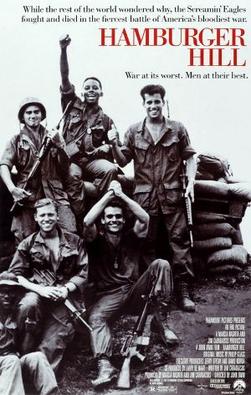
HAMBURGER HILL (1) vs. UNDER HEAVY FIRE (16)


VS.


***  THIS MATCH SLIPPED THROUGH THE CRACKS.  I BET EVERYONE WAS WONDERING WHO HAD WON THIS MATCH.


 ACTING

“Hamburger Hill” has a cast of actors who were unknown at the time, but some were at the start of significant careers. The cast is likeable and does not perform like a bunch of rookies. They are a bit too sincere in spots and their line readings sometimes indicate they do not understand the slang they have memorized. Although there was no Dale Dyeish “boot camp”, they do not look like actors playing soldier. Dylan McDermott is good as the sergeant who leads by example on and off the battlefield. His contract specifically mentioned “don’t touch the hair”. The standout in the cast is Courtney Vance as Doc. He chews a little, but it is a memorable performance. It was the first significant film role for both as well as the underused Don Cheadle. The only weak performance is Steven Weber as the platoon sergeant. B

“Under Heavy Fire” has a similar cast of unknowns, but they will remain that way. The “big” star is Casper Van Dien as the troubled, but ruggedly handsome Capt. Ramsey. You know you are in trouble when you wish that Casper would have given the others acting lessons. Carre Otis, as a documentary film bunny, succumbs to his charms. She is also ruggedly handsome. The rest of the cast should have gone to acting camp. They are typically sincere, but fortunately they save the foaming for the end. D

FIRST QUARTER SCORE
Hamburger Hill = 8
Under Heavy Fire = 6


PLOT

HH is a battle film that has two distinct parts. The first half deals with character development and tutoring the audience on what the soldiers had to go through. We are supposed to relate to the five FNGs and empathize with them. The second half is the payoff with the battle. Intense action interspersed with soldier campfire banter and bitching. The expository moments advance the theme that the home front can kiss these soldiers’ asses. The movie is clearly anti-anti-Vietnam War (as opposed to pro-war). The plot is the standard “who will survive?” variety. Don’t get too attached to the men. B

UHF has a daring plot. It starts twenty years after the war with a group of vets returning to Vietnam with a documentarian in tow. Meeting them there is their ex-commander who went from “Most Likely to Succeed” to “Most Likely to Make Us Bleed” during their time together. The first scene introduces us to a friendly fire episode for which Ramsey is blamed. The film effectively uses flashbacks to gradually flesh out the arc that led to the unit dysfunctionality. This builds to … a reenactment of the friendly fire incident! The movie closes poorly. B

HALF TIME SCORE
Hamburger Hill = 16
Under Heavy Fire = 14


COMBAT

HH has a high quantity of combat. It reminds a lot of “Pork Chop Hill”. There is an intense opening combat scene and then a patrol mission, but the core of the movie is the sequence of frontal assaults up the titular hill. The violence is graphic and the deaths are random and unpredictable. There is some pretty gory stuff, including decapitations. The film manages to avoid being repetitive. Probably only “We Were Soldiers” has higher quality and that could partly be explained by the higher budget. A

UHF does a good job with combat considering the production values. One thing you can be sure of – if it’s a flashback, there is going to be some action. The incidents portrayed are a greatest hits compilation. For instance, there’s a patrol with the trio of mortars incoming, spider holes, and a sniper. There is a briskly paced tunnel scene. The big set piece is in Hue during the Tet Offensive. The urban combat is pretty good and leads to an atrocity that sets up the full circle return to the friendly fire incident. There is little shooting from the hip and few hands thrown up in the air deaths. B

THIRD QUARTER SCORE
Hamburger Hill = 25
Under Heavy Fire = 22


REALISM

HH is one of the more realistic Vietnam War movies. The soldier behavior and camaraderie is on target for the army midway through the war. The bonding versus racial tensions is well played. The only discordant note comes from the dialogue put in the actors’ mouths. The screenwriter uses every slang term ever uttered in the Nam to the point that the dialogue feels forced. The battle is one of the more famous ones from the war and the movie is solid in its realistic depiction of it. One could complain about the exaggerated mortality rate, but that’s a war movie sort of thing that will always be with us. Besides, the actual battle did have a high casualty rate (just not Hollywood high). B

UHF has some problems with reality. Some of the combat scenes evidence either an ignorance of combat or more likely a disregard of reality for entertainment purposes. For example, when confronted by an NVA tank, Ramsey calls for a Skyraider to drop its fuel tank which the unit fires at causing an explosion that destroys the target! The behavior of the main characters both in the war and upon their return is the biggest problem. They are too melodramatic and one dimensional in response to the stresses they encounter. This leads to the laughable reenactment scene which degenerates into a cartoonish standoff. By the way, when you are shot an inch above the heart, you don’t run around unaffected like Ramsey does. D

FINAL SCORE
Hamburger Hill = 33
Under Heavy Fire = 28


ANALYSIS

This match was a lot closer than I anticipated. I had never seen “Under Heavy Fire” before and assumed that it’s seeding at #16 meant it was the worst movie in the tournament. It by no means is a good movie, but it does take a different approach to the war. Unfortunately, friendly fire was a fact of life in Vietnam (“Hamburger Hill” has a scene where American helicopters fire on their own men) and to use an incident as the framework for a military mystery was intriguing. Of course, with the low budget and the poor actors, the idea did not match the execution, but it was a nice try. The categories used for this match-up did not lend itself to the strength of UHF. It uses a lot of POV footage which is overdone, but still effective. As far as HH, it may not deserve the #1 seed (which is based on generic movie reviewers), but it is still one of the more highly thought of Vietnam War movies. It has no spectacular elements like “Apocalypse Now”, “Full Metal Jacket”, or “Platoon”, but it also does not have some glaring weaknesses. It is a balanced movie overall.


Saturday, August 20, 2011

#54 - Ulzana's Raid (1972)


BACK-STORY: “Ulzana’s Raid” is a revisionist Western by Robert Aldrich which was released in 1972 toward the end of the Vietnam War. It was filmed on location in Arizona and Nevada. It is not based on a true story.


OPENING: On the San Carlos Indian Reservation sometime in the 1880’s, a group of Chiricahua Apaches led by Ulzana (Joaquin Martinez) steal some horses (considering their need for horses later, maybe they should have taken more than one each) and leave on a raid. A messenger arrives at Fort Lowell and the word spreads that “Ulzana’s gone out!” Grizzled Indian scout MacIntosh (Burt Lancaster) is sent to the agency to gather information.

SUMMARY: The commanding officer at Fort Lowell assigns a green Lt. DeBuin (Bruce Davison) to lead the pursuit with twenty troopers and two scouts – MacIntosh and a Chiricahua named Ke-Ni-Tay (Jorge Luke). Ke-Ni-Tay happens to be Ulzana’s brother-in-law. Besides pursuit, there are settler families that need to be warned. One crusty codger sends off his wife and son, but stays to defend his homestead. The woman and boy are ambushed at the same time a trooper arrives on the scene. He shoots the woman and then himself to avoid the inevitable torture. The Indian braves do the next best thing by cutting out his heart and tossing it around. These are not noble savages. Later, DeBuin’s unit finds the husband’s body tortured.

     DeBuin is new to the West and wants to learn about the Apache’s and their culture. He is empathetic at first. After seeing the tortured corpse, he asks Ki-Ni-Tay “Why are your people mean and cruel?” The response is “it’s how they are.” Torturing a man means you acquire his power. Why did Ulzana leave the reservation? "Ulzana is at agency long time. His power is very thin. He had old smell in the nose. The smell of dog, of women, of children. Man with old smell in the nose is old man. Ulzana wants new smell. The smell of bullet. Pony running. For power!"  (We married fathers have Hooters, they had the open plains.) MacIntosh encourages DeBuin to be realistic. “Hating Apaches is like hating the desert for not having water.” He also tries to teach the young LT how to fight the Apaches. “Remember the rules, first to make a mistake gets to bury some of his people.”

     Ulzana is a classic guerrilla warrior. He tries to get an advantage over his pursuers by dismounting most of his men and having two warriors run the ponies in a loop to exhaust the bigger cavalry horses. This would probably have worked except that not only do the whites have the Yoda of Indian scouts in MacIntosh, but the T1000 of trackers in Ke-Ni-Tay. They see through the Indian ploy and do not fall for it. In fact, MacIntosh heads off the pony string killing one of the braves and depriving Ulzana of his horses. Although he has lost his empathy for the Apaches, DeBuin does stop some troopers from mutilating the Indian corpse.

     At another farm, they find a raped woman who has been left alive by Ulzana so that the cvalry will be forced to split, sending some men with the woman back to the fort. Since MacIntosh sees through this strategy, he and DeBuin come up with a counterplan. MacIntosh and a few men (and the woman) will walk into the inevitable ambush and then DeBuin will swoop in and catch Ulzana with his loin cloth down. The humane DeBuin seems unconcerned with sending this distraught rape victim into an ambush which will be suicidal for at least some of the bait. Considering she is dressed as a soldier, you would think a soldier could have masqueraded as her.

     The plan hinges on Ke-Ni-Tay eliminating the Indian who will be watching the main group. He is so good he is able to follow tracks over bare rock! Due to miscommunication, DeBuin moves prematurely and Ke-Ni-Tay has to catch up to the Indian before he warns Ulzana. Being super-tracker as well as super-warrior, Ke-Ni-Tay kills his prey in time.

Jaekel as the Sarge
     Meanwhile, MacIntosh is ambushed in a canyon with predictable results for the poor bastards that are the bait. Mac, the sergeant (the ever-reliable Richard Jaekel), and the woman are forced to take refuge under a wagon. The sarge is killed and Mac is gravely wounded. Ulzana, who holds all the cards, orders two of his men to charge in the open and they are gunned down by MacIntosh. Wait, aren’t they guerrillas?

     DeBuin arrives with bugle blaring (so much for surprise). Instead of flanking the Indians, he comes charging up the canyon. However, this tactic is sufficient to win the “battle” and rescue the few survivors.

CLOSING: Ke-Ni-Tay tracks Ulzana, but can’t locate him. Just kidding. The two confront each other and it looks like it will be a classic Western duel, except with Indians. Think again. Ke-NI-Tay shows Ulzana his son’s (and Ke-Ni-Tay’s nephew’s) bugle.  This is the Apache way of saying I killed your son.  Opting against vengeance, Ulzana sings his death song and kneels for Ke-Ni-Tay to shoot him in the back of the head. MacIntosh insists DeBuin leave him behind to die.

RATINGS:

Acting - 7


Action - 6


Accuracy - 6


Realism - 7


Plot - 5


Overall - 6


WOULD CHICKS DIG IT? Highly unlikely. There are no significant females in the movie and those that appear mostly have very bad things happen to them. This is very much a guys’ movie. It does not have a lot of violence, but some of it is graphic. It is definitely not a feel-good movie. If you took a date to it when it was in the theaters, the dinner better have been outstanding and even then don’t expect much after you leave the cinema.

ACCURACY: The film is not based on a true story which is a crying shame. Why make up Ulzana when there were similar and better actual historical figures like Cochise, Mangas Coloradas, Geronimo, and my choice – Victorio? Any one of their stories would have been more interesting and given Aldrich the opportunity to explore the same themes.

     As far as Apache culture, the movie is fairly accurate although it does not cover anything but warrior culture. The discussions between DeBuin and Ke-Ni-Tay are enlightening as to how the warriors thought and fought. Their guerrilla tactics appear to be realistic, but if they were the great guerrilla warriors respected by historians, some of Ulzana’s decisions seem weak. The Apaches certainly knew the value of horses so the decision to go on the warpath with just one mount per raider is suspect. The ploy of dismounting and leading the pony string around looks like a Hollywood plot invention to me. Ulzana was well ahead of his pursuers and lengthening the distance. Giving up that gap does not strike me as something an intelligent Apache would have done.

     There is little doubt that the Apaches could be hard on prisoners. They certainly tortured and mutilated prisoners, including other Indians. I cannot vouch for the “take their power” explanation. I do know that Indians tortured their foes because they expected the same treatment and saw it as a way to show their bravery. I have never run across reference to cutting the heart out and tossing it around. They did tend to cut off genitalia and stick it in the victim’s mouth, however.  (You're welcome for that fun fact.)

     The Apache did have a tendency to leave the reservations to conduct raids which were hard on white settlers. Geronimo and Victorio were good examples of this.

CRITIQUE: “Ulzana’s Raid” has the feel of a made for TV movie. It looks low budget and the cast (other than Lancaster) is underwhelming. Lancaster is his usual strong force and gives the film gravitas. Davison is surprisingly good as the naïve lieutenant. Jaekel is his reliable self and gets a meaty supporting role. Luke stands out as the stoical Ke-Ni-Tay. The rest of the cast is below average.

     The score is stereotypical Western music. If you only heard the music, you would know immediately you were watching a Western. Some of it borders on ridiculous. The cinematography is fine, but although the terrain is similar you will not mistake this for a John Ford oater. The vistas are impressive.

     The movie has been described as revisionist. This is spot on. Before you give it too much credit on this account, remember this was the seventies when most Westerns were outside the box. By revisionist, I mean it portrays both sides as shades of gray. However, there is no doubt who the bad guys are. The same bad guys as in most previous Westerns – the Indians. The revisionism is in the respect they are shown in their depiction and the less than saintly portrayal of the cavalry. Ulzana’s motives are briefly outlined, but not really debated. The torturing of victims dilutes any sympathy the audience might have for him.

     Davison’s character is supposedly the conscience of the film. He is the opposite of the clichéd Indian hating officer. He wants to understand the Apache. As the film progresses his Christian principles are challenged by what he witnesses. Aldrich does a good job of not predictably going all the way down this path. DeBuin ends up a realist, not a racist. It is telling that at the end, instead of bringing Ulzana’s head back as proof or a trophy, he insists on burying the corpse.

     The most memorable aspect of the movie is the relationship between MacIntosh and Ke-Ni-Tay. Their laconic friendship is like that of an old married couple. A nod is enough some of the time. Their mentoring of DeBuin is refreshing. They do not treat him as a rube, but there is some head-shaking. Ke-Ni-Tay is a strong character in his own right. He is loyal to his employer – the U.S. Army. He is super-Indian when it comes to tracking. I can’t help but point out that he is a traitor to his own people and chose the wrong side. He helps track down an Apache leader (and his own nephew) who are fighting for their way of life. And he kills them.

     The film has been described as an allegory on the Vietnam War. I do not know if this is something the critics deduced or was an intention of Aldrich. If he intended the movie to comment on the war, he missed the target. Ulzana does not do a good impression of a Viet Cong. They did torture and mutilate, but I would think that is not the point Aldrich would be trying to make. A liberal, anti-war statement would have portrayed the Indians in a more positive light and the whites as more imperialistic and racist. It seems more likely that Aldrich was more interested in making an iconoclastically realistic Western.

CONCLUSION: I know I am beginning to sound like a broken record, but… Just as with "She Wore a Yellow Ribbon", this movie is a Western first and nothing else second. Perhaps the critics that decided it was an allegory on the Vietnam War insist that it then has to be a war movie. Sadly, regardless of what genre it is placed in, it is not a particularly good movie.


Monday, June 13, 2011

#62 - "The Train"


BACK-STORY: “The Train” is a war movie directed by John Frankenheimer that was released in 1964. It is based on a non-fiction book entitled Le Front de l’Art by Rose Valland. The film was originally helmed by Arthur Penn, but co-producer and star Burt Lancaster axed him because Penn wanted to make more of a character study and Lancaster insisted the action be revved up. The film was shot on location in France. No models were used. Those are all real trains crashing and getting blown up. The air bombardment of the marshalling yard was symbiotic because the French government wanted the area cleared anyway. (That less than one minute scene required fifty men wiring TNT for six weeks.) Lancaster (51) did all of his stunts. This included sliding down a hillside. When he injured his knee stepping in a hole while golfing, it was written into the script that he would be wounded while fleeing under fire. One scene where the train races into a tunnel to avoid a strafing Spitfire was added to have an additional action sequence. Frankenheimer was almost killed when the helicopter he was filming from came within ten feet of being hit by the Spitfire.


OPENING: The movie opens in Paris on August 2, 1941 (the 1511st day of occupation), just days away from Allied liberation. A German officer Col. Von Waldheim (Paul Scofield) visits an art gallery where the Nazis have concentrated much of the French masterpieces they have stolen. The curator Mlle. Villard (based on the author Valland) thanks him for being a non-typical Nazi in that he admires art. He says “I’ve often wondered at the curious conceit that would attempt to determine taste and ideas by decree.” She is stunned when he suddenly orders the paintings to be crated up to be removed to a “safe place” in Germany.  It is unclear whether he is an art lover or simply a thief.

SUMMARY: Von Waldheim becomes obsessed with getting the train loaded with the art out of Paris. He considers it more important than military trains. We first meet his adversary Labiche (Lancaster) on a long tracking shot as he tries to flag down a train, slides down a ladder, runs along the tracks, and jumps aboard the moving train. Labiche runs the rail yard, but is also a leader in the Resistance. He is visited by Villard who makes a passionate case for delaying the art train because the art is part of the glory of France. Labiche is unimpressed and points out that his cell started with eighteen men and is now down to three. “I won’t waste lives for paintings.” Besides, their top priority is delaying a military train so it is still in the yard when a scheduled bombing raid takes place.

In a terrific scene, the bombardment catches both trains in the yard, but a crusty old engineer named Poppa Boule races the art train through the explosions to save the precious cargo. (This iconic scene used 140 explosions involving 3,000 pounds of TNT and 2,000 gallons of gasoline.) Boule (who has decided on his own to help Mlle. Villard) has sabotaged the engine, but he is discovered and executed. His death shames Labiche into taking on the task of delaying the train.

When the train heads for Germany, Labiche hatches an elaborate plan to fool the Germans by changing the names of stations they pass to hide the fact the train is actually heading in the wrong direction. Finally, Labiche cuts the engine loose and leaps free leading to the locomotive colliding head on into a disabled locomotive in a spectacular crash that destroyed several of the cameras filming it. Labiche takes refuge in a hotel where a jaded, but sympathetic French widow (Jean Moreau) aids him. “Men want to be heroes, but their widows mourn” says the war-weary Christine.

Word arrives from London that the art boxcars must be saved from an upcoming bombardment by having the roofs painted white so the bombers will bypass them. Labiche thinks this is crazy, but after some ranting, agrees to try it. During the night, a fake air raid siren causes the Germans to cut the lights allowing for the whitewashing of the roofs. This saves the art from the bombardment, but allows Von Waldheim to now move by daylight without being strafed.

Labiche blows up the tracks in front of the train, but the Germans repair it and add hostages riding on the locomotive to dissuade Labiche from further sabotage. Undeterred, Labiche loosens a rail causing the train to derail – end of journey.

CLOSING: Von Waldheim flags down a military convoy and tries to force the commander to replace his troops with the crates of art. The major is not cowed and refuses. He does pick up Von Waldheim’s men, however. Before the convoy moves on, the hostages are machine gunned. Von Waldheim stays behind for a final confrontation with Labiche. Labiche shows up, sees the dead hostages, and approaches Von Waldheim with a submachine gun. The German taunts him:

Labiche! Here's your prize, Labiche. Some of the greatest paintings in the world. Does it please you, Labiche? Give you a sense of excitement in just being near them? A painting means as much to you as a string of pearls to an ape. You won by sheer luck: you stopped me without knowing what you were doing, or why. You are nothing, Labiche -- a lump of flesh. The paintings are mine; they always will be; beauty belongs to the man who can appreciate it! They will always belong to me or to a man like me. Now, this minute, you couldn't tell me why you did what you did.

Labiche lets his machine gun do his retort. (In fact, Labiche only speaks once in the last 33 minutes of the film.)

RATINGS:

Action - 9


Acting - 9


Accuracy – 7


Realism - 7


Plot - 9


Overall – 9

WOULD CHICKS DIG IT? Yes. The story is stirring, the action is suspenseful, and the acting is strong. There are two notable female characters. Burt Lancaster is a real man. The deaths are not graphic.

ACCURACY: The movie is surprisingly based on a true story. The book is supposedly a real nail biter, but in reality the Resistance used paper work and red tape to delay the departure of the train and then put it on a loop around Paris until the Allies arrived. The Spitfire attack was also based on an actual incident, but not involving the art train. The activities of a train station and marshalling yard are authentically depicted.  Other than Villard, all the main characters are fictional.

CRITIQUE: This is a remarkable movie. Frankenheimer described it as the last great action movie made in black and white. It is hard to imagine it in color and colorizing it would be a sacrilege on a par with “Casablanca”. The cinematography is crisp and the railway yard comes off as appropriately gritty and busy. The long tracking shots are awesome and you see a lot of the Frankenheimer style (interesting angles and close-ups) in the way the movie is filmed.

The acting is great. Lancaster is in top form. He portrays the complexity of Labiche. Labiche is cynical, yet patriotic. He becomes just as obsessed as Von Waldheim. Scofield is an effective foil. He is not your typical Nazi. He is cultural, yet ruthless. He disobeys orders and schemes. The rest of the cast is memorable, especially Michael Simon as Papa Boule and Jacques Marin as the stationmaster. The trains do a great acting job as well. The musical score by Maurice Jarre is fine, but it is overshadowed by the sounds of a working railway and the trains themselves.

The one flaw in the movie is it is pretty preposterous at times. The Germans have to be clueless to be fooled by the changing of the station names. The idea that bombers could avoid hitting some box cars because they are painted white gives too much credit to bombing accuracy. Although the French Resistance was probably not as efficient (or lucky), the movie gives a good look at the dedication of its members and the incredible risks they took. It is an homage to these brave men.

The theme of the movie is thought provoking. Is a nation’s cultural heritage worth men’s lives? This is the question Labiche has to answer. It is unclear, even at the end, what his answer is. Considering he is the only good guy left alive at the end, the viewer could come to the conclusion that the art was not worth it.

CONCLUSION: “The Train” is a very entertaining movie that shows how there are advantages to not having color or CGI. It has everything that makes going to movies an enjoyable experience. It is underrated at #62.