Showing posts with label In Harm's Way. Show all posts

Saturday, September 22, 2018

BOOK / MOVIE: In Harm’s Way (1965)


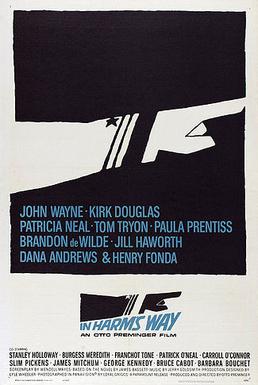
                “In Harm’s Way” is a WWII naval combat film based on the book “Harm’s Way” by James Bassett.  It was directed by Otto Preminger.  He envisioned it as a pro-Navy film and the Navy must have agreed because it gave extensive cooperation including allowing filming at Pearl Harbor.  The Navy also provided ships.  Wayne’s cruiser was played by the U.S.S. St. Paul.  However, the main battle was done with models.  It was the last war epic in black and white and John Wayne’s last black and white film.  He was diagnosed with lung cancer after the picture was finished and was coughing up blood during the shoot.  This did not prevent him from sticking with his six pack a day habit.  The title comes from the John Paul Jones quote:  “I wish to have no connection with any ship that does not sail fast , for I intend to go in harm’s way.”  The movie received an Academy Award nomination for Cinematography.

                The movie covers the period from the attack on Pearl Harbor through early successes in the first year of the war in the Pacific.  Capt. Torrey (Wayne) is on duty off Hawaii when the attack occurs.  His heavy cruiser, called “Old Swayback”, is joined by the destroyer U.S.S. Cassidy, which managed to exit the harbor during the attack.  Old Swayback gets torpedoed and has to be towed back to Pearl.  Torrey’s career is on hold because of this, which allows the soap opera plot to develop without combat interfering.  There are three interlocking arcs.  Torrey courts an age-appropriate nurse named Maggie (Patricia O’Neal).  He is reunited with his son Jere (Brandon DeWilde) who is in PT-boats.  They are estranged because like in most American war movies, Torrey has chosen his career over his family.  Torrey’s exec Eddington (Kirk Douglas) loses his adulterous wife in the attack and he is now a bitter alcoholic, but still trusted by Torrey.  He gets involved with Jere’s fiancĂ©, nurse Annalee (Jill Haworth).  Eventually, Torrey is restored to active duty and oversees the capturing of a Japanese-held island and then a campaign to attack another one.  This culminates in a huge battle with plenty of explosions.

                The soap opera aspects of the plot are reminiscent of “From Here to Eternity” and that was probably purposeful, although it does reflect the book’s plot.  The movie begins with a naval wife having an affair, but in this case, she gets what she deserves.  The movie is classified as a Pearl Harbor movie, but it only uses the attack as a jumping off point.  There is little of the attack in the film.  Heck, the main character is not even at Pearl at the time.  The film could have been the rare look at Navy actions in the first year of the war, but it is only a cursory history lesson and all of the islands are fictional.  The plot interweaves the subplots, but only the Torrey and Eddington characters really get satisfactory coverage.  This is not surprising considering the star power of Wayne and Douglas.  Both are fine in their roles.  Wayne does not stretch and plays Torrey as stoical and imperturbable.  His romance with O’Neal is tepid, but realistic.  Douglas has more fun as the caddish Eddington.  You could see him playing Torrey, but there is no way Wayne could (or would) have played Eddington.  Eddington gets to roller coaster from alcoholic has-been to trusted adviser to rapist to kamikaze redemption.  Whereas, with Torrey, it’s smooth sailing.  There is a shallow subplot involving a scheming politician/officer named Owynn (slimily played by Patrick O’Neal) and his incompetent admiral/mentor, but it is dropped when everyone realizes you don’t get the better of John Wayne. 

                The cast is minor league all-star.  O’Neal is perfectly cast as Maggie.  Tom Tryon plays the destroyer captain and has a few romantic interludes with his wife played by Paula Prentiss.  Although Wayne and Patricia O’Neal got along well with each other (after a rocky time on “Operation Pacific”) and they both liked working with the dictatorial director Preminger, Douglas had to get in Otto’s face and counseled the much-maligned Tryon to do likewise.  Unfortunately, Tryon (who had been tormented during the filming of “The Cardinal”) refused to stand up for himself and it got so bad that he retired from acting.  Henry Fonda warms up for his role in “Midway” by playing CINCPAC.

                All the drama would be worth it if the combat paid off, but it’s all saved for the finale (in a 2:45 movie).  When Torrey and crew get sent to Gavabutu to end the stalemate there, you expect some land combat, but instead it is all about the plan and little about the execution.  The final naval battle probably wowed audiences in the 60’s (before modern war films kicked in), but the models are obvious.  Not a single Japanese soldier or sailor appears in the movie.  Bizarrely, little effort is made to distinguish between the two fleets and you can’t tell who is who.  I have to give it credit for trying to  show the mayhem that can occur in a surface battle in the Pacific.  Considering the odds Torrey faces, the outcome is realistic.

                SPOILER ALERT:  How does it compare to the book?  Right off the bat, the movie gets credit for improving on the title.  After the title card, the script is amazingly similar to the book.  Wendell Mayes did not get very creative other than to consolidate some scenes for time purposes.  Much of his dialogue is from the book, but unfortunately, he does not use enough of it.  This is especially true in the Torrey/Maggie courtship.  O’Neal is let down by Mayes.  Maggie is a fascinating character that is exceptional in this type of film.  She is older and much plainer than cinematic nurses usually are.  Her banter with Torrey is filled with snark.  Their relationship is mature.  The problem is Wayne undoubtedly refused to play a lovestruck and shy divorcee.  The relationship is a highlight of the book, but Wayne had to be Wayne.

                The movie makes some minor changes for the better.  In the book, Torrey goes to meet Jere for the first time in years and oddly, Jere is not cold toward him and is enthused about being in PTs.  The estrangement and coldness of the relationship in the movie makes more sense, but then Mayes has Jere remarking about not wanting to go in harm’s way and enlisting to get a leg up for his future career.  He becomes a toady for Owynn in the movie and then changes on a dime.  The movie follows the book as far as Gavabutu is concerned, which is a shame because Bassett disappointingly has the whole secret, daring plan being anti-climactic because the Japanese were withdrawing anyway.  The final battle in the movie is substantially simplified.  In the book, there are actually two battles since there are two Japanese fleets.  The first is what the movie depicts and it’s fairly close.  However, in the book, Torrey is in the second battle.  This is also where the Yamato is.  This battle includes three baby carriers and their torpedo bombers, but no PT-boats.  The pummeling Torrey’s fleet takes is realistic, but could not be portrayed in a 1960s movie.  The same characters die and in similar ways.  Torrey ends up on the hospital ship with Maggie.

HISTORICAL ACCURACY:  The book was not meant to be accurate.  It does not even claim to be “based on a true story”.  There was a destroyer that escaped from Pearl Harbor during the attack.  But the captain of the USS Alywin did not come as close to getting on board as the USS Cassidy’s.  Old Swayback is based on USS Salt Lake City which was away at the time of the attack as part of the USS Enterprise task force returning from Wake Island.  The force did sortie from Pearl to search for the Japanese fleet and did encounter submarines, but the Salt Lake City was not hit.  Gavabutu is vaguely reminiscent of Guadalcanal.  There were paramarines in the Pacific, but there were no parachute drops.  The final two battles are clearly based on the Battle of Leyte Gulf in 1944.  The first is based on the Battle of Surigao Strait.  This was the battle where an American fleet of old battleships “crossed the T” on a Japanese fleet heading for the invasion fleet off Leyte in the Philippines.  The second is based on the Battle off Samar.  In this case, a powerful Japanese fleet led by the Yamato surprised a ragtag American fleet based on escort carriers.  The carriers’ planes and the destroyers and escort destroyers (there were no cruisers) put up an amazing fight, but took losses similar to the book.  Unbelievably, the Japanese (including the Yamato) did snatch defeat from the jaws of victory and turned away when they had clearly won.

CONCLUSION:  Those who read this blog might recall that I have a belief that movies based on novels should be better than the novel.  In this case, Wendell Mayes had a best-selling novel to adapt.  He could take that foundation and improved on it.  In some ways he did, the Eddington arc makes more sense.  Torrey’s awkward relationship with his son is an improvement.  However, overall the book is better than the movie.  This is particularly true of the romance between Torrey and Maggie.  It is a welcome change from the usual.  The Torrey of the book is no ladies man and in fact, is shy and awkward around women.  He is embarrassingly lovestruck at times.  He’s not John Wayne.  Maggie is even more fascinating.  She’s a feisty old maid.  The banter between them always has her leading.  Patricia O’Neal was shortchanged when most of this dialogue was eliminated.  The movie invents the collusion between Jere and Owynn and that is a misstep.  The main superiority of the novel is the final battle.  Bassett does an outstanding job setting it up and then depicting the pure chaos of modern warships battering each other.  As the book points out, it’s not like you can run away or even surrender.  Once superior warships with bigger guns and longer range zero in on you, you are royally fucked.   A 1965 war movie did not have the ability to recreate that scenario.

                I had enjoyed the movie when I was a kid and then we I rewatched it for this blog a few years ago, I turned full circle and gave it a scathing review.  This recent viewing, paired with reading the novel, has boosted my appreciation of the film.  The book is good and the movie is faithful in screening it.  It’s still not a very good movie, but it is hard to do naval war movies well.

GRADES:  Book  =  B
                                            Movie  =  C 

Tuesday, July 12, 2011

#59 - From Here to Eternity


BACK-STORY: “From Here to Eternity” is a war movie that is set in the weeks prior to the attack on Pearl Harbor. It takes place in Honolulu. It was directed by Fred Zinnemann and was based on the famous novel by James Jones. It was released in 1953 and is black and white. The movie was a huge hit and is still very popular. It won 8 Academy Awards including Best Picture, Director, Cinematography, Editing, Screenplay, Sound, Supporting Actor (Frank Sinatra), and Supporting Actress (Donah Reed). Lancaster and Clift were nominated for Best Actor but their split votes helped William Holden win for “Stalag 17”. Kerr was nominated for Best Actress. Sinatra’s win was the culmination of a campaign by him to get the role. Apparently the myth of Mafia involvement (the basis for a subplot in “The Godfather”) is not true. He got the role through persistence and help from his wife Ava Gardner who was friends with the wife of the studio head. He accepted a salary of only $8,000. The movie was filmed on location at Schofield Barracks.


OPENING: Private Prewitt (Montgomery Clift) is transferred to Schofield Barracks in 1941. He meets Sgt. Warden (Burt Lancaster) who is a hard-ass who runs the regiment for the incompetent Capt. Holmes (Philip Ober). Warden says “He’d strangle on his own spit if he didn’t have me around to swab out his throat for him.” Holmes wants Prewitt to join the regimental boxing team, but Prewitt has given up the sport after blinding a foe.

 SUMMARY: Prewitt is given “the treatment” by the noncoms to get him to reconsider his decision. They are constantly harassing him. Prewitt is befriended by an Italian-American named Maggio (Frank Sinatra). Maggio is like a volatile, alcoholic lapdog. While Prewitt and Maggio are bonding, so are Warden and Holmes’ wife Karen (Deborah Kerr). Karen is a notorious cuckolder, but one frosty hot dish. Warden is warned about her reputation, but still pursues her. Prewitt makes his own love connection with a “hostess” at a “night club” named Lorene (Donna Reed). He is pretty pathetic (“Nobody ever lies about being lonely.”) and obviously needs a shoulder to cry on.


      Warden and Karen openly conduct their affair. Apparently he is willing to chance his career in order to bed his commander’s wife when he clearly could have any single woman he would want (did I mention he’s Burt Lancaster?). Ah, the power of lust. They famously make a trip to the beach for the iconic kissing in the surf scene. Strangely, before the kiss, he confronts her with her past which allows her to excuse her behavior with the “he started it” adultery defense. With the audience reassured, they have 1953 movie sex (which means we see something equivalent to what you see on the Disney Channel today).
hubba, hubba!

     Maggio has made an enemy of a loathsome bully named Sgt. Judson (Ernest Borgnine). They get into a fight where “Fatso” pulls a knife. Warden intervenes to break it up (he threatens Judson with a broken bottle!), but Judson warns Maggio to never find himself in the stockade. Guess who gets himself thrown into the stockade for skipping guard duty to go out drinking? It is implied that Judson brutalizes him.

     Meanwhile the torrid love affair continues. Warden: “I’ve never been so miserable in all my life since I met you and I wouldn’t change a minute of it.” Karen: “Neither would I.” She wants him to try to become an officer, but he hates officers.

      One of the sergeants picks a fight with Prewitt to bring out his inner “Hulk”. The men gather around like a playground altercation. Holmes witnesses the fight and allows it to go on until Prewitt starts kicking ass, I mean punching face. Unfortunately, the base commander witnesses the fight and after some investigating discovers the “treatment” Holmes had applied to Prewitt. Holmes is put up on charges and resigns to avoid court-martial.

     Prewitt and Warden are out on the town drunk when Maggio comes stumbling up having escaped from the stockade and showing clear signs of the abuse by Judson. He dies in Prewitt’s arms. Later, Prewitt uses his bugling skills to play a mournful “Taps” for his buddy. He then seeks out Judson in an alley and kills him in a knife fight. Being wounded, Prewitt takes refuge with Lorene. Things are getting messy. It would be nice if some big event could help resolve all this dysfunctionality. Banzai!
      Dec. 7, 1941 – a date that will live in conflict resolution. The attack is not exactly “Pearl Harbor”. There is some actual footage, but some of it is of American planes. Models of ships are blown up. Warden and others race to a roof top to shoot at the planes (real original Michael Bay!). One of them actually shakes a fist at a Japanese plane. Warden shoots down a Jap using a M-60 like Rambo.

     When Prewitt hears the attack, he must return to serve his country. “Who do they think they’re messing with? They’re taking on the best army in the world.” Unfortunately, he underestimates the jumpiness of a sentry after the most stunning attack in American History. Ironically, the boxing tournament had been cancelled.

CLOSING: It’s a small world. Karen and Lorene are on the same ship going back to the states. They strike up a conversation. It turns out Warden has decided Karen is not worth adding some stripes. It’s probably safe to say the survivors do not live happily ever after.

RATINGS:

Action - 4


Acting – 8


Accuracy – 7


Realism – 6


Plot - 7


Overall - 6

WOULD CHICKS DIG IT? Definitely. Lancaster, Clift, and Sinatra. The torrid romance. The beach scene. Note, you don’t need to spring for the dinner if the chick is over age 60.

ACCURACY: “From Here to Eternity” is based on a novel that is set in pre-Pearl Harbor Hawaii. The attack plays only a tie-loose-ends role in the story. Historical accuracy is not really a factor in analyzing the movie. As a portrayal of Army life it is a bit melodramatic, but fairly realistic. Could the personal dynamics have occurred at Schofield Barracks? Possibly. Was the Army concerned that the book was falsely tarnishing its image or was it upset that Jones was exposing some dirty little secrets?

     Speaking of the book, the Army did insist on some changes to the plot in order to extend its cooperation (e.g. use of Schofield Barracks). First, the movie could not actually show the abuse of Maggio in the stockade and Judson had to be clearly portrayed as an anomaly. Second, Holmes had to resign, instead of be promoted. The Army did not seem to have a problem with the fact that the movie shows there was an incredible amount of drinking in the pre-war army.

     Other differences from the book were done for Hollywood reasons. Maggio is a male hustler in the book. The night club is a brothel and Karen is not simply a “hostess”. And Maggio does not die in the book. Oh, and by the way, Warden and Karen don’t just kiss on the beach in the surf.

CRITIQUE: “From Here to Eternity” is a classic example of how changes in social mores can antiquate a movie. Although I referred to the fact that the technology available in “Pearl Harbor” makes the attack here look quaint, that is not the reason why FHTE does not hold up well. The problem is what was shocking behavior in 1941 is tame by today’s standards. When the movie came out in 1953, audiences were titillated by the depiction of adultery and sex on a beach. If you are shocked by Rhett Butler saying “damn”, then you probably will find FHTE to be naughty. However, if you are younger than age 60, there are a lot of ho-hum moments. Here’s what I mean. Over age 60: “Oh my God, he is kissing a married woman in the surf and she is on top!” Under age 60: “OMG, they are keeping their swimsuits on and is that all?” It’s not just the outdatedly tame situations. The dialogue now seems cheesy. The movie is overly melodramatic.

     The strength of the movie is in the acting. It is uniformly good, although the critics have gone a little overboard on this. Clift is excellent and supposedly intimidated Lancaster with his acting ability. He also mentored Sinatra and helped him create the role of his life. Kerr acted against type effectively although I did not find her steaming hot like some did. Reed also is good, but certainly both women were not Oscar nomination worthy. Speaking of which, it is hard to imagine what was going through the Academy’s mind in doling out eight Oscars and thirteen nominations to this movie.

     The basic themes of the movie are effectively explored. Real men have responsibilities and duties that they are bound to carry out. This explains Prewitt accepting the “treatment” and in fact it looks like he is prepared to box in the tournament after all. He also returns from being AWOL in order to rejoin his unit for the war. Another theme is that military men will choose their unit over their women. Warden lets Karen go not just because there’s a war to be won, but he refuses to win it as an officer.

CONCLUSION: First, “From Here to Eternity” is not really a war movie so it does not belong on the list, in my opinion. The ten minutes of the Pearl Harbor attack do not qualify it. Second, the movie is overrated. I can understand why it created a stir in 1953, but that was more than fifty years ago. They had no rating system back then, but no doubt it would have been rated R. Today it would be PG-13 at the most. Torrid back then is tepid today. As I watched the surf scene I wondered what the big deal was. I am not in favor of remakes usually, but this movie begs for a modern reinterpretation.

ALTERNATE: “In Harm’s Way”


     Watching “From Here to Eternity” reminded me of a similar movie set around Pearl Harbor entitled “In Harm’s Way”. It was directed by Otto Preminger and stars John Wayne. It supposedly was the last WWII epic filmed in black and white and Wayne’s last black and white movie. In some ways it feels like a sequel to FHTE and as with most sequels, it sucks. It begins with the attack which is poorly reenacted. Pearl Harbor and the subsequent counteroffensive is an excuse to stage a melodrama about relationships in the Navy. Unlike FHTE, these relationships seem phony and designed to hit various situations. A. A career sailor (Wayne) is divorced and estranged from his son. He meets an old maid nurse (Patricia Neal) and has a chaste romance. B. A cuckolded friend (Kirk Douglas) becomes an alcoholic because his wife is a slut, but she gets killed in the attack.. C. A faithful sailor husband (Tom Tryon) is wedded to a typical Navy wife (Paula Prentiss). D. The son (Brandon De Wilde of “Shane” fame showing the same acting ability he had in that film) is engaged to a pretty young nurse named AnnaLee.

     Surprisingly, although it was made twelve years later, IHW is more repressed than FHTE. You get double the beach scenes, but quicker fade-outs. One is a rape of AnnaLee which gives Eddington (Douglas) the opportunity to redeem himself on a suicide mission. By the way, guess who gets unestranged from his son?

      The movie is based on a novel in which the author makes up some ridiculous names for fictitious islands that Torrey (Wayne) is in charge of capturing. This leads to a naval battle with a Japanese fleet led by the battleship Yamato. There is finally some action at the end with models and lots of geysers and explosions. The ships are all ghost ships because we never see a single sailor on deck. Son Jere is on a PT boat that charges in and gets rammed. Torrey has to abandon ship, but three weeks later wakes up on a hospital ship where quess who is his nurse? Also, surprise, the battle was won and he is a hero.

     The acting is fair. Wayne is restrained. The score is terrible. It is ridiculously inaccurate historically.
Rating – 4/10


Don't let the kids watch this!