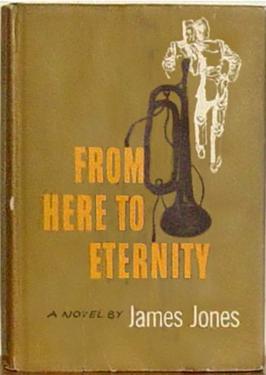
From
Here to Eternity was the debut novel for James Jones. He based it on his experiences with the 27th
Infantry in Hawaii before WWII. He was
in Company E which was called the “Boxing Company”. Jones had enlisted in 1939 at age 17. He was stationed at Schofield Barracks at the
time of the Pearl Harbor attack. Jones
was wounded on Guadalcanal and discharged in 1944. After his first attempt at writing a novel
failed, he hit paydirt with From Here to Eternity. Jones got the title from the Kipling poem
“Gentleman Rankers”. “Gentlemen-rankers
out on a spree / Damned from here to eternity”.
It won the National Book Award in 1951.
The novel was a best-seller and was immediately considered for movie
treatment. However, both Warner Brothers
and 20th Century Fox passed on the novel when the Department of
Defense indicated cooperation was highly unlikely. At this point, Harry Cohn of Columbia
Pictures purchased the rights to the book for $85,000. Studio insiders thought Cohn was nuts,
especially since he purchased the book before even talking to the Pentagon. The project was called “Cohn’s Folly”. He gave Jones a shot at writing the
screenplay, but it was a disaster. Jones
had no idea how to write a script and did not take it seriously. The final product was abysmal, according to
Jones himself. He made changes he
thought would result in the movie getting approval and in the process gutted
his own book. For instance, he changed
the Karen character to being Holmes’ sister!
For a writer who had so many problems with his book publisher, it was an
embarrassing cop-out. Jones had had to
accept deletions of many four-letter words in his novel. He also had to allow
elimination of some homosexual references.
When the novel was reissued in 2011, some of those references were
restored. For example, Maggio mentions performing oral sex for money and the
Army has an investigation of homosexual activities.
The
treatment was assigned to Daniel Taradash.
Taking into consideration objections likely from the Department of
Defense and the Production Code Office, he made logical changes to the
plot. For example, Lorene became a
hostess at a private club. Karen’s
hysterectomy came from a miscarriage.
The scenes in the stockage were cut.
Maggio gets a death scene. He had
judged the Army correctly in assuming it would be open to cooperating with the
movie if it did little damage to the Army’s reputation. Surprisingly, the Army did not insist that
the movie boost enlistment. However, it
did insist that the movie not depict mistreatment of soldiers that no longer
happened. Hence, the removal of scenes
depicting the torture of Maggio. The
Pentagon argued that it did not want recruits and their parents thinking the
Army was still that way. Taradash was
most upset about the requirement that Capt. Holmes not get promoted as in the
book, but it was a small price to pay for the use of Schofield Barracks and
Army planes playing Zeros. The Production Code’s input mainly dealt with
the removal of obscenities and homosexuality.
Taradash handled the bad words
by simply removing them rather than substituting for them. Jones hated the finished product, but later
warmed to it. Ironically, after the Army
gave its approval, the Navy banned
showing of it on ships or at shore facilities because it was deemed “derogatory
to a sister service”. Awww, such love
from a sibling.
Tarradash’s
biggest problem with the screenplay was Cohn’s insistence that the movie not be
longer than two hours. Taradash made the
wise decision to intercut the two romances as the core of the film. He opens with Prewitt being transferred for
the reasons outlined in the book. He
meets Maggio, but Maggio is not an old friend.
The dynamic between Holmes and Warden is retained. However, the relationship between Holmes and
his wife has a different back-story.
They have a son, but then Holmes began to cheat on her and contracted
VD, which he passed on to Karen, hence the hysterectomy. Warden’s courting of Karen is the same as in
the book, but there are more ups and downs.
The novel is clearer about how boxing is so important to the
company. The “treatment” is much more
extensive in the book.
The
movie is more faithful to the Prewitt/Lorene romance than with
Warden/Karen. At the beginning, Prewitt
has a “shack job” with a local girl.
This falls apart and then he meets Lorene at the New Congress Club (it’s
the New Congress Hotel in the book).
This meeting is reenacted in the movie, but the movie obviously cut
scenes where the pair are in bed.
Conversely, the famous beach scene with Warden and Karen was just a kiss
in the book. They did not have sex. Karen tells Warden about her relationship
with her husband in a hotel room, not at the beach. The book fleshes out the friendship of
Prewitt and Maggio. In one memorable
chapter, they go out with two gay men.
On that outing, Maggio gets caught drunk by MP’s and is given six months
in the stockade. In the book, the fight
on the parade ground is between Prewitt and Bloom. It starts when Prewitt saves Bloom’s dog from
being violated! When Bloom tries to
thank him, the fight breaks out. It is
broken up by Lt. Dick. It does not get
Holmes in trouble. Later, Bloom (a
closet homosexual) commits suicide.
Jones has Prewitt joining Maggio in the stockade for beating up Sgt.
Galovich, who attacks him with a knife.
The book spends a lot of time with Maggio and Prewitt in the
stockade. Fatso Judson is the same
Neanderthal, but the other men in the stockade are key characters, too. Even the most recalcitrant prisoners are
positively depicted by Jones. In
particular, their leader is a messianic repeater named Jack Malloy. Maggio decides to end the constant harassment
of Judson by feigning insanity. This
results in more abuse, but eventually he is given a Section 8 and sent back to
the States. He does not die as in the
movie. It’s another prisoner who is
beaten to death by Judson. Prewitt vows
vengeance and that is why he ambushes Judson in a fight similar to the
movie’s. While Prewitt is incarcerated,
Warden and Holmes have settled into their affair. They meet almost daily. In the book, Warden comes off as less mature
than Karen and guided mainly by his prick.
As in the movie, she wants him to apply to become an officer, but he is
reluctant. The Japanese attack is
replicated in the movie with some minor exceptions like shooting down an
American plane as well as a Japanese plane.
Prewitt’s death is basically the same.
It come after a long passage that has him staying with Lorene and
Georgette. He is drunk most of the time,
but Lorene puts up with him. When he
goes back to the company, he is in uniform.
He is stopped by four men in a jeep.
He runs and will probably get away when he stops and gets shot on the
golf course. (This happens ¾ of the way
into the book.) The rest of the book
deals with ending the Warden/Karen relationship.
The
novel made quite a stir because of its language and sexuality. These seem tame today, but it’s the writing
that has stood the test of time. Jones
has a style that makes you want to read on, even if the story does drag in
spots and is much too long. I have not
read his other novels, like The Thin Red Line, so I do not know if his
playing with diction was common in his books.
In From Here to Eternity he uses words like dint, compny, and cant. Apparently, he had a quota on
apostrophes. Some of the passages read
like stream of consciousness. The
biggest advantage the book has over the movie is you get inside the characters’
heads. The movie actually does a good
job in its short time in making clear the motivations of the main characters. Jones shines a light on the pre-war army that
the movie is not really interested in.
The main takeaway as I read the book was “how the Hell did we win the
war with this crew?” The country of
America was ill-prepared, but so were its warriors. Jones spends a lot of time discussing the
drinking and gambling that were common at Schofield. These activities dominated the soldiers’
lives. The pay was very low, but so was
the price of beer and whores. You get the
impression we confronted the Japanese with an army of poor, alcoholics. More stunning, I would imagine the readers in
1951 would have been unprepared for the homosexual activities of these alpha
males. I know I was surprised, even though I had seen the movie. It barely hints at this theme. It’s
safe to say that a future remake will cover these parts of the book.


