Showing posts with label Indian Wars. Show all posts

Monday, September 30, 2024

THE 100 BEST WAR MOVIES: #37. Son of the Morning Star (1991)

                        “Son of the Morning Star” was an epic made-for-TV miniseries (actually a two-part movie) about George Armstrong Custer and the Battle of Little Bighorn.  It aired on CBS in two parts.  It was based on Evan S. Connell’s bestseller.  Part of it was filmed on private property near Little Bighorn National Monument.  A fort was built for $200,000.  400 horses and 150 Native Americans were used. 100 re-enactors participated and served as technical advisers.  CBS considered Kevin Costner to play Custer, but decided that he was not a big enough name at the time.  Ironically, “Dances With Wolves” came out a few months ahead of it.  The movie got low ratings, but won Emmys for Sound Editing, Sound Mixing, Make-up, and Costumes.

                        Spoiler alert:  Custer (Gary Cole) dies in the end.  The movie recognizes that anyone with half an education knows that already and starts (as does Connell’s book) with the aftermath of the defeat.  Capt. Benteen (David Strathairn) sets the theme by stating that “mistakes were made”.  The movie then flashes back to Kansas ten years before the Battle of Little Bighorn.  It is linear from here (unlike the book).  Although it is basically a biopic of Custer, there is an arc for Crazy Horse.  The Custer arc is narrated by Custer’s wife Elizabeth (Patricia Arquette) and Crazy Horse’s is by a Cheyenne named Kate Bighead (narration by Buffy Sainte Marie, role by Kimberly Guerrero). The two women offer the white and Indian perspectives.  The movie hits the high marks of both men’s careers.  Although the movie is based on Connell’s book, it is closer to Stephen Ambrose’s “Crazy Horse and Custer”. 

ACTING:   A                 

ACTION:    A  (7/10)

ACCURACY:  A+           

PLOT:  A                         

REALISM:   A         

CINEMATOGRAPHY:    B

SCORE:   A               


SCENE:  the death of Custer

QUOTE:   Custer:  Give me a civilized war!  An enemy I can find and beat!  An enemy that fights by the rules!”

                        “Son of the Morning Star” is by far the best of the many Custer movies.  It is the opposite of “They Died With Their Boots On”.   The history of the cinematic Custer is one that starts with adulation of Custer as a hero killed by savages (e.g., “They Died…”) to Custer as a villainous poster boy for the mistreatment of Native Americans (e.g., “Little Big Man”).  This movie does not shift the pendulum back, but is more even-handed than recent depictions.  The narration offers a debate between the two views of the man.  Elizabeth Bacon Custer’s is laudatory (which reflects her great literary effort to create his public image after his death) and is in line with movies like “They Died…”  Kate’s is the Native American view and reflects movies like “Dances With Wolves”.  For instance, Kate mentions the unverified claim that Custer had an affair with a Cheyenne woman.  That said, it was probably true.  The movie is amazingly accurate, especially when you compare it to the others.

                        The movie is clearly made-for-TV, but the production values are a bit above the average.  The costumes are excellent and the reenactors and Native Americans brought verisimilitude to their roles.  This reminds me of “Gettysburg” which is a similar movie dealing with a famous battle.  Interestingly, there is a connection between the two.  When “Son” tanked, CBS gave up on its “The Killer Angels” project and Ted Turner picked it up.  The cast here does not match “Gettysburg”.  Gary Cole was criticized for his portrayal of Custer, but I found his megalomaniacal Custer to be realistic.  Custer himself was a bad actor who had delusions of grandeur.  Roseanne Arquette could also be faulted for a weak performance, but Elizabeth was his publicist and worshipped him.  The romance is creepy, as it was in reality.  They clearly were in love and had a partnership which both hoped would end up in the White House.  The supporting cast is TV stock.  David Strathairn was coming off “Memphis Belle” and is excellent as Benteen.  The movie gets the Custer – Benteen dynamic right.  Rodney Grant was in “Dances With Wolves” and does a good Crazy Horse, although given the laconic, mystical nature of the man, it did not require much emoting.

                        The movie flows well as each scene is not allowed to linger.  This is partly due to simplified takes on famous incidents like the Fetterman Massacre.  The movie does an admirable job interjecting the political machinations into the narrative.  The true villains of the movie are Sheridan (Dean Stockwell) and Sherman (George Dickerson) as they manipulate the reluctant Pres. Grant (Stanley Anderson).  These political scenes also allow the movie to show the bipolar nature of Custer as he steps on Grant’s toes by criticizing his Indian policy.  The use of narration to introduce the episodes works well.  It is balanced between the two women and the two viewpoints.  A key moment in the movie is when Elizabeth claims 158 warriors were killed in the Battle of the Washita and Kate admits to 11.  The movie makes it clear that most of the Indian deaths were women and children and Custer was far from holding his men back.  It is reminiscent of the scene in “Little Big Man”.    Most of the combat is saved for an extended recreation of the Battle of Little Bighorn and it is worth the wait.  No movie has better covered the battle.  It is excellent at depicting the chaos of the last stand and although it has to pull its punches, the gore is implied efficiently.  The cinematography is good with some well-positioned slo-mo.  It features some excellent stunt work on horseback.  You will definitely be rooting for the Indians by this point and will be able to list the numerous mistakes that were made.  The movie makes it clear that Custer was a charismatic leader, but not a good tactician.  There is no question that Crazy Horse is the hero of the movie and Custer is the villain.  Most historians would agree with that.

                        I do not normally consider Westerns to be war movies.  This is one of the rare ones that I put in the war movie genre, because it is the story of a battle.  I am very familiar with the subject as I have read extensively on the Plains Indians, Custer, and the Battle of Little Bighorn.  This movie is as good as you can expect from a made-for-TV production, especially if you want accuracy.  Not only does it recreate many of the seminal moments in Custer and Crazy Horse’s careers, but there are numerous direct quotes filtered in.  It even throws in details that only fanatics like me would recognize, like the regimental flag ominously falling down the night before the battle.

                        The Battle of Little Big Horn has been the subject of many books and a few movies.  Most of the books have tried to offer an explanation for what happened and most of the movies have filmed the legend of Custer’s Last Stand.  This is the first movie to try to be an accurate biopic.  Custer is a fascinating figure and fits well into the modern style of biopics that were inaugurated with “Patton”.  In othe words, we get Custer, warts and all.  And it’s mostly warts.  What makes the film special is not only the accurate depiction of Custer, but the inclusion of a much better role model in Crazy Horse.  “Son of the Morning Star” is an acclaimed (and highly overrated book), but the movie is better and a better history lesson for those not familiar with this very famous battle.  It’s also a great antidote to the ridiculous movies that came before it.  Hopefully, the 21st Century will be marked by this movie’s interpretation of Custer, instead of “They Died With Their Boots On.”

Sunday, January 20, 2019

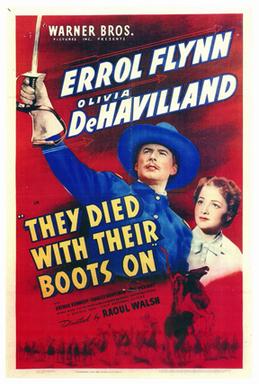
CONSENSUS #87 - They Died With Their Boots On (1941)


SYNOPSIS: "They Died With Their Boots On" is the story of George Custer (Flynn) and his wife Elizabeth (de Havilland). It covers their relationship from Custer's appearance at West Point to his death. The movie is part romance, part biopic, and part Western. The climax is the Battle of Little Big Horn.

BACK-STORY: They Died With Their Boots On is an old school war movie from 1941. It was directed by Raoul Walsh (“Objective Burma!”) and was the eighth and last screen pairing of Errol Flynn and Olivia de Havilland. It was a huge box office hit.

TRIVIA:  Wikipedia, imdb, TCM

1.  Three died during the filming. One fell from his horse and broke his neck.  A stuntman died of a heart attack.  Actor Jack Budlong was thrown from his horse as he rode alongside Errol Flynn and was impaled by his sword.
2.  Only sixteen Sioux were available as extras and were used for the closeups.  The rest of the more than 1,000 extras were Filipinos.
3.  Jim Thorpe was an extra and he got into a fight with Flynn during a break.  Thorpe knocked him down with one punch while Flynn was in uniform.
4.  Louis Zamperini of “Unbroken” fame, was also an extra.
5.  Flynn collapsed from exhaustion during the shoot.
6.  One of the most historically inaccurate war movies ever made.

Belle and Blade  =  N/A
Brassey’s              =  5.0
Video Hound       =  3.1
War Movies         =  N/A
Military History  =  #68
Channel 4             =  not on list
Film Site                =  yes
101 War Movies  =  no

OPINION:  “They Died” is more of a Western than a war movie.  It is a classic and was a big hit, but when you compare it to modern war movies like “Son of the Morning Star”, it is an antique.  The ludicrous historical inaccuracies make the movie hard for history buffs to watch.  And, given the power of movies in the 1940s, it created a misshapen portrait of Custer.  It is on a par with “Braveheart” in accuracy, but at least William Wallace was a legitimate hero.  I strongly disagree with it being in the top 100.


Wednesday, December 19, 2018

CONSENSUS 92. Ulzana’s Raid (1972)


SYNOPSIS: In the 1880's in the American West, a group of Apache Indians led by a Geronimo-type of leader named Ulzana escape from their reservation and start raiding, which includes murdering and torturing.  A cavalry unit under a green lieutenant (Bruce Davison) is sent to track them down. The cavalry is led by a seasoned scout named MacIntosh (Burt Lancaster) and an Apache Indian tracker who has sided with the whites. It is a cat and mouse game from here. 

BACK-STORY: Ulzanas Raid is a revisionist Western by Robert Aldrich (“The Dirty Dozen”) which was released in 1972 toward the end of the Vietnam War. It was filmed on location in Arizona and Nevada. It is loosely based on a true story.  Ulzana was an Apache who went on a raid in Arizona in 1885.  The movie has been described as an allegory about the Vietnam War.

TRIVIA:  Wikipedia, imdb

1.  Screenwriter Alan Sharp was inspired by “The Searchers”.  He felt that three of the worst historic locales were Nazi Germany, Turkey during WWI, and the American Southwest during the Indian Wars.
2.  Since Burt Lancaster was one of the producers, he got to edit his own version of the film.  His version was similar to Aldrich’s, however.
3.  The production cost only $1.2 million and took only seven weeks of filming.

Belle and Blade  =  N/A
Brassey’s              =  3
Video Hound       =  N/A
War Movies         =  N/A
Military History  =  54
Channel 4             =  not on list
Film Site                =  yes
101 War Movies  =  no


OPINION:  I understand why some consider it to be a war movie, but in my opinion it is clearly in the Western genre.  With that said, I do not think it is even a great Western.  I believe it gets more love than it deserves from critics because they like the criticism of the Vietnam War.  If Aldrich meant to comment on America’s role in the Vietnam War, he missed the mark because Ulzana and his Indians are not sympathetic characters.  It seems more likely that Aldrich was trying to make a revisionist Western and in this respect he was successful, but the 1970s were full of revisionist Westerns and this is not one of the better ones.

Saturday, April 20, 2013

DUELING MOVIES: Buffalo Soldiers (1997) vs. Rough Riders (1997)


vs.


                 TNT produced two movies bringing recognition to legendary cavalry regiments of the late Nineteenth Century.  It seemed logical to compare them especially since the two units fought alongside each other in the Spanish-American War.  “Buffalo Soldiers” is a fictional story about the Tenth Cavalry in the West participating in Victorio’s War.  “Rough Riders” tells the tale of the formation of Teddy Roosevelt’s volunteer cavalry regiment through its Charge Up San Juan Hill. 

                “Buffalo Soldiers” appeared on TV in 1997.  It is set in the New Mexico Territory in 1880.  Apache Indian leader Victorio has broken out of the Mescalero Apache Reservation and is ravaging the countryside.  The Buffalo Soldiers are represented by Company H, Tenth Cavalry stationed at Fort Craig.  They are led by Sgt. Wyatt (Danny Glover).  Their nobleness is established in the first scene as they rescue some Indians who are being hanged by Texas Rangers to get them to reveal the location of Victorio.  Theme:  whites racist, blacks mistreated, Indians misunderstood.  When the unit returns to Fort Craig they are confronted with the newly arrived all-white Second Cavalry  with its racist commander and the new post commander Gen. Pike (Tom Bower) who is openly hostile to the black soldier “experiment”. 


                Both units are sent out to track Victorio.  The units separate and the Buffalo Soldiers are lured by some decoys into an ambush.  They get spanked, but luckily capture Nana (another renegade leader who was hoping to hook up with Victorio).  However, Wyatt is blamed by Pike for abandoning the Second.  In case you don’t realize what a jerk he is, he murders a captive during the night because his singing is keeping him awake!

                Col. Benjamin Grierson (Bob Gunton) leads another tracking expedition, but is wounded by a sniper and command falls to Wyatt.  Redemption time?  Or corruption time?  Wyatt seems to be going over to the dark side (or the Texas Ranger side) as he threatens to kill an Indian woman warrior to get Nana to talk.  They ride into another ambush so a main character named Christy (Mykelti Williamson) can get killed.

                Wyatt sets up an ambush at a watering hole and Victorio’s band walks right into the trap.  It’s a Mexican standoff with both sides fingering their triggers.  Will the Buffalo Soldiers do their duty as members of the U.S. Army or will they side with the similarly mistreated  Indians?

                Historically speaking, “Buffalo Soldiers” is a farce.  It is fiction if you bother to check, but any casual viewer would get the impression that it is based on actual events.  Very loosely based.  There is no background given as to the history of the Buffalo Soldiers.  This is no “Tuskegee Airmen” (an obvious comparison).  We do not find out that the Ninth and Tenth Cavalry were established after the Civil War.  They were stationed in the West and earned their nickname from the Native Americans.  Sadly, their duties were more of the scouting, protecting railroad workers and mail carriers, and building roads variety, instead Indian fighting.

                As far as the movie events are concerned, Victorio broke out of the San Carlos Reservation in Arizona in 1879 and launched Victorio’s War.  They were provoked by disease, lack of supplies, and general mistreatment.  They did attack settlers.  They ambushed a company of the Ninth Cavalry in Las Animas Canyon using the classic decoy tactic.  Later, Grierson led the Tenth in a campaign to track down the Apaches.  His strategy involved staking out watering holes.  This forced Victorio to escape into Mexico where his band was surrounded and wiped out by Mexican soldiers.


                “Rough Riders” was a two part miniseries that appeared on TNT in 1997.  It covers the entire history of the First US Volunteer Cavalry.  It also gives an overview of the Spanish-American War, specifically the Cuban part.  The movie introduces us to numerous real and fictional characters.  It hits the greatest hits of the war:  Hearst telling Remington to provide the pictures and he’ll provide the war, TR sending Dewey to the Philippines, the Spanish use of smokeless powder, Teddy’s multiple glasses, etc.  It concludes with an extended reenactment of the Battle of San Juan Hill.


                The movie opens with pictures, newspapers, and political cartoons to get us into the war.  Teddy creates the Rough Riders and a motley crew of outlaws, Ivy Leaguers, ranchers, Indians, etc. gather at the encampment.  A famous sheriff named Bucky O’Neill (Sam Elliott) becomes the stereotypical drill sergeant.  There is more than a training montage.  Eventually they entrain to the singing of “Garry Owen” and pass by waving crowds that include forgiving Confederate veterans.  In Tampa, Teddy wins a race to get on ships first by commandeering a train and mooning the infantry as they race by.

                In Cuba, the unit walks into an ambush in the woods when Gen. Wheeler (Gary Busey) pushes the regiment ahead against orders.  The first main character dies.  An ex-outlaw named Nash (Brad Johnson) runs away and stumbles into a Spanish flank.  The unit has followed him so he ends up the reluctant, wounded hero.  This is supposed to be the Battle of Las Guasimas.  The rest of the film concentrates on the Battle of San Juan Hill.  There is an artillery bombardment.  Nash returns from the hospital to seek cinematic redemption.  Teddy leads the charge up Kettle Hill and kills a couple of Spaniards.  After taking the hill, they move on to San Juan Hill and mingle with the Buffalo Soldiers.  Teddy shoots two more.  Nash is brave.  We win.  The survivors return home.

                As far as historical accuracy, the movie is above average.  The creation of the unit and the roles of Teddy Roosevelt and Leonard Wood are accurate.  The Battle of Las Guasimas is vaguely close.  Wheeler did disobey orders and the Rough Riders walked into an ambush.  However, the Spaniards were firing volleys instead of from in and behind trees.  In the movie, the Americans blunder into the Spanish flank and force them to retreat.  In reality, the Spanish inexplicably withdrew in spite of having the Rough Riders in a bind.  The movie plays down the incompetence common in first battles in American wars.


                The Battle of San Juan Hill is problematical.  It starts accurate and ends laughable.  The movie accurately depicts the terrain and the pre-charge bombardment that provoked the charge.  Teddy did start out on his horse “Little Texas”.  The capture of Kettle Hill was close to as depicted.  Teddy did go off toward San Juan Hill with just a few men because of miscommunication.  From this point on, the movie descends into bull shit.  In actuality, the Rough Riders did move on to San Juan Hill but by the time they arrived the fighting was over.  The mingling with the Buffalo Soldiers occurred during the charge up Kettle Hill.  The movie does not have any Buffalo Soldiers doing that.  As far as Teddy’s personal actions, Bill Clinton must have based his push for awarding Teddy the Medal of Honor after he saw this movie.  In his autobiography, Teddy (not known for modesty) claimed he shot a running Spaniard “like a jack rabbit”.  In the movie, I counted him shooting at least four of the enemy.  That's Hollywood for you - take the facts and make them four times more exciting. 


                The fun part of “Rough Riders” is the intermingling of real historical persons with the fictional.  Surprisingly, the real figures are accurately portrayed.  Bucky O’Neill and Hamilton Fish died basically as depicted.  O’Neill did say the last words that are put in his mouth.  Frederic Remington and Stephen Crane were spectators as shown.  Wheeler was the loose cannon loony as played by his equivalent Gary Busey.  Tom Berenger gets Teddy’s personality down.  Some will be surprised by his zest for warfare and his boyish mentality, but it fits what I have read about him.

                Both the movies are admirable attempts to bring recognition to famous units.  “Buffalo Soldiers” has the additional aim of making a statement about racism both toward African-Americans and Native Americans.  It is done in a heavy-handed way with hissable villains and cringe-worthy preachy dialogue.  The acting is average and thank goodness for Glover anchoring the film.  The rest of the cast includes some scene-chewers (especially Bowers).  The scenery is excellent.  The music is a blend of made-for-TV forgettableness and some period songs.  The action is average as expected for a movie of this type.  The scenarios are ridiculous and the evolution of Wyatt’s character is hard to believe.  The movie ends with you scratching your head about the motivation of the Buffalo Soldiers.


                “Rough Riders” is well-acted, but also has some scene-chewing.  I’m tempted to mention Busey, but he was playing a scene-chewer.  The dialogue is a bit florid, especially from the mouth of Stephen Crane.  There are the expected cliches.  The redemption of Nash, the gruff leadership of O’Neill.  Westerners and easterners learning to become a team.  The music score is a cut above due to it being composed by Elmer Bernstein’s son Peter.  The sound effects are well done during the battle scenes.  There is some welcome old school humor of which “Buffalo Soldiers” is totally bereft.  Neither movie has anything special in the cinematography department.  The action is more intense and realistic than in “Buffalo Soldiers”, but neither is bloody or graphic.  There is quite a bit of hand-to-hand combat that is well staged.  It is a much better history lesson than “Buffalo Soldiers”.

                Which movie is better?  Clearly, “Rough Riders”.   It could not have been much better considering the made-for-TV nature of it.  “Buffalo Soldiers” could have been a lot better.  I’m no big fan of “Tuskegee Airmen”, but it did a better job lauding its unit.

Buffalo Soldiers  =  C-

Rough Riders      =  B+          

P.S.  I have often shown the charge up Kettle Hill from “Rough Riders” to my American History class because it is entertaining, action-packed, and acceptably accurate.  It also offers an excellent example of how Hollywood plays with history.  I have the students count Teddy’s kills and then I tell them the truth.

Sunday, July 29, 2012

BOOK / MOVIE: Arrow in the Sun / Soldier Blue


                 The Western novel “Arrow in the Sun” by Theodore Olsen became the basis for the screenplay of a revisionist Western entitled “Soldier Blue”.  The movie was directed by Ralph Nelson and released in 1970.  The movie is a classic example of taking a book and then veering off the plot into totally new territory.  Or in this case, taking a book with one theme and turning it into a movie with a totally different theme.
                “Arrow in the Sun” is a revisionist tale in that its heroine is far from the typical Western female.  Cresta Lee has been held by the Cheyenne Indians for two years before escaping.  She is being transported to Fort Reunion to be reunited with her fiancé, a cavalry officer.  She is part of a paymaster convoy that gets ambushed by warriors led by her “husband” Spotted Wolf.  She escapes and is joined by the only soldier survivor – Private Honus Gant.  While Honus is a typical Victorian Age male, Cresta is decidedly not a typical female.  She accepted captivity without either going insane, rebelling, or going native.  She did what she had to do to keep Spotted Wolf happy - you can figure that out for yourself.  She plotted for two years to get away.  That’s not the only plotting.  Her engagement to Capt. John McNair is not for love, it’s for money and status.  But that’s not the most feminist thing about her.  She speaks her mind and not in ladylike language.  She is obnoxious and abrasive.  And very sexy in a feral way.
                The arc of the Honus/Cresta relationship breaks no new ground, but Cresta does not go mushy quickly.  The first half of the book reads like a buddy story.  They are trekking through the wilderness to try to reach Fort Reunion when they encounter an old coot named Cumber who they discover is an arms dealer who is going to trade Winchesters for the paychest Spotted Wolf took in the ambush.  In the process of escaping Cumber, Honus is wounded and they end up hiding in a cave.  Cresta reluctantly nurses Honus back to health.  Reluctantly because she is a survivor and he is cramping her style.  Sparks begin to fly, naturally.
                Honus insists Cresta continue on to the fort to report Cumber’s activities.  She runs into a cavalry patrol which includes her fiancé, who surprisingly is not the jerk you assume he will be.  In fact, he is the only fiancé/husband I have ever encountered in this type of story who is willing to overlook his girl’s sexual history with Native Americans.  He’s even willing to accept that she was marrying him for nonromantic reasons.  What’s not to like about this guy?
                The novel lurches back into predictability as Cresta is recaptured by Spotted Wolf and rescued by Honus.  In between the Indians ambush McNair’s unit and surround them on a hill.  Cumber arrives to aid his customers and things look bleak.  We get the only appearance of Coehorn mortars that I have ever encountered in a Western.  Which of her suitors will Cresta choose?
                The movie starts out as a standard retelling of the novel.  The opening ambush is essentially the same with only minor differences.  Cresta (Candice Bergen) has saltier language (the first thing we hear from her is “Don’t just stand there, get your ass up here.”), but is not as prickly and domineering as in the novel.  Honus (Peter Strauss) is the same stick in the mud as in the book.  The movie begins to veer away from the book with its theme of mistreatment of Native Americans.  Cresta represents the “it’s their land and whites commit atrocities, too” school.  She wants the Indians to get the Winchesters.  Honus is your patriotic supporter of Indian policies.  He goes so far as to call Cresta a traitor.
                After a faithful rendering of the Cumber affair and the cave incident, the movie loses all contact with the book because director Ralph Nelson has some messaging to do.  Cresta goes off and runs into a much larger unit than in the book.  McNair is more of a horny milquetoast.  The unit is led by a John Chivington-like “the only good Indian is a dead Indian” type who is on a  mission to destroy Spotted Wolf’s camp.  Cresta escapes to warn the Cheyenne and they and Spotted Wolf welcome her back with open arms (unlike in the book where she is bound and threatened).  Bizarrely, Spotted Wolf insists on maintaining the peace (that he broke by massacring the paymaster detail).  He rides out with an American flag (soon to be trampled by the whites, get it?) and white flag, but Colonel Iverson (John Anderson) opens fire with cannons, defeats the Indians in dueling cavalry charges (the type of thing that never happened in the West), and assaults the village.  This scenario is almost completely opposite of what happens in the book because the good guys and bad guys are reversed.  The resulting cinematic massacre is rife with atrocities that were hard core for a 1970s movie.  (The movie was billed as “The Most Savage Film in History”.)  There are rapes (full frontal female nudity), beheadings, dismemberments, etc.
                The movie is interesting in its defiance of conventions.  It turns Westerns on their head by having the cavalry ride to the atrocity instead of to the rescue.  (In this respect it is similar to another 1970 film – “Little Big Man”.)  These troopers revel in their bestiality in a cartoonish way, but their behavior and actions are probably not that far from the Sand Creek Massacre that the movie admits to reenacting.  Informing the public about that “foulest crime in the annals of America” is commendable and basically accurate ( exceptions being there was no cannon fire and the Indians did not charge the cavalry).  Nelson throws in a “women and children in the ravine” segment that may or may not hearken to the My Lai Massacre.  The Cresta character is also revisionist and is actually less accurate than the depiction of the Sand Creek Massacre.  I doubt there was a single female in the Old West that she represents.  In this case, we have a character that is anachronistic.  Speaking of which, the Indians are like hippies.  This is emphasized by the ridiculous opening song by Buffy Sainte-Marie.  At least you know where the movie is coming from before the credits are done.
                My avowed theory is that most movies based on books are improvements over the book because competent screenwriters and directors should be able to improve on the story.  It is hard to judge these two because the movie decides to go off on a tangent to deliver a different message than the book.  I found the characters and dialogue in “Arrow in the Sun” to be superior to the movie.  The movie’s decision to make the final act historical is a plus as far as I’m concerned.  The movie also is more revisionist than the book.  The only thing unorthodox about the novel is the Cresta character (and I suppose I’d have to say McNair is a surprise).  The love triangle is much more intriguing than in the movie.
As far as which is superior, I’m going to go with “Soldier Blue” because it is an important departure from the Western genre.  Having read a lot on the Indian Wars, I can empathize with an attempt to show the other side of the coin.
RATINGS -  Arrow in the Sun =  C
                       Soldier Blue =  B   
the trailer


TRAILER -  The trailer does preview the buddy/romance nature of the film.  Cresta's personality comesout clearly.  The revisionist nature of the film is hinted at.  There is little preview of the second half which involves the assault on the village.  There is some allusion to the atrocities, but no context.  You also get a mercifully short taste of the theme song. 
grade =  B


                    the massacre scene