Showing posts with label Irish Republican Army. Show all posts

Wednesday, September 4, 2024

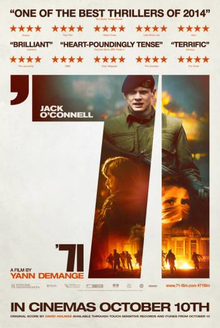
THE 100 BEST WAR MOVIES #41. ’71 (2014)


                “’71” is a British war film directed by Yann Demange.  It was his debut and he was awarded the British Independent Film Award for Best Director.  It is a fictional story set in “The Troubles” in Northern Ireland.  The movie did well in Great Britain but barely registered in the U.S. despite amazing reviews (97% on Rotten Tomatoes).   

                “’71” begins with a training montage.  This includes a type of boxing called “milling” which is trading punches to prove toughness and bravery. This is a good metaphor for the dynamics in Northern Ireland.  If you know anything about geopolitics from that time, you know the men are being trained to face the Soviets in a conventional war.  They are not being prepared for counterinsurgency in Northern Ireland.  And yet, they are suddenly deployed to Belfast because of the deteriorating situation there.  The city is divided (like the current Baghdad with its Shiite and Sunni enclaves) between Protestant and Catholic forces.  Both have paramilitary units. To make matters more confusing still, the Protestant rebels are divided between the more cautious old school and the more militant new breed. 

                The main character is a Private Hook (Jack O’Connell).  His only family is a younger brother in a state home.  His unit is tasked with supporting a police unit (the Royal Ulster Constabulary) which is going to arrest a suspected terrorist.  The men are told not to bother with riot gear (shades of “Black Hawk Down”).  They begin to ponder the wisdom of this when they pass a burning double-decker and are hit by piss bombs hurled by Catholic youths.  At the arrest site, women are banging trash can lids to alert the neighborhood.  A mob gathers and they are not welcoming.  Hook gets separated from his unit and is left behind.  A wild chase ensues through the houses and alley ways of the neighborhood.  He manages to escape, but is now the target of a manhunt by the Provisional IRA.  The night becomes something of an odyssey as Hook encounters the dysfunctional players in “The Troubles”.  It is a complicated situation and he is just a grunt thrust into it.  The Provisional IRA is led by Quinn (Killian Scott) and they are at odds with the old breed led by Boyle (David Wilmot).  Muddying the waters is the British Military Reconnaissance Force led by Capt. Browning (Sean Harris).  Browning and his unit are playing both sides of the IRA to keep them at each other’s throats.  Browning wants Hook dead because he witnessed the result of one of their plots.  It is cat vs. cat vs. cat hunting a mouse.

ACTING:   A                 

ACTION:   A  (8/10                    

ACCURACY:  N/A             

PLOT:  A                         

REALISM:   B                

CINEMATOGRAPHY:    A+

SCORE:   B                 

SCENE:  the foot chase

QUOTE:  Eomani:  “[The army] – Post cunts telling thick cunts to kill poor counts.”

                I have seen most of the war movies that have had major releases in theaters since I started this blog and “’71” is one of the best.  (I would put it behind only “Zero Dark Thirty” and “Lone Survivor.”  It is war movie as thriller.  In fact, Demange was influenced by movies like “Apocalypto”, “Escape from New York”, and “Warriors”.  But the main inspiration must have been Homer’s “Odyssey” with the interiors serving as the islands and the streets representing the seas.  For a debut effort, Demange shows real promise.  The only weakness is some plot holes typical for advancing a thriller plot.  In spite of following the thriller template, the movie is unpredictable.  The cinematography is mesmerizing, especially in the chase scene.  Another stand out scene is the pub explosion which is awesome and memorable.  Tad Radcliffe’s cinematography puts us in the middle of the mob, for instance.  The music matches the mood and does a great job revving up the action.

                The acting is top notch, especially by O’Connell.  He is better here than in “Unbroken”.  He plays Hook as a pawn caught in the fog of civil war.  The rest of the cast is up to playing the fascinating characters.  Browning is as slimy a villain as you will see.  The most intriguing is a young boy (Corey McKinley) who is a Loyalist and already caught up in the turmoil despite his age.  He befriends Hook and becomes a casualty of the world the adults have made for his generation.  (Suggestion:  Put on the English subtitles if you want to understand what he is saying.)  Another youth has been wooed by the Nationalists.  Sean (Barry Keoghan) wants to become a Provisional IRA gunman.  He represents the struggle of conscience versus corruption and the role of peer pressure in war.

                Although a fictional tale, the movie is nicely tutorial on “The Troubles”.  This period of heightened tensions and bloodshed between the British and Irish nationalists began in 1969.  It started with the RUC attacking Catholic civilians which caused a reaction that led to the deployment of British troops.  Belfast also was roiled by conflict between the Catholic Nationalists and the Protestant Loyalists.  It got to the point where the city was divided into enclaves.  The Catholic enclaves were designated “no-go zones” by the British Army.  Within those same enclaves there was a dispute between the official IRA which had decided that non-violent civil agitation was the best route to independence and the younger Provisional IRA that wanted to use terrorist tactics.  In 1971, the loyalists of the Ulster Volunteer Force blew up a nationalist pub, probably with the help of the MRF.  The original target was supposed to be a nearby pub linked to the official IRA and then they would blame it on the Provisional IRA to fuel the feud.  Security forces claimed it was an IRA bomb that accidentally exploded in their own pub.  This incident seems to have inspired the plot.  The Hook character was based on two British soldiers who were killed on patrol.

                 “’71” is a must see for war movie lovers.  It is the kind of movie you gush to your male friends about.  It is kick-ass entertainment, but it is not mindless and it is not aimed at the action film audience.  Its theme that all men are part of a tribe is unusual, but ably advanced.  A more common theme is soldiers are the pawns of power. You are put in the boots of Hook and it is a roller coaster ride.  In 1971, it would have been hard to imagine the current peacefulness in Northern Ireland. It’s great that the movie is now a history lesson, rather than an explanation for why things are.

Saturday, August 8, 2015

5th ANNIVERSARY: ’71 (2014)


       It has been five years since I started this blog and it has been an amazing journey.  It started out as a simple attempt to watch and review the 100 Greatest War Movies (as determined by Military History magazine) and has grown into a big part of my life.  I have been able to wed three fun activities: watching war movies, researching, and writing.  Early on I realized that reviewing the one hundred movies was too limited, so I branched out and created several categories of reviews.  I have even written about war novels and short stories.  I have been pleasantly surprised by how many war movies there are and can see reaching my tenth anniversary without having watched all the ones I want to.  Plus there are always new ones coming out.  This leads me to today’s anniversary post.
 
                One of my favorite things to do is to go to a theater and watch a war movie while playing the role of a movie critic.  Unfortunately, this does not happen very often with war movies.  (But more often than Westerns, at least.)  When a new war film debuts, I always check out the listings.  Sometimes New Iberia is not the best place to be living if you want to see new war movies.  Recently I read some outstanding reviews for a movie entitled “’71”.  I do not think it appeared anywhere in Louisiana and I had given up on seeing it in a theater.  However, on a trip to Austin to visit my sister I found a theater that specializes in independent films.  It was showing it!  (By the way, I had to go to Austin to see “The Hurt Locker” when it came out.)  Unfortunately, I lost my notes which means I did not post it as part of my “Now Showing” series.  I recently watched the DVD and decided it was a good choice for the 5th Anniversary because that post needs to be special.  “’71” is special because it shows that the war movie genre is alive and well.

                “’71” is a British war film directed by Yann Demange.  It was his debut and he was awarded the British Independent Film Award for Best Director.  It is a fictional story set in “The Troubles” in Northern Ireland.  The movie did well in Great Britain but barely registered in the U.S. despite amazing reviews (97% on Rotten Tomatoes).  
  
                “’71” begins with a training montage.  This includes a type of boxing called “milling” which is trading punches to prove toughness and bravery.  If you know anything about geopolitics from that time, you know the men are being trained to face the Soviets in a conventional war.  They are not being prepared for counterinsurgency in Northern Ireland.  And yet, they are suddenly deployed to Belfast because of the deteriorating situation there.  The city is divided (like the current Baghdad with its Shiite and Sunni enclaves) between Protestant and Catholic forces.  Both have paramilitary units. To make matters more confusing still, the Protestant rebels are divided between the more cautious old school and the more militant new breed. 

                The main character is a Private Hook (Jack O’Connell).  His only family is a younger brother in a state home.  His unit is tasked with supporting a police unit (the Royal Ulster Constabulary) which is going to arrest a suspected terrorist.  The men are told not to bother with riot gear (shades of “Black Hawk Down”).  They begin to ponder the wisdom of this when they pass a burning double-decker and are hit by piss bombs hurled by Catholic youths.  At the arrest site, women are banging trash can lids to alert the neighborhood.  A mob gathers and they are not welcoming.  Hook gets separated from his unit and is left behind.  A wild chase ensues through the houses and alley ways of the neighborhood.  He manages to escape, but is now the target of a manhunt by the Provisional IRA.  The night becomes something of an odyssey as Hook encounters the dysfunctional players in “The Troubles”.  It is a complicated situation and he is just a grunt thrust into it.  The Provisional IRA is led by Quinn (Killian Scott) and they are at odds with the old breed led by Boyle (David Wilmot).  Muddying the waters is the British Military Reconnaissance Force led by Capt. Browning (Sean Harris).  Browning and his unit are playing both sides of the IRA to keep them at each other’s throats.  Browning wants Hook dead because he witnessed the result of one of their plots.  It is cat vs. cat vs. cat hunting a mouse.
Next time Hook might want to let the little bugger go

                I have seen most of the war movies that have had major releases in theaters since I started this blog and “’71” is one of the best.  (I would put it behind only “Zero Dark Thirty” and “Lone Survivor”.)  It is certainly the best war movie that has come out this year.  It is war movie as thriller.  In fact, Demange was influenced by movies like “Apocalypto”, “Escape from New York”, and “Warriors”.  But the main inspiration must have been Homer’s “Odyssey” with the interiors serving as the islands and the streets representing the seas.  For a debut effort, Demange shows real promise.  The only weakness is some plot holes typical for advancing a thriller plot.  In spite of following the thriller template, the movie is unpredictable.  The cinematography is mesmerizing, especially in the chase scene.  Another stand out scene is the pub explosion which is awesome and memorable.  Tad Radcliffe’s cinematography puts us in the middle of the mob, for instance.  The music matches the mood and does a great job revving up the action.

                The acting is top notch, especially by O’Connell.  He is better here than in “Unbroken”.  He plays Hook as a pawn caught in the fog of civil war.  The rest of the cast is up to playing the fascinating characters.  Browning is as slimy a villain as you will see.  The most intriguing is a young boy (Corey McKinley) who is a Loyalist and already caught up in the turmoil despite his age.  He befriends Hook and becomes a casualty of the world the adults have made for his generation.  (Hint:  Put on the English subtitles if you want to understand what he is saying.)  Another youth has been wooed by the Nationalists.  Sean (Barry Keoghan) wants to become a Provisional IRA gunman.  He represents the struggle of conscience versus corruption and the role of peer pressure in war.
It's kill or be killed in a "no-go zone"

                Although a fictional tale, the movie is nicely tutorial on “The Troubles”.  This period of heightened tensions and bloodshed between the British and Irish nationalists began in 1969.  It started with the RUC attacking Catholic civilians which caused a reaction that led to the deployment of British troops.  Belfast also was roiled by conflict between the Catholic Nationalists and the Protestant Loyalists.  It got to the point where the city was divided into enclaves.  The Catholic enclaves were designated “no-go zones” by the British Army.  Within those same enclaves there was a dispute between the official IRA which had decided that non-violent civil agitation was the best route to independence and the younger Provisional IRA that wanted to use terrorist tactics.  In 1971, the loyalists of the Ulster Volunteer Force blew up a nationalist pub, probably with the help of the MRF.  The original target was supposed to be a nearby pub linked to the official IRA and then they would blame it on the Provisional IRA to fuel the feud.  Security forces claimed it was an IRA bomb that accidentally exploded in their own pub.  This incident seems to have inspired the plot.  The Hook character was based on two British soldiers who were killed on patrol.

                 “’71” is a must see for war movie lovers.  It is the kind of movie you gush to your male friends about.  It is kick-ass entertainment, but it is not mindless and it is not aimed at the action film audience.  Its theme that all men are part of a tribe is unusual, but ably advanced.  A more common theme is soldiers are the pawns of power.  Eamon (an ex-medic who tends to Hook) summarizes war this way:  “Posh cunts telling thick cunts to kill poor cunts.”  Put that in your dictionary.


GRADE  =  A


Tuesday, September 13, 2011

#51 - The Informer (1935)


BACK-STORY: “The Informer” is a movie about the Irish Republican Army set in Dublin in 1922. It won John Ford his first Oscar for Best Director. It was based on the novel by Liam O’Flaherty. It was released in 1935 and although not a box office hit, it was critically acclaimed. It was nominated for Best Picture (losing to “Mutiny on the Bounty”). It won for Actor (Victor McLaglen), Screenplay (Dudley Nichols), Score (Max Steiner), and Director. The studio did not want to make the picture because of its depressing nature. When the execs were convinced that Ford was worth the risk, they insisted that he stay under a $250,000 budget. Ford gave up his salary, shot the film in 17 days and brought it in around $243,000.


OPENING: Gypo Owen (McLaglen) sees a wanted poster for his best friend Frankie McPhillip (Wallace Ford). He rips the poster down. The wind-blown poster will reappear in scenes coming up. British soldiers called “Tans” rove the streets intimidating the Irish. Gypo is down on his luck. He was recently kicked out of the IRA because he refused to execute a Tan. Frankie meets Gypo in a flop house and mentions he is going to sneak home to see his mum and sister. Gypo is tempted to claim the reward for Frankie because his girlfriend Katie (Margot Grahame) has turned to prostitution and dreams of starting a new life in America.

SUMMARY: Gypo succumbs to temptation and the fact that he is a dumb ox. He goes to the police station and rats out Frankie for the 20 pound reward. The Tans catch Frankie at his mother’s house and kill him in a fierce gun battle. Gypo, wracked with grief, buys some whiskey and starts a binge to end all binges. (Being Irish his alcohol consumption is remarkable only in its extreme quantity.) He lies to Katie, telling her he robbed a sailor for the new-found money.

"My best friend is worth 20 pounds!"
     Gypo goes to Frankie’s wake to try to look innocent, but being drunk and stupid and suddenly flush with cash is not a good combination for him. It does not take Sherlock Holmes to solve this case. He is called to see the local IRA commander, a man named Gallagher (Preston Foster). He is told he will be reinstated if he helps find the informer. It’s clear they suspect him, so he fingers a patsy named Mulligan claiming he had a grudge against McPhillip.

"Fish and chips, on me!"
     By this time the prodigious drinking has made Gypo careless and belligerent. He knocks out a snob and then a cop, but he buys the love of the crowd with fish and chips. That 20 pounds is going fast. Next Gypo and a sychophant visit a “gentleman’s club” that is not a brothel because all the girls are wearing hats. (The hats were Ford’s way of getting around the censors.) More money slips away. It’s rapidly approaching the point where Gypo and Katie will not be able to afford a cab ride across town, much less a trip to America.

     Gypo is summoned to a board of inquiry hosted by Gallagher. He accuses the befuddled Mulligan, but he has an alibi. The court turns its attention to the obviously guilty Gypo and he confesses after some grilling. He is thrown in a cell while Gallagher’s henchmen draw straws to see who will shoot him. The quivering, short straw drawer lets Gypo escape. He goes to Katie’s room. They’ll never look for him there, right? When Gallagher and McPhillip’s sister (Heather Angel – nominated for Best Actress) arrive, Katie pleas for forgiveness. No dice.

CLOSING: Gypo emerges from hiding and fights his way out only to be shot three times on the doorstep by one of Gallagher’s men. The bullets go through his clothing without leaving holes! The executioner conveniently does not stick around for any last words. Gypo stumbles into the nearby church where he finds Mrs. McPhillip and gets her forgiveness before he dies.

RATINGS:

Acting - 7


Action - 5


Accuracy - 8


Realism – 6


Plot - 6


Overall - 5

WOULD CHICKS DIG IT? Possibly. There are some strong female characters. The violence is tame. It is firmly PG-rated. If they don’t like war movies, no problem here.

ACCURACY: The movie is set in the Irish War of Independence. This conflict began in 1919. The Irish Republican Army conducted a guerrilla war against the British authorities. Those authorities included the Temporary Constables, better known as the “Black and Tans” (or simply “Tans” in the movie). They were mostly WWI veterans recruited for counterinsurgency in Ireland. Not surprisingly, atrocity was met by atrocity as in all guerrilla wars. Both sides were big on reprisals. The Tans did pay for information and given the nature of the conflict, informers were not uncommon. Although the movie is not based on a true story, it could have happened. We can assume some of the informers were alcoholic dumbasses.

     The war lasted until 1921 when the Anglo-Irish Treaty was negotiated giving southern Ireland its independence and retaining Northern Ireland for the United Kingdom. At this point conflict broke out within the IRA between the pro and anti-treaty forces. And, of course, the insurgency moved into Northern Ireland. This would seem to indicate that either the timing or the location of the movie is historically inaccurate. It is set in Dublin in 1922. It should have been set in Belfast in 1922 or Dublin in 1921. This is a minor quibble, but still a perplexing mistake.

CRITIQUE: The movie is very dark and foggy. It takes place in one night and a foggy one at that. This fits the mood of betrayal central to the plot. It is impossible to imagine the movie being set in the daytime. Gypo is essentially Judas turning in his friend for 20 pounds instead of 30 pieces of silver. We sympathize with Gypo because he is a likable lug, but in some ways he is more despicable than Judas. At least Judas did his treachery out of misguided principle and committed suicide when the consequences dawned on him. Gypo is motivated by desire for the money and to impress a lady. He compounds his sin by fingering an innocent man. The movie makes it clear that the decision to turn in Frankie was spur of the moment and much of the subsequent actions are based on the effects of alcohol. I wonder if the movie would have been stronger if Gypo’s actions were not tainted by drunkenness.

     The acting is good with McLaglen the standout. However, I do not think his performance warranted an Oscar. It is a bit hammy. According to legend, Ford got this performance out of McLaglen through tricks like telling him he would have the day off knowing he would get drunk and then suddenly putting him in front of the cameras with a raging hangover. These tales are probably apochryphal. McLaglen made twelve movies for Ford and Ford once said that being drunk made it impossible to play a drunk. No doubt a sober McLaglen could play a drunk from experience. I know one thing, if McLaglen was drinking real whiskey during the filming, he would have died of alcohol poisoning! Gypo was super Irish.

      If I was covering this movie as part of my “Classic or Antique?” series, I would have to consign it to the antique bin. It is quaint. The acting is stereotypical. The death of Gypo sans blood or bullet holes is expected, but ridiculous. The fights are fake with missed punches. The city looks like Hollywood’s idea of an Irish town. The old school atmospherics and score hold up well, but overall the movie does not.

CONCLUSION:  I know I am beginning to sound like a broken record, but this is another movie that does not belong on the list because it is not a war movie and it is not even very good.