Showing posts with label prison camp. Show all posts

Monday, April 15, 2024

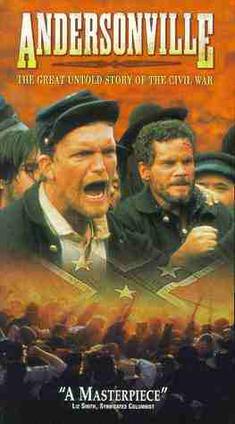
THE 100 BEST WAR MOVIES: #66. Andersonville (1996)


                Ted Turner is a Civil War buff.  “Andersonville” was his third foray into the time period.  Most people forget that he produced “Ironclads” in 1991, two years before “Gettysburg”.  Like “Ironclads”, “Andersonville” was made-for-TV.  But unlike the earlier film, a lot of effort went into “Andersonville”.  Turner got John Frankenheimer (The Manchurian Candidate, The Train) to direct.  Turner also opened up his check book so Frankenheimer could make the film as authentic as possible.  Frankenheimer won an Emmy for Best Direction of a Miniseries or Special.  The movie was nominated for six other Emmys.  The screenplay was loosely based on Andersonville Diary:  Life Inside the Civil War’s Most Infamous Prison by John Ransom.

            A group of Yankees is captured during the Battle of Cold Harbor in June, 1864.  They are shipped to Camp Sumter outside Andersonville, Georgia.  Their first taste (smell) of the camp includes vicious tracking dogs, dead bodies, and stockades with prisoners in them.  The camp has a fifteen-foot wall around it.  When they enter the camp, they are greeted by a seemingly empathetic character named Munn (William Sanderson).  He offers to befriend the “fresh fish” and help them survive.  Fortunately, Pvt. Josiah Day (Jarrod Emick), Sgt. McFadden (Frederic Forrest) and their mates are reunited with a former comrade named Dick (Gregory Sporleder) who clues them in on Munn’s fellow travelers known as the “Raiders”.  The Raiders are led by a bully named Collins (Frederick Coffin).  They prey on the other prisoners. They live fairly well in their sector of the camp by stealing from the vulnerable captives.  Besides the depredations of the Raiders, the camp is a hell hole because of things like lack of food, lack of shelter, lack of clothing, inadequate medical care to deal with diseases, horrible sanitation, and inhumane guards. Do not step across the “dead line”, you won’t be handed your baseball glove and get a stay in the cooler.  To make matters worse, the camp is run by the mentally unstable Capt. Henry Wirz (Jan Triska).  Day, McFadden, and the others hook up with a group led by Sgt. Gleason (Cliff DeYoung).  Gleason’s boys are digging a tunnel and let the new guys in on the digging.  If escape does not work, they will have to deal with the Raiders sooner or later.

ACTING:                      B

ACTION:                      N/A

ACCURACY:               N/A  there is one great fight and one gigantic brawl

PLOT:                          A

REALISM:                   B

CINEMATOGRAPHY:    B

SCORE:                        forgettable

BEST SCENE:  the battle

BEST QUOTE:  Limber Jim:  Who’s with me?!  Whoooo?!  

            For a made-for-TV movie, the amount of effort that went into the production is incredible.  The movie was filmed on location on a farm about one hundred miles from Camp Sumter.  A less than scale model of the camp was constructed.  It covered nine acres.  A panning shot reveals the painstaking effort to recreate the officers’ quarters, the stockades, the walls, the stream, and the “tents” of the captives.  The fact that it rained consistently during the sixty day shoot helped create the muddy environment that added to the horror of the story.  It was a difficult shoot for the cast and crew.  Plus the 4,000 extras that participated.  Many of them were reenactors, some of whom came from all over the country.  They lent an air of realism to the movie, although it was hard to reenact the emaciation of the prisoners.  You can’t expect reenactors to starve themselves for their hobby.  For the bigger scenes, 3,000 cardboard cutouts of men were used at a cost of $150,000.  (You can’t tell the fakes in the movie.)  Speaking of cost, several reels of film dealing with the trial were lost in transit to the studio and the trial set had to be rebuilt and the principal actors brought back in at a great expense.  If you watch the trial scene, you cannot tell the original footage from the new.

            The laudatory effort goes beyond the production.  The cast is outstanding.  Emick was making his first movie, but he had won a Tony on Broadway.  He does not take acting honors.  Those go to Forrest, Sanderson, Sporleder, and Triska.  Sanderson’s Munn and Coffin’s Collins are great villains.  Triska (a celebrated actor in Czechoslovakia) manages to create some sympathy for Wirz, a man who clearly was in over his head and lacked the personality to be humane.  Special mention goes to Jayce Bartok, who was so good as the drummer boy Billy that his role was expanded.  There is not a single woman in the film.

            David W. Rintals wrote the script and he deserves kudos.  The characters are memorable and the dialogue is fine.  The movie does not slump into melodrama.  The plot builds nicely to the battle between the Raiders and the Regulators.  The ensuing melee is provoked by the charismatic “Lumber Jim” (Peter Murnik) as he calls the victims to arms with his cry of “who’s with me?  who?”  I wanted to jump into the screen and join in.  The brawl is one of the best in cinema history and very satisfying.  It may be the biggest fight in war movie history.  The movie could have ended here, but the decision was made to tell the whole story.  Naturally, there is a denouement after the fisticuffs, but the trial does bring closure and more importantly, is based on fact.  The score is excellent and visually the film is intriguing.  Frankenheimer made good use of the Steadicam. There is a remarkable long take of the camp. The makeup is excellent in giving the actors the look of men deprived of humanity.

            The movie is not without flaws.  The characters are all good or bad, there is no in between. Heck, Dick is basically a Christ figure.  Rintals adds a visiting inspecting officer played by William H. Macy. Col. Chandler is highly upset with what he sees.   This may have been to show that not all Confederates were bad, but it does allow for a debate between Chandler and Wirz that foreshadows the war crimes trial of Wirz after the war.  The tunneling and escape are short-changed.  There are no underground scenes.  This movie is not “The Great Escape”.  There is no hospital scene, so the full bleakness of the camp is not shown.  It is a film that lacks humor, but having seen so many WWII prison camp movies that make the camp look like a summer camp for men, I can live with that.

            It is a shame that “Andersonville” is not better known.  It could not have been much better for a made-for-TV movie.  Not only is it an entertaining story that is well-acted, but it is a valuable history lesson.  Although fictionalized, you will learn a lot about the most infamous prison camp ever located in America.  I love movies that bring important, but not textbook-worthy stories to the public.  Sometimes those stories are botched and usually there is only one attempt at telling the story.  I’m talking about you “Windtalkers”.  This story was not botched.  It is definitely one of the 100 Best War Movies.

HISTORICAL ACCURACY:  Camp Sumter was built in Feb., 1864 to handle the large number of Yankee prisoners that were being captured after paroling ended.  Gen. Grant ended the exchange of prisoners partly because it benefitted the Confederate Army and the South refused to repatriate black soldiers.  (The movie has some members of the 54th Massachusetts in it.)  The camp was originally 16.5 acres, but was expanded to 26.5 soon after.  At its max, the camp held 30,000 prisoners.  That was way above capacity.  Of the 45,000 total, 13,000 died.  Most of the deaths were attributable to diseases like scurvy, diarrhea, and dysentery.  The diseases were amplified by the poor food, clothing, and shelter.  The lack of hygiene was mainly blamed on Stockade Creek which provided the water supply, but was tainted by human waste.  Thankfully, the movie only hints at the role of hygiene in the horrors of the camp.  It has been posited that membership in some type of social network was the most important factor in survival.  Loners tended to die soon.  The camp quickly divided into the Raiders and their victims.  The movie accurately depicts the Raiders and their methods.  Collins stands in for the group of “chieftains”.  Munn is based on another of their leaders.  He was not a lackey as depicted in the film, although the chieftains certainly had plenty of followers who were willing to do the dirty work.  This work included fleecing “fresh fish” and robbing others at night.  Sometimes they killed their victims.  The Regulators evolved in response to their depredations.  Matters reached a head when the Regulators went to Wirz and asked for authority to act as a police force.  Surprisingly, and to his credit, Wirz agreed.  The Regulators rounded up most of the Raiders, including a fight for control of the Raiders’ relatively cushy habitat.  Wirz allowed a trial where many were sentenced to stockades, ball and chain, or running the gauntlet.  Six were given the death penalty, including Collins and Munn.  In a reversal of the movie, Collins rope broke during the hanging and he tried to escape, but was reexecuted.  Munn expressed remorse on the scaffold.  As far as the tunnel, there were a 351 documented escapes, which is only .7%  Only a few avoided death or recapture.

            Henry Wirz was the only Confederate to be executed for war crimes after the Civil War.  The movie takes a balanced approach to this controversial figure.  While he undoubtedly could have done more for the prisoners, he was in a difficult position that he did not have the moral strength to deal with.  The food problem, for instance, was not his fault.  His own men were not eating well either.  However, he could have insisted on more humane treatment of the prisoners and more discipline from his own troops.  He appears to have been clueless to the internal dynamics of the camp.  The Chandler character is based on a Dr. James Jones, who spent a day at the camp and wrote a scathing report that got Wirz hung at his trial.    

Friday, November 10, 2017

Andersonville (1996)


                Ted Turner is a Civil War buff.  “Andersonville” was his third foray into the time period.  Most people forget that he produced “Ironclads” in 1991, two years before “Gettysburg”.  Like “Ironclads”, “Andersonville” was made-for-TV.  But unlike the earlier film, a lot of effort went into “Andersonville”.  Turner got John Frankenheimer (The Manchurian Candidate, The Train) to direct.  Turner also opened up his check book so Frankenheimer could make the film as authentic as possible.  Frankenheimer won an Emmy for Best Direction of a Miniseries or Special.  The movie was nominated for six other Emmys.  The screenplay was loosely based on Andersonville Diary:  Life Inside the Civil War’s Most Infamous Prison by John Ransom.

                A group of Yankees is captured during the Battle of Cold Harbor in June, 1864.  They are shipped to Camp Sumter outside Andersonville, Georgia.  Their first taste (smell) of the camp includes vicious tracking dogs, dead bodies, and stockades with prisoners in them.  The camp has a fifteen-foot wall around it.  When they enter the camp, they are greeted by a seemingly empathetic character named Munn (William Sanderson).  He offers to befriend the “fresh fish” and help them survive.  Fortunately, Pvt. Josiah Day (Jarrod Emick), Sgt. McFadden (Frederic Forrest) and their mates are reunited with a former comrade named Dick (Gregory Sporleder) who clues them in on Munn’s comrades known as the “Raiders”.  The Raiders are led by a bully named Collins (Frederick Coffin).  They prey on the other prisoners. They live fairly well in their sector of the camp by stealing from the vulnerable captives.  Besides the depredations of the Raiders, the camp is a hell hole because of things like lack of food, lack of shelter, lack of clothing, inadequate medical care to deal with diseases, horrible sanitation, and inhumane guards. Do not step across the “dead line”, you won’t be handed your baseball glove and get a stay in the cooler.  To make matters worse, the camp is run by the mentally unstable Capt. Henry Wirz (Jan Triska).  Day, McFadden, and the others hook up with a group led by Sgt. Gleason (Cliff DeYoung).  Gleason’s boys are digging a tunnel and let the new guys in on the digging.  If escape does not work, they will have to deal with the Raiders sooner or later.

                For a made-for-TV movie, the amount of effort that went into the production is incredible.  The movie was filmed on location on a farm about one hundred miles from Camp Sumter.  A less than scale model of the camp was constructed.  It covered nine acres.  A panning shot reveals the painstaking effort to recreate the officers’ quarters, the stockades, the walls, the stream, and the “tents” of the captives.  The fact that it rained consistently during the sixty day shoot helped create the muddy environment that added to the horror of the story.  It was a difficult shoot for the cast and crew.  Plus the 4,000 extras that participated.  Many of them were reenactors, some of whom came from all over the country.  They lent an air of realism to the movie, although it was hard to reenact the emaciation of the prisoners.  You can’t expect reenactors to starve themselves for their hobby.  For the bigger scenes, 3,000 cardboard cutouts of men were used at a cost of $150,000.  (You can’t tell the fakes in the movie.)  Speaking of cost, several reels of film dealing with the trial were lost in transit to the studio and the trial set had to be rebuilt and the principal actors brought back in at a great expense.  If you watch the trial scene, you cannot tell the original footage from the new.

                The laudatory effort goes beyond the production.  The cast is outstanding.  Emick was making his first movie, but he had won a Tony on Broadway.  He does not take acting honors.  Those go to Forrest, Sanderson, Sporleder, and Triska.  Sanderson’s Munn and Coffin’s Collins are great villains.  Triska (a celebrated actor in Czechoslovakia) manages to create some sympathy for Wirz, a man who clearly was in over his head and lacked the personality to be humane.  Special mention goes to Jayce Bartok, who was so good as the drummer boy Billy that his role was expanded.
 
                David W. Rintals wrote the script and he deserves kudos.  The characters are memorable and the dialogue is fine.  The movie does not slump into melodrama.  The plot builds nicely to the battle between the Raiders and the Regulators.  The ensuing melee is provoked by the charismatic “Lumber Jim” (Peter Murnik) as he calls the victims to arms with his cry of “who’s with me?  who?”  I wanted to jump into the screen and join in.  The brawl is one of the best in cinema history and very satisfying.  The movie could have ended here, but the decision was made to tell the whole story.  Naturally, there is a denouement after the fisticuffs, but the trial does bring closure and more importantly, is based on fact.  The score is excellent and visually the film is intriguing.  Frankenheimer made good use of the Steadicam.

                The movie is not without flaws.  The characters are all good or bad, there is no in between. Heck, Dick is basically a Christ figure.  Rintals adds a visiting inspecting officer played by William H. Macy. Col. Chandler is highly upset with what he sees.   This may have been to show that not all Confederates were bad, but it does allow for a debate between Chandler and Wirz that foreshadows the war crimes trial of Wirz after the war.  The tunneling and escape are short-changed.  There are no underground scenes.  This movie is not “The Great Escape”.  There is no hospital scene, so the full bleakness of the camp is not shown.  It is a film that lacks humor, but having seen so many WWII prison camp movies that make the camp look like a summer camp for men, I can live with that.

                It is a shame that “Andersonville” is not better known.  It could not have been much better for a made-for-TV movie.  Not only is it an entertaining story that is well-acted, but it is a valuable history lesson.  Although fictionalized, you will learn a lot about the most infamous prison camp ever located in America.  I love movies that bring important, but not textbook-worthy stories to the public.  Sometimes those stories are botched and usually there is only one attempt at telling the story.  I’m talking about you “Windtalkers”.  This story was not botched.  It is definitely one of the 100 Best War Movies.

GRADE  =  A-

HISTORICAL ACCURACY:  Camp Sumter was built in Feb., 1864 to handle the large number of Yankee prisoners that were being captured after paroling ended.  Gen. Grant ended the exchange of prisoners partly because it benefited the Confederate Army and the South refused to repatriate black soldiers.  (The movie has some members of the 54th Massachusetts in it.)  The camp was originally 16.5 acres, but was expanded to 26.5 soon after.  At its max, the camp held 30,000 prisoners.  That was way above capacity.  Of the 45,000 total, 13,000 died.  Most of the deaths were attributable to diseases like scurvy, diarrhea, and dysentery.  The diseases were amplified by the poor food, clothing, and shelter.  The lack of hygiene was mainly blamed on Stockade Creek which provided the water supply, but was tainted by human waste.  Thankfully, the movie only hints at the role of hygiene in the horrors of the camp.  It has been posited that membership in some type of social network was the most important factor in survival.  Loners tended to die soon.  The camp quickly divided into the Raiders and their victims.  The movie accurately depicts the Raiders and their methods.  Collins stands in for the group of “chieftains”.  Munn is based on another of their leaders.  He was not a lackey as depicted in the film, although the chieftains certainly had plenty of followers who were willing to do the dirty work.  This work included fleecing “fresh fish” and robbing others at night.  Sometimes they killed their victims.  The Regulators evolved in response to their depredations.  Matters reached a head when the Regulators went to Wirz and asked for authority to act as a police force.  Surprisingly, and to his credit, Wirz agreed.  The Regulators rounded up most of the Regulators which included a fight for control of the Regulators' relatively cushy habitat.  Wirz allowed a trial where many were sentenced to stockades, ball and chain, or running the gauntlet.  Six were given the death penalty, including Collins and Munn.  In a reversal of he movie, Collins rope broke during the hanging and he tried to escape, but was reexecuted.  Munn expressed remorse on the scaffold.  As far as the tunnel, there were a 351 documented escapes, which is only .7%  Only a few avoided death or recapture.


                Henry Wirz was the only Confederate to be executed for war crimes after the Civil War.  The movie takes a balanced approach to this controversial figure.  While he undoubtedly could have done more for the prisoners, he was in a difficult position that he did not have the moral strength to deal with.  The food problem, for instance, was not his fault.  His own men were not eating well either.  However, he could have insisted on more humane treatment of the prisoners and more discipline from his own troops.  He appears to have been clueless to the internal dynamics of the camp.  The Chandler character is based on a Dr. James Jones, who spent a day at the camp and wrote a scathing report that helped get Wirz hung after he was found guilty at his trial.    

Saturday, January 23, 2016

CRACKER? Hanoi Hilton (1987)


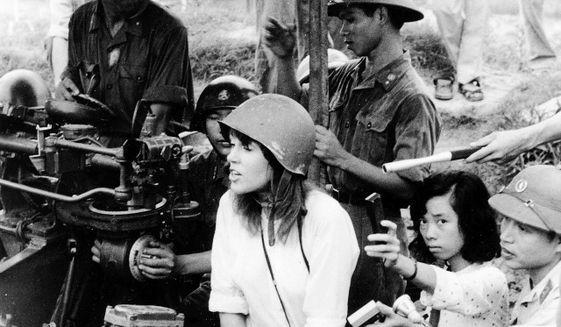
                     A recent post on Face Book reminded me that I still had not posted my review of "Hanoi Hilton".  The post was about Jane Fonda and her horrible treatment of prisoners of war when she visited Hanoi during the Vietnam War.  I am no fan of Jane Fonda.  My father flew an F-105 fighter-bomber in the war.  I lived in Japan for three years while he was doing this.  My father harbored a hatred for Hanoi Jane because of her support for the people he fought against.  He partially passed this on to me, but I never went to the extent of never watching a movie with her in it.  Still, seeing her sitting in the seat of an anti-aircraft gun whose purpose was to shoot down my dad is hard to forgive.  With that said, my extensive reading on the war tempers my view of her because the war was a mistake and I am not a blind patriot.  She certainly can be taken to task for her method of voicing her opinions.  The fact is that the post accused her of heinous actions that she did not commit.  There is a character in this movie that reenacts some of the calumnies.
   

                “Hanoi Hilton” is a prisoner of war movie about the infamous North Vietnamese prison.  It was directed by Lionel Chetwynd.  It came out the same year as “Full Metal Jacket”, “Good Morning, Vietnam”, and “Hamburger Hill” and got lost in the wake of those other films.  It was an example of the backlash against the cynical, anti-grunt films like “Platoon” and “Full Metal Jacket”.  All of the characters are fictional, but the movie purports to enlighten the audience about the mistreatment of American prisoners.  It covers the entire history of American internment at the Hoa Lo Prison.

                 The movie’s main character is a Lt. Williamson (Michael Moriarty) who gets shot down early in the war.  Before that, he is interviewed and proclaims that we are in Vietnam to help the South Vietnamese get their freedom.  The movie says nothing to contradict this belief.  When Williamson is captured, his co-pilot is shot in the head.  This movie is not going to show empathy for the North Vietnamese.  Williamson is taken to the Hanoi Hilton where he finds out that because there was no declaration of war, the Geneva Conventions do not apply.  He is a war criminal.  The first torture is a dry shave.  A variety is yet to come.  These include shock treatment, beatings, and sitting on a pile of bricks.  At one point a group of prisoners is marched through the streets of Hanoi and it becomes a gauntlet with civilians assaulting the Americans. 

                Williamson interacts with other prisoners who are all dealing with the dilemma of when and whether to answer the questions.  How much torture is enough to justify telling the torturers what they want to hear?  Unfortunately, some of the torture is to break the prisoners.  A guy is whipped for yelling when a rat crawls on him.  Another is killed because of an escape attempt.
Don't worry, Jane Fonda is coming to get us out
 

                The movie has two themes.  The captors are evil and manipulating the prisoners for propaganda purposes.  The commandant tells the prisoners that the media coverage of their confessions will help win the war.  The guards are hissable with the volume turned up to 11 with a Cuban interrogator who kills a Puerto Rican who refuses to betray the USA.  Equally loathsome are the liberal media.  A Jane Fonda type wants the men to apologize and ignores tales of mistreatment.  And don’t forget the home front stabbing the men in the back as they do their duty to their country.  At one point the guards pipe in coverage of hippies protesting.  A new prisoner tells the men that most Americans consider them to be fascists.

                “Hanoi Hilton” is the counterpoint to all those Vietnam War movies that cast aspersions on the American war effort and the men carrying it out.  Although from a different subgenre (POW film), it’s most close kindred soul is “Hamburger Hill”.  Hmmm, both have double H’s.  They both portray the Americans as simply doing their duty under difficult circumstances and being betrayed by the home front.  Having read extensively on the war, I can see both the hawkish viewpoint and the dove perspective.  There is a place for both among Vietnam War movies.  There is room for “Hamburger Hill” and “Platoon”.  Needless to say with Hollywood being what it is on the political spectrum, there are quite a few more movies that are cynical toward the war.  It is a shame when a movie like “Hanoi Hilton” botches the attempt to balance the scale.  It takes a worthy subject and bludgeons it.

                It is no wonder the movie got lost in the 1987 box office duel.  It looks second tier.  The cast is B-list and is not memorable.  Moriarty was not a good choice for the lead.  He is too tepid in a role that could have used some emoting.  In fact, one surprise of the movie is the lack of scene-chewing, but sometimes the opposite can be almost as bad.  For a movie about mistreatment of prisoners, the movie is curiously flat.  This may be because most of the torture is implied.  The movie is not graphic.  Weirdly, Williamson does not seem to be terribly mistreated in his eight years in the camp.  In other words, Moriarty was given no chance for an Oscar campaign.

                The biggest flaw is the ham-handed steamrolling of its themes.  The movie is too anti-anti-war.  Jane Fonda is a cheap target and pushes buttons with the intended audience, but why not be factual in her depiction.  In fact, the decision to have all fictional characters was a perplexing and poor one.  Throwing in the hippies and a detestable Cuban was overreaching.  A documentary style film about the prison would have been better.  As it is, one is left to question how accurate the movie is in depicting the treatment.  A neutral viewer could easily watch this poorly made movie and blow it off as conservative propaganda.

                How historically accurate is it?  The Williamson character was probably based on Lt. Edward Alvarez, Jr.  He was the first American taken prisoner and spent almost the entire war in the Hoa Lo Prison.  The North Vietnamese did not honor the Geneva Conventions with the excuse that the Americans were war criminals fighting an illegal war of aggression.  The torture included rope bindings, iron foot stocks, beatings, and solitary confinement.  The movie does show a variety of methods, but is not graphic enough.  The gauntlet scene was based on the infamous “Hanoi March” in which prisoners were paraded down a Hanoi street for newsreels, but the crowd got out of hand and attacked not only the Americans but the guards.  The goal of the jailers was not so much to get military information as to get the men to make statements that could be used for propaganda purposes.  The men developed a code of honor that basically said that you should take as much pain as you could before you were justified in talking.  Almost every prisoner eventually broke and signed statements.  Most of which wer e fabrications.  Executions, torture, injury, and diseases took the lives of 65 prisoners.  Most of the deaths came in the period before 1969.  It was in that year that the Nixon Administration reversed policy and began to condemn the mistreatment of prisoners.  After this, treatment improved.  As far as the Jane Fonda character, Jane did interview some prisoners, but did not encourage them to apologize.  (P.S. to those who have read and swallowed the post about her actions in Hanoi, she did not turn over to the guards notes passed to her by prisoners.)

                "Hanoi Hilton" is not in the upper tier of Vietnam War movies.  If you want some knowledge about the treatment of American POWs, it is not without merit.  However, it could have been a lot better.  It is too simplistically pro-America.


GRADE =  C

Sunday, May 25, 2014

FORGOTTEN GEM? The McKenzie Break (1970)


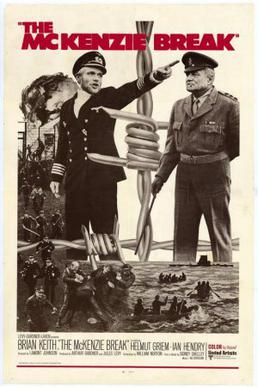
                “The McKenzie Break” is a prisoner of war movie released in 1970.  It was directed by Lamont Johnson (“The Execution of Private Slovik”) and was based on the novel The Bowmanville Break by Sidney Shelley.  It tells the story of an attempted prison escape by Germans  who hope to hook up with a u-boat.
                The movie is set in Camp McKenzie in Scotland during WWII.  There is a discipline problem in the camp as the Nazis are rebellious and the British commandant does not have complete control over the camp.  The Germans are led by a charismatic u-boat captain named  Schluter (Helmut Griem).  Captain Jack Conner (Brian Keith) is brought in to restore control.  He is a loose cannon who has been spared court-martial to do the job. 
                The Germans are divided into two factions.  The Luftwaffe personnel want to chill, but the Reichsmariners are hard core.  Schuler accuses two of the non-rebels of being gay.  That was unusual for a 1970 film.  The submariners are at work on a tunnel similar to the one in “The Great Escape”.  The dirt is disposed in the attics. 
garbage versus garbage collectors
                Schuler stages an insurrection which results in Conner sending in the fire brigade.  A big brawl breaks out and two Germans disguised as British are able to blend in with the British.  They will make contact with a u-boat that will pick up the escapers.  One of the Germans accused of being gay is badly beaten by his mates and is taken to the infirmary.  While there he is killed by Nazis who make it look like a suicide.  Before he dies, he tells Conner that there will be an escape attempt.  Conner decides to let the escape go on to bait a trap for them.
                The tunnel exit is under the guard house.  (Well, that is unique!)  Schuler purposely collapses the ceiling with the dirt as a diversion.  28 submariners escape and hook up with a truck.  Conner is tracking them by plane.  When they reach the beach,  Schuler’s second in command decides that instead of camouflaging the truck, he drives it into  huge hole resulting in an explosion and smoke that attracts Conner’s attention.  Ridiculous!  Conner decides the smoke is nothing.  Doubly ridiculous!!
                Will they escape?  See spoiler below.
                “The McKenzie Break” is in the middle tier of POW films.  It is moderately entertaining.  Keith is his usual dependable self and Griem makes a good asshole Nazi.  The movie makes use of the strong personalities clashing theme.  Both men are full of hubris and neither is likeable.  Another theme is how far should you go to continue fighting once you are captured.  (Something explored in the similar “Hart’s War”).   Some of the cinematography is interesting.  Fades are used to blend some scenes.  There is some good tunnel escaping music.  However, the movie has a made-for-TV feel to it.  The plot does have some unpredictability to it.  This includes the ending which unfortunately is weak and unsatisfactory.   Speaking of which.
THE ENDING
                The u-boat (which was obviously not a u-boat) surfaces and the escapees paddle out to it.  Conner spots the sub from his plane and calls in a motor torpedo boat.   Conner buzzes Schuler’s boat prevent it from reaching the u-boat before it crash dives.  Conner and Schuler stare at each other.  One is going back to incarceration and the other better be heading for that court-martial.
 
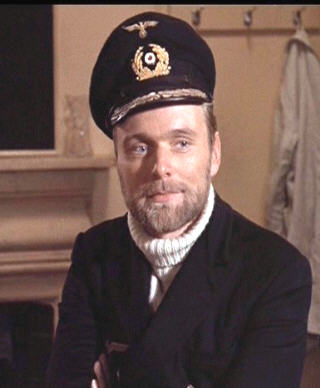
 Schluter (Helmut Griem)
 
Conner (Brian Keith)


HISTORICAL ACCURACY
 Surprisingly, the plot is based on an actual incident.  It happened at a camp in Bowmanville, Ontario in Canada.  An audacious plan was hatched to get four u-boat captains out and back to sinking Allied shipping.  The leader of the group was the famous u-boat ace Otto Kretschmer (who Schuler must have been based on).  Kretschmer did lead a rebellion to protest prisoners being shackled.  The Germans called the escape plan  Operation Kiebitz.  The prisoners contacted the Reichsmarine via coded letters through the Red Cross.  Unfortunately for this cool idea, the Canadians broke the code and knew the basics of the plan which was to break out via a tunnel, make the 870 mile trek to the Atlantic coast, and link up with a u-boat.  The Canadian counterplot was called Operation Pointe Maisonnette (named after the destination of the escapees).  The Canadian plan was to allow the escape and then catch the submariners in the act of escaping and capture the sub at the rendezvous.  The tunnel was basically as depicted in the movie and dirt was stored in the attic.  However, the ceiling collapse was not intentional.  The Canadians pretended to not notice it.  The escape was choked off as soon as it began, but one prisoner managed to use a zip line to get over the wire.  Wolfgang Heyda was actually able to reach the pick-up site but was arrested there.  The u-boat surfaced but the captain was suspicious and soon dove.  The U-536 survived a depth charging from the waiting task force and escaped.
GRADE  =  C

Saturday, March 15, 2014

# 7 - La Grande Illusion (1937)


BACK-STORY:  “The Grand Illusion” is a film by the acclaimed French director Jean Renoir, son of the famous Impressionist painter.  He wrote the screenplay along with Charles Spaak.  Renoir was inspired by his own experiences as a reconnaissance pilot in WWI, but the film is far from autobiographical.  Von Stroheim wore Renoir’s uniform in the movie.  The title of the film was influenced by the book “The Great Illusion” by British economist Norman Angell.  Angell argued that war was useless because nations have common economic interests.  Good call, Norm!  The movie was famously banned in Italy and Germany.  Goebbels even had Renoir labeled “Cinematic Enemy #1” and attempted to have all copies of the prints destroyed.  Fortunately, a print was recovered by the U.S. Army (no, not by the Monuments Men) after the war and Renoir was able to accomplish a celebrated restoration.  The movie was the first foreign language film to be nominated for Best Picture at the Academy Awards.

OPENING SCENE:  In the bonne homme atmosphere of a base canteen, a French pilot Lt. Marechal (Jean Gabin) is called to the commander’s office and informed that he will be carrying a passenger on his next flight.  Capt. Boeldieu (Pierre Fresnay) is an upper class staff officer who wants a taste.  Jump to a German officer’s club where the ace Rauffenstein (Erich von Stroheim) is returning from shooting down a French plane.  You don’t suppose?  You guessed it. Rauffenstein invites his two victims to dinner and establishes a bond with Boeldieu because they are both aristocrats.  Marechal is accepted because he is a fellow knight of the air.

SUMMARY:  Boeldieu and Marechal are sent to a prison camp that reminds of a summer camp.  This is definitely not a WWII POW movie.  They are put in a room with a group of everymen who dine on non-slop with wine and cognac.  The fare is provided by a Jewish prisoner named Rosenthal (Marcel Dallo) who belies the stereotype of his race by sharing the contents of his parcels.  (These guys eat better than their guards, but the guards are cool with this.)  The men get along smashingly well and even tolerate the snooty Boldieu as he tolerates the unwashed.  Which reminds me to mention that one of the men gives Marechal a foot bath!  What’s the opposite of a POW movie cliché?  One of the prisoners is a barracks clown.  It is like if Lou Costello was in “The Great Escape”.


Rosenthal receives one of his wonderful parcels
                The men are digging a tunnel and dispose of the dirt in a manner similar to “The Great Escape” except that they do not seem to care if German guards see them disposing of the evidence.  Speaking of clichés, the camp receives a trunk of women’s clothes which allows them to stage a vaudeville show.  The clown sings a jaunty number and British soldiers do their impression of the Folies Bergere.  In the middle of the show word arrives that the French have retaken Fort Douaumont in the Battle of Verdun.  This prompts Marechal to lead the POWs in “Le Marseillaisse”.   (Note to “Casablanca”: copy this.)  Marechal is thrown is solitary for this act of taunting.  He goes a little stir crazy since he is deprived of the gourmet dining.


Boldieu cleverly hides his bag of dirt
                Just when we are primed for the big tunnel escape scene, the men get sent to another prison camp.  When told, they take it remarkably well.  None curse their infernal luck.  Boeldieu and Marechal end up in a converted castle run by … Rauffenstein!  He is disabled from war wounds (which make him literally stiff) and has been relegated to camp commandant.  He is happy to see Boeldieu who is a kindred soul (they both have monacles).  Raffenstein reads a list of escape attempts they made at the interim camps.  Marechal and Boldieu have been quite the artists, which is news to the audience.  Raffenstein gives them a tour of the very picturesque castle (filmed in an actual castle in Alsace)  and proclaims it “inescapable” (like every other prison camp in war movie history).


Boeldieu and Rauffenstein discuss aristocratic stuff
                The quarters are even more comfortable than the first camp.  Once again, their roommates are all swell guys.  One of them is Rosenthal!  He and Marechal concoct an escape plan involving a homemade rope, but they will need a distraction.  Boeldieu suggests they have all the inmates play flutes and raise a ruckus.  Apparently the Red Cross has sent them 50 flutes.  When stage one of the racket has succeeded, Boldieu buys more time with a command performance with his flute as he roams the upper reaches of the castle.  Rauffenstein is forced to fire on his soulmate and mortally wounds him.  Boeldieu gets a great death scene with the heartbroken Raffenstein by his bedside. He tells the German: “For the commoner, dying in a war is a tragedy.  But for you and me, it’s a good way out.”  He warns Raffy that the days of the aristocracy are coming to an end and their kind will have trouble adjusting to the new social order after the war.

My first blog GIF!  confiscation of the flutes
                Marechal and Rosenthal are on the lam, but the biggest problems they face are themselves.  They have a falling out until they realize that everyone in this movie is supposed to like each other.  They find refuge at a German farm belonging to a war widow named Ella (Dita Parlo) who has lost her husband at Verdun and two brothers in other battles.  She holds no grudges and falls in love with Marechal.  Who wouldn’t?  She has the cutest little girl who, sticking with the main theme of the movie, is not a brat.


War is Hell!
CLOSING SCENE:  Hard to believe, but Ella’s home is even better than the German POW camps.  Marechal and Rosenthal settle in long enough for a relationship to develop between Marechal and Ella.  But as we all know, bros before hoes in war movies.  Marechal and Rosenthal must be moving on to help win the war against Ella’s country.  Marechal promises to return after the war.  (Is this the Grand Illusion?)  The movie leaves us hanging as it ends with the duo making it to Switzerland ahead of a German squad that nicely restrains from shooting them.  This movie does not have Nazis, it has Nicies.

WOULD CHICKS DIG IT?  Sure.  There is no combat to offend anyone’s sensibilities.  There is bromance and romance. There is a cute little girl.  Jean Gabin was the French George Clooney of his day.  There are no villains to creep out anyone.

HISTORICAL ACCURACY:  The movie is not based on a true story, so historical accuracy is not a factor.  I was very curious about the portrayal of the prison camps because they were so different than what we are used to seeing in WWII POW movies.  It turns out that the relatively cushy life in the camps shown in the movie is fairly representative of reality.  The Germans did establish camps for officers (Offizierlagers) in castles, hotels, etc.  The officers got much better treatment than the enlisted.  They had more space, better food, and did not have to work.  They were allowed recreational activities like theatricals.  In some camps they were even allowed to go on walks outside the camp if they swore on their honor not to escape!  The Germans also had “reprisal camps” designed partly to punish escapees.  It seems likely that Marechal and Boldieu would have ended up in one of these instead of in the castle.  Rauffenstein is representative of the fact that commandants were sometimes disabled officers.  The camp guards did have a reputation for being humane so “Arthur” is typical.

                The diet of the prisoners was poor.  Not surprising because due to the Allied blockade the German people were suffering from malnutrition, too.  The prisoners did get to supplement their food with parcels from home, but it seems highly unlikely that Rosenthal’s family could have sent enough parcels to allow the meals the crew routinely eats in the camp.  Plus, the French prisoners were noted for receiving substantially less parcels than the British.

                The reference to Fort Douaumont seems accurate.  The fort did fall to the Germans in Feb., 1916 and then was recaptured by the French in Oct., 1916.  The movie’s time frame must be actually referring to the French recapturing part of the fort in May which they held only temporarily.

CRITIQUE:  “La Grande Illusion” is famous for its themes. Renoir was aiming at class divisions.  Specifically the gulf between the upper and lower classes.  Marechal, a mechanic before the war, and Boeldieu, a nobleman, represent the opposing classes.  Surprisingly, Renoir does not show the conflict between the classes.  These characters do not even have a rocky start before developing their friendship.  Even Rauffenstein treats the lower class inmates with respect, if disdain.  Renoir does not make the case that the two social classes can not live together, unless he is contrasting the egalitarian prison camp to peacetime society.  Boeldieu blends in easily with his prison mates and only rolls his eyes occasionally.  The Boldieu character is the least stereotyped in the movie.  Second least is Rauffenstein.  Stroheim had a reputation for playing villains so you do not expect him to be so humane.  Hell, he did not even mean to kill Boeldieu – he was aiming at his leg.  He is more stiffly (literally) upper class than the Frenchman, but only slightly so.  He has to work harder to tolerate the commoners, but he is not a pompous ass.  The subtheme is that the upper class sticks together.  Boeldieu and Rauffenstein feel a kinship that goes beyond national boundaries.  Renoir is making the case that in the future there will hopefully be no national boundaries and no class distinctions.  The movie makes this prediction.

                The movie has the technical hallmarks of a masterpiece.  The cinematography is not overblown, but shows the ability of a master.  He tends toward long takes with few cuts.  In other words, the opposite of a modern war movie.  When we are introduced to the first group of prisoners, they share a meal (food was important to Renoir) as the camera moves around the table.  There is a nice tracking shot during the theater rehearsal.  The camera pans over items in Raffenstein’s castle room to establish his Prussianness in the mise en scene.  The dialogue is nothing special.  You do not get the impression you are watching a play transferred to the cinema.  The music did not make an impression on me other than to notice there were large stretches where there was no background music to set the mood of the scene.

                The acting is a strength of the movie.  The cast is appealing, which is not surprising since all the characters are appealing.  Gabin has a lot of charisma – enough to get a German war widow (who he cannot communicate with) to fall in love with him in record time.  Fresnay is not as wooden as Boeldieu could have (should have?) been.  He does not twirl his mustache and his flute playing is transcendent.  Stroheim is good in playing against his usual villainy.  He had a lot of say in the character’s development.  Dallo is fine as Rosenthal and does not ham up the Jewishness of the character.  Rosenthal is an important cinematic figure given what was going on in Europe at the time.

I was not kidding about that foot bath!
CONCLUSION:   When I first watched “La Grande Illusion”, I wondered what the big deal was.  Then I watched the movie again with the commentary track by a cinema expert and I wonder less, but still I don’t get what the big deal is.  I understand what Renoir was trying to do, but I did not find it effective.  It is not genius to point out there was a class problem in Europe.  What is perplexing to me is why Renoir chose to make the upper class characters likeable and why the two classes get along so well in movie.  There is not a single negative character in this movie.    There is zero dysfunction.  How unrealistic!  Speaking of lack of reality, I know the depiction of the camps was accurate in the basics, but to portray them as better than being home with the wife was implausible.  I also found that the movie lacked suspense.  They dig a tunnel and then don’t get to use it. They escape from the castle and there are no shots fired and no pursuit. They hide out in a German farm house and no one comes banging on the door. I know it’s not “that kind of movie”, but that does not make it great entertainment (as many claim).  I suppose you could argue that it is a great movie, but I do not think it is a great war movie.  It is tremendously overrated and does not belong in the Top 10.  Discuss.

RATINGS: 

Acting =  A
Action =  4/10
Accuracy =  C
Realism =  C
Plot =  B

Overall =  C