Showing posts with label John Hersey. Show all posts

Saturday, May 7, 2022

MOVIE / BOOK: A Bell for Adano (1945)


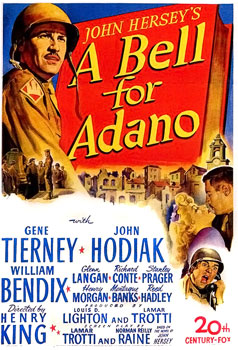
            In 1944, a war correspondent named John Hersey won a Pulitzer Prize for a novel entitled “A Bell for Adano”.  The very popular book was based on his spending time with a Capt. Frank Toscani who was military governor of the liberated town of Licata in Sicily.  Hersey felt Toscani’s efforts to replace a 700-year-old bell that had been melted down for ammunition would make a good story.  It did and was soon made into a Broadway play starring Fredric March.  Twentieth Century Fox bought the screen rights for $85,000.  It considered Dana Andrews, Gary Cooper, Spencer Tracy, and Jimmy Cagney for the role of Major Joppolo.  The role went to John Hodiak.  It was his first lead role and he considered it to be his favorite.  Gene Tierney was cast as his love interest and was given top billing for a much smaller role.  (But the movie poster could legitimately have a woman on it.)  The director was Henry King, a prolific director who was nominated for Best Director twice.  He directed “A Yank in the RAF” and “Twelve O’Clock High”.  The film ran into some problems with the War Department.  The Pentagon did not like Hersey’s portrayal of a blowhard, unjust general and wanted the town’s problems to be caused by the war, not by a Pattonesque general.  The screenplay ended up following the military’s “suggestions”.  The movie also ran into trouble with Toscani.  He sued because it depicted him as a married man who was not faithful.  He was also upset that the film showed him disobeying an order.  He lost the case because the judge pointed out that the movie did not use his name and technically Joppolo was a fictional character.

            The movie opens with a jeep arriving in a Sicilian town.  Major Victor Joppolo (Hodiak) is accompanied by Sgt. Borth (William Bendix).  Joppolo is there to run the town and handle any problems.  They are immediately accosted by Zito (Marcel Dalio) who insists he is anti-fascist and wants a job. His brown-nosing is eerily similar to the old brothel owner in “Catch-22” when he explains to Nately how he shifts allegiance depending on the situation.  Zito gets the main subplot rolling by pointing out that the town is without its most prized possession -  the bell.  Joppolo appears unhappy with his job and barely tolerant of the variety of characters he will have to deal with.  All of them are anti-fascists, of course.  Joppolo is determined to do his job and impress the Sicilians with American efficiency.  Getting a new bell will be a high priority.  He attends mass to show an American face and can’t help but notice a stunning blond named Tina (Tierney).  Romance ensues, even though Joppolo is married.  He comes of as a Boy Scout compared to the horn-dog Capt. Purvis (Henry Morgan).  Joppolo does a great job winning over the citizens and dealing with the mixture of colorful characters, but his real trouble comes from above.  A general gets miffed over a stalled donkey cart and orders no more carts in the town.  (He has the recalcitrant mule shot in a scene similar to Patton’s encounter with a mule cart in Sicily.)  Since the town depends on the carts for water and other essentials, Joppolo decides to disregard the order.  Imagine what would have happened if Patton had issued the order.

            “A Bell for Adano” does justice to the novel, as you will see below.  If you are familiar with the novel, you will know not to expect any action (except for what Joppolo is hoping to get from Tina).  It’s more of a character study with some culture clash humor.  The movie has a touch of propaganda, but not the type that would motivate audiences to work harder in the factories.  After all, the war was over in Europe when it was released.  The goal of the movie was to show that Italians were now our allies and Americans are humane occupiers. Oddly, the film has the Navy coming through on the bell and the Army looking bad as represented by a martinet general.

             The plot could be compared to Andy Taylor arriving in Mayberry to take over from a corrupt administration.  There’s no Barney Fife, but there are some comic relief characters.  Adano is a stereotypical Italian town and the movie is a bit condescending toward it.  It’s hard to view Italy as much of a foe.  It’s impossible to imagine a German occupied town behaving the same way. The movie fits into the most popular movie setting of the time – the small town. 

            The movie earns some good will from the performances.  Hodiak and Bendix were well-known at the time and they are deft in their portrayals of soldiers just trying to do a job.  Morgan’s wolf is too over the top.  Joppolo brings him to a date with Tina’s family and he behaves like a total cad, and yet his superior officer just puts up with it.  The problem in the cast is Tierney, who is woefully miscast and struggles with the accent.  But she’s easy on the eyes and somebody had to play Tina.

            “A Bell for Adano” is a nice little movie.  It’s not going to challenge you, unless you think there is a possibility the town won’t get its new bell.  It’s a good alternative to reading the book because it follows its source pretty faithfully.  And you get to see what a Sicilian town was like in the Middle Ages.

GRADE  =  B-

The Book:  In the Pulitzer Prize winning novel, Hersey makes it clear that Joppolo is a good man and the book is about him.  The theme is America comes to Europe.  It starts soon after the invasion of Sicily.  Joppolo is more idealistic than the movie character.  He sees his job as a chance to prove that occupation governing can be fair and effective.  He represents AMGOT (American Military Government Occupied Territtories).  In a subtle change, in the book Joppolo asks the priest to go to his Mass, in the movie the priest asks Joppolo.  He does notice Tina in the church.  She does not have anything to do with the bread line kerfuffle.  (Clearly the scene was rewritten to give Tierney more screen time.)  The subplot about the bell is basically the same, except the bell was for city hall, not the church.  The romance is the same chaste affair as in the movie.  Joppolo does try to get information about Tina’s fiancé.  When the story of his death is revealed, it is so bizarre as to be almost comical.  Thankfully, the movie does not reenact it.

            The book’s supporting cast is well-portrayed in the movie.  The book does have an omitted sub-plot involving the fascist mayor.  Joppolo has him apologize to a crowd for a different offense each day.  Later, the mayor spreads rumors and gets himself put in jail.  He escapes, but is quickly recaptured.  Another negative character is Gen. Marvin, who was clearly modeled after Patton.  It’s ironic that although Joppolo is supposed to be the model for democracy, his boss is just as much a Mussolini as the Italians were used to.  The book’s Marvin is a bigger jerk, which means that Joppolo’s defiance of his order can have only one outcome.  The book does a better job of putting Joppolo out on a limb.  Purvis is also toned down for the movie.  In the book, he is more of an alcoholic and his comments are more lewd.  He represents the ugly American.

            The book fleshes out the fishing subplot.  Tina’s father is the leader of the fisherman’s “union”.  Joppolo gets them back on the job.  One of the boats hits a mine.  A little boy is run over by an American truck while trying to get candy.  There is a chapter on a poison gas scare.  As you can tell, the movie wanted a more upbeat narrative.  But the book and the movie end up in the same place with the demoted Joppolo leaving town to the sound of the bell.

            The book emphasizes more of how Joppolo’s rule was very different from the previous government.  There is more on the culture shock of Italians meeting Americans.  Setting the novel in a Sicilian town is like taking a step back in time.  Hell, the town has a town crier!  It relies on mule carts.  Joppolo is more saintly in the book.  He does not arrive in town with a frown on his face.  He looks forward to the challenge. 

            As usual, the novel that is the source of a movie gives you more details and more characters.  Unfortunately, in this case, more is not better.  Hersey should have taken his four day stay with in Licata and turned it into a short story.

BOOK =  C


Sunday, August 16, 2015

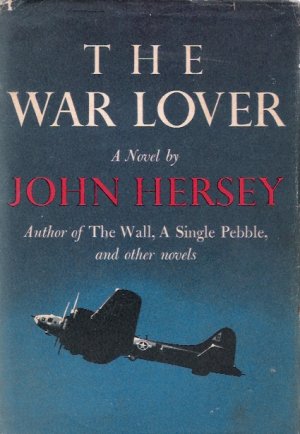
BOOK/MOVIE: The War Lover (1959/1962)


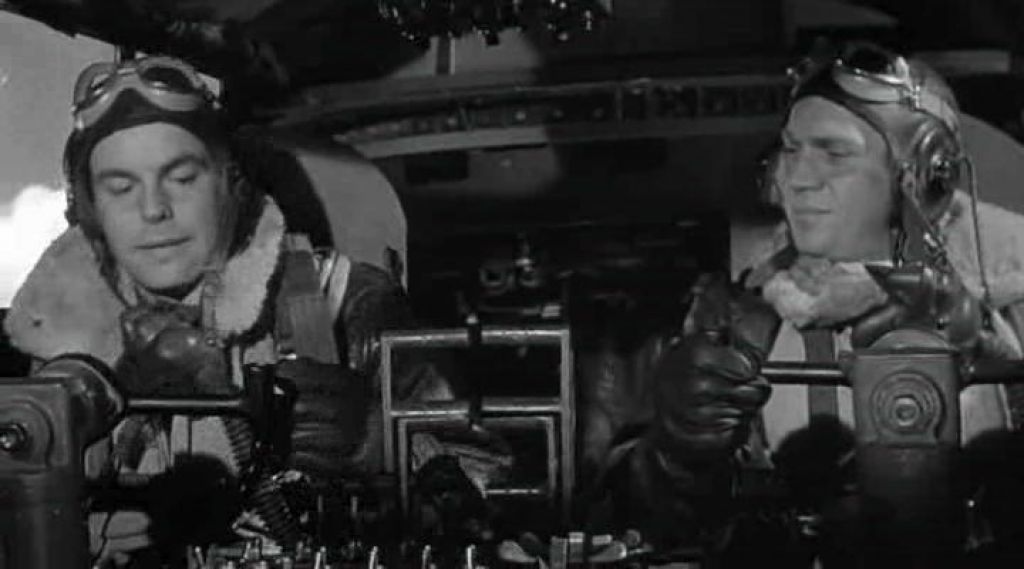
                “The War Lover” is a WWII aviation picture based on the best seller and Pulitzer Prize winning novel by John Hersey.  It was filmed in England and directed by Philip Leacock.  Two RAF bases were used for the exterior shots.  The producers found three B-17s in America.  Famous aviation writer Martin Caidin helped restore them and flew one across the Atlantic to be used in the film.  He wrote a book about the experience entitled Everything But the Flak.  A stuntman died during a stunt when he drowned parachuting into the English Channel.  Warren Beatty was first choice for the lead role but he turned it down because he had recently caused the breakup of Robert Wagner and Natalie Wood.  It would have been awkward if he acted with Wagner.  Steve McQueen got the part and was his usual difficult self.  He did not get along with Shirley Anne Field and once pushed so hard she went over a sofa and cut her lip.  In a subsequent kissing scene, she bit McQueen on his lip in revenge.  Director Leacock was lenient with McQueen’s contractual stipulation that he avoid racing cars during the filming.  McQueen proceeded to get into an accident, so those injuries from his fight with the Bolland character are not the result of make-up.
Awkward!

                The movie is set on an American bomber base in 1943.  “Buzz” Rickson (McQueen) is a hot shot pilot who rooms with his co-pilot “Bo” Bolland (Wagner).  Bo is your typical American airman who is just trying to survive the required 25 missions.  Buzz likes the war.  “The only trouble with this crummy war is it begins too early in the morning.”  Their bomber is nicknamed “The Body” and is on its seventh mission.  Their mission is to bomb submarine pens at Kiel.  By changing the nose art, the movie is able to make the three bombers look like a lot more on takeoff.  Due to cloud cover, the commanding officer aborts the mission, but Buzz goes below the cloud cover to bomb the target anyway.  He has an orgiastic look on his face as the bombs explode.  Back at the base, Buzz does not seem to care that one of the bombers that followed him ended up getting blown up.  The CO calls him on the carpet and accuses him of being insubordinate and irresponsible.  Since this is a war movie, his superiors put up with him because he’s such a crackerjack pilot.  The Air Force (actually Army Air Corps) loves mavericks.

                We have a maverick, how about a love triangle to go with that cliché?  Bo and Buzz meet a British bird at a dance.  Surprisingly, Daphne (Field) does not opt for the stereotypical brash American and instead chooses Buzz.  She realizes she would always be second best to the war in Buzz’s life.  Bo puts her first, but is she just a fling until he finishes his tour?  Although Bo will have to be like a sheep-dog watching out for the wolf, he idolizes Buzz as a pilot and leader.  So does the rest of the crew except the navigator Lynch who despises the amoral Rickson.   Buzz gets him transferred to a lesser pilot and as though that does not doom him enough, he proceeds to show Bo a picture of his wife and kids!  Why does the military give lectures on VD, but not on picture discipline?
"I'll bet you 50 bucks our last
mission is a milk run"

                Buzz continues to be insubordinate.  When a mission requires them to drop leaflets instead of bombs to kill Germans, he buzzes the field several times at very low altitude to show his displeasure.  The Doctor states that “Rickson is a good example of the fine line that separates the hero from the psychopath.”  (I wonder how many Medal of Honor winners this statement would apply to.)   There is no talk of grounding such a loose cannon.

                Before the last mission, the predictable hook up between Buzz and Daphne occurs.  Buzz shows up at her apartment, but she sees right through his macho bull-shit.  He does not attempt to charm his way out of this assessment.  “In war time, you don’t fall in love.  You make love.”  She gives as well as she gets.  “You can’t make love.  You’re twisted.  You can only make hate.”  Ouch!  When he returns to base, he implies that something went on which makes the next mission very awkward.  They don’t have a lot of time to glare at each other as they have to try to avoid the kitchen sink on this mission.  I counted ten problems.  That’s “Memphis Belle” territory.  At least the love triangle problem gets solved by subtraction.


                “The War Lover” is an underrated war movie.  It is well made with good cinematography and effects.  The sound effects are also well done.  You do feel you are along for the ride.  The interior of the bomber is realistic.  The flight procedures are rendered accurately.  As is usual for an air combat movie, the film takes off when it is in the air.  There is some good stunt work in the buzzing of the field, but the obligatory belly landing was borrowed from “Twelve O’Clock High”.  The plot is a little leaden on the ground. 
the real star of the film

The central theme that some warriors are in it for the thrill is worth exploring and this was a rare theme for a movie from the early 60s.  There aren’t that many war movies that have the hero as a psychopath.  Coincidentally, I also watched “The Hurt Locker” this week and the main characters in both movies have similar personalities and motivations.  McQueen’s performance has been criticized, but I found his style to be perfect for the role.  Who better to play a jerk than a jerk?  He’s the kind of actor who can act with just his eyes, which is helpful when you are wearing an oxygen mask.  Wagner is fine in a role that is not fully fleshed out.  It is never clear why he and Buzz are best friends considering their views on the war are opposite.  Field is the wild card and her performance is hard to analyze.  Daphne is not your usual pilot groupie.  Although she falls in love with Bo, she is realistic about the temporary nature of the relationship.  She is probably the strongest character among the three.  Her reaction to Buzz’ “seduction” is interesting.  The rest of the characters are not really fleshed out.  Lynch should have been more of a foil to Buzz.  The rest of the crew is nondescript.  There is no dysfunction.
“The War Lover” is probably not going to make my 100 Best War Movies list.  It is still a nicely entertaining war movie mainly because of the theme and the fact that it is not very predictable.  There is one death that you will not see coming (and two that you will see from a mile away).  The last mission, although crammed with “what next?”, is exciting and not head-shaking.  It is certainly a better movie than its closest companion – the pious “Memphis Belle”.  And it stars Steve McQueen.

How does it compare to the novel?  Needless to say, the novel is much more wordy.  Scratch that if you are going to cast McQueen.  For instance, in the book, when Buzz barges in on Daphne he ends up telling his life story.  The book is told from the perspective of Bo and he can be a bit of a whiner.  He also is less likeable because we see so much more of his personality.  The romance is of course fleshed out and the book makes Daphne out to be a more sympathetic girl who is truly in love, but also trying to make the best of the war situation.  Bo’s inability to fully commit to her is frustrating.  Hersey uses the Bo character as his device to make the point that there is nothing good about war and those that buy into it have either drank the propaganda kool-aid or they love war for its own sake.  The main incidents in the movie are from the book with some changes for the better.  Lynch is much more important in the book.  Bo is simpatico with him and is really broken up when he dies.   The movie makes the wise decision to put Lynch on the crew, but downplays his relationship to Bo.  Another good decision was to have Bo imagining the worst about Buzz’ visit to Daphne.  In the book, Daphne tells Bo what happened and he is upset more with finding out just how loathsome his former best friend is rather than seething over his sleeping with his girl.  Most importantly, the movie substantially changes the last mission for the better.  Not giving away the move ending for those of you who have not seen it, but here is what happens in the book.  They get hit in the nose and the bombardier loses a leg and his life.  The tail gunner bails out without telling anyone.  Buzz cracks up and Bo ends up flying the plane for the rest of the time.  They decide to ditch in the Channel, but Junior asks to bail out and does.  When the plane hits the water, Buzz decides to go down with the ship.

BOOK  =  B-

MOVIE  =  B+