Showing posts with label John Huston. Show all posts

Thursday, July 10, 2014

WORLD CUP SPECIAL: Victory (1981)


                In honor of the upcoming World Cup final match, I thought it would be appropriate to review the only war soccer (sorry rest of the world, but that’s what I’m going to call it) movie that I am aware of.  Talk about a tiny subgenre.  It is my favorite movie that combines war (specifically the prisoner of war subgenre) and soccer.  I actually saw it long before I became a soccer coach.  I now use it in my Soccer P.E. class on rainy days.  The boys love it, what’s not to like?  It combines their favorite sport with war.

                The movie opens with an escaping prisoner being machine gunned while caught in the barbed wire surrounding the prison camp.  This abuses you of any thought that it might be a comedy.  There is no time frame given but it would appear to be 1942 as there is a reference to British successes in North Africa.  A German officer named Von Steiner (Max Von Sydow) proposes a match between a team of POWs led by a British officer named Colby (Michael Caine) and the German national team.  Both men are former professional soccer players.  Von Steiner seems sincere in just wanting to have an international match, but Nazi propagandists quickly see the potential for an ass-whipping display of Aryan superiority.  Von Steiner facilitates a fair match by allowing Colby’s squad to get special treatment and even gets Colby some emaciated and mistreated Eastern European stars from other prison camps.  Colby’s team includes a very talented Luis (Pele) from Trinidad.  It also includes a typically obnoxious, cocky, soccer-challenged Yank named Hatch (Sylvester Stallone).  The subplot of Hatch escaping from the camp is somehow blended into the soccer match plot which itself is morphed into a prison escape.  It is not as pretzely as you would anticipate.  All of this builds to the match in Colombe Stadium in Paris.  It is arranged for the team to escape at half-time, but will they flee as losers?

                “Victory” (also known as “Escape to Victory”) was one of John Huston’s ("The African Queen") last films.  I’m guessing most cinephiles are surprised to be reminded that he directed it.  In fact, movie has been long forgotten by most.  I was under the impression that it had bombed when it came out, but my research shows that it was a moderate success and even got mostly positive reviews.  It was filmed in Budapest because the city looked more like 1940s Paris than Paris did.  Budapest also had a 1940ish soccer stadium. 


                   The movie is technically proficient with a well-constructed three acre prison camp set.  The barracks are a bit too pristine, but the settings are realistic.  The cinematography is nothing special until the match where Gerry Fisher does a wonderful job lensing the action.  We get a mixture of close-ups, medium, and longer range shots that manage to avoid making the game look fake.  There is even some slow motion (like on Pele’s bicycle kick).  Quick cuts work perfectly to make the game look like a battle.  It also reduces the visuals that might have soccer fans crying fake.  The way the game is depicted is among the best cinema contests.  The game was choreographed by a former pro with input from Pele (who I would imagine was listened to when he spoke).  Amazingly, on a key foul that results in a penalty kick, I rewatched it and could not determine if it was a bad call.  That may not mean anything to a non-soccer fan, but trust me - I just gave the movie  a huge compliment.   There is absolutely no comparison to the soccer piece of crap in “The Boys from Company C”.  The score by Bill Conti is above average.  The theme rolling over the credits is old school reminiscent of “The Dam Busters” ilk.  The music matches the scenes well and rises to a crescendo in the match.


                The acting is much better than you would expect considering a large part of the cast is not actors, including Sylvester Stallone.  Seriously, Sly does some acceptable work here.  The role of a cocky American suits him and he certainly plays soccer incompetent well.  Caine is solid although way too old to play a soccer player.  The movie has eighteen international soccer stars appearing on screen.  Some are quite famous and this explains why the movie was a bigger hit overseas than in America.  They do fine and it does not come off as just stunt casting.  Pele is comfortable in front of the camera, but none of the others embarrass themselves.  Of course, it helps that they are on screen with Stallone.  I have to specifically mention Werner Roth who plays the German captain with verve.  Roth is in the National Soccer Hall of Fame and was a key member of the New York Cosmos back when teammate Pele was trying to bring soccer to America.  Special mention has to go to the crowd at the game.  Aside from the anachronistic clothing, they are as good as you could ask for.  I am sure they were grateful that Stallone was overruled when he insisted on scoring the winning goal.


Sly stopping a goal is infinitely more plausible
than him scoring one
                I was pretty shocked to find that a basis for the story could be posited, although it is unclear whether the screenwriters were aware of this.  There is no claim that it is based on a true story.  The seed could have been the mythical “Death Match” in the Ukraine in WWII.  The FC Dynamo Kyiv played some matches against German military units during the occupation.  They were undefeated and according to legend, after the last victory the team was arrested by the Gestapo and they were executed.  This extreme version of the story has been refuted by modern scholarship, but when the legend becomes fact, print the legend.


                If you were to read a summary of the plot, you would shake your head and you would not green-light the production.  Somehow it works as light-weight entertainment.  Parts of it are implausible, but nothing is laughable.  It is not totally predictable and the end is crowd-pleasing without being cloying.  The game is above average and we all know how hard it is to realistically act out game action.  But the best thing I can say about it is repeat viewings have not made me question my sanity.  Is it more entertaining than a World Cup soccer match?  Decide for yourself. 

GRADE  =  B- 


the trailer


Thursday, July 26, 2012

#32 - The African Queen (1951)


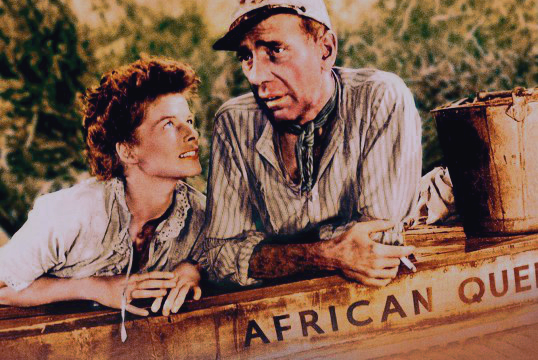
POSTER -  The central figures are straight off a Harlequin romance.  They must have posed on the first day of filming.  The rest of the poster is too busy and confusing.  Even if you've seen the movie, it's hard to tell what is being referred to.  If you haven't seen it, you would assume the movie is about a shipwreck.  Grade =  D

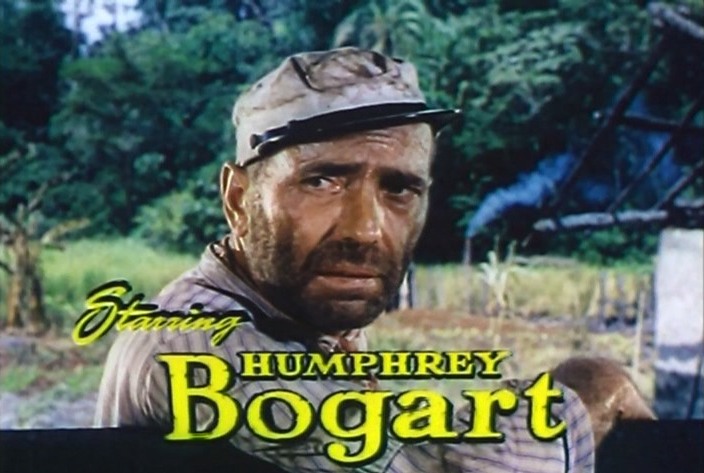
BACK-STORY:   “The African Queen” had one of the most famous productions in cinema history.  Director John Huston insisted on filming half the movie on location in Uganda and the Congo.  The production was beset by climate, critters, and diseases.  Virtually the entire cast and crew suffered from ill health (ex. dysentery) with the notable exceptions of Huston and Humphrey Bogart who inoculated themselves with copious amounts of alcohol.  The teetotaler Katharine Hepburn later wrote of enjoying the experience, but had to overcome dysentery, drunken pranks from Bogart and Huston, and Huston’s unique directing style.  (Clint Eastwood later made a film about the production entitled “White Hunter Black Heart”.)  The movie was a big hit with audiences and critics.  It turned out the suits that felt an action / romance about an older couple would be icky were wrong.  Bogart won his only Oscar and the film was nominated for Director, Adapted Screenplay, and Actress.  In the most recent AFI ranking of the best movies it placed #65.
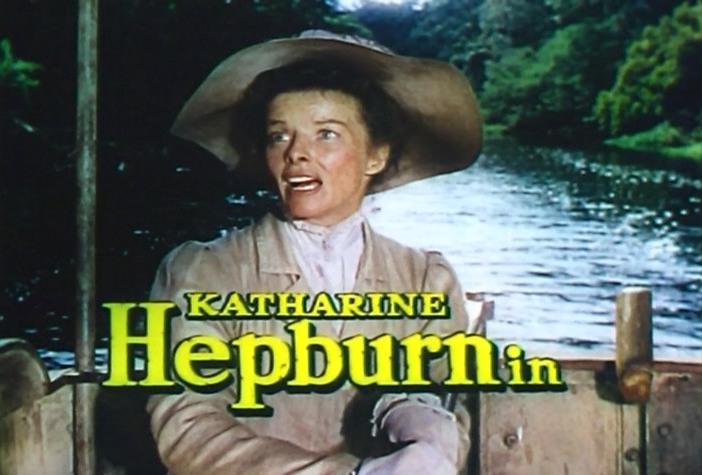
OPENING:   The movie is set in German East Africa in 1914.  Missionary Samuel Sayer (Robert Morley) and his sister Rose (Hepburn) are conducting a mass for villagers when a rickety old boat captained by Charlie Allnut (Bogart) arrives.  The subsequent tea with the straitlaced Sayers is made more awkward by Allnut’s growling stomach.  Charlie informs them the war is on which they don’t seem concerned about until the Germans almost immediately arrive and conscript the villagers, burn the village, and beat up Samuel who suffers a nervous breakdown and dies soon after.  When Charlie returns he helps bury the missionary and puts Rose aboard.
SUMMARY:  It doesn’t take long for the feisty Rose to make the ridiculous suggestion they go down the river to the lake to attack the German warship Louisa.  Off the top of her head she comes up with a plan to turn the African Queen into a torpedo delivery system.  (Apparently even missionaries day dream during their brother's sermons.)  Charlie grudgingly gives in to her stronger personality and they start on their adventure.  He figures she will see reason when they run the first set of rapids, but they only exhilarate her.  Charlie reacts by getting drunk, but awakens to Rosie pouring out his entire stash (see the clip below) and reminding him that he promised her to give the mission a shot.  The silent treatment wears him down quickly and he cleans up his act.  A little too pat, but it’s a movie.
ladies, do you look at your man like this?  you should
                The next problem is passing by a German fort that frowns on the river.  They survive gunfire with minor damage to the boat.  (Later, the audience must survive Bogart mugging at various animals.  Comic relief from Bogie!)  Next are bigger rapids which results in an awkward kiss that when paired with the moony eyes (see above) and the schmaltzy music reminds us we are watching a 1950s movie.  Soon after Rose is butt naked and doing the nasty with Charlie (or at least that is what I was imagining during the fade).  They come out of the fade fully in love (see poster).
                Here comes a waterfall that for some reason riverboatman Charlie was not aware of.  The boat propeller and shaft are damaged.  There is a great conversation where they calmly discuss repairing the boat.  They are now partners.  They work together to do the repairs.  For a missionary's sister, Rose is very game.  She's like Ripley's grandma.
soon after the woman started steering, the boat crashed
                Pressing on, Charlie has to literally pull the boat through a marsh.  A leech-infested marsh!  Ewwww, says the audience.  Tragically, the movie ends with them running aground unable to move forward or backward.  Unless a sudden rainstorm raises the water level they will die in each other’s arms and become crocodile food.  Is that thunder?
                Hiding in the reeds they spot the Louisa and move on to the plan implementation stage.  They make the torpedoes out of oxygen cylinders.  It turns out Charlie has a green thumb for homemade ship killers.  They fix the boat so when it rams the Louisa it will take both ships down.  Piece of suicidal cake.
CLOSING:  Their night kamikaze mission is literally overturned by another storm and Rosie is drowned (or so the idiots in the audience are led to believe).  Charlie is captured and interrogated by the Germans on the Louisa.  Since he does not care to live now that Rosie is dead, he cops to everything and is sentenced to be hanged.  Rosie is then fished out and she defiantly corroborates the story.  Their last request is for the Captain to marry them (with the nooses in the background).  As they say “I do”, so does the African Queen as it resurfaces in the path of the Louisa.  The ships kiss too.  It’s explosive!  Charlie and Rosie go swimming off into wedded bliss (hopefully with no crocodiles involved).
RATINGS:
Acting -  A
Action -  6/10
Accuracy -  N/A
Realism -  B
Plot -  A
Overall -  A-

WOULD CHICKS DIG IT?   I would think so.  It’s not a testosterone fueled war movie.  It’s more of a romance with adventure thrown in.  The leads are amazing and the chemistry is great.  There is certainly nothing to turn anyone’s stomach.  (I did mention that Hepburn does not get naked, right?)  I must have been an almost perfect date movie for the 1950s.
HISTORICAL ACCURACY:  The film is not based on a true story.  There is a small seed that might have grown into C.S. Forester’s novel.  The Germans had a warship named the Graf Von Gotzen that dominated Lake Tanganyika until pressure from the British caused them to scuttle it.
                In comparing the movie to the book, it appears the plot of the movie improved on the book.  I have not read the book, but a summary of its contents finds that the film sticks close to the book.   The few changes enhance the story.  For instance, in the novel the Germans do not beat Rose’s brother so she has less reason for vengeance.  The ending is vastly improved.  Forester’s conclusion is weak and would definitely not have been crowd-pleasing.
CRITIQUE:  This is old fashioned entertainment.  It’s an almost perfect blend of adventure and romance.  There is suspense in each of the travails they go through and it builds to a surprising and satisfying ending.  Although a little stodgy, the plot holds up better than some other supposed classics.  The acting by the two leads could not be better.  This is probably Bogart’s best performance and Hepburn matches him.  In her book about the making of the movie, Hepburn tells that Huston felt that she was playing Rose as too serious.  He suggested she channel Eleanor Roosevelt and adopt her hopeful smile.  She admitted this was the best acting advice she ever got (and from a man she thought at the time was off his rocker).  Bogart and Hepburn appear to be having a lot of fun with their roles (although Bogart hated the comfortless African locales and couldn’t wait to get home).
                The plot has some refreshing unorthodoxy to it.  Rose and Charlie may have a disagreement about the wisdom of the mission at the beginning, but they are not at each other’s throats like in most romances of that (and this) era.  The opposites attract angle is there, but it’s not overemphasized.  The arc of the romance is a bit simplistic and speeded up, but it’s not mushy.  However, it does fit comfortably into the "shared hardships bring people together” school.  Making Rose the more dominant personality is a nice touch, but it is diluted a bit by the obvious Bible defeats booze theme.   The success of the mission, while predictable, takes some interesting turns that could not have been anticipated.  The theme of the movie is where there’s a will there’s a way.  Throw in a little "God helps them that help themselves".   
                The cinematography is not mesmerizing.  It’s adequate and some credit must go to the difficult conditions much of the movie was shot in.  The film does have more flora and fauna than your typical Tarzan movie.  You will see hippos, apes, elephants, crocodiles, giraffes, lions, and antelopes.  And, of course, leeches.  Surprisingly, there are no problems with animals (even when Charlie taunts them).  Charlie does not have to wrestle a crocodile.  They catch hell from the leeches and mosquitoes.  The scenery is beautiful, making the decision to shoot in Africa a wise one.  The one flaw is the pompous score.  It really is intrusive at times.  Give us a break, we know how to feel!
CONCLUSION:  While undoubtedly a classic, “The African Queen” does not sit comfortably at #32.  This is mainly because I am not sure it is a war movie.  Two of my three main sources (Video Hound and Freitas) do not have it.  I know it fits even my definition of a war movie, but there is just something about it that does not make me see it as a war movie.  By contrast, I would compare it to "Casablanca" .  While “Casablanca” has no warlike action like the sinking of a warship, it feels much more like a war movie.  To tell the truth, neither movie is solidly in the genre.  What’s puzzling is that Military History magazine determined both to be war movies and then put “Casablanca” at #65 and “The African Queen” at #32.  This is perplexing because not only is “Casablanca” more of a war movie, but it is clearly the better movie.  It is #3 on AFI’s latest list of the Top 100 of all time.  And if you are defining "greatest" as synonymous with "important", "Casablanca" would have to come before "Queen".  So once again, what was Military History thinking?

the trailer


TRAILER -  Definitely old school.  Does a good job on the relationship, but you get no idea of the mission to sink the Louisa.  You also get a taste of the score.  B+

Bogart acting (?) drunk


Sunday, January 30, 2011

# 74 - The Man Who Would Be King


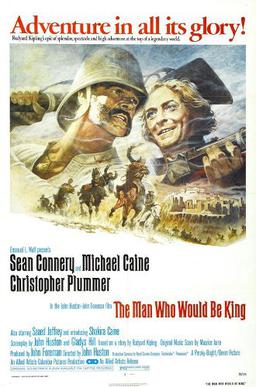
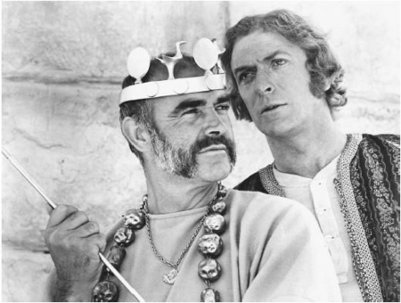
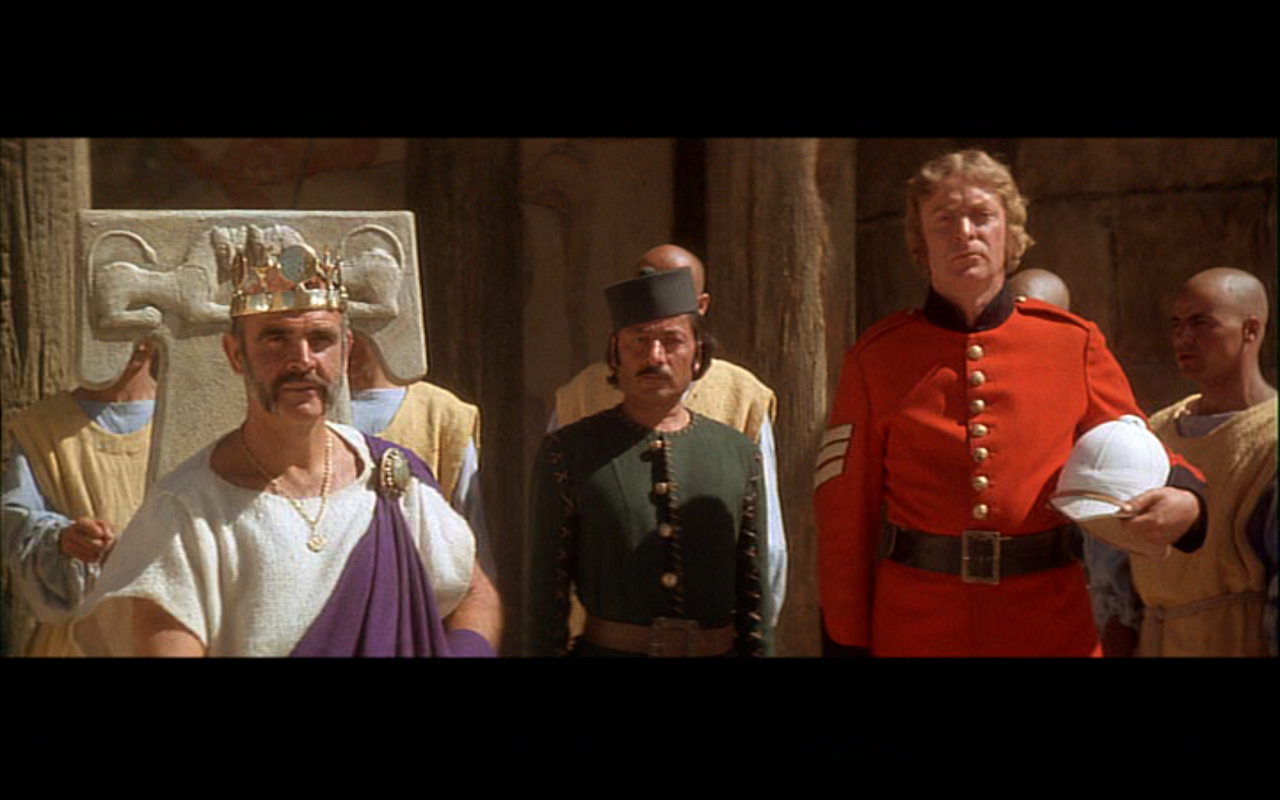
BACK-STORY: “The Man Who Would Be King” is a war movie that was released in 1975. It was directed by John Huston and is based on a short story by Rudyard Kipling. Huston co-wrote the screenplay. Originally intended as a project for Humphrey Bogart and Clark Gable, then Burt Lancaster and Kirk Douglas, then Robert Redford and Paul Newman, it was finally made starring Michael Caine and Sean Connery. It was nominated for Academy Awards for Best Art Direction, Writing, Costume Design, and Editing. The movie was critically acclaimed and did well at the box office.


OPENING: We open in an outdoor bazaar which could be “live” considering how little this part of the world has changed since the late 19th Century. British journalist Kipling (Christopher Plummer) is writing in his office when a mysterious man appears. He claims to be an old friend and has obviously fallen on some very hard times. Cue flashback.

SUMMARY: Peachy Carnehan (Caine) meets Kipling when he sits next to him on a train. Peachy has stolen Kipling’s watch. An Indian sits with them and is proceeding to eat a watermelon. Peachy throws the man off the moving train. So much for political correctness. Peachy is a typically racist ex-NCO in the British army.

Later, Peachy and his BFF Danny Dravot (Connery) meet with Kipling in his office and outline an outrageous plan to cross the Khyber Pass into present-day Afghanistan to become kings in a region called Kafiristan. They sign a contract in front of Kipling that pledges each to abstain from women and drink for the duration of their quest. The audience is told that the last person to conquer Kafiristan was Alexander the Great and his first wife Roxanne was from there.

The mates are off as part of a caravan. They are transporting a mule-load of rifles. The scenery is awesome as the cross the Kyhber Pass (actually shot in Morocco). They cross a raging river in goat skins. When they reach an impassable crevice, their bitter laughter starts an avalanche that covers the gap.

When they reach their destination they have an immediate impact by shooting some horsemen who are attacking some women and kids. They bring a captive to the nearby fortified town where they meet a Gurkha soldier named Billy Fish (Saeed Jaffrey) who is the sole survivor of a map-making expedition. He eagerly agrees to be their interpreter and advisor on local customs. Peachy and Danny offer to train an army for the local chieftain. The village lives in fear of more belligerent villages, so they decide to take up the offer. We get lots of local color like women singing songs and a polo match using a human head.

Next is the obligatory training montage. Danny tells the recruits that “when we’re done with you, you’ll be able to slaughter your enemies like civilized men.” (A line used later by the CIA with the mujahideen when they delivered Stinger missiles to be used against the Russians in the 1980s, I would guess.) He also tells them: “You are going to become soldiers. A soldier does not think. He only obeys. Do you really think that if a soldier thought twice he’d give up his life for queen and country? Not bloody likely”. Thus does he sum up the British army’s philosophy on discipline.

Let's get the hell out of here before they realize you are only James Bond
In the first battle, the enemy comes swarming out of their village to fall in heaps before the disciplined volley fire of Peachy and Danny’s army. An enemy arrow sticks in Danny’s bandolier under his shirt causing the immediate conclusion that he is a god. Specifically, he is assumed to be the son of Alexander (“Sikander” as they call him). With the morale that comes with having a god as your leader, the army takes several other villages and the army expands.

Danny is smitten with a beautiful woman named Roxanne (just like Alexander was). The boys are summoned to the holy city of Sikandergul to be vetted by the chief priest (played by 103 year old local Karroom Ben Bouih in his only movie). “God’s holy trousers!” say the mates. The priest is very skeptical and wants Danny to stop another arrow as proof of his divinity. Danny refuses and when they rip open his shirt he happens to be wearing a Masonic amulet given to him by Kipling. It just so happens to match the symbol for Sikander. He is proclaimed a god on the spot. Talk about a lucky amulet!

Danny, Billy, and Peachy
Now that he is crowned king, it is revealed that there is a storeroom full of treasure left by Alexander. Peachy and Danny are rich beyond their wildest dreams, as they say. Before returning to civilization, Danny decides to play the role of king to the hilt. He sits in judgment over local crimes and issues proclamations. It naturally goes to his head and cracks in the friendship appear when he insists that Peachy bow before him like everyone else “for appearances sake”. Peachy determines to leave and preoccupies himself with building a bridge over a gorge while he waits for spring. Danny, suffering from delusions of grandeur, decides to stay and develop Kafiristan into a modern country rivaling Britain. Of course a king must have a queen, so Danny decides to marry Roxanne (Michael Caine’s real life wife Shakira). So much for the vow of abstinancy.

When Danny announces his marriage plans, the priests are aghast because a god can not marry. Danny insists, even though everyone in the theater is yelling at him to read the omens. At the wedding, Roxanne is so afraid of marrying a god that she is in a trance-like state until she bites Danny on the cheek. All hell breaks loose as gods cannot bleed. The crowd wants a new polo ball and Peachy uses his riflemen to try to hold them off. Billy makes a suicide charge waving his kukri and yelling “Ayo Gurkhali” to buy time, but the mates are overwhelmed and captured.

CLOSING: Danny apologizes for being such a egotistical fool and Peachy accepts the apology. Danny’s punishment is to have to walk out onto the bridge over the gorge and then have the supports cut causing him to plunge to his death. (Connery performed the stunt landing on a pile of cardboard boxes.) At least he dies instantly, unlike the punishment for Peachy who is crucified between two trees. He miraculously survives the night so they set him free. Flashback over, Peachy reveals what’s in his bag to Kipling.

RATINGS:

Acting – 10

Action - 6

Accuracy – 8

Realism – 7

Plot – 9

Overall - 8

WOULD CHICKS DIG IT? Definitely. The story is a classic. The leads are among the greatest leading men of their time. The violence is not graphic. They can elbow their significant other in the ribs at the parts where Danny proves to be an insufferable jerk, like all men would be in his position. Oh, and did I mention that when Danny is getting robed for the wedding, you get to see Sean Connery’s bare ass? No fair fast-forwarding to that scene, ladies.  Or rewinding continuously.  Or pausing and sighing.

ACCURACY: The movie is based on a fictional story so accuracy is not really an issue. However, I can comment that the depiction of life in Afghanistan at that time is authentic. They really did play polo with human heads, for instance. After all, Kipling knew of which he was writing. Peachy and Danny did reflect the attitudes of your typical British soldiers. The Gurkhas were armed with knives called kukri like what Billy wielded. His last war cry, which translates to “the Gurkhas are here!” is the traditional war cry of them.

Kipling got the inspiration for the story from the real-life adventures of an American named Josiah Harlan. Harlan travelled to Afghanistan to become a king. He became involved in politics and military conflicts in the region. He trained local armies and did such a good job that a prince awarded him with the title “Prince of Ghor”. However, when Harlan made a trip back to Kabul, the British came in and conquered his “kingdom” and he was not allowed to return. He bounced around other parts of the world for the rest of his life and did not die falling in a gorge.

The movie follows the story very closely.  Kipling's story is pretty short so Huston had to fill in the details.  He does an outstanding job.  The movie is an excellent companion for the book and what few changes Huston makes with the book are wise ones.  For instance, the book is vague as to why Danny is considered a god.  The movie adds the arrow scene.  Also, the significance of the Masonic symbol is more adeptly handled in the movie. Huston decided wisely to make the unnamed journalist Kipling himself. The ending is different with Danny not leaving the item from the bag on the desk. Two days later, the narrator has Peachy committed to an insane asylum where he dies from the effects of sunstroke.

CRITIQUE: “The Man Who Would Be King” is rollicking fun. As the British would say, “It’s a golly good show”. Caine and Connery were obviously having a great time and it is contagious for the audience. (Of the four pairings considered by Huston, I would imagine them as number two behind Lancaster and Douglas). They have a roguish swagger appropriate for playing two rogues. Something to ponder: if remade today, who should the leads be? Saeed Jaffrey is a great third banana and adds some humor. I was very impressed with him.

John Huston does his usual great job as director. It was a labor of love which took twenty years to bring to fruition. He chose his actors well. They fit their characters perfectly. Even Shakira Caine (who was chosen when Huston was having trouble filling the role) fits well. Perhaps wisely, she is given no lines. She bites well, however. The scenery is beautiful. The score is wonderful. The one battle is artfully staged and accurately reflects modern fire discipline versus swarm tactics. The story is by Kipling so you know it is going to be grand. The script, because it does not sanitize Kipling’s British attitudes, is refreshingly politically incorrect.

My only quibble with it is I do not think it fits comfortably in the war movie genre. . It does not appear in some war movie review books. It is much more of an adventure story than a war story.  It also fits well in the buddy picture genre.  For example, Peachy commends his buddy for being able to "break wind at both ends simultaneously - which is more than any god can do".  That was meant as a compliment, by the way.  Being a war movie / buddy picture makes TMWWBK pretty unique.

CONCLUSION: “The Man Who Would Be King” is one of the great adventure movies. In fact, it should be required viewing for all boys. Or men who still have a bit of the boy still in them. Parents, force your boys to watch it, they’ll thank you after.

Next up:  #73 - The Bridges at Toko-Ri


the trailer


Danny = son of Sikander