Showing posts with label Sean Connery. Show all posts

Monday, September 11, 2017

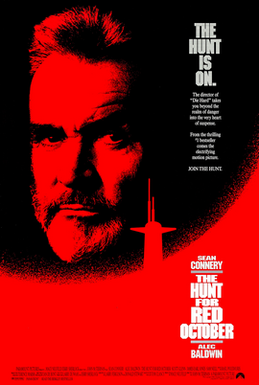
CRACKER? The Hunt for Red October (1990)


                “The Hunt for Red October” was based on Tom Clancy’s debut novel about a rogue Soviet sub captain who attempts to defect to the West.  The book was a bestseller and Hollywood was interested.  The U.S. Navy was interested in cooperating due to the desire to have a boost to submarine recruitment similar to the effect “Top Gun” had on naval aviation.  The Navy vetted the script and was pleased.  It allowed inspection of the non-classified sections of American subs so the production could create realistic interior sets on soundstages on gimbals for pitch and roll.  For the first time, the USN allowed the filming of a sub in dock. For exterior shots, the production built a 500-foot mock-up that could submerge and surface.  The movie was directed by John McTiernan who was famous for action films like “Die Hard”.  This was his only war movie.  “The Hunt for Red October” was a big hit.
                The movie is set in the Cold War before the collapse of the Soviet Union.  The movie opens with a title card informing the audience that there was an incident in 1984 where a Soviet sub sank in the Atlantic due to a radiation problem.  Very suspicious, right?  “But according to repeated statements by both Soviet and American government nothing of what you are about to see actually happened.”  Wink, wink.  Now that the seed is planted, we learn that there is a Soviet Typhoon class ballistic missile submarine captain who wants to defect to the West and bring his boat with him.  The rest of the officers are on board and if they aren’t, Capt. Ramius (Sean Connery) will take care of them Ninja style.  A CIA analyst named Jack Ryan (Alec Baldwin) has discovered that the Red October has a revolutionary propulsion system called a “caterpillar drive” that makes the boat very difficult to be picked up by passive sonar (which is basically the ability of another sub to hear the sub when they are both under water).  Coincidentally, the USS Dallas (an attack submarine) is on duty monitoring Soviet subs in the Atlantic.  It’s ace sonar operator Jones (Courtney Vance) picks up the Soviet boat and then loses it when the caterpillar drive is initiated.  Ryan connects the dots and convinces the CIA that the reason why the Soviet navy has sallied in large numbers is to track down the Red October before it can defect.  We need to make contact with Ramius and facilitate his gifting this amazing technology.  Since its your crazy theory, you can do the contacting, Mr. CIA analyst.  Meanwhile the entire Soviet navy is determined to sink its ship.  In particular, one of Ramius’ proteges is chasing him in an attack sub called the V.K. Konovalov.  It’s like “Fast and Furious” underwater.  The movie would have been better titled “The Chase of Red October” as the boat is actually easy to find.
                “The Hunt for Red October” is an entertaining rendering of a popular novel.  It has been a long time since I read the book, but as good as it was, the movie is better.  The plot makes clearer the motivation of Ramius.  The book emphasized the death of Ramius’ wife due to a corrupt system.  Sean Connery insisted in clearer motivation so John Milius was brought in to write dialogue where Ramius speaks about having an impact on the Cold War.  He is a “good Russian”.  Connery also insisted that the movie make it clear that the incident is occurring before the Gorbachev era.  Once the motivation and goal is firmed up, the movie is very manipulative to get to the desired conclusion.  Not that that is particularly unusual for a Hollywood action movie.  You decide on the outcome and then arrange the dots to get there in as exciting a manner as possible.  And plausibility be damned.  I already mentioned “Fast and Furious” as a good example. 
                The connecting of the dots is competently done by an outstanding cast.  Alec Baldwin was the original Jack Ryan and he does a good job in portraying him as a reluctant hero.  An egg-head who was also a Marine so it is fairly believable that he can go from policy wonk to action hero. Scott Glenn is well-cast as the captain of the USS Dallas.  The Navy may have been hoping for a “Top Gun” type recruiting result, but the sailors are not mavericks.  Glenn went on board the USS Houston and was allowed to parrot orders to get a feel for the captaincy of a sub.  Mancuso is not a Captain Queeg.  In fact, he even listens to a CIA analyst at the risk of his boat and its crew.  This is the modern Navy, young men.  But the key recruiting bait is Sonar Operator Jones. Hey potential African-American submariners, you can now be a Sonar Operator instead of a cook in today’s silent service.  (And in just a few years with “Crimson Tide”, you could actually become an executive officer.)  Not only can you be a sonar expert, but you can go aboard a Soviet sub with a select group even though the enemy sub already has a sonar operator.  (But they did not have a black guy.)  Sean Connery is solid especially after he no longer has to fake a Russian accent.  He is so good you forget he plays a traitor and murderer.
                The movie is refreshingly free of submarine movie clichés.  It does have the claustrophobic setting.  The sets are authentic looking.  The Navy cooperated with the mise-en-scene for the Dallas and set designers winged it with the Red October by putting in lots of dials, buttons, and assorted gizmos.  The underwater shots are excellent, but clearly CGI.  This is an improvement over models, however.  The special effects are good and unfortunately encourage some silly pot developments, as I will point out below.  The sound effects are outstanding as evidenced by the film’s lone Academy Award for Sound Editing.  Speaking of sound, the soundtrack is one of the best for a war movie. 
                So, it’s a good movie then?  Yes, but it is a bad war movie.  Plot devices that have the average viewers on the edge of their seats, have hard-core war movie lovers pulling their hair.  There is much that is ridiculous in this movie.  Let me name a few things that I found laughable.  Ryan is an unheralded CIA analyst and yet he convinces the head of the CIA and a submarine captain to take action on his theories even though he presents no convincing evidence.  Although Ramius is meant to be a positive character, he is certifiably insane if you look at some of the things he does.  He sends a letter to the head of the Soviet Navy telling of his intentions, which makes his goal infinitely more difficult.  This was a plot requirement, obviously.  By the way, he made this decision without consulting his fellow mutineers.  He traverses an underwater twisting cavern at a recklessly high speed.  The movie is also chock full of implausibilities - all of which propel the narrative.  It is an incredibly small ocean as three submarines keep running into each other.     Well, not literally running into each other, but coming within a whisker of each other.  They are so close that torpedoes don’t have time to arm themselves!  The final showdown between the Red October and the Konovalov strains credulity for anyone familiar with how subs actually fight.  This is intercut with an equally ridiculous showdown between Ryan and a patriotic Soviet (and that’s exactly what he is!).  There’s more, but I won’t bore you with the details.  You may now yell “it’s just a movie, for Christ’s sake!”   It is just a movie, but this blog reviews war movies.  It is definitely a war movie so it should be held to a higher standard than “Die Hard”.  And the technical adviser should also be held to a higher standard.
                Will it crack my 100 Best War Movies?  No.  In fact, although there is a fairly large submarine subgenre, few are well done.  “Das Boot” stands out because its competitors are weak.  It is hard to make a realistic submarine movie, although the dynamics are rife for drama.  Those dynamics tend to be cliched.  One thing about “Hunt” is it avoids the tropes of the subgenre, but it substitutes the tropes of the action genre.  Enjoy.

GRADE  =  C

HISTORICAL ACCURACY:  If you believed that based on a true story bull shit that opens the film, you probably have not made it this far.  If you are still reading, sleep well knowing that the world did not come close to ending in 1984 due to a rogue Soviet sub.  Surprisingly, there was a seed of truth to Clancy’s novel.  He was inspired by an article about the attempted defection of a Soviet anti-sub frigate named the Storozhevoy (Sentry).  The political officer named Sablin planned the defection on his own.  He was upset with the corruption of the Brezhnev government and wanted to start a revolution.  His plan was to sail to Leningrad, take over a radio station, and broadcast a call to arms.  And I thought Ramius was insane!  He tried to convince the rest of the officers to join after he locked up the captain.  Only half the officers were convinced and the rest were locked up.  One of the supposed conspirators escaped to sound the alarm, so the ship was forced to flee the harbor ahead of schedule.  Sablin, who was persuasive for a delusional individual, got the crew to support the mutiny.  Many of them were conscripts.  They lost their enthusiasm when the Soviet air force found the ship and dropped bombs on it.  One hit the stern.  At this point, some of the crew set the captive officers free and they freed the captain.  The captain confronted Sablin and wounded him with a gunshot.  And that was that.  Sablin was executed, naturally.  However, the other mutineers were not.  All the officers were demoted or dishonorably discharged.  Most of the crew was sent home after taking an oath of secrecy.  The Soviet government did not want the public to get any ideas about rebellion or any Western authors any ideas for a book.  Or become the buffoons of a US Navy recruiting film.

Tuesday, November 6, 2012

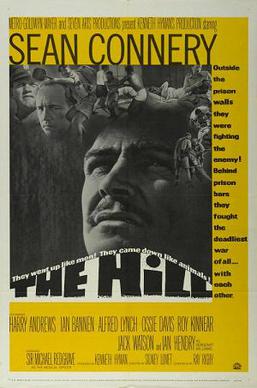
FORGOTTEN GEM? The Hill


           “The Hill” is a British prisoner of war movie released in 1965.  It was directed by Sidney Lumet and stars Sean Connery.  The screenplay is based on a play by R.S. Allen.   It is set in the Libyan desert in a British “glasshouse” which is what British Detention Barracks were called.  British soldiers are sent to these military prisons for various infractions like insubordination and desertion.  They had a reputation for cruelty.  This camp is run by the martinet Sgt. Major Wilson (Harry Andrews) who believes you have to break the inmates before you can remold them into good soldiers.

            The “Hill” is the artificial sand hill in the middle of the camp that is used for punishment.  The movie opens with a soldier carrying a sand bag to the top of the hill, emptying it, fainting in the hot sun, and being carried away as the other inmates drill in the background.  The camera pans away to reveal other soldiers going up the hill.  It’s an intriguing opening.

            A set of five new inmates arrives.  One is a former Sgt. Major Roberts (Connery) who has been convicted of assaulting a superior officer when he was given a suicidal order.  He is one sassy SOB and immediately tangles with the sadistic Staff Sgt. Williams (Ian Hendry).  Williams labels Roberts a coward and targets him for special treatment.  To make matters worse, one of his cellmates (McGrath – Jack Watson) takes a hating towards him.

            Williams also picks on Stevens (Alfred Lynch) because he thinks he’s gay.  He makes him climb the hill with a gas mask on.  In a movie where even the guards are sweating their asses off, this is particularly evil.  Later, Stevens dies in his cell.  The Medical Officer (Michael Redgrave) is a wimp who refuses to stand up to Wilson when he demands he cover up the death.  Wilson realizes Williams is a bad egg, but believes loyalty to his officers is crucial to maintaining order.  On the other hand, Sgt.Harris (Ian Bannen) is humane and the conscience of the camp.

            A mutiny by the men has them chanting “Stevens”.  Wilson stands up to them and by threatening them with capital punishment for mutiny, gets them to back down.  When Roberts steps forward and demands to see the commandant, Williams and two other guards beat him up.

            Eventually, Williams gets what he deserves, but the movie ends with the distinct impression that the feel-good justice will be replaced with severe consequences.

            This is a powerful film.  It is not your standard POW film because the inmates are not technically prisoners of war.  They are more like convicts.  Also, there is no escape planned or executed.  It is basically a character study and an interesting one.  The themes are abuse of authority and the battle of wills.  There is a “power corrupts” vibe to it.  Never give power to flawed personalities like Williams.  You also get the frustration of trying to buck the system as represented by Harris.

            The movie is strong technically.  It won the BAFTA for cinematography.  Oswald Morris shot the film in monochromatic hues.  There are numerous close-ups and odd angles.  Morris uses quick cuts and some hand-held.  The screenplay has some good dialogue (although I couldn’t always understand those limey accents).  Connery gets some witty lines.  The characters are varied and fleshed out.  The acting is top notch.  This was Connery’s first big non-Bond role and he proves he will not be type-cast.  The rest of the cast is very strong.  Ossie Davis scores as an unstable prisoner who eventually appears before the CO in just his underwear.  Kudos to Lumet for making a movie with no likeable characters. 

            Although not based on a true story and not your standard POW film, “The Hill” deserves a place among the best of this subgenre.  It accurately portrays the brutality of the “glasshouse” system and gives the audience a look back to when physical abuse of soldiers to make men out of them was standard procedure. 
 
Grade =  B+ 


Sunday, January 30, 2011

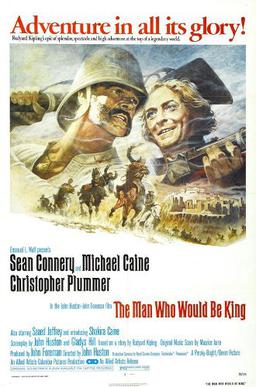
# 74 - The Man Who Would Be King


BACK-STORY: “The Man Who Would Be King” is a war movie that was released in 1975. It was directed by John Huston and is based on a short story by Rudyard Kipling. Huston co-wrote the screenplay. Originally intended as a project for Humphrey Bogart and Clark Gable, then Burt Lancaster and Kirk Douglas, then Robert Redford and Paul Newman, it was finally made starring Michael Caine and Sean Connery. It was nominated for Academy Awards for Best Art Direction, Writing, Costume Design, and Editing. The movie was critically acclaimed and did well at the box office.


OPENING: We open in an outdoor bazaar which could be “live” considering how little this part of the world has changed since the late 19th Century. British journalist Kipling (Christopher Plummer) is writing in his office when a mysterious man appears. He claims to be an old friend and has obviously fallen on some very hard times. Cue flashback.

SUMMARY: Peachy Carnehan (Caine) meets Kipling when he sits next to him on a train. Peachy has stolen Kipling’s watch. An Indian sits with them and is proceeding to eat a watermelon. Peachy throws the man off the moving train. So much for political correctness. Peachy is a typically racist ex-NCO in the British army.

Later, Peachy and his BFF Danny Dravot (Connery) meet with Kipling in his office and outline an outrageous plan to cross the Khyber Pass into present-day Afghanistan to become kings in a region called Kafiristan. They sign a contract in front of Kipling that pledges each to abstain from women and drink for the duration of their quest. The audience is told that the last person to conquer Kafiristan was Alexander the Great and his first wife Roxanne was from there.

The mates are off as part of a caravan. They are transporting a mule-load of rifles. The scenery is awesome as the cross the Kyhber Pass (actually shot in Morocco). They cross a raging river in goat skins. When they reach an impassable crevice, their bitter laughter starts an avalanche that covers the gap.

When they reach their destination they have an immediate impact by shooting some horsemen who are attacking some women and kids. They bring a captive to the nearby fortified town where they meet a Gurkha soldier named Billy Fish (Saeed Jaffrey) who is the sole survivor of a map-making expedition. He eagerly agrees to be their interpreter and advisor on local customs. Peachy and Danny offer to train an army for the local chieftain. The village lives in fear of more belligerent villages, so they decide to take up the offer. We get lots of local color like women singing songs and a polo match using a human head.

Next is the obligatory training montage. Danny tells the recruits that “when we’re done with you, you’ll be able to slaughter your enemies like civilized men.” (A line used later by the CIA with the mujahideen when they delivered Stinger missiles to be used against the Russians in the 1980s, I would guess.) He also tells them: “You are going to become soldiers. A soldier does not think. He only obeys. Do you really think that if a soldier thought twice he’d give up his life for queen and country? Not bloody likely”. Thus does he sum up the British army’s philosophy on discipline.

Let's get the hell out of here before they realize you are only James Bond
In the first battle, the enemy comes swarming out of their village to fall in heaps before the disciplined volley fire of Peachy and Danny’s army. An enemy arrow sticks in Danny’s bandolier under his shirt causing the immediate conclusion that he is a god. Specifically, he is assumed to be the son of Alexander (“Sikander” as they call him). With the morale that comes with having a god as your leader, the army takes several other villages and the army expands.

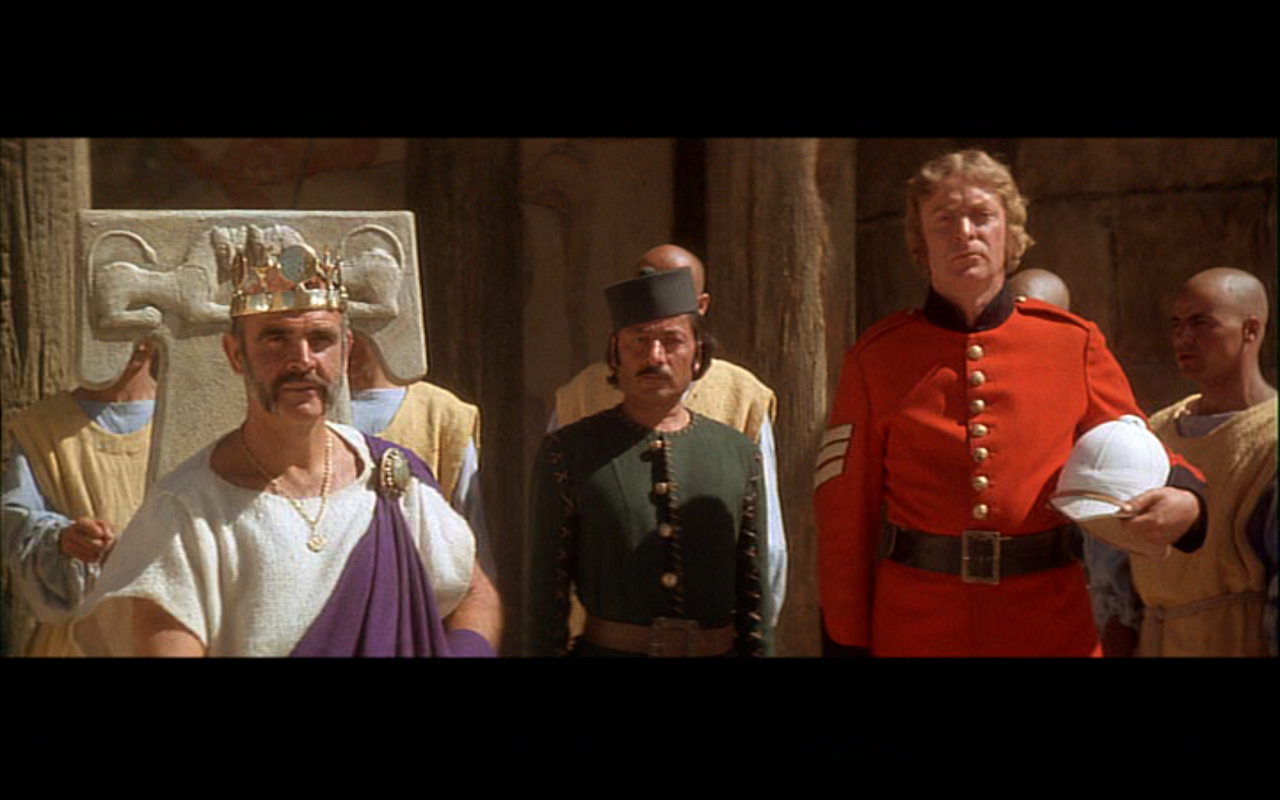
Danny is smitten with a beautiful woman named Roxanne (just like Alexander was). The boys are summoned to the holy city of Sikandergul to be vetted by the chief priest (played by 103 year old local Karroom Ben Bouih in his only movie). “God’s holy trousers!” say the mates. The priest is very skeptical and wants Danny to stop another arrow as proof of his divinity. Danny refuses and when they rip open his shirt he happens to be wearing a Masonic amulet given to him by Kipling. It just so happens to match the symbol for Sikander. He is proclaimed a god on the spot. Talk about a lucky amulet!

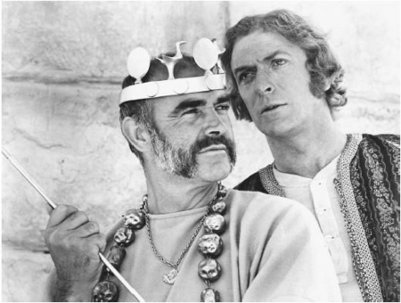
Danny, Billy, and Peachy
Now that he is crowned king, it is revealed that there is a storeroom full of treasure left by Alexander. Peachy and Danny are rich beyond their wildest dreams, as they say. Before returning to civilization, Danny decides to play the role of king to the hilt. He sits in judgment over local crimes and issues proclamations. It naturally goes to his head and cracks in the friendship appear when he insists that Peachy bow before him like everyone else “for appearances sake”. Peachy determines to leave and preoccupies himself with building a bridge over a gorge while he waits for spring. Danny, suffering from delusions of grandeur, decides to stay and develop Kafiristan into a modern country rivaling Britain. Of course a king must have a queen, so Danny decides to marry Roxanne (Michael Caine’s real life wife Shakira). So much for the vow of abstinancy.

When Danny announces his marriage plans, the priests are aghast because a god can not marry. Danny insists, even though everyone in the theater is yelling at him to read the omens. At the wedding, Roxanne is so afraid of marrying a god that she is in a trance-like state until she bites Danny on the cheek. All hell breaks loose as gods cannot bleed. The crowd wants a new polo ball and Peachy uses his riflemen to try to hold them off. Billy makes a suicide charge waving his kukri and yelling “Ayo Gurkhali” to buy time, but the mates are overwhelmed and captured.

CLOSING: Danny apologizes for being such a egotistical fool and Peachy accepts the apology. Danny’s punishment is to have to walk out onto the bridge over the gorge and then have the supports cut causing him to plunge to his death. (Connery performed the stunt landing on a pile of cardboard boxes.) At least he dies instantly, unlike the punishment for Peachy who is crucified between two trees. He miraculously survives the night so they set him free. Flashback over, Peachy reveals what’s in his bag to Kipling.

RATINGS:

Acting – 10

Action - 6

Accuracy – 8

Realism – 7

Plot – 9

Overall - 8

WOULD CHICKS DIG IT? Definitely. The story is a classic. The leads are among the greatest leading men of their time. The violence is not graphic. They can elbow their significant other in the ribs at the parts where Danny proves to be an insufferable jerk, like all men would be in his position. Oh, and did I mention that when Danny is getting robed for the wedding, you get to see Sean Connery’s bare ass? No fair fast-forwarding to that scene, ladies.  Or rewinding continuously.  Or pausing and sighing.

ACCURACY: The movie is based on a fictional story so accuracy is not really an issue. However, I can comment that the depiction of life in Afghanistan at that time is authentic. They really did play polo with human heads, for instance. After all, Kipling knew of which he was writing. Peachy and Danny did reflect the attitudes of your typical British soldiers. The Gurkhas were armed with knives called kukri like what Billy wielded. His last war cry, which translates to “the Gurkhas are here!” is the traditional war cry of them.

Kipling got the inspiration for the story from the real-life adventures of an American named Josiah Harlan. Harlan travelled to Afghanistan to become a king. He became involved in politics and military conflicts in the region. He trained local armies and did such a good job that a prince awarded him with the title “Prince of Ghor”. However, when Harlan made a trip back to Kabul, the British came in and conquered his “kingdom” and he was not allowed to return. He bounced around other parts of the world for the rest of his life and did not die falling in a gorge.

The movie follows the story very closely.  Kipling's story is pretty short so Huston had to fill in the details.  He does an outstanding job.  The movie is an excellent companion for the book and what few changes Huston makes with the book are wise ones.  For instance, the book is vague as to why Danny is considered a god.  The movie adds the arrow scene.  Also, the significance of the Masonic symbol is more adeptly handled in the movie. Huston decided wisely to make the unnamed journalist Kipling himself. The ending is different with Danny not leaving the item from the bag on the desk. Two days later, the narrator has Peachy committed to an insane asylum where he dies from the effects of sunstroke.

CRITIQUE: “The Man Who Would Be King” is rollicking fun. As the British would say, “It’s a golly good show”. Caine and Connery were obviously having a great time and it is contagious for the audience. (Of the four pairings considered by Huston, I would imagine them as number two behind Lancaster and Douglas). They have a roguish swagger appropriate for playing two rogues. Something to ponder: if remade today, who should the leads be? Saeed Jaffrey is a great third banana and adds some humor. I was very impressed with him.

John Huston does his usual great job as director. It was a labor of love which took twenty years to bring to fruition. He chose his actors well. They fit their characters perfectly. Even Shakira Caine (who was chosen when Huston was having trouble filling the role) fits well. Perhaps wisely, she is given no lines. She bites well, however. The scenery is beautiful. The score is wonderful. The one battle is artfully staged and accurately reflects modern fire discipline versus swarm tactics. The story is by Kipling so you know it is going to be grand. The script, because it does not sanitize Kipling’s British attitudes, is refreshingly politically incorrect.

My only quibble with it is I do not think it fits comfortably in the war movie genre. . It does not appear in some war movie review books. It is much more of an adventure story than a war story.  It also fits well in the buddy picture genre.  For example, Peachy commends his buddy for being able to "break wind at both ends simultaneously - which is more than any god can do".  That was meant as a compliment, by the way.  Being a war movie / buddy picture makes TMWWBK pretty unique.

CONCLUSION: “The Man Who Would Be King” is one of the great adventure movies. In fact, it should be required viewing for all boys. Or men who still have a bit of the boy still in them. Parents, force your boys to watch it, they’ll thank you after.

Next up:  #73 - The Bridges at Toko-Ri


the trailer


Danny = son of Sikander