Showing posts with label Medal of Honor. Show all posts

Monday, November 26, 2018

CONSENSUS #97 To Hell and Back


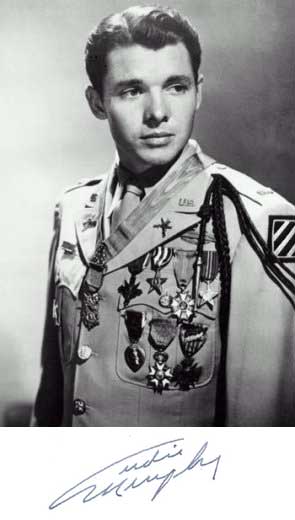
SYNOPSIS: "To Hell and Back" is the Audie Murphy story starring the hero himself. It is essentially Murphy's "greatest hits" and covers the major incidents in his career starting in Sicily and leading up to the climactic Medal of Honor moment in Southern France.  Although a biopic, the movie does have a squad feel to it as Murphy leads a typical cinematic heterogeneous unit.  There are several good battle scenes.

BACK-STORY: “To Hell and Back” is an autobiopic released in 1955. It is based on the book by the same name. It stars Audie Murphy as himself. It was his 16th movie. He had come to Hollywood after WWII at the urging of his friend James Cagney. This movie was his biggest hit in a career dominated by B westerns. He also starred in the acclaimed war movie version of “The Red Badge of Courage”. Murphy was reluctant to play himself because it smacked of self-promotion. He wanted Tony Curtis for the role. Studio execs and friends convinced him to take the part. They were right.

The movie was a critical and box office success. In fact, it was Universal’s biggest hit until “Jaws”. It was not a hit with Murphy, however. He felt that even though he had acted as technical adviser and tried to get things right, the studio sanitized the blood and gore of combat. He also felt the movie muted the unpleasantness of war and the negative emotions it brings out. He noted that the climate conditions that he actually fought in (mud, rain, snow) were usually depicted as nice, sunny weather.

TRIVIA:  imdb, Wikipedia, TCM
1.  In the Medal of Honor scene, Murphy was actually on a M10 tank destroyer, not a M4 Sherman.
2.  Murphy did not want to play himself because he thought it would come off as too egotistical.  He wanted his friend Tony Curtis.
3.  The production used 50,000 rounds of ammunition, 300 pounds of TNT, 600 pounds of blasting powder, and 10 cases of dynamite for the battle scenes.
4.  The movie was a huge hit and was Universal Pictures top film until “Jaws”.
5.  Audie Murphy in “To Hell and Back” was the inspiration for Rambo.
6.  The movie popularized the term “dogface”.
7.  It is still the only biopic that stars a movie star as himself.
8.  Murphy wanted to make a sequel called “The Way Back”, but could not get the financing.
9.  It was Murphy’s sixteenth film.
10.  Murphy was the technical adviser and was very hands-on in getting everything realistic.
11.  Murphy did not like the finished product and referred to it as a “Western in uniform”.  He was angry about the battle scenes being filmed in nice weather when the reality was worse.  He did not want the film to close with the Medal of Honor ceremony.  (He had left it out of the book.)  He generally felt the movie was not gritty enough and did not explain why he suffered from PTSD.
12.  Murphy was tabbed to be the villain in “Dirty Harry” when he died in the plane crash.

Belle and Blade  =  4.5
Brassey’s              =  2
Video Hound       =  3.8
War Movies         =  3.8
Military History  =  #77
Channel 4             =  not on list
Film Site                =  yes
101 War Movies  =  no


OPINION:   “To Hell  and Back” is a classic WWII movie.  Although it is rife with the usual clichés and stock characters, it is special because of the involvement of Audie Murphy.  Murphy, the most decorated American soldier of the war, deserved to have his story told and the fact that he stars as himself is unique.  It was a huge hit, but now seems a bit outdated in comparison with the more realistic and gritty films that began to hit the screen in the 1960s.  For instance, you get little of the reasons why Murphy was haunted by PTSD the rest of his life. 

Sunday, November 6, 2016

NOW SHOWING: Hacksaw Ridge (2016)


                “Hacksaw Ridge” is the new war film by Mel Gibson.  It is Gibson’s first movie in a decade.  The last having been “Apocalypto”.  Gibson’s earlier war movies were “Braveheart” and “We Were Soldiers”.  This one differs since it concentrates on a pacifist instead of a warrior.  But it has a similar religious vibe to “We Were Soldiers”.  The movie was fourteen years in development before Gibson brought it to fruition.  He spent a relatively sparse $45 million on it.  The filming took place mainly in New South Wales.  Robert Schenkkan and Randall Wallace wrote the original script, but thankfully Andrew Knight was brought in to polish it.  The movie premiered at the 73rd Venice Film Festival and received a ten minute standing ovation.  The movie is the true story of the first practicing conscientious objector in Congressional Medal of Honor history – Desmond Doss.  (Alvin York was a conscientious objector, but he decided to participate in battle as a regular infantryman.)  Doss earned his decoration on Okinawa in WWII.

                The movie opens with a violent combat scene replete with slo-mo, flames, flying bodies, etc.  A prayer is recited over the chaos.  This brief taste leads to a flashing back to sixteen years earlier in the hills of Virginia where Desmond Doss (Andrew Garfield) is dealing with a father who is a bitter WWI veteran who hits the bottle and occasionally his wife.  His mother is a religious woman who instills a love of the Bible in her son.  The family has a framed copy of  the Ten Commandment and the Lord’s Prayer.  Cain killing Abel is a prominent illustration.  Desmond grows up strictly believing the Sixth Commandment and also caring about his fellow human beings.  His saving a man who severs an artery in an accident foreshadows his future medical interests.  He meets a nurse named Dorothy (Teresa Palmer) in a kill two birds with one stone scene. Their 1940s romance goes as you would expect.  When Desmond volunteers for the Army, she sends him off with a Bible.  He goes because he wants to serve his country, but not kill for it.  He ends up at Fort Jackson for boot camp and when he meets the other guys, they seem nice - until they find out on the rifle range that he refuses to even touch a rifle.  At this point, his mates and superiors try to convince him that the military life is not for him.  Since we have seen the opening scene, we know his stubbornness will be rewarded with an all expenses paid trip to the tropical paradise of Okinawa.

                When they arrive at Hacksaw Ridge, they are welcomed by truck-loads of dead bodies and the thousand yard stares of the unit they are replacing.  Next thing you know, they are standing at the base of a cliff looking at some cargo nets that they must ascend to sweep the Japanese defenders off the ridge and thus win the war for the Allies.  Stop eating your popcorn because this shit is about to get real.  And really noisy.  And Doss is about to get really busy.

                “Hacksaw Ridge” is a surprisingly competent return for Mel Gibson.  I was definitely skeptical when I first heard about the movie.  I was intrigued with the subject matter, having mentioned Desmond Doss in my American History classes.   When my wife and I went to the WWII Museum this past summer, we spent time at the tribute to Doss as a Medal of Honor recipient.  A longer version of the interview shown before the movie’s credits is on display.  That interview makes clear the man’s deep religious convictions which naturally led me to fear what the religious Gibson might do with that theme. (I found “We Were Soldiers” to have laid on Col. Moore’s faith a little thick.)  Thankfully, “Hacksaw Ridge”, while it has numerous religious references, did not cause me to cringe.  For instance, many soldiers carried Bibles in WWII and Doss does not do any preaching.  There is a Christ on the crucifix image towards the end but it is subtle, especially for Gibson.  In other words, the film is not trying to convert anyone and appears to be a sincere attempt to bring the remarkable story of Doss to  the masses.

                The movie is well-made, but not memorable.  Not worthy of a ten minute standing ovation. The cast is fine with only a miscast Vince Vaughn causing head-scratching.  Interestingly, Vaughn is the only American actor in a movie where all the principal characters are American.  He plays the stereotypical gruff sergeant, but his boot camp schtick is that of Don Rickles more than R. Lee Ermey.  It is hard not to view it as stunt casting.  I am not big fan of Andrew Garfield, but he is satisfactory as Doss.  The role does not require a lot of heavy lifting as Doss is really one-dimensional.  Unlike his closest equivalent in cinema, Alvin York, he does not undergo a conversion experience and he doggedly maintains his original pacifist beliefs.  Garfield appears to have watched “Forrest Gump” a few times to prepare for the role.  There is some chemistry with Palmer as Dorothy, but the romance is straight out of a WWII movie made in WWII.  At least we get to know her a bit.  I can’t say the same for Doss’ comrades.  If Vaughn’s Sgt. Howell did not give a few nicknames in the obligatory barracks scene, they would have no personalities whatsoever.  The screenwriters only fleshed out Pvt. Smith (Luke Bracey) to be the embodiment of the units’ condescension toward the “cowardly” Doss and the respect Doss would earn on Okinawa.  Sam Worthington as Capt. Howell is solid in what is essentially the same cliché that Vaughn is playing.

                This could be a very polarizing movie.  The audience when I saw it was mostly senior citizens.  I can see where they enjoyed the biographical part of the feature, but then the movie shifts into combat porn midway through I doubt they expected to see a lot of entrails or rats eating corpses. (But there is little cursing in the film!)  The commercials claim that “Hacksaw Ridge” is the best war movie since “Saving Private Ryan”.  Sorry, no.  SPR revolutionized war movies by coming the closest to recreating what the soldiers experienced.  Since then some movies have been in the same league – Black Hawk Down, Flags of Our Fathers, Letters from Iwo Jima. We Were Soldiers, and Lone Survivor.  Others have taken the what I call “exteme realism” route.  The theory behind these movies is that because war is hell, the more hellish you depict it, the more realistic it will be.  Movies of this ilk include Pearl Harbor, Flyboys, Behind Enemy Lines, 13 Hours, and Fury.  And countless straight to DVD titles.  Since SPR, these types of combat porn movies have tried to top SPR by throwing a kitchen’s sink worth of weapons, explosions, flames, entrails, and gallons of blood.  More is not better.  Let me give you one example.  In SPR, a flamethrower is used to finish off a pillbox.  In HR, flamethrowers are used to roast charging Japanese.  The first example is an accurate depiction of use of that weapon, the second is not.  Here is another example.  In SPR, Capt. Miller drags an upper torso along the beach.  In HR, Smitty uses an upper torso as a shield as he wastes several Japanese in a Ramboesque spree.

                In conclusion, I recommend “Hacksaw Ridge” as a biopic, not as a war movie.  The movie is commendably accurate in bringing the story of one of America’s great heroes to the screen.  Desmond Doss deserved this movie and if jazzing it up with ridiculous combat was required to green light it after fourteen years, then so be it.  The combat is gonzo and reminded me of the Korean style as in movies like “Taegukgi”.  The difference is “Taegukgi” is clearly fictional and the combat is supposed to be entertainingly over the top.  I fear that American audiences who are not familiar with that style will mistake it for reality.  For instance, there are more bayonet stabbings in this movie than in the entire war in the Pacific.  If you want to know what it was like on Okinawa, watch the Okinawa episode of “The Pacific” miniseries.  If you want to learn about Desmond Doss, watch “Hacksaw Ridge”.

GRADE  =  B

HISTORICAL ACCURACY:  Desmond Doss did not volunteer for the war.  He was drafted.  However, he could have claimed a deferment due to his shipyard job.  He did claim conscientious objector status and was allowed to become a medic.  The movie is partly accurate in showing the animosity his beliefs fueled within his unit.  But the men were not as upset about his refusal to carry a weapon as they were with his refusal as a Seventh Day Adventist to work on Saturdays.  The men considered this to be shirking.  They let their feelings be known when they would pelt the praying Doss with shoes and epithets.  They called him “Holy Jesus” and Holy Joe”.  There were no beatings and the Smitty character is fictional.  (One soldier did threaten to kill him the first time they entered combat.)  His superiors (Hammel and Glover) did encourage him to quit and the movie does a fair job with the Section 8 and the court-martial.  The Army backed down, not because of intervention by Doss’ father, but because it realized that prosecuting him was a political mistake. 

                Doss did marry a nurse named Dorothy, but they met in a church and he was not prevented from making their wedding.  She did give him a Bible when he left for war.  His parents are well depicted.  His mother was the key to his religiousity.  His father was an embittered veteran with alcohol problems.  However, the incident involving the gun was between his father and an uncle, not his mother.

                The movie gives the impression that Doss’ unit first saw combat in Okinawa.  (And does not bother to explain what they were doing from 1942 to 1945.)  In actuality, the 77th Division fought on Guam and then Leyte in the Philippine campaign.  They were battle hardened.  And by Okinawa Doss had earned their respect. He earned a Bronze Star on Leyte.  The movie implies the men were still skeptical about him when they climbed the ridge.  They did go up on cargo nets.  The assault was successful at first with several pill boxes taken out with few casualties.  (One of the few tactical accuracies in the film has the men providing covering fire for Smitty as he sneaks up and throws in a satchel charge.)  A night attack by the Japanese swept Doss’ unit off the escarpment.  (The Japanese rarely launched banzai attacks in the daytime.)  He did stay and lowered wounded by way of a special sling he had learned in Virginia.  He later admitted to saving 50 men while the movie used the Medal of Honor citation number of 75.  He did pray to “help me get one more”.

                 The second assault was delayed as the men waited for Doss to pray and that assault did take place on his Sabbath.  The movie depicts this assault as though it was a routing of the Japanese.  (The scene reminded me of Gibson’s ridiculous feel-good ending in “We Were Soldiers”.)  In reality, evicting the Japanese from the escarpment was not via a heroic charge, but was done through painstaking and painful taking of enemy positions like caves.  The movie does not clearly portray his other feats.  On May 2, he rescued a soldier exposed in a position two hundred yards forward.  He also treated four wounded men very close to a cave entrance and dragged each back.  On May 5, he aided an artillery officer who was under fire.  And carried a wounded soldier one hundred yards soldier from where he had been pinned down.  On May 21, Doss was wounded by a grenade while in a fox hole at night.  He took 17 pieces of shrapnel in his leg.  When he was being moved five hours later, he rolled off his stretcher to bandage a wounded man.  Later that day, he was wounded by a sniper.  They did target medics.  He made a splint out of a rifle stock and crawled back 300 yards under fire.  He did lose his Bible in the process, but it was not returned by his searching mates until he was on a hospital ship.  Gibson decided that reenacting his actual wounding and selfless actions afterwards would be considered fictionalized by the audience.  And yet, it was okay to have Doss pulling Howell on a shelter half while Howell uses his grease gun to hold off pursuing Japs!  You can’t make this stuff up.  Oh, wait… 

P.S.  Dear Mel, during warfare soldiers occasionally have to reload.  I saw no examples of that in your movie.   

Saturday, January 26, 2013

Courage Under Fire


              “Courage Under Fire” is a film by Edward Zwick (“Glory”) that uses a “Rashoman” structure to explore the fog of war, friendly fire, and post-traumatic stress disorder.  The movie reteams Zwick with his “Glory” star, Denzel Washington.  The script is by Patrick Sheane Duncan (“84 Charlie Mopic”).  It was released in 1996 and is one of two major motion pictures that are set in the Persian Gulf War.  The other being “Three Kings”.  Both films are what I simply call “modern war movies”.
Serling:  "Get some!"
                Washington plays Lt. Col. Nathan Serling.  Serling is suffering from PTSD due to a friendly fire incident during the Persian Gulf War.  While leading a tank assault on the opening night of the ground war (with burning oil wells in the background), he fires on a tank commanded by his friend Capt. Boylar.  The Army awards him a Silver Star for that night and covers up the incident.  He is put in a desk job, but he is haunted by the accident.  He is drinking and is separated from his family.   His commanding officer Brigadier General Hershberg (Michael Moriarity)  gives him an assignment to help him recover.  He is to investigate the possible awarding of the Medal of Honor to a female soldier.  The Army expects him to give the green light to this publicity bonanza, but Capt. Karen Walden’s (Meg Ryan) story is complicated.
"Don't shoot till you see the men"
                The official story is Walden flew her medevac Huey to rescue a downed Black Hawk crew.  Taking fire from an Iraqi tank, Walden’s crew dropped a fuel cell on the tank and set it afire with a flare gun.  They still went down, however.  One of the crew (Rady) was badly wounded.  They held out under fire through the night.  The next day they were rescued, but Walden was killed and left behind.  She’s a heroine, right?  Or was she actually a typically cowardly female?
the brave version of Ilario
               Walden interviews the surviving crew members and a “Rashoman” theme develops as there are two distinctly different versions of what happened.  Specialist Ilario (Matt Damon in his first big role) confirms Walden’s heroism, but his account is suspicious.  The film reenacts Ilario’s version.  The opposing view is offered by Staff Sergeant Monfriez (Lou Diamond Phillips).  He is a card carrying member of the “He Man Woman Haters” Club.  In his reenacted version he is Rambo and Walden is Olive Oil.  Who is telling the truth?  Is the Army trying to give a medal to Sally Piss Panties?


Cobras versus Iraqis.  Spoiler alert: we kick ass!
                Herschberg pressures Serling to issue a rubber-stamped report.  When he refuses, he is taken off the case.  Would you believe he decides to pursue the truth on his own?  (You’ve seen movies before, haven’t you?)  He is aided by, you guessed it, an investigative reporter named Gardner (Scott Glenn) who is actually investigating the friendly fire incident.  The subplots intersect.
                I won’t give away the rest.  There are some interesting twists.  We get to see what actually happened in reenactments of both the Walden scenario and the Serling friendly fire incident.  Everything is tied up in a nice, tearjerking ball.
                This is a multi-layered movie.  It juggles several themes and two major plots.  The themes include:  shit happens in war (friendly fire), the military likes to cover up shit that happened, the authorities want heroes (or heroines) for the masses, PTSD can effect even the strongest personalities.  The plots of Serling dealing with his trauma and investigating the Walden case weave together effectively.  Duncan’s script is strong.  There are some cool twists.  The “Rashoman” elements are well done and entertaining.  It is not obvious which recreations are the truth  It gets a bit hammy in the end, but remember this film was made for a mass audience, not for hard core war movie nuts.  It is not a cynical movie.  This is part of what I mean by a “modern war movie”.
Monfriez:  "Say you hate women soldiers"
                The movie is technically sound.  The cinematography is outstanding.  The combat scenes are visceral, if a little too pristine.  The soundtrack is restrained and does not push emotional buttons too much.  The acting is top notch.  No surprise that Washington is amazing.  He does tormented like no other.  His scenes with his wife (Regina Taylor) are powerful.  She holds her own, by the way.  If you want to see a master at work, watch his visit to Boylar’s parents to tell them the truth about their son’s death.  The rest of the cast is excellent.  You can see Damon’s promise as he portrays the drug-addled Ilario.  He lost forty pounds for the later scenes.  An example of method acting that damaged his health for a while.  Phillips is surprisingly good as the macho Monfriez.  He gets a great death.  Moriarity portrays the general as compassionate, but part of the establishment.  Glenn is appropriately rumpled as the news hound.  Kudos must go to Ryan.  She has to play too totally different characters in the flashbacks.  She pulls it off without looking silly.  No small feat.
a Centurion playing an Abrams
                As far as accuracy, the movie is not based on a true story.  You can see a seed of inspiration from the incident in the Battle of Mogadishu ("Black Hawk Down") involving the snipers (Shughart and Gordon) that rescued Durant.  But, intentionally or not, I found the tale of Jessica Lynch to be another possible inspiration.  Lynch was captured during the war and the early press reports had her as a female warrior.  The truth turned out to be a lot tamer and less heroine-worthy.  The movie is a bit unrealistic on two accounts.  The tank tactics in the friendly fire incident has the M1A1 Abrams (actually disguised British Centurions due to DOD withdrawal of support for the film) virtually hub-to-hub in formation.  This isn’t the Napoleonic Wars, Zwick.  The medevac Huey is too well-armed for a chopper with a red cross on it.  These dudes were hardly noncombatants, but the movie does not make the case that the tank should not have fired on them and I can see where medevac crews might arm themselves beyond the Geneva Convention rules.  The dropping of the fuel cell is clearly ridiculous, but Hollywood has to have its explosions.
                “Courage Under Fire” got some love from the critics and did acceptable box office, but I am obviously a bigger fan than most.  I have read criticism of the conclusion, in particular.  However, if a movie can draw a tear from me, I’ll man up to it and say kudos.  Any other criticism of the plot is perplexing.  Some of it may be critics being critics and not reacting well to anyone attempting to copy “Rashoman”.  Boy, are they protective of those classics!  But since most people don’t have a clue about “Rashoman”, chill out.
              Sadly (and shamefully) I read a review by a war movie expert who I respect and he disliked the movie partly because he could not see a female soldier behaving bravely in combat.  That is bull shit!  Let’s face it, it may be against the law, but we have had females in combat since the Gulf War.  It’s just the nature of the “war with no front lines” that we have faced in Iraq and Afghanistan (and future locales).  I have read nothing to indicate that our female soldiers have become sniveling cowards when the bullets are flying around.  The Walden character is believeable and in the not too distant future we will have our first female Medal of Honor awardee for combat action.  You go, girls!  

grade =  A
 
Since I wrote this review, the Pentagon has announced plans to allow females to become combatants beyond fighter pilots.  Looks like we will see that female Medal of Honor winner sooner than I expected. 


Monday, December 31, 2012

#19 - Sergeant York (1941)


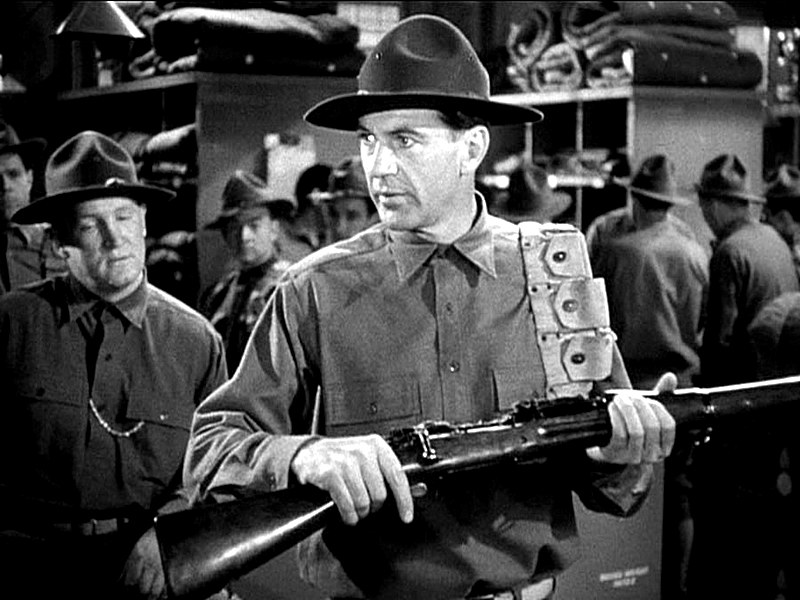
BACK-STORY:  “Sergeant York” is one of the great American classic war movies.  It was directed by Howard Hawks (“Air Force”,  the original “Dawn Patrol”)  and starred the biggest Hollywood star of that time – Gary Cooper.  It was the first major American biopic that told the story of a living person.  The desire to avoid law suits and controversy led to great efforts by the studio to keep the film accurate and authentic.  Of course, the main effort was to keep Alvin York happy.  York (true to his portrayal at the end of the movie) was not interested in taking advantage of his fame.  However, persistence on the part of producer Jesse Lasky eventually wore York down.  York drove a hard bargain and insisted on veto power over the screenplay and would accept only Cooper playing him.  The movie was a huge success and was the highest grossing film of 1941.  (The studio insisted on the outrageously high ticket price of $2.20!)  The movie was also critically acclaimed and garnered eleven Academy Award nominations, winning for Best Actor (Cooper over Welles in “Citizen Kane”) and Editing.
OPENING:  The national anthem plays over the credits.  Words tell us we are in the Cumberland Mountains in Tennessee in 1916.  A church congregation’s hymn is interrupted by the drunken carousing of Alvin York and his drinking buddies.  York uses a pistol to etch his initials in a tree.
SUMMARY:  A scene in the town general store establishes that the townspeople are isolated hillbillies.  Mention of the hostilities in Europe evinces puzzled looks and “What war?” remarks.  As far as their opinion, it is summed up with “t’ain’t none of our business”.  They may be isolated but they represent the prevailing opinion of the American public at the time the movie began production.
"You want me to do what with this?"
                York and his buddies (Ward Bond and Noah Beery, Jr.) go to their favorite bar.  It straddles the Tennessee – Kentucky line so Tennesseans can step into “wet” Kentucky to get a drink.  Naturally, a humorous bar fight breaks out.  It seems that York will fight if pushed.  File this away for later.  The cinematography puts the audience in the middle of the fight and the piano player literally controls the tempo of the scene.  York returns home to his saintly, put-upon ma (Margaret Wycherly).  She enlists the aid of the sagely pastor played by Walter Brennan.  Pastor Pile tries unsuccessfully to reform the hell-raising York who is only willing to concede that he will be open to the idea in the future.  The pastor predicts that religion “may come like a bolt of lightning”.  Spot on prediction!
                Isn’t there supposed to be a romance somewhere in this 1940s movie?  York reacquaints himself with the girl- next-farm named Gracie (Joan Leslie).  She is 16 and he is 28.  Before you cry “creepy”, remember these are hillbillies.  Before York can properly court Gracie, he must become the stereotypical American landowner.  A montage portrays his efforts to raise the cash to buy some bottom land.  In the montage is rail-splitting, of course.  The last of the cash comes from York’s victory in a turkey shooting contest.  All he has to do is get the bird to pop its head up and it’s over.  (I wonder if this would work with humans.)  Would you believe the property owner has sold the plot to York’s Gracie competitor?  York gets drunk and has bloodshed is on his mind when the Lord intervenes with that predicted lightning bolt.  The Lord adds sound effects in the form of a hymn from the nearby church just in case York is thick-headed.  York takes the hint and is born-again.  He even teaches Sunday school.  Redemption accomplished.  What is left?
"Is the target that huge circle?"
                War!  It comes in the form of a speeding rider and bold-faced headlines.  The bumpkins quickly agree that now it is our business, except holy-roller York who has a fundamentalist belief that thou shalt not “tech someone off”.  He refuses to be drafted, but even with the help of the pastor he cannot get an exemption which accurately reflects the niggardliness (look it up in a dictionary before you have a cow) of draft boards in WWI.  He ends up at Camp Gordon in Georgia.  It’s like a fantasy boot camp for adult men!  York makes friends with a guy from, you guessed it, Brooklyn.  Pusher (George Tobias) is the urban opposite of the rural York.  He teaches York what a subway is and York teaches him to kill the last turkey in a line first and work your way to the front.  Their tough drill sergeant curses York out for his pacifist leanings.  Just kidding, instead of curses he uses snide remarks.  That changes when York impresses everyone at the rifle range with his Robin Hoodesque prowess.   Damn it, this guy could be a killing machine if not for those pesky morals.
                York’s commanding officer (who gets a commission for every dead German killed by his unit) tries to get through to York.  He gives the dead-eye a civics lesson that must have had the audiences nodding.  He unfairly throws in a reference to Daniel Boone. That was below the belt!  York holds his own with his adherence to the Fifth Commandment (that’s the one about killing, you heathens).  However, he agrees to go on a ten day furlough to contemplate the commander’s duty trumps religion argument.  York takes along an American History textbook.  It’s God versus country.  On a hillside with his dog, York struggles until:  1.  the wind blows the Bible open to the “render unto Caesar” passage 2.  the dawn comes up  3.  patriotic music swells.  (The Founding Fathers say “I see your lightning bolt and raise…”)
                At the 1 hour 37 minute mark, we are finally off to war.  A trench episode introduces our soon-to-be-hero to bombardment.  Brit: “ If one has your name on it, there’s nothing you can do.”  One has the name of a comrade on it so York is introduced to death.  From here on, he’ll be putting the names on.
"Gobble, gobble"
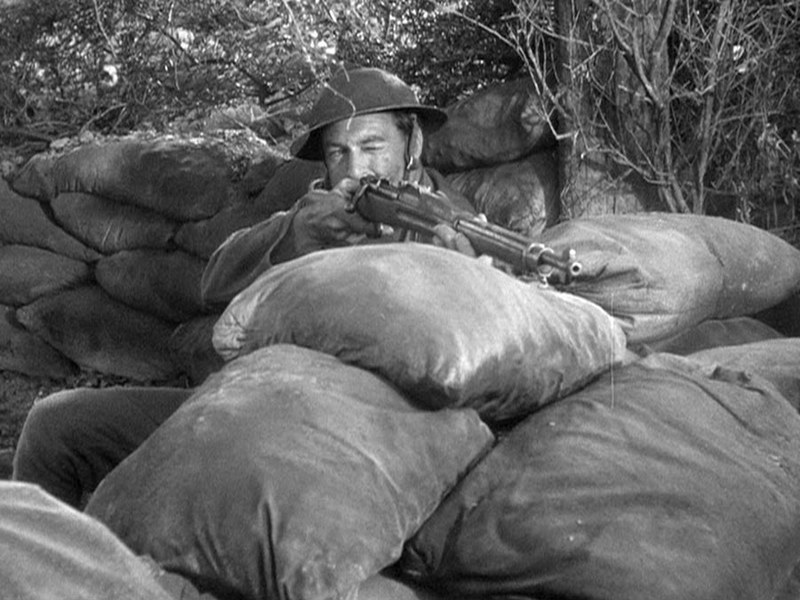
                On Oct. 8, 1918, York’s unit goes over the top (to “Yankee Doodle Dandy”) in the Meuse-Argonne Offensive.  The mission is a frontal assault on a machine gun infested hill.  The trip across no man’s land is fraught with touchdown signaling deaths.  The camera keeps us informed of York’s progress as well as that of his generic comrades.   When the assault stalls, York and 17 others are ordered to flank the ridge.  In the process, they surprise a group of Germans at breakfast and take them captive.  Unfortunately, this draws the interest of two machine gun nests on the hill which proceed to spray the area pinning down captors and captive alike.
                York takes it upon himself to rectify the situation.  He becomes the killing machine his commanders had hoped for.  The quartermaster also loves his not wasting bullets on missed shots.  His turkey hunting experiences come in handy with is appropriate because everyone knows the Germans are the turkeys of Europe in intellect.  (Germnas don't read this blog, do they?)  Oddly, six Germans charge York in a row instead of the line he had outlined in the barracks.  No matter, York “techs them off” in random order with his captured Luger.  Picking off the others from front to back results in the surrender of the entire unit.  York gathers up the prisoners, one of whom dastardly kills Pusher with a grenade.  (WWI or WWII – they are still evil!)  York (and the seven surviving Americans) returns to American lines with 132 prisoners.  He is an instant hero.
CLOSING:  York recounts his exploit to his commanding general to verify for the audience that his superhuman feat was indeed the real deal.  When asked what motivated him, York simply says that the machine guns were killing his men and gave him no alternative.  York receives several medals including the Medal of Honor from Gen. Pershing.  He is thus rewarded for fighting for his country.  He declines all endoresement offers and refuses to profit from his fame.  His returns home to a brass band playing at the train station.  (A scene brilliantly parodied in “Hail the Conquering Hero”.)  The state of Tennessee rewards York and his new bride with an idyllic farm and they live happily ever after
RATINGS:
Acting =  A
Action =  6/10
Accuracy =  B
Plot =  B
Realism = B
 
Overall =  B+
 
WOULD CHICKS DIG IT?  It depends on their tolerance for corn.  Certainly there is nothing offensive in it.  The combat is 1940s intense and has only a brief glimpse of blood.  The romance is appealing and not schmaltzy.  Cooper is charismatic and likeable.  A patriotic American woman should enjoy the plot and it won’t hurt if they are religious.  I would think non-American females might be left cold by it.  What say you, Caroline?
HISTORICAL ACCURACY:  “Sergeant York” is admirably accurate.  That’s what you get when you have an American icon and his persnickety peers watching over your shoulder.  Plus the producers had to be aware of a backlash from the isolationists if they laid it on too thick.  If you stick to the facts, you are on safe ground.  The screenplay was based on York’s diaries and he was hands on in his and Gracie’s depiction.  However, he did bow to some Hollywood tweaks.
                The movie is strongest in the authenticity area.  The country store, the York home, the church, and the border bar are all rendered with an attention to period details.  The portrayals of the common folk are also strong.  Warner Brothers provided a great company of hillbilly-looking character actors.  Older viewers will recognize many of them (or so I was told).  The accents ring true.  Cooper is in a league with Meryl Streep here.  The faces are truly rural American.  Wycherly hardly has to speak to communicate.
                As a biopic, you certainly get the gist of the York story and if he was happy with it, who are we to complain.  With that said, allow me to complain.  First, the things the movie does not tamper with.  York was wild and alcoholic in his early life.  He did get in bar fights and was actually arrested several times (not shown in the movie).  He did become born-again before U.S. entry.  He did claim exemption as a conscientious objector and was aided by Pastor Pile.  He did refuse to kill until talking with his commander and pondering on a furlough.  Most importantly, the Medal of Honor incident is substantially depicted as it was.  The post war epilogue is fine.  He did refuse endorsements and was given a farm.  Lastly, all but the Pusher character are real people who demanded they be accurately portrayed.
                There are a few Hollywood touches.  York was the third of eleven children and after his father’s death he helped raise the younger eight.  The movie has only room for two.  This is understandable as is the decision to simplify his conversion story.  There was no lightning bolt.  York gradually moved to redemption and it was capped off by a revival meeting.  There also was no rifle range revelation.  Speaking of rifles, the movie has York using a 1903 Springfield and a German Luger.  In fact, he was armed with a 1917 Enfield and a Colt .45.  It was Hawks who came up with affectation of licking his sight before aiming.  A nice touch.  And to be overly picky, the German officer did not use a bugler to call in more Germans to surrender, but used a whistle.
                There’s a weird moment when York returns to America and is staying at the Waldorf Astoria.  He flicks the light switch several times as though astounded by electrical lighting.  Are we to believe that he encountered no lights at Camp Gordon or in France?  None of this is egregious.  The very end approaches that status, however.  The postcard-worthy farm house and farm are a great exaggeration.  There was no farm house and the farm was heavily mortgaged which caused the York’s financial problems for years.  If I was York I would have vetoed this cruel joke.
CRITIQUE:  “Sergeant York” could not have been much better considering when it was made.  It is definitely in the top rank of black and white war films.  It is technically masterful.  The sets are obviously painstakingly prepared.  The no man’s land set was constructed by 300 workers and entailed the use of five tons of dynamite and the defoliating of 400 trees.  The indoor sets are particularly commendatory.  Look around the rooms for the little details on the walls.  The lighting is often mentioned by critics.  The score by Max Steiner makes use of patriotic songs, folk tunes, and hymns.  We hear “Give Me That Old Time Religion” several times in the background.  This could have been cringe-inducing, but the music is not used to ham up the emotions.  It just matches the already clear theme of the scene.  The cinematography is fine.  Nothing artsy. 
                The acting is a strength.  Cooper is at his best and said it was his favorite role (ironically, he was reluctant to play it).  He is a master of underacting.  He deserved the Oscar, although Welles’ fans might dispute that.  Brennan and Wycherly were nominated for Supporting Oscars.  The rest of the cast is perfect for their roles.  Such great faces, especially Wycherly.  (Watch for her portrait in York’s Waldorf Astoria room – there were no roaches in that room!)
                The screenplay is a marvel of achieved themes.  The film can be viewed as two parts.  The first part takes York from disdain for religion to Bible-thumping .  In general, the dynamic is between the religious people (exemplified by Mrs. York and the Pastor) and the hell-raisers (York and his compadres).  The second half has him make the shift from fundamentalist belief in the Old Testament to love of country, duty, and honor.  His evolution from pacifism to interventionism mirrored York’s actual feelings in the 1930s.  He began the decade, as did many Americans, disillusioned with the results of WWI and the machinations of the bankers and weapons makers to get us involved.  However, partly through conversations with Lasky and his experiences with the movie, he switched to pushing for U.S. entry and even went on publicity campaigns for the movie.  His involvement in the Fight for Freedom organization was the opposite of Lindbergh with America First.  In this respect, the movie York and the real York stand in for the American public.  The post script adds the third theme of reward for serving your country well.  Oh, and throw in "killing for your country is not a sin".  So go to it, guys.
               The combat scene lasts less than fifteen minutes, but is quite good.  I show it to my American History classes to prep them for their letter from the trenches which requires them to go over the top into no man's land.  (The other clips I use are from "Paths of Glory" and "The Lost Battalion".)  I have to admit that my students laugh at some of the deaths which include a rare 360 degree twirl while signalling a touchdown (which is shown from a different angle seconds later - why waste acting like that?).  See it in the clip below.  The action is well done and it helps that it closely parallels the actual event. It is superior to the Medal of Honor scene in "To Hell and Back".    
                The film is in many ways typical of the war films made during that era.  However, it does have an two interesting diversions.  First, the American officers are portrayed in a positive light.  They are not martinets, uncaring, or incompetent.  York’s CO and his second speak to him almost as an equal and are sympathetic to his dilemma.  The movie is refreshingly lacking in military cliches.  More significantly, this was the first movie about WWI that did not have a strong pacifist vibe.  This was clearly due to the motivation of the producers to encourage U.S. intervention and was a distinct gamble when you consider the predominately pacifist feelings of the public not long before the movie was released.  Pearl Harbor could not have come at a better time for this movie.  You could make a case that “Sergeant York” is the rare significant war film that is not anti-war.  Compare it to “All Quiet…” and “Paths of Glory” to see what I mean. 
CONCLUSION:   Does “Sergeant York” belong in the top twenty?  It depends on how you define “greatest”.  If you read it as “most important”, then you can make a case for it.  It’s effect went beyond simple entertainment.  It is a very entertaining film, but it also tells an important tale of a warrior that deserved the coverage (similar to Audie Murphy’s “To Hell and Back”).  More significantly, it played a role in American intervention in WWII.  The most popular film of 1941 encouraged Americans to see the positive aspects of involvement in the world conflict.  The attack on Pearl Harbor seemed to confirm that theme.
               To see clearly the evolution of war movies, compare "Sergeant York" (1941) and "To Hell and Back" (1955) to their modern equivalent "Born on the Fourth of July" (1989).  We've come a long way, for the better. 


Friday, December 31, 2010

#77 - To Hell and Back


BACK-STORY: “To Hell and Back” is an autobiopic released in 1955. It is based on the book by the same name. It stars Audie Murphy as himself. It was his 16th movie. He had come to Hollywood after WWII on the urging of his friend James Cagney. This movie was his biggest hit in a career dominated by B westerns. He also starred in the acclaimed war movie version of “The Red Badge of Courage”. Murphy was reluctant to play himself because it smacked of self-promotion. He wanted Tony Curtis for the role. Studio execs and friends convinced him to take the part. They were right.


     The movie was a critical and box office success. In fact, it was Universal’s biggest hit until “Jaws”. It was not a hit with Murphy, however. He felt that even though he had acted as technical adviser and tried to get things right, the studio sanitized the blood and gore of combat. He also felt the movie muted the unpleasantness of war and the negative emotions it brings out. He noted that the climate conditions that he actually fought in (mud, rain, snow) were usually depicted as nice, sunny weather.

OPENING SCENE: General Bedell Smith opens the movie with a monologue. He points out that soldiers have to adjust from civilian life to military life. Some of these men go beyond the call of duty. The movie is the story of the foot soldier as seen through the eyes of one of them.

SUMMARY: The movie begins in 1937 in rural Texas. Audie is part of a poor family in the Depression and things get worse when his father abandons them. Audie has to drop out and get a job. His mom dies and his siblings are put in an orphanage. He enlists, but is turned down by the Marines, Navy, and paratroopers because of his puny stature. He ends up as a lowly grunt. He is only 17.

     In an interesting decision, the movie skips the obligatory boot camp scenes and plops Murphy down in North Africa as a replacement. He is acting sergeant. We are not told how he got this promotion. In a scene that appears out of sequence, his commanding officer calls him in and wants to transfer him to a noncombat role because he is not cut out to be a soldier (why did he get promoted then?). Audie convinces him that he wants to be in combat.

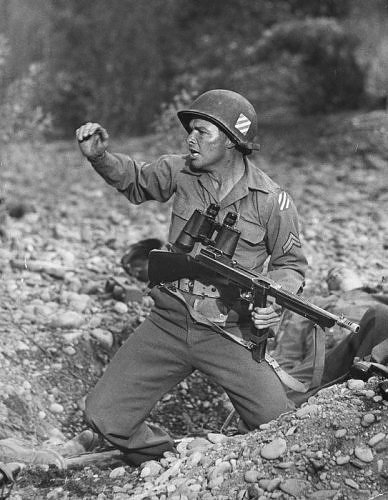
     Murphy sees his first combat in Sicily. They walk into an ambush which the Germans inexplicably spring long before the unit is in the kill zone. Three themes have reared themselves at this point. One, soldiers in this movie do not die realistically. They die like soldiers in a 1940/1950s war movie – twirling, arms outstretched, bloodless, and overly dramatic. (War Movie Cliché #29)  War Movie Cliches Two, Murphy likes to charge into danger, but not for glory. Instead, he does it for the good of his men. Third, Murphy (and his comrades) do not want to be promoted. They like being regular “dogfaces”. He is promoted to Second Lieutenant anyway.

first base only, dogface!
     In Italy, the squad sees more action. They engage the enemy along the Volturno River. Murphy continues to get promoted due to battlefield valor. It’s not all fighting. Since this is an old school war movie, we have to have the bar scene where they encounter another branch and a fight breaks out. Surprise! (War Movie Cliché #15) The unit gets some R&R in an Italian town which allows for some chaste interaction with females. One soldier hires a prostitute to listen to him rhapsodize about his girlfriend! Audie hooks up with a nice girl (but terrible actress) who takes him home for a home-cooked meal. The scene closes with a kiss.

     One good set piece is an attack on a farm house. We get more overly dramatic deaths with no visible wounds. When Johnson (Marshall Thompson) gets hit in a C-Ration can, he actually says “well I’ll be a dirty word”.  I bowel movement you not. They take the farm house and inside Murphy shoots his own image in a mirror. This obvious nod to combat stress is not explored in the film. One of the men gets killed when the stove he was just bragging about gets caught on some barbed wire he is crawling through. Add that to things not to do in a war movie – do not brag about your girlfriend or your stove! Murphy unrealistically takes out a German tank with a grenade launcher (why not a bazooka?). A point is made that veterans do not want to get friendly with new guys because it is too gut-wrenching when they buy it.

     They leave Italy for southern France. They are ambushed again and Murphy goes forward with his BFF (who he has been protecting throughout the movie) to take out the machine gun nest. His friend, Brandon (Charles Drake), actually says “they can kill us, but they can’t eat us – that’s against the law”. What? That is one bizarre line. Brandon gets killed when he assumes the Germans are surrendering and he exposes himself for them to treacherously blast him. At least there’s some blood this time. With revenge music swelling, Audie Murphy goes Rambo on several German machine gun nests. They messed with the wrong Ami.  The scene actually simplifies this remarkable action which resulted in the Distinguished Service Cross.

FINAL SCENE: The final combat scene is the famous Medal of Honor performance. This takes place during the Battle of Holtzwihr in a forest in France. His squad encounters a large German force of infantry and tanks coming across a field. Murph sends his men back for reinforcements and stays as the forward observer to call in artillery. The incoming rounds scare off the tanks, but the infantry keeps coming, so our hero jumps on an abandoned Sherman tank and uses its .50 caliber machine gun to slaughter a host of krauts. The tank is on fire, but he keeps firing away until he jumps off right before it blows up.  (This one man battle actually lasted about two hours!) The reinforcements arrive and he launches the counterattack before collapsing from a wound that ends his military career.

     The movie closes with his Medal of Honor ceremony which is observed by ghostly images of his buddies (in an homage to the end of “All Quiet”?).


RATINGS:

Action - 7/10

Acting - C  (Murphy is good, the others are not)

Accuracy - B

Realism - C

Plot - C

Overall - C

WOULD CHICKS DIG IT? There is nothing offensive in this movie. It is pretty tame for a war movie. If your significant other cannot stomach modern war films like “Saving Private Ryan” because of their grit and gore, a 40/50s war film like THAB might be her cup of tea. The cast is likeable and Murphy has a lot of charisma. There is the one romantic scene which your grandma might like.

ACCURACY: You would think that with Audie Murphy starring as himself in a movie based on his autobiography, accuracy would not be an issue. Unfortunately, either Murphy was not insistent enough or the studio overrode some of his objections. Based on his comments after release (“ a western in uniform”), it was the latter. You cannot really fault him for losing some of these battles. He was being paid as an actor, not historian. Plus, the studio bosses knew what elements of a war movie sold tickets in the 1950s. For instance, the book stops before the Medal of Honor ceremony, but the movie includes it. That does not excuse the producers for bending the facts.

     The main events are accurate. The film covers two of Murphy’s medal-winning exploits (but skips his two Silver Star exploits) and other than the sanitized nature of the scenes, they appear to be close to what happened. One small fudge was the use of a Sherman tank instead of a tank destroyer in the Medal of Honor scene. The deaths of several of his friends are authentic, if overly dramatic.

     What are inaccurate are the small details. The soldier banter, complaining, and ragging are very lame. Soldiers do not talk like the characters in this movie. The combat environment is usually too pristine. But hey, it’s a 50s war movie. What do you expect?

CRITIQUE: “To Hell and Back” has everything you would expect in a 50s war movie. You get the clichéd bar room brawl and the lame attempts at humor. You also get the deaths with no bullet holes or blood. The special effects are primitive. It is obvious the artillery explosions are charges placed in the ground. The burning tank looks fake. It is sincere, but quaint.

     The editing leads one to believe a lot ended up on the cutting room floor, perhaps to control the length of the film. There are several scenes that end early. These scenes leave the audience wondering what happened next and do not bridge well to the next scene. There is little attempt at character development, even for Murphy. Why do the vets accept the baby-faced Murphy as their leader? How does one of the youngest members (Murphy) become mother to these hardened veterans? Some themes are underdeveloped. Examples being Murphy is young, but overcomes it and don’t befriend new guys. More bizarrely, the movie uses maps to trace the movements of the unit, but does not do this for the invasion of southern France.

     The squad is stereotypically heterogeneous. There is a ladies’ man, Polish guy, Indian, jokester, Italian, country boy (Murphy), etc. Their banter is forced and interaction is not realistic. No WWII G.I. would use the phrase “I’ll be a dirty word”! This is a PG movie before there was such a thing.

     On the positive side, the movie is refreshingly not overly patriotic or propagandistic. The sound effects are good. There is plenty of old school action. The acting is adequate with Murphy carrying the load well. He dominates every scene even though several quality actors like Marshall Thompson share the screen. This was probably his best work along with “Red Badge of Courage”. You cannot downplay the kick you get from seeing a great warrior play himself in a war movie. That is pretty unique!

CONCLUSION: I hate to do this to one of my heroes, but “To Hell and Back” is very overrated at #77. If Murphy did not make the movie special by playing himself, it would be run of the mill. It would be an average 1950s combat film. It has many of the clichéd elements of that decade.

     What is disappointing is it could have been much better. Murphy should have stuck to his guns (sorry, pun not intended) and insisted the film explore the themes he wanted examined. As a victim of post traumatic stress disorder (he slept with a gun under his pillow), he could have easily portrayed the effects of combat and the deaths of friends. Supposedly one of the combat scenes caused him to have a flash back where he thought the scene was real. He was an advocate for recognition of PTSD as a disease, so you would think he could have used the platform of the movie.

     Murphy also knew better when the movie sanitized soldier life and combat. That would have been a harder battle to win with the studio given that the movie was meant to be a family film. This movie would be radically different if remade today. in other words, this movie is pre-“Patton” in psychology and pre-“Cross of Iron” in realism.

     With that said, watch it because it teaches you about the most decorated American soldier of WWII.  Audie Murphy really gets into the characters head.  It's like he knew the guy.  I heard he spent years preparing for the role.