Showing posts with label PT Boats. Show all posts

Wednesday, August 4, 2021

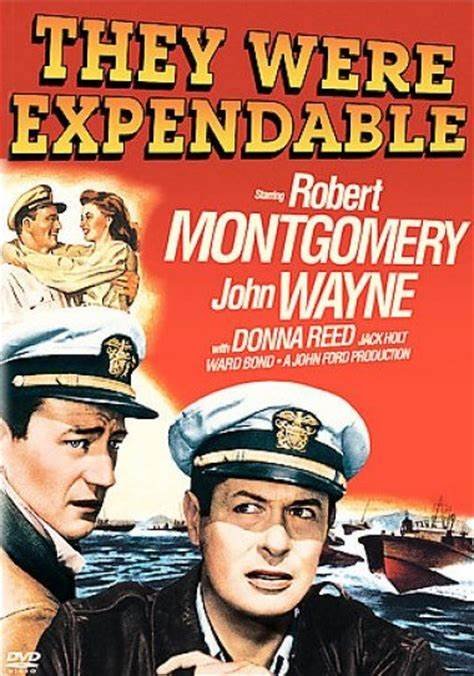
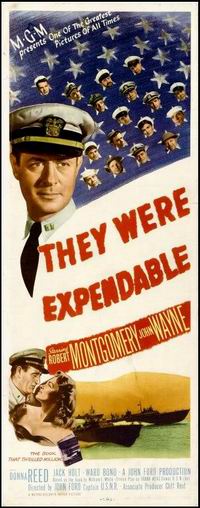
1st REVIEW REVISITED: They Were Expendable (1945)


                This is 11th anniversary of this blog.  I wanted to do something special and I decided to return to my first review.  I often think back to movies I have reviewed and wonder if I was right about my grade.  This is because even though I have reviewed over 900 movies for this blog, I have seen many of them a second time since the review.  Rarely do I change my mind about the movie now that I am a reviewer.  This differs from my perceptions of some of my childhood favorites that I have reviewed and found to be less than I thought at the time.  But what about a movie I reviewed eleven years ago?  I’ve seen a lot of war movies since then and read a lot of books about war movies.  Part of that reading is because I am a history buff and like to include back-stories for the films.  “They Were Expendable” is a movie with a lot of back-story. 

                In 1942, William L. White wrote They Were Expendable:  An American Torpedo Boat Squadron in the U.S. Retreat from the Philippines.  It was excerpted in “Reader’s Digest” and “Life” and then became a bestseller.  In 1945, MGM obtained the rights and wanted John Ford to direct it.  Ford was serving with the Navy Field Photographic Unit and had famously filmed the Japanese attack on Midway for a documentary.  He refused to leave the war to make the film.  However, he met John Bulkeley (the hero of the book) when he spent five days on his PT-boat during D-Day.  The experience convinced Ford to change his mind.  This was ironic because Bulkeley felt White had exaggerated his actions and he did not deserve the Medal of Honor.  Robert Montgomery’s casting as Bulkeley was brilliant.  He had entered the American Field Service in London before Pearl Harbor.  He was already a well-respected actor before that. He was President of the Screen Actors’ Guild and had been nominated for Best Actor.  After driving ambulances in France before the fall, he returned to his day job in Hollywood.  He was nominated for another Best Actor in 1941 and then enlisted in the Navy after Pearl Harbor.  He served in PT-boats in the Solomons and served on the USS Barton, a destroyer that was at D-Day.  He left the Navy as a Lt. Commander.  “Expendable” was his first movie after his war service.  

                John Wayne was second-billed as Bulkeley’s exec Robert Kelly.  Wayne’s WWII experience was almost the opposite of Montgomery’s.  He was 34 at the beginning and classified 3-A (family deferment), but could have enlisted.  He talked about it and wanted to join Ford’s unit, but Republic Pictures threatened to sue for breach of contract and Wayne kept postponing his defiance of Republic until after his next picture. That moment never came.  Ironically, the epitome of cinematic war heroes was considered by some to be war avoider.   Surprisingly, the problem on set was not with Montgomery.  Ford, partly to suck up to Montgomery, treated Wayne like dirt, calling him “clumsy bastard” and “big oaf”.  The snide comments continued until Montgomery intervened and told Ford to lay off.  Another significant cast member was Ward Bond.  Ford created the role of Mulcahey for his down on his luck player (he made 25 movies with Ford).  The screenplay was by Frank “Spig” Wead who Wayne had played in “The Wings of Eagles” (“I’m gonna move that toe.”)

                After wrapping, Ford returned to his unit in time to cross the Rhine with it.  He did not like the finished product.  He felt it was forced and claimed to not have watched it until an interviewer suggested it to him in 1950.  Upon viewing, Ford admitted it was good.  He may have avoided watching it because of bad memories.  He fell off a scaffolding and broke his leg during production.  He spent two weeks in traction.  Montgomery took over directing.  He was the logical choice since he had been treating the experience as an apprenticeship under Ford.  At one point, Montgomery had suggested a different way to shoot a scene.  Ford did it Montgomery’s way and then when it was finished, he asked Montgomery if he was satisfied.  When he said yes, Ford opened the camera and gave the film to Montgomery saying “Here, take it home with you”.  At the helm, Montgomery did a good job and went on to direct several films, including “The Gallant Hours”.

                The movie is considered a classic example of the WWII films made during the war.  Although the war was coming to an end, it still has a heavy whiff of patriotism and propaganda.  It is an homage film to PT-boats in the darkest days of the war, specifically “in the year of Our Lord nineteen hundred and 41”.  John Brickley (Montgomery) and his exec Rusty Ryan (Wayne) head a unit of PT-boats which they proudly show off for a visiting admiral.   The admiral parts by proclaiming he prefers “something more substantial”.  Rusty agrees and wants a transfer to a destroyer.  (Way to think big!)  Pearl what?  Screw this transfer, I’d rather die in a “high-powered canoe”.  The god of war is going to try to make that happen.  It is going to be a bleak month or so.  In between two attacks on Japanese cruisers, they are tasked with evacuating MacArthur from the Philippines.  Through the whittling down of the boats moreso than the men, a romance between Rusty and a nurse (Donna Reed) is thrown in.  There is some command dysfunction similar to a submarine movie. 

                Although made during the war, TWE is considered subgenre challenging.  It appears to be different than films like “Bataan” and “Wake Island”.  Both are grim depictions of the hopeless, yet hopeful, early days.  Wayne does not get the girl, which is the only thing about the romance that is not cliche.  There is a scene that perfectly contrasts with where war movies are today.  Nurse Davis is invited to a dinner with the officers and is serenaded by some of the sailors. Imagine that in a modern movie.  The two leaders accept abandoning their men.   The enemy does not even appear (except in the form of T-6 Texans disguised as Zeros and dropping bombs they aren’t carrying).  However, in most ways it is not groundbreaking.  It has two heroes who butt heads.  (By the way, although Wayne is second-billed, his role is more substantial than Montgomery’s.)  The unit is heterogeneous.  There is a redemption arc, for the boats. They have a mascot, the cat “Bad Luck”.  There is a funeral.  In some ways it is the combination of a small unit and a submarine movie.

                The biggest problem with the movie and the thing that keeps it from being a great movie is its targets for adulation do not hold up.  The central theme is that the PT-boats were an underestimated weapon and had a bright future after the Philippines fell.  The whole point of Bulkeley and Kelly being evacuated is for them to help build the force.  The movie has them sinking two Japanese cruisers and taking credit for an escort carrier, a tanker, and a freighter.  By 1945 when the movie came out, it would have been very apparent that the boats, while glamorous, were light on successes and the successes shown in the movie were not based on facts.  For instance, in the second cruiser attack the movie has most of the torpedoes hitting the Japanese warship with fireworks ensuing.  In actuality, only one of eight torpedoes hit and it was a dud.  (Clearly the movie was not interested in criticizing our abysmal early war torpedoes.)   Perhaps the historical license is why the names of Bulkeley and Kelly were changed.  More unpalatable is the movie’s treatment of the MacArthur evacuation.  The general is treated like the god that the press had built him up as, so the movie was giving the audience what they expected.  But to have the sailors fawn over him is laughable considering his reputation amongst the men he left behind. 

                It turns out that I have not changed my mind about the movie.  I thought it was overrated in 2010 and I still do.  It was a good movie for its time and is one of the best movies made during the war, but it feels stodgy today.  The overly patriotic score and poorly written romance drag it down.  It breaks some tropes, but overall it is pretty predictable.

GRADE  =  B- 

Saturday, August 7, 2010

#99 - They Were Expendable


BACK STORY: Our 99th ranked movie was released in 1945 and directed by the legendary John Ford.  (Some consider it his best film.)  This was the last of his fourteen films with famed cinematographer Joseph August. The film is based on the book by the same name by William White. The book is the story of a PT boat squadron in the Philippines at the start of WWII. The screenplay was written by Frank “Spig” Wead who war movie buffs will recognize as the hero of Ford’s “Wings of Eagles” starring John Wayne  (“I’m gonna move that toe”) . The main characters in the book and movie are the commander John Bulkeley ( played by Robert Montgomery as John Brickley ) and his executive officer Robert Kelly ( played by John Wayne as “Rusty” Ryan ). Ford was good friends with Bulkeley and spent five days with him during the Normandy invasion. Bulkelely was in command of a PT-Boat squadron at the time. Ford had to step down from the director’s chair midway through shooting due to health reasons and surprisingly tapped Montgomery instead of Wayne to finish up. In a side note, real-life nurse Beulah Greenwalt (played by Donna Reed as "Sandy Davys") felt her portrayal “cheapened her character” and sued and won $290,000. The movie was a hit and was praised for its authenticity. It was nominated for Best Visual Effects and Best Sound Recording.  It was filmed in the Florida Keys which stand in well for the Philippines.
 
OPENING SCENE: The film opens with a patriotic song and quote from Douglas MacArthur ( “I shall return” ). We are in Manila Bay "in the year of Our Lord 1941". A line of PT boats approaches the harbor as naval brass watches. Brickley orders a maneuver by the squadron to show off their speed and maneuverability. This elicits the comment from the Admiral that the boats “maneuver magnificently, but I in wartime I would prefer something a little more substantial.” This establishes the theme that the torpedo boats are the navy’s stepchildren.

SUMMARY: We move on to the obligatory “sailors drinking in a club” scene. Any war movie buff knows a major announcement will be forthcoming to break up the party. Before that we get the cliché of a sailor (Ryan) demanding a transfer to a combat outfit and then tearing up the request when it is announced that Pearl Harbor has been attacked.

Brickley anticipates an air attack and leads the squadron out of the harbor. They fight off an attack shooting down two in a good action scene. However, upon returning to base they find it destroyed and burning. This actually happened.

The Admiral calls in Brickley and sets the theme that the PT boats are expendable. He uses the baseball analogy of a sacrifice bunt. He assigns them messenger and patrol duty. Later they earn a mission against a Japanese cruiser. Ryan has an arm wound and insists on going, but in cliché-busting move Brickley sends him to the hospital.

In the hospital, Ryan meets a comely nurse ( Donna Reed as Sandy Davys ) and of course, their relationship starts off prickly. Guess what – this is temporary! There is no historical basis for the love story, but this is a 1940s war movie so you are required to have romance.

Meanwhile they are having trouble with their engines due to sabotage. Before you say that that could not have been the actual reason – it was. They go after the cruiser in spite of faulty equipment. A model of a cruiser blows up in a spectacular fireworks display. Unfortunately, this never happened.

Nurse Davys stoically helps in an operation under bombardment, but later dons pearls for a dinner with the guys (she may be in uniform, but she’s still a woman). Rusty and Sandy begin their chaste romance.

Things are not going well at the front. Whenever a PT is lost the crew is conscripted into the army. In one admirable scene, Brickley sends off a group of his mates with a speech that does not sugar-coat the situation – you are expendable. In another surprising turn from the usual war movie fare, Ryan’s attempt to say goodbye to Sandy over the phone gets cut off and he does not see or hear from her again.
The squadron is given the secret mission of evacuating some big brass which turns out to include MacArthur and his family. MacArthur is presented reverentially with no hint that many soldiers were at this point calling him “Dugout Doug” for his rare appearances at the front. The “Battle Hymn of the Republic” plays on the soundtrack (the movie is full of patriotic music). A map shows the perilous journey which contributed to Buckely being awarded the Medal of Honor.

The survivors return to regular duty and sink another cruiser in an action-packed scene similar in fireworks to the first, but at least this one is based on an actual attack. The only problem is in reality only one torpedo hit and it was a dud. The movie-makers decided not to delve into the fact that American torpedoes in the early months of the war were notoriously unlikely to explode on contact with Japanese ships.
The next scene is an accurate depiction of a seaplane attack on Brickley’s boat resulting in its destruction. Try not to notice that the movie planes are dropping bombs they are clearly not carrying. Several crew members are killed and in the clichéd funeral scene, Rusty realistically proclaims that in war you cannot expect a fancy funeral.

They are now all in the Army. Ryan goes off by himself for no discernable reason, but at least he is sweating as he tromps through the jungle. He meets up with Brickley and they find the Army in full retreat. Before they can join their brothers in arms and go down in a blaze of glory a general informs Brickley and Ryan that they are too valuable to the future of the torpedo boat program and are going to be evacuated on the last flight to Australia. Sadly, their crew is not on the list so they part ways in an appropriately stoical male way. “Good luck” “So long” 

THE FINAL SCENE: In a refreshingly nontraditional scene, Rusty insists on getting off the plane to fight on, but desists after Brickley reminds him he cannot put himself above the needs of the service. “We’re going home to do a job and that job is to get ready to come back”. All those who thought no way the Duke escapes the battle in a plane – think again! We see the plane flying off into the sunset as their mates gaze up on their way to death or imprisonment as the “Battle Hymn” makes a reappearance.

RATINGS:

Action - 7


Acting - 8


Accuracy - 7


Realism - 8


Plot - 7


Overall - 7

WOULD CHICKS DIG IT?:  Surprisingly, in spite of the romantic subplot, my wife did not like this movie. She felt the love story was just thrown in to show the softer side of war. She found the film had too much of a documentary feel to it. She also had trouble keeping track of the characters.

CRITIQUE: Considering when the movie was made ( during WWII ), “They Were Expendable” is laudably free of many of the old-school clichés movies made during this period are noted for. There is no happy ending. The romance does not close with a long passionate welcome-back kiss. The heroes do not bathe in glory in the end.

An interesting dynamic is that between the two leads.  Montgomery underplays his Brickley and Wayne is, well, John Wayne.  Montgomery was just coming off his real-life stint as a wartime PT commander and probably would have been embarassed to be overly heroic.  He has the look of someone who has been there.  Wayne's character is much more gung-ho. For this reason, Brickley and Ryan are not BFFs and that is realistic.

In spite of the refreshing reining in of the standard plot-lines, the film does not altogether avoid some cringe-worthy moments. We get the patriotic soundtrack swelling at the appropriate scenes. There is the reverential treatment of the controversial MacArthur. Not surprisingly the effectiveness of the PT boats is exaggerated.

I was especially impressed with how the film-makers put in the usual plot-lines, but then twisted them. The romance between Rusty and Sandy is standard until their last conversation is cut off. Rusty insists on fighting although wounded, but gets over-ruled and sits the big attack out in a hospital. Rusty wants to go down fighting, but ends up fleeing the war zone. All very refreshing and unexpected.

ACCURACY: It handles a true story as accurately as could be reasonably hoped for. It is the realism of the script that is particularly praiseworthy. In an era when most war movies were puff-pieces, TWE dares to flout many conventions. Although optimistic at the end, there is no doubt that we got our ass kicked during the period the movie covers.

CONCLUSION: I would have to say that TWE holds up pretty well after all these years. The acting is strong and it tells a story that would normally be overlooked by Hollywood. The valiant PT crews in the Philippines at that stage of WWII deserve the recognition.  Specifically, John Buckeley deserves the recognition.  Let’s face it, if Hollywood had not made this movie, how many Americans would have known the role the PT boats played in the defense of the Philippines?


Next up:  #98 -  Thirty Seconds Over Tokyo

Coming soon:  DUELING MOVIES -  Expendable vs. Bataan