Showing posts with label Poland. Show all posts

Tuesday, November 28, 2017

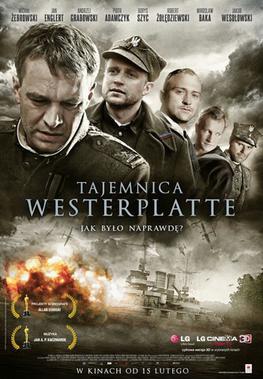
1939 Battle of Westerplatte (2013)


       “1939 Battle of Westerplatte” is a Polish-Lithuanian movie written and directed by Pawel Chochlew.  It was originally titled “Tajemnica Westerplatte”.  The movie chronicles the “Polish Thermopylae”.  This was the heroic defense on the Westerplatte peninsula in the harbor of Danzig at the start of WWII. 

                The movie opens just prior to the German invasion of Poland.  The Polish commander on the peninsula is a Maj. Sucharski (Michal Zebrowski).  He  is informed that he will have to hold out for twelve hours instead of six.  “This is a fight for honor.”  He is upset because he has only 200 men.  The clock starts ticking when a shell hits his headquarters. The initial German assault is repulsed with excellent explosive effects and graphic wounds, but the combat is brief.  The next seven days are a series of assaults followed by lulls in the fighting.  The Germans bring in CGI Stukas, an armored train, and flamethrowers, but the defenders continue to hold out.  The stress is having an effect on the Poles, but especially on Sucharski.  He is suffering from combat fatigue which looks a lot like cowardice.  On the third day, he wants to surrender.  This leads to command dysfunction as his second in command Capt. Dabrowski (Robert Zoledziewski) wants to hold out.
 
                “1939 Battle of Westerplatte” was controversial when it was released.  Some Polish patriots were upset with the less than flattering portrayal of the defenders, especially Sucharski.  The fact that the word tajemnica means “secret” implied that it was a revisionist view of the battle.  There is some justification for this viewpoint.  The Battle of Westerplatte  was technically the defense of the Military Transit Depot on Westerplatte peninsula.  The defense was centered on the fortified barracks as depicted in the film.  The battle opened with bombardment by the battleship Schleswig-Holstein.  This was followed by an assault by elite German forces which walked into an ambush.  A Polish soldier that was killed was the first death in WWII.  The Poles used  howitzers and mortars to repulse the attack.  The second attempt was met by felled trees, barbed wire, and heavy fire.  This and a third attack were also thrown back.  The Poles were forced to withdraw to a smaller perimeter centering on the barracks, but they continued to hold out against renewed forays and intense artillery and Stuka bombardments.  An attempt to set the bridge connecting the peninsula to the mainland failed when the fire from the train set the woods afire and allowed the defenders to wreak havoc.  By this time, Sucharski was urging surrender, but Dabrowski took temporary command to prevent this.  However, Sucharski got his way on the Sept. 7.  Only 14 Poles died in the battle so it was not exactly Thermopylae or the Alamo.  Sucharski came out of the battle as the most decorated hero and the defense was an inspiration to the Polish nation.  The movie tarnishes Sucharski’s reputation, but not really the rest of the men.  If anything, the Germans come off much worse.  These are hardly elite soldiers.  They are depicted as cowardly and incompetent.  Since the Poles are far from stalwart warriors, it is hard to see why it takes the Germans a full week to defeat them.

                The logical movie to compare this movie to is “The Brest Fortress” which covers a similar Alamo-type defense by Soviet troops in the early days of Operation Barbarossa.  “1939 Battle of Westerplatte” does not come off well in this comparison.  It is poorly acted.  The dialogue is stilted and there is too much of it.  At one point, Sucharski actually tells one of the men “You won’t die – that’s an order.”  There is plenty of time for talking because there is a shortage of combat throughout the movie.  There is a lot of fizzle to the events.  You expect kick-ass moments, but you get long stretches of boring.  This is disappointing because the initial combat is fairly well staged.  Classic case of bait and switch.  The lack of combat leads you to believe that there is no good reason for Sucharski to surrender.  This is a disservice to the men who held out against incredible odds for a full week.  One thing you can say, the movie is not overly patriotic.

                The only positive thing I can say about the movie is it clued me in on an event in WWII that I was not familiar with.  I was already familiar with the Alamo and as an American I think I would be upset if a new movie came out depicting Davy Crockett as suffering from shell shock and wanting to surrender early in the siege.  For this reason I have to side with the historical critics of the movie.


GRADE  =  D-

Wednesday, April 27, 2011

The Best WWII Comedy


My recent review of  as the #70 movie "Hail the Conquering Hero" on the 100 Greatest War Movies list got me thinking about what is the best WWII comedy. Besides “Hail”, other contenders would be:


“The Miracle of Morgan’s Creek”

“The Great Dictator”

“Buck Privates”

“Catch-22”

“Mister Roberts”

“Operation Petticoat”

“At War with the Army”

“Father Goose”

“What Did You Do in the War, Daddy?”

“Two Men Went to War”

“On the Double”

     In this post I am going to make the case for “To Be or Not to Be” as the greatest WWII comedy. TBONTB was released in 1942. It was directed by the acclaimed Ernst Lubitsch and stars Jack Benny and Carol Lombard (in her last film before her death in a plane crash on a war bond tour). It is set in Warsaw in 1939. Josef Tura (Benny) and his wife Maria (Lombard) are members of an acting troupe performing “Hamlet”. They have a typically dysfunctional acting-spouses relationship. Maria is having an affair with a dashing Polish pilot named Sobinski (Robert Stack) who comes to her dressing room each performance when Josef begins his “to be or not to be” soliloquy. Josef is very upset with this insulting distraction, resulting in the following exchange with Maria:

Josef: Someone walked out on me. Tell me, Maria, am I losing my grip?


Maria: Oh, of course not, darling. I'm so sorry.


Josef: But he walked out on me.


Maria: Maybe he didn't feel well. Maybe he had to leave. Maybe he had a sudden heart attack.


Josef: I hope so.


Maria: If he stayed he might have died.


Josef: Maybe he's dead already! Oh, darling, you're so comforting.

     Poland is invaded and months pass via a montage of Polish resistance. Sobinski is flying for the Royal Air Force. He meets a Professor Siletsky who is supposedly connected to the Polish underground, yet does not know who Maria Tula is. Sobinski goes to his superiors with his suspicion and is parachuted into Poland to alert the resistance. In turns out that Maria is working with the underground. She goes to Siletski’s hotel and pretends to be attracted to him. One of the acting troupe arrives disguised as a German soldier and takes Siletsky to Gestapo headquarters (the theater in disguise) to meet “Concentration Camp” Ehrhart (Josef in disguise). They have a hilarious exchange, but when Siletsky figures out he is being played he flees but is killed by Sobinski.

     Josef, disguised as Siletsky, goes to the spy’s room to get some papers from his trunk, but is intercepted and brought to meet the real Ehrhart. He finds out Hitler is coming to Poland the next day. Meanwhile, Siletsky’s body is found, so Ehrhart invites Josef back and shows him into a room with the dead Siletsky and closes the door. Ehrhart thinks being in the room with the corpse will cause him to crack and talk. Instead, Josef shaves off Siletsky’s beard and puts a spare fake beard on his chin. He then gets Ehrhart to pull on the beard and scolds him for not doing it earlier!

     A play is to be performed for der Fuhrer and the troupe plots a way to escape from Poland on Hitler’s plane. One of the actors (Bronski) does an excellent Hitler so they play like Hitler and his entourage are leaving the play early and thus commandeer his car. They have to pick up Maria, but when Bronski walks into her room he finds Ehrhart seducing her. Bronski immediately leaves, but Ehrhart is horrified to realize he is messing with Hitler’s girl. Maria adds to this by running after Bronski yelling “Mein Fuhrer!” They escape in Hitler’s plane. Bronski orders the two pilots to jump out without parachutes, which they do robotically.

     “To Be or Not to Be” is a true classic, but that fact was not recognized at the time of its release. The timing had something to do with this. The public and critics were in no mood for a comedy about the Nazis. The tragic death of Lombard also dampened enthusiasm for the film. Now that time has passed, the movie has taken its rightful place among the greatest comedies. AFI ranked it #49 on its list of greatest comedies. The only WWII comedy rated higher is “The Great Dictator” at #37. In my opinion, it is a much better film than Chaplin’s. It is certainly more laugh out loud funny. It is also less dated. The cast is great. Lombard is at her best and she definitely goes out at top of her game, sadly. Benny was never better. The dialogue is crisp and funny. There is taut suspense rare for a war comedy.