Showing posts with label To Be Or Not To Be. Show all posts

Sunday, June 2, 2024

100 BEST WAR MOVIES #57. To Be Or Not To Be (1942)


In this post I am going to make the case for “To Be or Not to Be” as the greatest WWII comedy.  TBONTB was released in 1942.  It was directed by the acclaimed Ernst Lubitsch and stars Jack Benny and Carol Lombard (in her last film before her death in a plane crash on a war bond tour one month later). Lombard told friends the movie was the most enjoyable experience of her career. Because of her death, the editor removed a line where Maria says “What could happen in a plane?”  Benny’s movie career was going nowhere when Lubitsch contacted him. Lubitsch (who co-wrote the screenplay) had written the role with Benny in mind. He wanted Miriam Hopkins for Maria, but she was upset with playing second banana to Benny. Lombard heard about the role and wanting to work with Lubitsch, she contacted him. Benny was on board with her replacing Hopkins and even agreed to give her top billing. Lombard suggested Robert Stack for the role of the Polish pilot and  was thrilled to work with him because she had been friends with him since they were teenagers. Lombard was so involved in the production that she was almost a co-director. Lubitsch was a Berlin Jew who left Germany after success in the German film industry. He found greater success in Hollywood which rankled Hitler. Footage of Lubitsch was used in the rancid propaganda film “The Eternal Jew.” It was nominated for an Oscar for Best Music.  

 The movie opens in Warsaw right before the Nazi invasion. Josef Tura (Benny) and his wife Maria (Lombard) are members of an acting troupe performing “Hamlet”.  They have a typically dysfunctional acting-spouses relationship.  Maria is having an affair with a dashing Polish pilot named Sobinski (Robert Stack) who comes to her dressing room each performance when Josef begins his “to be or not to be” soliloquy.  Josef is very upset with this insulting distraction, resulting in the following exchange with Maria.

Josef:  Someone walked out on me. Tell me, Maria, am I losing my grip?
Maria: Oh, of course not, darling. I'm so sorry.
Josef: But he walked out on me.
Maria: Maybe he didn't feel well. Maybe he had to leave. Maybe he had a sudden heart attack.
Josef: I hope so.
Maria: If he stayed he might have died.
Josef: Maybe he's dead already! Oh, darling, you're so comforting.

            Poland is invaded and months pass via a montage of Polish resistance.  Sobinski is flying for the Royal Air Force.  He meets a Professor Siletsky who is supposedly connected to the Polish underground, yet does not know who Maria Tula is.  Sobinski goes to his superiors with his suspicion and is parachuted into Poland to alert the resistance. He will enlist the aid of the acting troupe to get to Siletsky before he turns over a list of the Polish pilots’ family and friends. Josef and Maria will have to use their acting skills. Throw into the mix a visit from Hitler to see the play.

ACTING:                      A

ACTION:                      N/A

ACCURACY:               N/A

PLOT:                           A

REALISM:                   N/A

CINEMATOGRAPHY:   B 

SCORE:                       A

BEST SCENE:  when Josef gets out of a jam by shaving a corpse and putting a fake beard on it

BEST QUOTE: Bronski (dressed as Hitler):  “Heil, myself”      

            “To Be or Not to Be” is a true classic, but that fact was not recognized at the time of its release.  The timing had something to do with this.  The public and critics were in no mood for a comedy about the Nazis. Jack Benny’s father was at the premiere and walked out when he saw his son wearing a Nazi uniform. Benny convinced him to reconsider and his dad ended up seeing the movie 46 times.  The tragic death of Lombard also dampened enthusiasm for the film.  Now that time has passed, the movie has taken its rightful place among the greatest comedies.  AFI (American Film Institute) ranked it #49 on its list of greatest comedies.  The only WWII comedy rated higher is “The Great Dictator” at #37.  In my opinion, it is a much better film than Chaplin’s.  It is certainly funnier. It is also less dated. The film holds up amazingly well. . In fact, it holds up better than Mel Brooks’ unnecessary remake. Sometimes classic is better, even if it’s black and white.

The cast is great.  Lombard is at her best and she definitely goes out at the top of her game, sadly. Miriam Hopkins had been unhappy with the role because she felt Maria was just a foil for Josef’s one liners, but she was wrong because Maria is quite funny and holds her own. Benny was never better. His Josef is a ham actor and an egotist. Benny was clearly loving the role. He later said it was his favorite film. Robert Stack is well cast as the dashing young pilot. The rest of the cast are reliable character actors. They get some of the best lines. Nazi Colonel Ehrhardt is played by Sig Rumann.  He had escaped from Germany before Hitler took power.  

The dialogue is crisp and funny. The repartee between Josef and Maria is hilarious.  "If we should ever have a baby, I'm not sure I'd be the mother." "I'm satisfied to be the father." I counted 24 times that I laughed out loud.   There is taut suspense rare for a war comedy. There’s even a death that is not played for laughs.

It was considered daring to lampoon Nazis in 1942, so some wimps criticized its timing. It was slammed for being tasteless. A joke about concentration camps! Looking back at it, you could argue that it was one of the first black comedies. Laughter can be used as a weapon. The Nazis were ripe for being made buffoons. Lubitsch described the film as a farcical tragedy or a tragic farce.   

Friday, April 6, 2012

MARCH MADNESS: QUARTERFINALS

Dr. Strangelove (1) vs. Duck Soup (3)


FIRST HALF: CHARACTERS

        “Dr. Strangelove” has one insane character – Gen. Ripper. He is upset that fluoridation is harming our “precious bodily fluids”. He sends a flight of B-52 bombers to bomb the Soviet Union. Gen. Turgidson is a Curtis Lemay type jingoist who wants to win a nuclear war. Dr. Strangelove is a Werner Von Braun type of ex-Nazi scientist who has trouble remembering that the President is not der Fuhrer. The rest of the characters are normal people thrust into abnormal situations.

      “Duck Soup” has three outlandish characters. Groucho plays the President Rufus T. Firefly as an insult hurling cad. Chico plays Chicolini as a punning imbecile. Harpo plays Pinky as a adult brat. In other words, the same characters they always play. The other characters are all stock. The real standout is Zeppo as Bob Roland. What an incredibly complex character. Just kidding.

First half score: Strangelove - 46 Duck Soup - 40

SECOND HALF: SATIRE

        “Dr. Strangelove” is considered to be one of the great satires of war and nuclear war in particular. It was so cutting that some conservatives accused it of being leftist in its condemnation of Mutually Assured Destruction. The debates in the War Room on how to handle a nuclear crisis are hilariously chilling because they anticipate the insanity of an actual crisis.

        Surprisingly, “Duck Soup” has a similar theme: how a crisis can escalate into full-blown war. Of course it takes a different path to get to the explosions. The overall satirical theme is exploited for silly wordplay, sight gags, and slapstick, but in all the frantic action the point is made in a bludgeoning sort of way. Where “Strangelove” is Aristophanesesque, “Duck Soup” would make Plautus proud.

Second half score: Strangelove - 50 Duck Soup - 38

ANALYSIS:

        You will laugh more at “Duck Soup”, but that does not make it a better comedy. The characters are stronger in “Strangelove” and the satire is sharper. They are very much of their time period. “Strangelove” could not have been made in the 1930s and “Duck Soup” would have flopped in the 1960s. Neither would do well today. Most moviegoers are not smart enough to get satire like “Strangelove” (note the performance of “In the Loop”) and people do not want messages with their silliness as in “Duck Soup”.

FINAL SCORE:


DR. STRANGELOVE - 96


DUCK SOUP - 78


MISTER ROBERTS (5) vs. GOOD MORNING, VIETNAM (7)

FIRST HALF: CHARACTERS

      “Mister Roberts” has four main characters. Roberts is the noble warrior wannabe who cares for the crew and battles with the captain on their behalf. The captain is an incompetent martinet. The Doc is wise. Ensign Pulver is comic relief as the wolf in sheep’s clothing. The rest of the crew are comfortable stereotypes. Although all the main characters have been seen before, they fit the plot perfectly.

      “Good Morning, Vietnam” has one amazing character – Cronauer. Of course, the character is actually Robin Williams playing himself, so a lot depends on if you like his schtick. Tuan is an interesting character as the Viet Cong friend. He puts a sympathetic face to the enemy. Hauk is crucial as the humor-impaired superior. Dickerman (the station manager) is a cliché of the villainous, stick in the mud officer (excuse me, non-com). The most unorthodox character is General Taylor who is not portrayed as incompetent or hide-bound. He is refreshingly open to Cronauer’s antics because it boosts morale.

First half score: Mr. Roberts - 42 Good Morning, Vietnam - 40

SECOND HALF: SATIRE

       “Mister Roberts” is not really a satire, it is more of a service comedy. There is some satire of the officer class, but it is subtle and obvious. No new ground is broken, but that was not the intention of the movie. The movie does not make you squirm and it has no message to convey. It is meant to entertain and does that admirably.

      “Good Morning, Vietnam” is not purely a satire, but it definitely has satirical elements. It has a martinet, old school superior (Dickerson) similar to the Captain in “Roberts”. We’ll call that a tie. GMV goes beyond MR by satirizing conservatives versus liberals and pro-war versus anti-war. Of course, the movie is clearly liberal and anti-war. When it’s not masquerading as a Williams’ stand-up act, it has some shots to take at the War, but I think most of its audience did not leave the theater thinking they had seen a satire.

Second half score: Mr. Roberts – 32 Good Morning, Vietnam - 35

ANALYSIS:

This was a tough call. The movies are so different and both do their job well. Their main characters are equally strong. It comes down to the fact that GMV is funnier than MR and has more to say about the military and war. It is not necessarily a better film, it is simply a better war comedy.

FINAL SCORE:


GOOD MORNING, VIETNAM - 75


MR. ROBERTS - 74


STRIPES (8) vs. MASH (6)

FIRST HALF: CHARACTERS

       “Stripes” revolves around two screw-ups who do not adjust well to the Army. Winger (Murray) is a glib troublemaker and Ziskey (Ramis) is his smug straight-man. They remind me of Hope and Crosby. The rest of the unit are your typical heterogeously humorous mixture – the hick, the psycho, the jolly fat guy, etc. Capt. Stillman is from the officers are incompetent buffoons school. No extra points there. Sgt. Hulka is your typical Hollywood drill sergeant, but the movie deserves credit for pulling a character from a serious war movie (e.g., “Full Metal Jacket”) and not making him comical.

       “MASH” has more well developed characters. Hawkeye, Trapper John, and Duke are similar in their anti-military attitudes to Winger. The supporting characters are better developed than in “Stripes”. Major Burns and “Hot Lips” are good foils for the trio. Father Mulcahy, Lt. Col. Blake, and Radar are not as strong as in the TV series, but make more of an impression than most of Winger’s comrades.

First half score: MASH - 46 Stripes – 40

SECOND HALF: SATIRE


       “Stripes” is not a satirical film. It is mainly aimed at 14 year old boys and that audience is not known for getting satire. “Stripes” is low-brow humor and it is undeniably entertaining, but it has no important message to convey. With that said, it does poke fun at boot camp and incompetent officers. It also features an armored, multi-weapon RV designed for urban warfare. It is doubtful that the screenwriters meant that to be criticism of the Army’s Research and Development, however.

       “MASH” is a satirical, dark comedy. It is clearly anti-military. All the “positive” characters are unhappy with rules and regulations. All the “negative” characters (Burns, Hot Lips) are military toadies. The movie treats the Army apologists brutally. The movie uses the setting of a military hospital to criticize the insanity of war. The darkness is a deep shade of red.

Second half score: MASH - 45 Stripes - 33

ANALYSIS:

      You can argue that “Stripes” is a funnier movie. Of course, that depends a lot on your tolerance for Bill Murray. However, this tournament is to determine the “best” war comedy, not necessarily the funniest. It is clear that “MASH” is a better movie. It is a more important movie and that deserves some consideration. The makers of “Stripes” would probably admit that they had no message to deliver and were not trying to make the greatest war comedy of all time.

FINAL SCORE:


MASH - 91


STRIPES - 73


TO BE OR NOT TO BE (2) vs. TROPIC THUNDER (13)

FIRST HALF: CHARACTERS


       “To Be Or Not To Be” has a variety of interesting characters. Josef Tura stands out as the hammy actor. His wife Maria is not exactly loyal to him, but she is bravely helping the Resistance. Sobinski is a bit boring as the Maria-infatuated pilot. Ehrhardt is the buffoonish Gestapo commander. Silitsky is appropriately slimy as the traitor.

       “Tropic Thunder” goes over the top with most of its characters. Speedman is the action star who is trying to revive his stalled career and is full of actor insecurities. Lazarus is the method actor who immerses himself in his role to the point of getting his skin tinted. Portnoy is the drug addicted funny man. The list goes on. Virtually every role is a parody.

First half score: To Be or Not to Be - 42 Tropic Thunder - 47

SECOND HALF: SATIRE

       “To Be or Not to Be” satirizes acting troupes and Nazis. That’s an odd combination, but it works well. Benny’s Tura pokes fun at many leading men and their enormous egos. His marriage to Maria is a satire of Hollywood marriages. The movie daringly makes fun of Nazis at a time when the Germans dominated Europe. It makes them malevolent, yet laughable.

       “Tropic Thunder” is a biting satire of actors also. It takes on several stereotypes as mentioned in the character section above. It paints with broad strokes, but there must have been some actors squirming when they watched it (I’m talking to you Schwarzenegger/Willis/Stallone and Crowe/Day-Lewis). The movie also brilliantly satirizes war movies, in particular Vietnam War movies like “Platoon” and “Apocalypse Now”.

Second half score: To Be or Not to Be - 44 Tropic Thunder - 48

ANALYSIS:

       This is a battle between old school satire and modern satire. “To Be or Not to Be” was actually controversial when it came out. That is hard to believe today. It appears pretty tame compared to recent satires. In comparison, “Tropic Thunder” is the most recent film in the tournament. My how far war satire has come! Your opinion on which of these movies is a better comedy will tell a lot about your sense of humor and your age. In my opinion, the characters in TT are hilariously outlandish and that is acceptable in a satire. In addition, TT is the best (only?) satire of war movies and the skewering of sacred Vietnam War movies is spot on.

FINAL SCORE:


TROPIC THUNDER - 96


TO BE OR NOT TO BE - 86

Friday, March 30, 2012

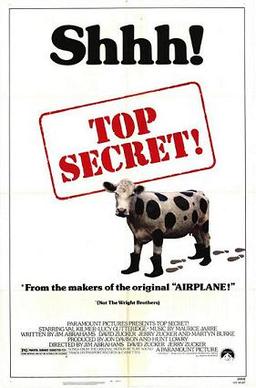
To Be Or Not To Be (2) vs. Top Secret! (15)


BACKGROUND:


        “To Be Or Not To Be” is a WWII comedy set in wartime Warsaw after the Germans have occupied Poland. It was released in 1942 and was bashed by critics for making fun of the ever-serious Nazis.  The plot centers on a Polish acting troupe led by the egotistical Josef Tula (Jack Benny) and his loose wife Maria (Carole Lombard). They get involved in a plot to stop the Gestapo from getting information from a spy. It requires their acting skills and even includes an imitation of Hitler.

        “Top Secret!” was released in 1984 and was directed by the “Airplane!” team of Zucker, Abrahams, and Zucker. It is set in Cold War East Germany. An Elvis Presleyesque American singer named Nick Rivers (Val Kilmer) meets a beautiful girl named Hillary (Lucy Gutteridge). He gets involved in a Resistance plot to rescue her scientist father.  Low brow comedy ensues.

FIRST HALF: ACTING

       “To Be Or Not To Be” has the pairing of Benny and Lombard. They are in top form. Both are perfect for their roles and the chemistry is apparent. Benny is hilarious in parts. The supporting cast is strong and all have their moments.  For instance, Maria's maid delivers some stabbing one-liners.  Even the Nazi Col. "Concentration Camp" Ehrhardt (Sig Ruman) is sinister, yet comical.

        “Top Secret!” features an impressive performance by Val Kilmer. He really gets into the silly role and carries the film. It’s hard not to enjoy his mugging.  He also does an amusing imitation of Elvis and sings convincingly. The rest of the cast is weak, but other than Rivers this is not a character movie. The actors are just there as props.

First half score: “To Be Or Not To Be” - 45      “Top Secret!” - 37


SECOND HALF: HUMOR

         “To Be Or Not To Be” is the perfect 1940s war comedy. It has a good plot, great acting, suspense, some great lines, and is consistently amusing. The one liners are spaced for best effect – the opposite of “Top Secret!” It also deserves credit for aiding the war effort by lampooning the Nazis at a time that they were fearsome. Benny does a great job making fun of hammy actors and his marriage to Maria is obviously a take-off on Hollywood celebrity pairings.  Some of the dialogue is very funny.

       “Top Secret!” is from the “Airplane!” school of frenetic humor. In this tournament it closely resembles “Hot Shots!” I have a theory that if a comedy has an exclamation point at the end, you can expect it to be silly with tons of jokes. It is a little less gag-crazy than “Hot Shots!” and includes some funny scenes spoofing Beach Boys music and teen idol performances. There are two unique scenes: a scene in a bookstore that is run backwards and an incredible underwater barroom fight sequence. There are lots of sight gags, but most are cute rather than funny.  Many are painfully silly (e.g., flying people shitting on a statue of a pigeon).  Some of the gags are very dated.   Who under fifty would get a Ford Pinto joke today? (By the way, it’s hilarious.)

Second half score: “To Be Or Not To Be” - 44 “Top Secret!” - 42


ANALYSIS:

       Once again, we have a match-up between old school and new school. In other match-ups I have argued that modern humor is funnier than old-time humor. However, acting and writing still rule. Quantity does not defeat quality when it comes to most comedies. Especially when the quantity of jokes comes with a low percentage of yuks. I happen to be a fan of the “Airplane!” school of comedy and do not mind cringing and laughing at the same time. (By the way, has anyone else noticed no similar movie has managed to top the original?) I do not mind feeling guilty about laughing. I have a soft spot for “Top Secret!”, but it does not stand up to “To Be Or Not To Be”.  The movie is now considered a classic and is ranked #49 on AFIs greatest comedies.  You could argue that it is underrated.  One thing you cannot argue is that "Top Secret!" belongs on the same list.

FINAL SCORE:


TO BE OR NOT TO BE   89


TOP SECRET!                79


Wednesday, April 27, 2011

The Best WWII Comedy


My recent review of  as the #70 movie "Hail the Conquering Hero" on the 100 Greatest War Movies list got me thinking about what is the best WWII comedy. Besides “Hail”, other contenders would be:


“The Miracle of Morgan’s Creek”

“The Great Dictator”

“Buck Privates”

“Catch-22”

“Mister Roberts”

“Operation Petticoat”

“At War with the Army”

“Father Goose”

“What Did You Do in the War, Daddy?”

“Two Men Went to War”

“On the Double”

     In this post I am going to make the case for “To Be or Not to Be” as the greatest WWII comedy. TBONTB was released in 1942. It was directed by the acclaimed Ernst Lubitsch and stars Jack Benny and Carol Lombard (in her last film before her death in a plane crash on a war bond tour). It is set in Warsaw in 1939. Josef Tura (Benny) and his wife Maria (Lombard) are members of an acting troupe performing “Hamlet”. They have a typically dysfunctional acting-spouses relationship. Maria is having an affair with a dashing Polish pilot named Sobinski (Robert Stack) who comes to her dressing room each performance when Josef begins his “to be or not to be” soliloquy. Josef is very upset with this insulting distraction, resulting in the following exchange with Maria:

Josef: Someone walked out on me. Tell me, Maria, am I losing my grip?


Maria: Oh, of course not, darling. I'm so sorry.


Josef: But he walked out on me.


Maria: Maybe he didn't feel well. Maybe he had to leave. Maybe he had a sudden heart attack.


Josef: I hope so.


Maria: If he stayed he might have died.


Josef: Maybe he's dead already! Oh, darling, you're so comforting.

     Poland is invaded and months pass via a montage of Polish resistance. Sobinski is flying for the Royal Air Force. He meets a Professor Siletsky who is supposedly connected to the Polish underground, yet does not know who Maria Tula is. Sobinski goes to his superiors with his suspicion and is parachuted into Poland to alert the resistance. In turns out that Maria is working with the underground. She goes to Siletski’s hotel and pretends to be attracted to him. One of the acting troupe arrives disguised as a German soldier and takes Siletsky to Gestapo headquarters (the theater in disguise) to meet “Concentration Camp” Ehrhart (Josef in disguise). They have a hilarious exchange, but when Siletsky figures out he is being played he flees but is killed by Sobinski.

     Josef, disguised as Siletsky, goes to the spy’s room to get some papers from his trunk, but is intercepted and brought to meet the real Ehrhart. He finds out Hitler is coming to Poland the next day. Meanwhile, Siletsky’s body is found, so Ehrhart invites Josef back and shows him into a room with the dead Siletsky and closes the door. Ehrhart thinks being in the room with the corpse will cause him to crack and talk. Instead, Josef shaves off Siletsky’s beard and puts a spare fake beard on his chin. He then gets Ehrhart to pull on the beard and scolds him for not doing it earlier!

     A play is to be performed for der Fuhrer and the troupe plots a way to escape from Poland on Hitler’s plane. One of the actors (Bronski) does an excellent Hitler so they play like Hitler and his entourage are leaving the play early and thus commandeer his car. They have to pick up Maria, but when Bronski walks into her room he finds Ehrhart seducing her. Bronski immediately leaves, but Ehrhart is horrified to realize he is messing with Hitler’s girl. Maria adds to this by running after Bronski yelling “Mein Fuhrer!” They escape in Hitler’s plane. Bronski orders the two pilots to jump out without parachutes, which they do robotically.

     “To Be or Not to Be” is a true classic, but that fact was not recognized at the time of its release. The timing had something to do with this. The public and critics were in no mood for a comedy about the Nazis. The tragic death of Lombard also dampened enthusiasm for the film. Now that time has passed, the movie has taken its rightful place among the greatest comedies. AFI ranked it #49 on its list of greatest comedies. The only WWII comedy rated higher is “The Great Dictator” at #37. In my opinion, it is a much better film than Chaplin’s. It is certainly more laugh out loud funny. It is also less dated. The cast is great. Lombard is at her best and she definitely goes out at top of her game, sadly. Benny was never better. The dialogue is crisp and funny. There is taut suspense rare for a war comedy.