Showing posts with label Richard Widmark. Show all posts

Saturday, July 15, 2017

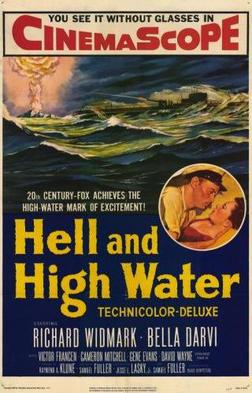
SUB MOVIE: Hell and High Water (1954)


                “Hell and High Water” is a Samuel Fuller (“The Steel Helmet”) film.  He did not really want to make the film, but he owed Darryl Zanuck because he had stood up to FBI Director J. Edgar Hoover when he wanted to squash the release of Fuller’s film noir “Pickup on South Street”.  Hoover did not like Fuller’s movies and felt the movie was not patriotic enough.  Zanuck told him tough luck.  Fuller insisted on rewriting the script and agreed to use cinemascope to prove that it could work in a submarine setting.  The movie was nominated for an Oscar for Best Special Effects.  The movie was a big hit and is one of Steven Spielberg’s favorite films.

                The movie begins with a narrator telling us that there has been a mysterious nuclear explosion in the North Pacific.  The year is 1953 and the world is stuck in the Cold War.  This ominous development has brought a team of international scientists together and they hire an ex-sub skipper named Jones (Richard Widmark) to go on a special mission to save the world from nuclear destruction.  Jones is provided with an old WWII Japanese sub that he accurately describes as a “sewer pipe”.  But he at least gets to pick his motley crew.  However, he will also have to bring aboard the lead scientist Professor Montel (Victor Francen) and his comely assistant scientist Denise Gerard (Bella Darvi).  Once they get their wolfish comments out of the way, the crew realizes that they are supposed to be upset about having a woman on board.  Jones quells the mutiny by pointing out that it is impossible to have a romance without a female.  As with all submarine special missions, the sub has to sail prematurely.  It follows a Chinese freighter that is delivering supplies to a mysterious island.  And it is being followed by a Chinese sub.  Queue the sub duel.  When they reach their destination they have to make two shore party landings.  Double the fun! 

                I have to admit that I was not familiar with “Hell and High Water” until I did my Submarine Movie Tournament.  This is surprising because it is a Sam Fuller film and it was a box office success.  The movie has possibly been forgotten because it is something of a curio from the Cold War era.  It is the only sub movie that I can recall that features a Red Chinese sub.  The plot is unique (although not immune from sub movie clichés), but not outlandish.  The idea of the Communist Chinese possessing a nuclear bomb would have been a scary specter in 1954, but the how the movie posits they might use it is James Bondsian.  Jones is no secret agent, but he does have Bond’s snarky nature and gets to bed the sexy scientist.  Widmark is perfect for the role and could play it in his sleep.  The rest of the cast is fine.  Even Darvi, who did not have to win the role by out-auditioning others.  She was Zanuck’s mistress.  The rogue invented her stage name from a hybrid of Darryl and his wife’s name, Virginia.  (War movie fans might recall that Zanuck also put his current mistress, Irina Demick, into “The Longest Day” eight years later.)  She does not embarrass her mentor/lover. She is the rare strong female character in a war movie.  She is a hot egg head who can fight.  Her character gets to kill a commie – surely the only female kill in a sub movie.  The big three get some character development (Jones lost his boat in WWII to a mine), but other than drooling and bitching about the dame, the crew is just along for the ride.

                “Hell and High Water” is one of the better sub movies.  This is mainly because it is a Sam Fuller film.  It has his gritty, no nonsense style.  This is crucial because there are plot developments that are nonsensical.  He avoids most sub clichés.  The most common cliché, the sub is depth charged, does not occur.  It can’t avoid the special mission and commando raid tropes.  The first landing has a lot of “Crash Dive” in it.  The effects are fine and deserved an Oscar nod.  The underwater effects are fine, but hardly revolutionary.  It is certainly a must-see for war movie lovers and Sam Fuller fans.


GRADE  =  B

Saturday, November 19, 2011

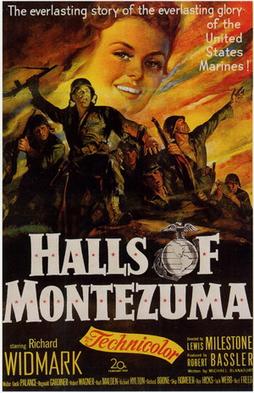
The Halls of Montezuma (1951)


      “Halls of Montezuma” is a war movie released in 1951. It was directed by Lewis Milestone and was inspired by a short film entitled “Objective – Prisoners” which was about the necessity of taking prisoners for interrogation purposes. It was filmed at Camp Pendleton, California with the full cooperation of the Marine Corps. The movie is dedicated to the Marines and was later used as a recruiting film. It opens with the “Marine Corps Hymn” which, of course, starts with ”From the halls of Montezuma”.

      The seven surviving members of a platoon are on a troop ship headed for an unnamed Pacific island circa 1943. Lt. Col. Gilfallan (Richard Boone in his film debut) gives a speech emphasizing the need to take prisoners. (In reality, this speech would have gone over with a yawn from Marine vets who had seen or heard about the results of trying to take prisoners.) The leader of the unit is Lt. Anderson (the always reliable Richard Widmark) who is suffering from psychological migraines due to combat fatigue. Through a flashback we learn he was a science teacher before the war, so the war experience is pretty foreign (a theme of the movie). He pops pills given to him by the medic (Karl Malden). It’s your typical “quit your preaching and give me the pills, doc” situation. (It’s unclear what message the Marines were hoping to send with this subplot.) In spite of his own problems, Anderson is able to convince an ex-student, who he had helped overcome stuttering, to fight on in spite of his fears. (A message for Marines in Korea?)

     The landing in amphtracs is well played and includes a seamless blending of color archival footage. We get old school deaths sans the blood. Those are real Shermans spouting flame. “Spray the whole hill, it’s lousy with Japs.” After the initial combat, we get some character development for our heterogeneous small unit. This is done through flashbacks and realistic soldier talk. Strangely, I was shocked to hear the comment “They can kill me, but they can’t eat me” for the second time in a war movie. Wait, what? The ensemble cast is first-rate and includes Jack Palance, Neville Brand, Jack Webb, Martin Milner, and a very young Robert Wagner as Coffman.

     When Coffman is killed in a Japanese rocket barrage, Anderson pops some more pills and we realize we are in a “who will survive?” war movie. One down, how many more to go? Anderson is sent by Gilfallan on a mission to bring back some Japs hiding in a cave. The location of the rocket site must be discovered because the frontal attack must go on. Accompanying the squad is a Brit named Johnson who speaks Japanese and knows their culture and psychology. Played by Reginald Gardner, he appears to have wandered in from North Africa, but is droll and adds color. They take several prisoners including a wounded officer (we’re the humane ones) and head back to headquarters. In the process, Pretty Boy (the resident psychotic) goes crazy and is killed accidentally when he yanks on a buddy’s gun (that’s original, anyway). Death #3 is the medic. The rest make it back. However, Conroy (the stutterer) dies from shrapnel, sending Anderson over the edge. Fortunately, a letter written to him by the doc reminds him of his duty to his men and he throws away the pills and gets his act together.

     The movie slows down appreciably at this point as deduction is necessary to pinpoint the rocket site. A big clue comes from the pompous Japanese officer. The attack goes off as planned and as the rockets come raining down, Corsairs swoop down to take them out.

      This movie is definitely second string Milestone. The acting is pretty good, especially Widmark. It’s also a kick to see the recognizable faces. The back-stories are not particularly compelling, but it is a commendable effort to flesh out the warriors. In fact, the movie is a part of the second wave of WWII movies which spend more time on the effects of war on the soldiers and admit to dysfunctions within units. In spite of the cooperation of the Marine Corps, the film is not a jingoistic flag-waver.

     The action is fine and the actual footage adds to the authenticity. The weaponry is accurate. The location (Camp Pendleton) must have been convenient, but the terrain does not look like a tropical island. The plot is not strong. The two main plot points – take prisoners for questioning and find the rocket site – are not very realistic to the war in the Pacific. In all my reading about the war in the Pacific, I never ran into Japanese rocket barrages as being a problem. Another problem is the ending. It does not appear all the trouble of discovering the site is put to use. The attack is launched and comes under rocket fire. The Corsairs taking out the rocket battery is not contingent upon pinpointing them on a map. The movie would have been better if the unit had gone on to take out the site after questioning the Japanese found in the cave. The dead could have more effectively died going after the site than returning to base.

     “Halls of Montezuma” is worth watching. It is entertaining and has good performances. However, it is definitely not one of the 100 Best War Movies.

      By the way, check out that movie poster.  Who is that woman?  There are no women in the movie!  Imagine the disappointment of women who went to this movie.  False advertising!!!  Also, this is not "the everlasting story" of the Marine Corps.

GRADE =  B-