Showing posts with label Marines. Show all posts

Wednesday, November 23, 2022

DOCUMENTARY: With the Marines at Tarawa (1944)


76 hours of hell ended on Nov. 23, 1943.  There is a documentary of that hell. 

            “With the Marines at Tarawa” is appropriately titled.  The Second Marine Division invaded the island of Betio in the Tarawa atoll.  The invasion took place from November 21-23, 1943.  The amphibious invasion was the first of the island-hopping campaign and the first landing that was contested.  The 2nd Marine Division had fought on Guadalcanal, but that invasion was not opposed.  Betio was very well-defended and the Marines had trouble just getting to the beach, much less inland.  Some of the Marines had to wade to the beach under heavy fire.  One of those men was Sgt. Norman Hatch who was armed with a .45 pistol and a 35 mm. movie camera.  Hatch and other photographers were embedded with the Marines.  Two of them were killed.  Louis Hayward, an actor who enlisted before the war, was the director.  The footage was brutal and when the film was shown to President Roosevelt, his aides recommended that the film be censored.  They were worried the public was not ready to see what war is really like.  FDR consulted with war correspondent Robert Sherrod (who later wrote a book about Tarawa).  Sherrod told the President that the Marines wanted the public to know what the war was really like.  FDR agreed and gave the green light for the film to be shown in movie theaters. It had the effect of causing many factory workers to work harder.  The movie won the Best Documentary Short Story Oscar.

            The movie has a typical war documentary template.  But this was the first war documentary that many Americans saw, so it was new to them.  The doc begins with the Marine Corps Hymn, naturally.  The music pops up throughout the movie.  Troops board the transport ships.  They view a relief map of the island.  As the camera pans over the Marines, the narrator tells the audience “Many of these men were killed the following morning.”  The Navy warships and planes bomb the island.  “It didn’t seem possible that anyone could live through that bombardment.”  That would have been a conclusion reached by most of the Marines.  They will be wrong.  The combat is intense as the photographers are amazingly close to the action.  There is a lot of gunfire in this movie.  The audience sees Marines wading to shore.  Flamethrowers are used.  The Marines use grenades on the entrenched Japanese.  Before Americans see dead Marines, they see a lot of dead Japanese.  “They are savage fighters.  Their lives mean nothing to them.”  Later, we see American corpses.  “These are Marine dead.  This is the price we have to play.”  (I just recently saw an exhibit of art by Tom Lea.  Lea was an artist who painted scenes he saw when he was on board the carrier Hornet and with the Marines on Peleliu island. One of his most famous paintings is of a Marine who has been shreaded by machine gun fire.  He entitled the painting “The Price.”)  Marines are buried at sea.  The Seabees come in and repair the airfield.  The American flag goes up.

            It’s no surprise the film won an Oscar.  It was groundbreaking.  The color footage would have wowed audiences.  That would have been one emotion.  Others would have been horror and patriotism.  Although Hayward wanted to show the hell of war, he also wanted to Marines effectively defeating the “savage” enemy.  Although that enemy is referred to as Japs and Nips, this is not really a propaganda film.  It is a chronicle of a battle.  The film covers many of the highlights that the battle is famous for.  But it is a little hazy as to strategy and tactics.  The battle comes off as simpler than it actually was.  It omits all the errors the Navy and Marines made.  The narrator says about the bombardment:  “Everything went like clockwork.”  The fact that a force of B-24 bombers failed to show up is not mentioned.  The wading across the coral reef is glossed over.  Seems like Hatch (who provided much of the footage) would have wanted that emphasized.  The most patriotic impact the film could have had would have been to describe how those American boys risked their lives for each other.  (Not for the people in the audience.)

            Tarawa deserved a good documentary and it got one.  The 76 hours of hell are not hellish enough in celluloid, but considering it came close to not being released, it was as hellish as you could get in 1944.  The narration is sparse and it’s not jingoistic.  The film let’s the remarkable footage do the talking most of the time. 

            On a personal note, I used to show a documentary to my American History classes entitled “Seven Views of War.”  It focused on the experiences of seven American servicemen and women in WWII, Korea, or Vietnam.  One of the seven was Hatch.  I can remember him saying that his footage was the first time Americans saw dead Americans.  Do your part, factory worker!

            P.S.  I just was doing some research on the battle for my website (History Anecdotes for Teachers) and I ran across a myth that the documentary perpetuated.  The narrator mentions that the shore guns that the Navy took out was Vickers guns captured by the Japanese at Singapore.  Many years later, historians discovered the guns were sold to Japan in 1905 for the Russo-Japanese War.  The mistake was understandable.

 Here is the documentary:  https://www.youtube.com/watch?v=JolhiCbU_u8

GRADE  =  B

Friday, May 30, 2014

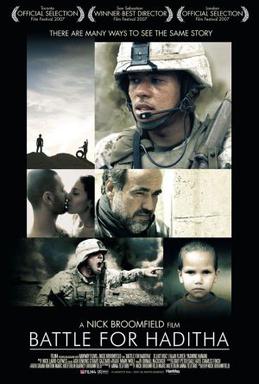
DOCUDRAMA or PROPAGANDA: The Battle for Haditha (2007)


SPOILER ALERT:  Because of the nature of this post (comparing the movie to the actual facts), I will cover the whole plot of the movie.


                “The Battle for Haditha” is misnamed as it is actually about the Haditha Incident (alternately called the Haditha Massacre or Haditha Killings).  It was probably the most infamous atrocity (or so it was claimed) of the Iraqi War.  The reenactment was filmed in documentary style by British filmmaker Nick Broomfield.  Broomfield cut his teeth on documentaries and used the minimalist approach for his second feature film.  He produced, directed, and co-wrote the movie.  Broomfield filmed in the city of Jerash, Jordan and used some ex-Marines in the cast and Iraqi refugees.  The cast was allowed to improvise some of their lines.  The finished product is controversial, to say the least.
                The film opens with a montage of several Marines describing their feelings about being in Iraq.  One says he’s only interested in surviving and does not know what he is there for.  Another mentions the problem of having civilians turn into combatants.  A third likens the situation to being similar to hunting because you have to think like the enemy.  Cpl. Ramirez (Elliott Ruiz) likens Iraq to the asshole of the world and the insurgents are like dingleberries.
                Words on the screen preview that the movie is about an incident in 2005 that involved an IED (improvised explosive device) killing a Marine and then subsequently the Marines killed 24 civilians.  (The perceptive viewer gets an inkling of what is to come by noting that the word “marines” is not capitalized.)  The Marines of Kilo Company, 3rd Battalion, 1st Marines are young and immature.  They listen to heavy metal in their Humvees and delight in pranking each other.  The barracks banter feels authentic.  The video game generation goes to war. 
                The movie has three threads.  The second revolves around Ahmad (Falah Flayla) who is a disgruntled Iraqi Army vet who is now unemployed.  He does not like the foreign Al Qaeda jihadists, but agrees to plant a command-detonated IED for $500.  He is assisted by a younger man who is just as immature as the Marines.  They plant the bomb in broad daylight along a road.
                The other thread follows a typical Iraqi family that is preparing to celebrate a toddler’s circumcision.  Hiba (Yasmine Hanani) is pregnant and in love with Rasheid.  The family and neighbors are aware of the bomb, but try to go about their lives and do not take sides.  One remarks that if they tell the Americans about the bomb, the jihadists will kill them.  If they don’t tell, the Americans will blame them.  Spoken like a South Vietnamese civilian.  The party is a good taste of Iraqi culture, but there is a heavy layer of dread.
                On Nov. 9, 2005, Ramirez’s squad of eleven Marines in four Humvees are hit by the IED.  The last Humvee is destroyed and a Marine is killed.  At the same time a white car is stopped on the other side of the road.  Ramirez, who is deeply affected by the death of his mate, executes the occupants.  A relative of the men opens fire from a nearby home.  Ramirez is given permission to take out the house, but it’s not the house the fire came from.  He interprets the “Rules of Engagement” to justify shooting first and asking questions later. 
                House 1 is greeted with a fragmentation grenade.  Ramirez and a few comrades indiscriminately kill most of the occupants although they are clearly noncombatants and none are armed.  Hiba and her boyfriend survive by hiding behind a chest.  The Marines move on to House 2 with similar results.  The “battle” is being monitored back at headquarters where a colonel orders a helicopter strike on a group of individuals walking together.  Hibas’ boyfriend is shot by a sniper because he is running (as per the ROEs = rules of engagement).  He high-fives his mates.  House 3 yields prisoners, but the killing is finally over.  A captain arrives and in a prayer for Cpl. Terrazas mentions the battle they have won.  He gives Ruiz a field promotion and recommends him for a Bronze Star.
                The Marine Corps issues a press release that 15 civilians were killed by the IED and another 8 were insurgents that opened fire on the convoy.  The story drew little media attention until a video made by the jihadists was released.  It contains eyewitness accounts which force the military to investigate.  Ramirez and three others are charged with murder.
                Taken at face value the movie is entertaining.  It’s definitely low budget, but Broomfield overcomes the vibe by giving it a vibrant documentary feel.  This is through mostly hand-held cinematography.  The negative side of this is some might swallow all of it as a factual documentary, although I am not accusing Broomfield of trying to put something over on the audience.  However, it is clearly apparent that Broomfield is offering an alternative view to the Marine Corps version.  The movie is obviously pro-Iraqi and anti-Marine Corps, but it is somewhat balanced.  Ramirez is depicted as suffering from stress and the rest of his squad are not evil.  The acting is adequate and does not get in the way of the story.  Ruiz is good, if a bit too earnest.  Hanani seems to have a future in the business.
                The movie has some noteworthy themes that could be enlightening to anyone with little knowledge  of the Iraqi War.  Civilians get caught in the crossfire in a conflict like this.  Rules end up being bent sometimes in stressful combat situations.  Atrocities happen.  Young Americans who view war as a game sometimes react outside the rules when confronted with its realities.
                I spent the whole movie wondering how much was true and looking forward to finding out.  It had some head-scratching moments like the planting of the bomb in plain sight.  Earlier, the bombers had gone through a check point without the Marines bothering to check the back of the truck where the bomb was hidden.  I suppose that was possible.  When running away from the scene, the bombers open fire for no good reason.  There is a scene where Ramirez goes to his commanding officer to admit to stress and ask to see a doctor.  The officer denies the request and cites Marine Corps policy.  I could not determine if this was factual, but it does not seem so. 
                I did a lot of research on the Haditha Incident and still cannot say definitively where the truth lies.  Although it is compared to the My Lai Massacre, it is a lot less clear exactly what happened here.  The movie presents the Iraqi version of what happened.  The American version goes something like this.  Ramirez represents Frank Wuterich.  The IED explosion is the same in both versions, but from there the stories diverge.  When the white car is stopped it is suspected of being involved in the ambush.  One of the men runs so Wuterich shoots him and then proceeds to shoot the others. Fire comes from the direction of House 1 and Wuterich leads a fire team in.  He did apparently tell them to shoot first, but it was dark and confusing inside.  It was unclear the victims were unarmed and supposedly an AK-47 was heard being “racked”.  The second house was taken because it was assumed someone from the first house ran there.  The group admitted to firing through the door which happened to have a man on the other side.  The situation inside this house was basically a replay of the first.  Only prisoners were taken in House 3 ( as per the film ).  At House 4, two men with AKs were shot and two others that were using the house as a refuge.  This incident was surprisingly not depicted in the film, but the Iraqi version contends that the four were innocent and were executed.
                The film adds a few things that even the Iraqis don’t claim.  The bombers were fictionalized.  There was no helicopter strike on a group.  No one was shot by a sniper while running.  The video was not by jihadists, it was done by a journalism student (who granted may have sympathized with the insurgents).
                At the time the film was made the latest development was the charging of Wuterich and three others for murder and the charging of several higher officers for a cover-up and non-investigation.  In the subsequent trial, all but Wuterich got off.  He was found guilty of a much lesser charge and basically given a slap on the wrist.  This lack of justice aggravated many, but NCIS did put 65 agents on the case and although the prosecution may have done a less than stellar job, it was understandably difficult to prove a case like this.  For instance, no Iraqis would testify.  Forensics tended to disprove the two execution scenarios and lenient interpretation of the ROEs left reasonable doubt as to premeditation or revenge.  It is instructive to note that the military tightened up the Rules of Engagement after this to no longer condone shooting of clearly unarmed civilians.
                So who is telling the truth – Broomfield and the liberal press or the military and Fox News?  As usual in cases like this the truth is somewhere in between.  Although I cannot discount the possibility that Broomfield is accurate,   I lean towards the Marine version.  With that said, I do not feel that even under a flexible interpretation of the ROEs, what happened in Houses 1 &2 and with the white car was justified.  Like an ex-Marine said, the Marines were the baddest asses in this situation and they should have been capable of asking questions first and then shooting.  To shoot civilians in two houses where they had not taken any fire from within indicated either payback or the desire to take no chances whatsoever.  As far as the white car, it seems logical that confronted with a group of very pissed off Americans, one might run and Wuterich would have snapped.  I do feel Wuterich got off easy.  In this respect he reminds of Lt. Calley.  The coverup also is reminiscent of My Lai and again the higher ups got off.  The press release was ridiculously false and there was no attempt to get to the truth until Time magazine broke the story.
                  So, what to make of the film?  I recommend it provided you realize it is one point of view about an historical incident.  I also suggest that you watch the Front Line documentary "Rules of Engagement" afterwards.  Then keep in mind that the truth is somewhere in the middle and we may never know what actually happened that day.

GRADE  =  B
the trailer

the whole film

Saturday, January 4, 2014

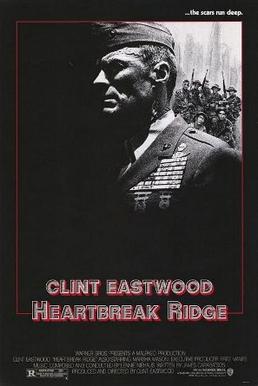
Day 11 - Heartbreak Ridge (1986)


On the eleventh day of Christmas, my true love gave to me – eleven gyrenes a reconning


                “Heartbreak Ridge” is named after an actual battle in the Korean War, but it has nothing to do with that battle, unfortunately.  It was released in 1986 and was directed and produced by Clint Eastwood.  Part of it was filmed on the island of Grenada.  Eastwood got limited Pentagon support due to the fact that the main character drank, was divorced, had a potty mouth, and used unorthodox training methods.  The Marine Corps disowned the film because of the language.  The movie was nominated for an Oscar for Sound (I’m assuming that was not for the sound of the words coming out of the men’s mouths).  It was a big hit and critics were kind.

                We meet Gunny Highway (Eastwood) in a jail cell telling war stories.  He’s a warrior without a war.  He soon meets Stitch Jones (Mario Peebles) who is a lover who is not interested in war.  Surprise, he is in the platoon that Highway has been assigned to shape up.  The heterogeneous unit (black playa, two Hispanics, Italian paisano, hick, he-man, etc.) is in need of discipline and motivation.  They remind of the men in “Stripes”, except this movie is not supposed to be a comedy.  (Shockingly, “Stripes” came out five years earlier and thus is not the parody of this movie that you would assume.)   Highway’s commanding officer Maj. Powers (Everett McGill) takes an instant dislike to Highway (completely disregarding the fact that the gunny is a Medal of Honor recipient).  Powers is an ambitious asshole Annapolis grad who considers Highway to be a dinosaur.  “This is the new Marine Corps and you are an anachronism – old timer.”  Theme established:  old versus new, veteran versus greenie-weinie.

                Highway puts the platoon through some tough physical training.  There is a running gag that involves Highway forcing the men to work out shirtless.  Hilarious (not) and WTF.  What do these men do in training?  Rappelling, obstacle course, live fire, and the shooting range.  Highway handles the mutiny of his wussies by beating he-man.  R-E-S-P-E-C-T is inevitable.  Meanwhile, Highway is trying to rekindle with his wife Aggie (Marsha Mason).  It’s a rocky road but you don’t need a map to tell where it’s going.

                Highway continues to butt heads with Powers who uses the Recon Platoon to make his platoon look elite.  This leads to a melee between the two units culminating in a tie-breaker bout between Highway and Powers.  Bonding complete, now all they need is a war to consummate. 

                The Recon Platoon is sent to Grenada to liberate the Medical School.  On the way they use a bulldozer to take a bridge.  Later, they have a “last stand” against the vaunted Cuban army.  One guy has to die so the movie can claim realism.  (This is the kind of movie where even one death in the unit is a surprise.)  They use a phone and credit card to call in air support.  Powers calls Highway’s pushing forward disobedience.  Highway calls it initiative.  What will the general call it?  The men return to an anti-Vietnam War welcome.  Guess who’s waiting for Highway?

                Have you ever re-watched a movie that you were not impressed with as a teenager and found you were wrong about it?  This is not one of those times.  I invariably find that my first impressions are correct in cases like this.  If I did not like a war movie when I was a naïve teenager, it’s unlikely to gain respect now that I analyze them critically.  “Heartbreak Ridge” is a terrible movie.  Even Grenada deserved better.  The acting is poor, other than Eastwood, and even he is not at the top of his game.  He sways between gruffly  growling and petulantly pining.  Peebles is aggravating as the rocker wannabe and Powers needs a mustache to twirl.  The ensemble mugs its way through the film.  Speaking of which, in the combat scenes they look like actors playing soldier.  There obviously was no boot camp for this group.  Maybe that’s why there is a lack of action in the movie.  You sit through almost two hours just to get to Grenada, for Christ’s sake.   

                The dialogue is a weakness.  Although the screenplay was by a Vietnam veteran, the words he puts in the soldiers’ mouths do not ring true.  Many of the lines are smack talk aimed at fourteen year old boys.  A good drinking game would be to take a drink every time you feel the urge to say “oh, snap!”  The writer appears to have bought a copy of “101 Great Military Insults” and attempted to cram all of them into the script.  Here are a few of my favorite lines:

                Highway:  “I eat concertina wire and piss napalm and I can put a round in a flea’s ass at 200 meters.”
                Choozoo:  “If your brain was half as smart as your mouth, skunk stool, you’d be a frickin’ twenty star general by now.”
                Highway:  “You pump the neighbor’s dog again, Jakes?   Or are you always slack-jawed and silly in the afternoon?”
                Highway:  “Why don't I bend you over the table there... send you home with the "I just pumped the neighbor's cat" look on your face.”
                 Highway:  “If you pull another shithead stunt like that again, the only thing that'll beat you to the brig is the headlights on the ambulance you'll be riding in.  

And by the way, much of the dialogue is homophobic in a cringe-inducing way.  Highway nicknames the Italian “Fag –eddi”.  There’s a lot of high school locker room humor in the film.

                The movie is full of clichés.  The warrior who is out of place in peacetime.  The clash of generations.  Molding recalcitrant charges into a lean mean fighting machine.  The incompetent glory-hound standing in the way of the pure warrior.  Military life trumps home life.

                Surprisingly, the movie is fairly accurate for a film that makes no claim to be based on a true story.  There was a Heartbreak Ridge which was a typical Korean War hill assault with frontal tactics that resulted in high casualties and the acquisition of some worthless real estate after attacks and counterattacks by stubborn commanders.  Similar to Pork Chop Hill.  Three real incidents from Grenada are portrayed in the movie.  The use of the bulldozer was based on an action taken by future head of Central Command, Capt. John Abizaid.  The Medical School was liberated as depicted, but by Army Rangers.  The phone call for air support was a famous anecdote from the conflict and was the incident that inspired the screenwriter to develop the script.

                Christmas gift?  No, you shit-bird, queer-bait, maggot.

Grade =  D   

Saturday, November 19, 2011

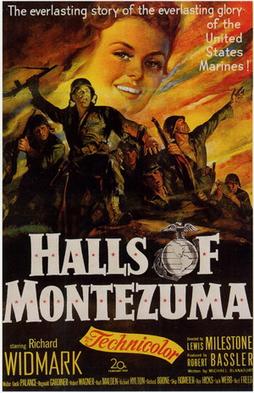
The Halls of Montezuma (1951)


      “Halls of Montezuma” is a war movie released in 1951. It was directed by Lewis Milestone and was inspired by a short film entitled “Objective – Prisoners” which was about the necessity of taking prisoners for interrogation purposes. It was filmed at Camp Pendleton, California with the full cooperation of the Marine Corps. The movie is dedicated to the Marines and was later used as a recruiting film. It opens with the “Marine Corps Hymn” which, of course, starts with ”From the halls of Montezuma”.

      The seven surviving members of a platoon are on a troop ship headed for an unnamed Pacific island circa 1943. Lt. Col. Gilfallan (Richard Boone in his film debut) gives a speech emphasizing the need to take prisoners. (In reality, this speech would have gone over with a yawn from Marine vets who had seen or heard about the results of trying to take prisoners.) The leader of the unit is Lt. Anderson (the always reliable Richard Widmark) who is suffering from psychological migraines due to combat fatigue. Through a flashback we learn he was a science teacher before the war, so the war experience is pretty foreign (a theme of the movie). He pops pills given to him by the medic (Karl Malden). It’s your typical “quit your preaching and give me the pills, doc” situation. (It’s unclear what message the Marines were hoping to send with this subplot.) In spite of his own problems, Anderson is able to convince an ex-student, who he had helped overcome stuttering, to fight on in spite of his fears. (A message for Marines in Korea?)

     The landing in amphtracs is well played and includes a seamless blending of color archival footage. We get old school deaths sans the blood. Those are real Shermans spouting flame. “Spray the whole hill, it’s lousy with Japs.” After the initial combat, we get some character development for our heterogeneous small unit. This is done through flashbacks and realistic soldier talk. Strangely, I was shocked to hear the comment “They can kill me, but they can’t eat me” for the second time in a war movie. Wait, what? The ensemble cast is first-rate and includes Jack Palance, Neville Brand, Jack Webb, Martin Milner, and a very young Robert Wagner as Coffman.

     When Coffman is killed in a Japanese rocket barrage, Anderson pops some more pills and we realize we are in a “who will survive?” war movie. One down, how many more to go? Anderson is sent by Gilfallan on a mission to bring back some Japs hiding in a cave. The location of the rocket site must be discovered because the frontal attack must go on. Accompanying the squad is a Brit named Johnson who speaks Japanese and knows their culture and psychology. Played by Reginald Gardner, he appears to have wandered in from North Africa, but is droll and adds color. They take several prisoners including a wounded officer (we’re the humane ones) and head back to headquarters. In the process, Pretty Boy (the resident psychotic) goes crazy and is killed accidentally when he yanks on a buddy’s gun (that’s original, anyway). Death #3 is the medic. The rest make it back. However, Conroy (the stutterer) dies from shrapnel, sending Anderson over the edge. Fortunately, a letter written to him by the doc reminds him of his duty to his men and he throws away the pills and gets his act together.

     The movie slows down appreciably at this point as deduction is necessary to pinpoint the rocket site. A big clue comes from the pompous Japanese officer. The attack goes off as planned and as the rockets come raining down, Corsairs swoop down to take them out.

      This movie is definitely second string Milestone. The acting is pretty good, especially Widmark. It’s also a kick to see the recognizable faces. The back-stories are not particularly compelling, but it is a commendable effort to flesh out the warriors. In fact, the movie is a part of the second wave of WWII movies which spend more time on the effects of war on the soldiers and admit to dysfunctions within units. In spite of the cooperation of the Marine Corps, the film is not a jingoistic flag-waver.

     The action is fine and the actual footage adds to the authenticity. The weaponry is accurate. The location (Camp Pendleton) must have been convenient, but the terrain does not look like a tropical island. The plot is not strong. The two main plot points – take prisoners for questioning and find the rocket site – are not very realistic to the war in the Pacific. In all my reading about the war in the Pacific, I never ran into Japanese rocket barrages as being a problem. Another problem is the ending. It does not appear all the trouble of discovering the site is put to use. The attack is launched and comes under rocket fire. The Corsairs taking out the rocket battery is not contingent upon pinpointing them on a map. The movie would have been better if the unit had gone on to take out the site after questioning the Japanese found in the cave. The dead could have more effectively died going after the site than returning to base.

     “Halls of Montezuma” is worth watching. It is entertaining and has good performances. However, it is definitely not one of the 100 Best War Movies.

      By the way, check out that movie poster.  Who is that woman?  There are no women in the movie!  Imagine the disappointment of women who went to this movie.  False advertising!!!  Also, this is not "the everlasting story" of the Marine Corps.

GRADE =  B-