Showing posts with label Robert Mitchum. Show all posts

Thursday, August 31, 2017

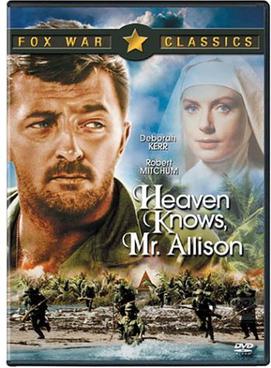
DUELING MOVIES: Heaven Knows, Mr. Allison (1957) vs. Father Goose (1964)


VS.


                “Heaven Knows, Mr. Allison” was based on a novel by Charles Shaw.  John Huston and John Lee Martin adapted the screenplay and Huston directed.  Huston and 20th Century Fox envisioned it as a successor to “The African Queen”.  You’ll enjoy it more if you forget that.  It stars Robert Mitchum and Deborah Kerr.  It was the first of their four screen pairings.  They became good friends during the filming as Mitchum bonded with her when she would curse while wearing her nun costume.  She gamely put up with the drunken binges of her director and co-star.  She ended up being nominated for Best Actress.  Huston and Martin were nominated for Best Adapted Screenplay.  It was a screenplay that was vetted by the National Legion of Decency.  The Catholic Church also had a hand in monitoring the production to protect the image of its nuns.  The movie was filmed on Trinidad and Tobago. The actors to portray the Japanese-speaking soldiers had to be brought in from a Japanese community in Brazil. 

                The movie opens with a stranded Cpl. Allison (Mitchum) coming ashore on a little island in the Pacific.  There is a deserted village, but he meets a lone nun named Sister Angela (Kerr) who maintains the church.  What Allison hopes is an Adam and Eve scenario ends when the Japanese arrive and the duo goes into hiding.  Close proximity and the tension of being prey could lead to something.  If the Catholic Church was not on the set.

                “Heaven Knows, Mr. Allison” was a popular movie, but as a war movie it is nothing to get excited about.  It is more of a character study than a war film.  There is little suspense, even when Allison sneaks into the Japanese camp.  This is a shame as the situation should have lent itself to some edging to the front of your seat.  The movie is too busy toying with the “will they or won’t they?” question.  The leads do have a lot of chemistry and Mitchum and Kerr were great actors, but the moral restraints placed on the script hindered a realistic portrayal of two beautiful people marooned on an island.  Actually, Kerr’s Angela is an authentic character.  Or, what the Catholic Church would have us believe is a typical nun.  As far as Mitchum’s gyrene, we get a family-friendly leatherneck.  He is one of the more saintly Marines you will run into in a war movie.  (Maybe the Marine Corps was on set also.)  Mitchum’s dialogue sounds phony and the romantic arc is unrealistic.  It is rushed due to cinematic time constraints.  We go from “hey lady, get real” to “I never realized how attractive you are” to “let’s make the best of the situation” to “marry me” to “admit it, you want it too” to “I respect you” too patly.  The “supervision” of the film caused a watering down of the theme comparing the Marine Corps to the Catholic Church.  The biggest problem with “Heaven Knows” is that the plot makes little sense.  Specifically, the actions of the Japanese are unrealistic.  (For instance, the Japanese actually invade the island twice!) At least they speak with no subtitles and are not demonized.

                “Father Goose” was Cary Grant’s second-to-last screen role.  He turned down the role of Henry Higgins in “My Fair Lady” because he wanted to play against his usual suave characters and instead play a role that was close to his actual personality.  Apparently, the real Grant  liked to dress like a bum and yell at kids to get off his lawn.  The movie was directed by Ralph Nelson (“Soldier Blue”).  The screenplay was an adaptation of the short story “A Place of Dragons” by S.H. Barnett.  Peter Stone and Frank Tarloff won an Oscar for the screenplay.  The movie was nominated for Film Editing and Sound.  The song “Pass Me By” was not nominated but was later a hit for Peggy Lee and was recorded by Frank Sinatra and others.  The movie was filmed in Jamaica.  It was a big hit.

                The movie opens in early 1942 with the Japanese rampaging through the Southwest Pacific.  Walter Eckland (Grant) is a loner who couldn’t care less about the war effort.  He is “recruited” by Commander Broughton (Trevor Howard) of the Royal Australian Navy to be a coast watcher.  The curmudgeonly Eckland is more civilian than most civilians, but he is given no choice.  He is deposited on a deserted island with a radio.  To get him to file periodic reports, Broughton has hidden whiskey bottles and reveals their locations only upon receipt of the reports.  When he is sent to rescue another coast watcher, Eckland instead is saddled with a school teacher named Catherine (Leslie Caron) and her seven girl charges.  The situation is reminiscent of Felix Unger moving in with Oscar except that Felix is a woman and she brings teenage girls with him.  Eckland tops Oscar by being not only a slob, but also an asshole.  Naturally, “Mother Goose” (Eckland’s code name) gets along with “Goody Two Shoes” like an old mutt with a Persian cat.  Eckland hurls a lot of invective such as “you should carry a tambouring and put fig leaves on statues”.  Oh, snap!  These two have as much chance of falling in love as that old mutt and the Persian cat.  Unless this is a movie.

                “Father Goose” is fluff, but it is well done fluff.  The confection has one prime ingredient – Cary Grant.  He has fun playing against type and Caron is an excellent foil.  They have chemistry and this makes the absolutely predictable romance watchable.  Like “Heaven Knows, Mr. Allison”, the romantic arc is too rushed, but hell, there’s a war going on.  In most ways, the movie is more of a romantic comedy than a war movie.  As far as the comedy part, the movie is fairly amusing.  Grant gets some funny lines (he had his writers on call), as does Howard.  Although it co-stars the venerable war movie stalwart Howard, his Boughton is mainly there to facilitate the comedy.  He seems to have had fun as well.  It’s not often you get to top a Cary Grant character.  His character is the key to making the movie above average.  For a comedy, it is surprisingly more suspenseful than “Heaven Knows”.  You’re not going to lose sleep, mind you.  Another surprise is that it actually has more of an “The African Queen” vibe than the other movie.  The two main characters are much closer to Charlie and Rose than Allison and Angela are.  Speaking of which, although the script is competent, it hardly deserved an Oscar.  (It beat out “Hard Day’s Night”!)  “The African Queen” was only nominated.

                Both movies are better as movies than war movies.  However, “Father Goose” is more entertaining and less unrealistic in its handling of an unrealistic situation.  At least, there were coast watchers that served in the Pacific.  I wouldn’t say that the movie honors them, however.  “Father Goose” is just more comfortable in the romantic comedy genre than “Heaven Knows, Mr. Allison” is in the romantic genre.  “Heaven Knows” was crippled by the production code and the blue noses and clergymen who scrutinized it.  It also fumbled the trapped scenario.  The two are very much of their times, but “Father Goose” would fit well into today’s rom-com environment.  “Heaven Knows” is too uptight to find a modern audience. 

GRADES:  Heaven Knows  =  C-

                  Father Goose  =  B-    

Sunday, January 1, 2012

#45 - The Story of G.I. Joe


BACK-STORY: “The Story of G.I. Joe” was released in 1945 and is based on the columns of war correspondent Ernie Pyle. It was directed by William Wellman who had been a pilot in the Lafayette Escadrille in WWI and at first refused to do a movie about the despised infantry until he met Pyle and saw the adoration the infantry had for him. Once on board, Wellman insisted on realism and convinced the Army to loan him 150 soldiers training near the production. The movie also used several actual war correspondents. So the actors would not look foolish alongside real soldiers, Wellman put them through the first actors’ boot camp. Sadly, Pyle was killed before the opening of the movie and many of the real soldiers were killed on Okinawa. For this reason, Wellman never watched the movie after its release. The movie was a hit and is considered one of the most realistic war films. It was nominated for four Oscars (Supporting Actor - Mitchum, Song, Score, and Screenplay).


OPENING: The 42 year old Pyle (Burgess Meredith) attaches himself to Company C, 18th Infantry as it prepares to go by truck into action in Tunisia. He meets Lt. Walker (Robert Mitchum) who agrees to let him accompany them all the way to the front. The men are rookies with a nervous bravado about them. The hound in the group named Dondaro (Wally Cassell) greets Pyle by saying: “Hey Pops, why wasn’t you born a beautiful dame? Or even an ugly one?” That night they lounge in their pup tents and listen to Artie Shaw as played by Axis Sally. Her taunting about their girls back home registers various facial reactions in a series of close-ups. The soldier talk is tame, but realistic.

SUMMARY: The first death occurs soon after as a plane strafes and one of the men dies off screen. Walker: “The first death is always the hardest.” The Company mascot, a cute little dog named Arab (“Squirt”), is passed on to one of the survivors.

      Next thing we see is the unit facing defeat at Kasserine Pass (although not mentioned by name). The defeat is seen through Pyle’s eyes as he follows the degeneration at headquarters. A montage of columns follows. The film skips Sicily and has Pyle reuniting with the now seasoned unit in Italy. The men are genuinely glad to see Pyle and give him the typical gentle ribbing. At mail call, Sgt. Warnicki (Bobby Steele) receives a recording of his son “Junior”, but will spend the rest of the movie trying to listen to it.

     The only battle scene has the men taking an Italian town house to house. The assault culminates with Walker and Sgt. Warnicki cat-and-mousing with German snipers in a bombed out church. The scene is bereft of dialogue, but has great sound effects (but no music). It really sounds like a WWII battle. The tactics of covering fire and maneuver are also realistically portrayed. After the liberation of the town, the men settle down for a while. The movie is true to the stop and go nature of war. During this interlude, Murphy (John Reilly) weds his nurse fiancĂ© (played by Wellman’s wife Dorothy). In the honeymoon suite/ambulance, he falls asleep before the camera has to cut away.

     The next big set piece involves the capture of a monastery on a hill (obviously meant to be Monte Cassino). This is one of the grubbiest scenes in war movie history. The men are dirty and unshaven and living in caves surrounded by a sea of mud due to the incessant rain. Patrols go out and return with less than they started with. One of the victims is Murphy. The men take the deaths in stride, but clearly the strain mounts. We see this attrition through Pyle (“The G.I. lives so miserably and dies so miserably”) and Walker (who agonizes over being a “murderer”). Everyone is weary, but they do what they have to do. “Every step forward is a step closer to home.” They maintain their sardonic G.I. humor throughout. After another vicious artillery barrage, a soldier says “Gee, a guy could get killed around here”. Warnicki snaps when he finally hears Junior’s voice. Finally, Eisenhower bombs the religious site and although the movie alludes to this making the monastery a tougher nut, the movie moves on after a brief final assault that includes actual war footage.

CLOSING: The last scene is a reenactment of Pyle’s most famous column “The Death of Captain Waskow”. The men are resting when a mule train arrives from the front carrying dead bodies. One of them is Capt. Walker. The men are stunned and their facial expressions reflect the love of soldiers for a well-respected officer. One by one members of the unit pay their last respects laconically. “I’m sorry, old man” is a typical eulogy. But the war must go on so they march past into the sunset. Pyle: “For those beneath the wooden crosses, there is nothing we can do except perhaps to pause and murmur “Thanks pal, thanks”.

     As a post script, we see actual footage of Pyle interviewing a soldier. Cool.

the real Ernie Pyle


RATINGS:


Acting - 9


Action - 6


Accuracy - 6


Realism - 8


Plot - 8


Overall - 8


WOULD CHICKS DIG IT? Probably. It is bloodless and not graphic. There is a sweet wedding scene. The soldier language is toned down. The acting is stellar.

HISTORICAL ACCURACY: The movie starts with a disclaimer that the “characters and events are fictional”. Several of the main characters are based on soldiers that figured prominently in Pyle’s columns. Walker is based on Henry Waskow and sentiments voiced by Sgt. Frank Eversole. Warnicki was based on Sgt. Jack Peterson who had a son named “Junior”.  There was a dog named "Squirt".

     The main divergence from truth is the fact that although Pyle travelled with Company C, 18th Infantry in Tunisia, the unit did not fight in Italy. Pyle accompanied a different unit in Italy. This Hollywoodizing of the facts is totally justifiable for the continuity of the film. After all, the movie and Pyle were interested in boosting the G.I.s in general, not in particular.

     The two battles – San Pietro and Monte Cassino – are simplified and not meant to accurately depict actual battles. This is not a movie about strategy and tactics. It does not give the big picture. A minor flub is having Eisenhower order the bombing of Monte Cassino when it was actually done by Gen. Harold Alexander.

      The final scene is close to the famous column except that the incident actually occurred at night. It is well done and quietly poignant.

CRITIQUE: “The Story of G.I. Joe” has a reputation as one of the best of the circa-WWII movies. That reputation is well-deserved. It holds up well partly because it does not have to compete with the recent crop of hyper-realistic combat films started by “Saving Private Ryan”. It is a simpler soldier slice of life picture. As such, it is better than most modern attempts to depict soldier life. The dialogue is sparse and rings true. The only flaw being the language constraints of 1940s cinema. A remake would undoubtedly have a lot of f-words.

      The acting stands out. Meredith is perfect as Pyle. He met Pyle before filming and spent time with him. He looks like the famed war correspondent, but more importantly he portrays Pyle’s ambiguous feelings about war and the men who had to fight it. Meredith was an Army Captain at the time of the filming and was given an honorable discharge by Gen. Marshall so he could do the movie. MItchum is superb in perhaps his best performance. He earned his only Academy Award nomination. Ex-boxer Bobby Steele is another who puts in his best effort as Warnicki. (His other recognizable role was in “Hail the Conquering Hero”, but he is more central in this one.) The rest of the cast is fine and “Squirt” is adorable.

      The cinematography is outstanding. There are lots of close-ups of facial expressions. These are often more powerful than the dialogue they replaced. The landscapes are appropriately stark. The soundstage for the monastery scenes is one of the muddiest in movie history. The sound and soundtrack are very good.

       The film is true to the reality of war being mostly downtime followed by brief periods of terrorizing violence. This makes it reminiscent of another great WWII film – "A Walk in the Sun". Like that film, it avoids dysfunctionality within the unit, but that was typical of that era’s war movies.

CONCLUSION: Dwight Eisenhower called “The Story of G.I. Joe” the best war film made on WWII. That is high praise and may have been true at the time. Although it does not stand up to modern films like “Saving Private Ryan” and “Enemy at the Gates”, it holds up better than most 1940s WWII films. The only real complaint I have is there is still a movie about Ernie Pyle waiting to be made. Watch it if you can find it – it ain’t easy.