Showing posts with label Cary Grant. Show all posts

Thursday, May 21, 2020

CLASSIC or ANTIQUE? The Eagle and the Hawk (1933)


                        “The Eagle and the Hawk” is a forgotten WWI air combat movie.  I have seen a lot of these and this one flew under my radar, so to speak.  It was directed by Stuart Walker and Mitchell Leisen.  The original story was by John Monk Saunders, who also wrote “Wings” and “The Dawn Patrol”.  Saunders had been in the Air Service during the war, but was stuck in Florida as a flight instructor.  The movie casts Cary Grant and Carol Lombard before they made it big.  It was Lombard’s 37th film and her fifth in 1933!  She does not appear on the original poster but made it onto the rerelease poster.  Grant and Frederic March were almost killed when a premature explosion collapsed some beams on them.  Grant held up a beam while March was pulled out.  Grant suffered some internal injuries.  The movie had a nice set of vintage aircraft to work with.  These included five Thomas-Morse Scouts, four Nieuport 28’s, two de Havilland DH-4’s, and a Curtiss JN-4.

                        The movie opens with Lt. Young (March) and Lt. Crocker (Grant) having joined the Royal Flying Corps.  Crocker makes a poor landing resulting in the pair being upside down.  Crocker takes it with a laugh, but Young begins to think Crocker is not cut out to be a pilot.  When the squadron gets sent to France, Young makes sure Crocker is held back.  Young becomes a photo reconnaissance pilot.  He flies, the backseater takes pictures and uses a machine gun to defend the plane if pounced on.  On his first mission, he shoots down two Germans.  The footage was from “The Dawn Patrol” (1930).  But upon returning to base, he discovers that his comrade is dead.  This becomes a pattern as Young is as bullet proof as his photographers are bullet magnets.  Squadron mates are dying to fly with him.  Get it?  Nobody seems to hold this against him because he becomes a celebrated flying ace.  But at what cost?  He’s not Stachel from “The Blue Max”.  After two months, he has reached the point where his job description is:  “I’m a chauffer for a graveyard, driving men to their deaths, day after day, for what?”  For medals, apparently.  He begins to drink and not the usual WWI air combat movie drinking.  More the Gresham from “Aces High” alcoholism.   He also has nightmares.  His victims (the Germans and his observers) are just kids!  Kids!   Into his morose life comes his foil, Crocker.  Crocker has conceded his dream of being a pilot and now is a fearless observer.  Although they loath each other, they pair up.  The mutual animosity goes up to 10 when Crocker shoots a parachuting German.  Young is the tormented, chivalric knight of the air and Crocker is the Machivellian, stone cold killer.  Young belongs in WWI, Crocker belongs in WWII.  They are grudgingly going to learn to respect each other, but will it be enough to halt Young’s descent into alcoholic depression?  Maybe if he meets a Beautiful Lady (Lombard) on R&R, that will turn him around.

                        Recently I have seen “Ace of Aces” and “Lafayette Escadrille” and I figured this movie would be a similarly low-quality dogfighting movie.  I was wrong.  “The Eagle and the Hawk” is one of the better WWI air combat movies.  It avoids most of the clichés so prevalent in this subgenre.  Nobody rides a motorcycle, but the main character does lose his best friend, the squadron does party hard, and there is an enemy ace (Voss, apparently based on Werner Voss) they joust with, but he is not a villain.  The cannon fodder replacements are enthusiastic, as usual.  However, although the movie is predictably antiwar, it is otherwise unpredictable.  In fact, for a Cary Grant movie, it is shockingly downbeat.   It’s closest to “Aces High” in its depressing take on the war in the air.
 
                        “The Eagle and the Hawk” is realistic in showing the stress the war could put on even the best pilots.  Young and Stachel are at opposite extremes of the spectrum when it comes to how pilots must have reacted to shooting down fellow human beings.  With Young, you have to add that he also loses a lot of comrades and could argue to himself that he was at fault.  What makes the movie a cut above is the movie literally puts Young and Stachel in the same plane because Crocker is a Stachel-like character.  The cast is strong with March great as the tormented Young and Grant his usual debonair self, but with an edge that he showed in movies like “Notorious”.  He is not humorous.  Jack Oakie provides the comic relief you often see in otherwise serious WWI movies.  Lombard has basically a cameo.  She is billed as “Beautiful Lady” and she certainly matches the description.  Her short time on screen is crucial in showing how far down the well Young has fallen.  She throws him a rope, but does he even want redemption?  While her role is as developed as her billing, the three main characters are well-developed.  We know what makes these guys tick.  The dialogue helps with this as the movie has the feel of a play in parts.

                        I would hesitate to call it a dogfighting movie.  It has a small amount of actual combat, but the quality makes up for the lack of quantity.  Although the producers had those vintage aircraft to work with, most of the action is footage from other movies like “The Dawn Patrol”, “Wings”, and “Young Eagles”.  You can’t tell, though.  The sound effects are good and match the footage well.  But don’t watch it to learn about dogfighting in WWI.  Don’t even watch it to learn about photo recon.  It’s a movie with a main character that has a character arc that has to spiral downward, so we’ll overlook the fact that every observer he takes up gets machine gunned and yet the German pilots can’t hit the guy sitting three feet in front of them.  We’ll also overlook having an observation pilot become a famous ace.  I can guarantee you Young is not based on an actual pilot! 

                        “The Eagle and the Hawk” got positive reviews, but did not make a splash at the box office.  I theorize this was due to Grant and Lombard not being big box office draws yet.  It could also be explained by the far from happy ending.  The public had been conditioned by this time to expect good WWI movies to be anti-war, but “The Eagle and the Hawk” takes it up a notch.  I won’t give it away, but I will mention that the original ending was even more down-beat.  Some things are beyond the public’s ability to handle.

GRADE  =  B

Thursday, August 31, 2017

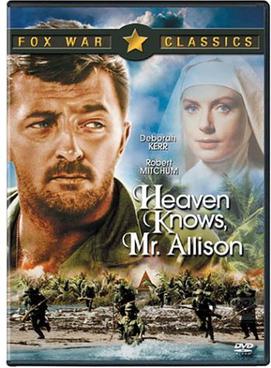
DUELING MOVIES: Heaven Knows, Mr. Allison (1957) vs. Father Goose (1964)


VS.


                “Heaven Knows, Mr. Allison” was based on a novel by Charles Shaw.  John Huston and John Lee Martin adapted the screenplay and Huston directed.  Huston and 20th Century Fox envisioned it as a successor to “The African Queen”.  You’ll enjoy it more if you forget that.  It stars Robert Mitchum and Deborah Kerr.  It was the first of their four screen pairings.  They became good friends during the filming as Mitchum bonded with her when she would curse while wearing her nun costume.  She gamely put up with the drunken binges of her director and co-star.  She ended up being nominated for Best Actress.  Huston and Martin were nominated for Best Adapted Screenplay.  It was a screenplay that was vetted by the National Legion of Decency.  The Catholic Church also had a hand in monitoring the production to protect the image of its nuns.  The movie was filmed on Trinidad and Tobago. The actors to portray the Japanese-speaking soldiers had to be brought in from a Japanese community in Brazil. 

                The movie opens with a stranded Cpl. Allison (Mitchum) coming ashore on a little island in the Pacific.  There is a deserted village, but he meets a lone nun named Sister Angela (Kerr) who maintains the church.  What Allison hopes is an Adam and Eve scenario ends when the Japanese arrive and the duo goes into hiding.  Close proximity and the tension of being prey could lead to something.  If the Catholic Church was not on the set.

                “Heaven Knows, Mr. Allison” was a popular movie, but as a war movie it is nothing to get excited about.  It is more of a character study than a war film.  There is little suspense, even when Allison sneaks into the Japanese camp.  This is a shame as the situation should have lent itself to some edging to the front of your seat.  The movie is too busy toying with the “will they or won’t they?” question.  The leads do have a lot of chemistry and Mitchum and Kerr were great actors, but the moral restraints placed on the script hindered a realistic portrayal of two beautiful people marooned on an island.  Actually, Kerr’s Angela is an authentic character.  Or, what the Catholic Church would have us believe is a typical nun.  As far as Mitchum’s gyrene, we get a family-friendly leatherneck.  He is one of the more saintly Marines you will run into in a war movie.  (Maybe the Marine Corps was on set also.)  Mitchum’s dialogue sounds phony and the romantic arc is unrealistic.  It is rushed due to cinematic time constraints.  We go from “hey lady, get real” to “I never realized how attractive you are” to “let’s make the best of the situation” to “marry me” to “admit it, you want it too” to “I respect you” too patly.  The “supervision” of the film caused a watering down of the theme comparing the Marine Corps to the Catholic Church.  The biggest problem with “Heaven Knows” is that the plot makes little sense.  Specifically, the actions of the Japanese are unrealistic.  (For instance, the Japanese actually invade the island twice!) At least they speak with no subtitles and are not demonized.

                “Father Goose” was Cary Grant’s second-to-last screen role.  He turned down the role of Henry Higgins in “My Fair Lady” because he wanted to play against his usual suave characters and instead play a role that was close to his actual personality.  Apparently, the real Grant  liked to dress like a bum and yell at kids to get off his lawn.  The movie was directed by Ralph Nelson (“Soldier Blue”).  The screenplay was an adaptation of the short story “A Place of Dragons” by S.H. Barnett.  Peter Stone and Frank Tarloff won an Oscar for the screenplay.  The movie was nominated for Film Editing and Sound.  The song “Pass Me By” was not nominated but was later a hit for Peggy Lee and was recorded by Frank Sinatra and others.  The movie was filmed in Jamaica.  It was a big hit.

                The movie opens in early 1942 with the Japanese rampaging through the Southwest Pacific.  Walter Eckland (Grant) is a loner who couldn’t care less about the war effort.  He is “recruited” by Commander Broughton (Trevor Howard) of the Royal Australian Navy to be a coast watcher.  The curmudgeonly Eckland is more civilian than most civilians, but he is given no choice.  He is deposited on a deserted island with a radio.  To get him to file periodic reports, Broughton has hidden whiskey bottles and reveals their locations only upon receipt of the reports.  When he is sent to rescue another coast watcher, Eckland instead is saddled with a school teacher named Catherine (Leslie Caron) and her seven girl charges.  The situation is reminiscent of Felix Unger moving in with Oscar except that Felix is a woman and she brings teenage girls with him.  Eckland tops Oscar by being not only a slob, but also an asshole.  Naturally, “Mother Goose” (Eckland’s code name) gets along with “Goody Two Shoes” like an old mutt with a Persian cat.  Eckland hurls a lot of invective such as “you should carry a tambouring and put fig leaves on statues”.  Oh, snap!  These two have as much chance of falling in love as that old mutt and the Persian cat.  Unless this is a movie.

                “Father Goose” is fluff, but it is well done fluff.  The confection has one prime ingredient – Cary Grant.  He has fun playing against type and Caron is an excellent foil.  They have chemistry and this makes the absolutely predictable romance watchable.  Like “Heaven Knows, Mr. Allison”, the romantic arc is too rushed, but hell, there’s a war going on.  In most ways, the movie is more of a romantic comedy than a war movie.  As far as the comedy part, the movie is fairly amusing.  Grant gets some funny lines (he had his writers on call), as does Howard.  Although it co-stars the venerable war movie stalwart Howard, his Boughton is mainly there to facilitate the comedy.  He seems to have had fun as well.  It’s not often you get to top a Cary Grant character.  His character is the key to making the movie above average.  For a comedy, it is surprisingly more suspenseful than “Heaven Knows”.  You’re not going to lose sleep, mind you.  Another surprise is that it actually has more of an “The African Queen” vibe than the other movie.  The two main characters are much closer to Charlie and Rose than Allison and Angela are.  Speaking of which, although the script is competent, it hardly deserved an Oscar.  (It beat out “Hard Day’s Night”!)  “The African Queen” was only nominated.

                Both movies are better as movies than war movies.  However, “Father Goose” is more entertaining and less unrealistic in its handling of an unrealistic situation.  At least, there were coast watchers that served in the Pacific.  I wouldn’t say that the movie honors them, however.  “Father Goose” is just more comfortable in the romantic comedy genre than “Heaven Knows, Mr. Allison” is in the romantic genre.  “Heaven Knows” was crippled by the production code and the blue noses and clergymen who scrutinized it.  It also fumbled the trapped scenario.  The two are very much of their times, but “Father Goose” would fit well into today’s rom-com environment.  “Heaven Knows” is too uptight to find a modern audience. 

GRADES:  Heaven Knows  =  C-

                  Father Goose  =  B-    

Friday, July 21, 2017

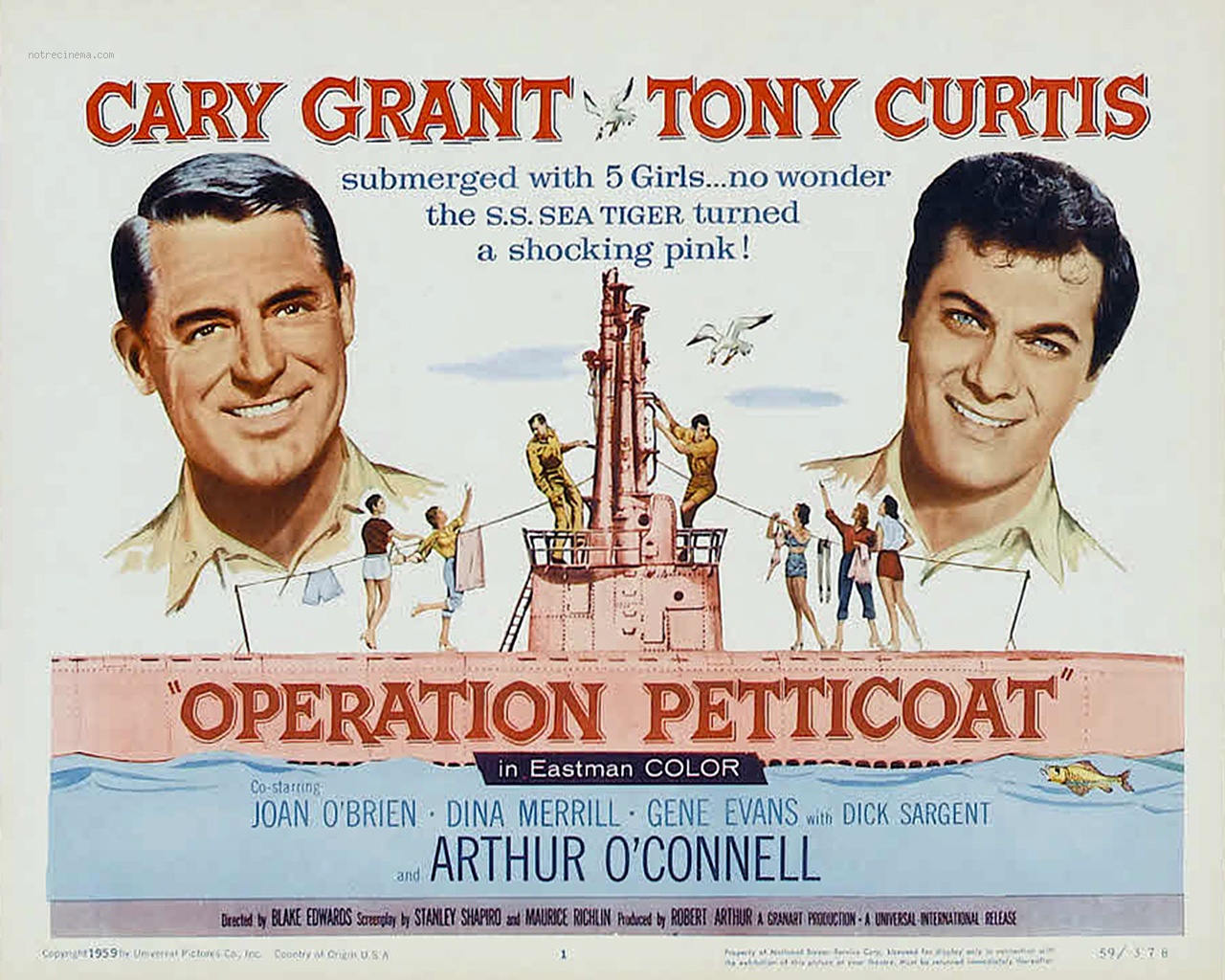
DUELING MOVIES: Operation Petticoat (1959) vs. Down Periscope


VS.


                I am closing out my summer of sub movies by comparing two sub comedies.  By the end of the 50s the sub subgenre had been played out and was ripe for parody.  “Operation Petticoat” closed the decade with a humorous take on the silent service.  Thirty seven years later, 20th Century Fox decided it was time for another sub comedy.  Too soon?  Let’s see.

                “Operation Petticoat” was initiated by Tony Curtis as a vehicle for Cary Grant and himself.  A young Curtis had enlisted in the Navy because he had enjoyed “Destination Tokyo” so much.  Grant was a bit reluctant to make the film due to his age (something that did not bother Gene Hackman when “Crimson Tide” came along), but made a very good business decision in accepting the role.  The movie was a huge hit (it was #3 at the box office that year) and he made $3 million from the deal.  The film was directed by Blake Edwards (“What Did You Do in the War, Daddy?”) and was his first big budget effort.  The movie had the full cooperation of the Navy, which allowed filming at Naval Station Key West and Naval Station San Diego.  It also provided three WWII era subs, including the USS Balao, which it allowed to be painted pink!

                “Operation Petticoat” takes place early in WWII.  The USS Sea Tiger is caught at its berth during an air raid on Cavite Naval Yard in the Philippines.  The sub is sunk by fighters not carrying bombs (like in every other war movie).  Lt. Commander Sherman (Grant) puts the crew to work refloating and refitting the boat.  He is aided by the arrival of a country club warrior, Lt. Holden (Curtis).  Holden is your typical cinematic scrounger and wolf rolled into one character.  When they set sail, they pick up five nurses that are evacuating an island.  Double entendres and sight gags ensue.  Each of the leads gets a romantic arc.  Holden is putting the moves on Barbara (Dina Merrill) and Sherman gets the buxom, but clumsy Dolores (Joan O’Brien).  There is also something going on between the Chief (Arthur O’Connell) and the head nurse Edna (Virginia Gregg).  They don’t get along until she solves his engine problem with her girdle.  I mentioned sight gags, right?
 
                The Sea Tiger goes through a series of misadventures.  It sinks a truck because the boob with boobs Dolores accidentally hits the fire button (surprisingly not with a breast – there was still a Production Code in 1959). This “sinking” leads to the funniest joke, although it was unintentional – the sub comes under shore fire and has to retreat even though it is submerged!   Mixing red and white paint results in the “pink sub” that Tokyo Rose taunts.  They have an encounter with an American destroyer (“Take it down. Express!”  Huh?)  They avoid being sunk by depth charges by using the old expelling-debris trick.  The key to identifying that they are Americans is adding one of Dolores’ bras to the debris.  Hilarious sight gag and racist comment on Japanese women.

                Incredibly, some of these misadventures are loosely based on actual incidents!  A group of nurses were evacuated from the Philippines by the Spearfish.  The Sealion was sunk at Cavite.  The flames peeled the paint off the nearby Seadragon, uncovering the reddish undercoat.  Tokyo Rose made reference to “red pirate submarines”.  The USS Bowfin fired torpedoes at ships docked in a harbor.  One of them went astray and hit a pier with a bus on it.  This makes the movie more accurate than most sub movies.

                “Operation Petticoat” is a movie very much of its time.  The fact that it was a huge hit tells you something about the state of humor in the late fifties.  In other words, what was funny back then is not necessarily funny today.  I like old comedies, but this one does not hold up well.  I find it incredible that it was nominated for an Academy Award for Original Screenplay.  The sexual innuendo is broad (an appropriate word for the time frame) and never beyond blush-worthy.  The idea of putting females on board a sub was inevitable and the results are predictable.  The cast does play it with some enthusiasm.  Grant does not satirize his character from “Destination Tokyo”, but instead plays the CO as bemused by the gals.  Curtis is young Cary Grantish as the stock lothario/scrounger.  The nurses are not particularly sexy by modern standards. Hell, one of them is Marion Ross of “Happy Days” fame.

                “Down Periscope” has a title that implies it is a satire of “Up Periscope” and other WWII sub movies.  Unfortunately, that satirical movie is yet to be made.  “Down Periscope” is more of a “McHale’s Navy” for submarines.  It was directed by David S. Ward (who wrote “Flyboys”, another comedy).  It stars Kelsey Grammer as Lt. Commander Dodge.  Dodge’s career is going nowhere because he is a screw-up and his immediate superior Rear Admiral Graham (Bruce Dern) is offended by the fact that Dodge has “Welcome aboard” tattooed on his penis.  This joke alone tells us how far humor had “evolved” since “Operation Petticoat”.  (Of course, were the movie to be remade today, we would get to see the tattoo.)  To achieve promotion, Dodge must perform some “tasks” that will entertain the audience.  He is given the impossible mission of evading the fleet (including his previous, critical captain) in an old WWII diesel boat and sink a dummy ship in a harbor.  He is given a rusty old pig boat and a motley crew to accomplish his objective.  The crew includes a gambler, a malcontent, a black baller, a fat slob cook, and one hot dive officer (Lauren Holly). Her presence on board will “make things hard on all of us”, quips the captain.   The crew has an insane electrician who reprises the role of the daffy air traffic controller in “Airplane!”, except without the laughs.  Dodge is also saddled with a very uptight exec (Rob Schneider).  Command dysfunction is played for laughs, supposedly.

                After a brief clean-up montage, the Stingray sets sail.  Dodge tests the crush depth, just as the movie will test the audience’s ability to withstand crushing jokes.  These jokes will include the electrician mimicking whale noises to deceive a tracking sub’s sonar.  At this moment, I would have preferred being on a crippled sub at the bottom of the ocean.  The movie jumps the USS Shark when Dodge and the crew dress as pirates to make the obnoxious exec walk the plank.  If you survive this scene, you will be treated to a sub chase and the sight of the Stingray sneaking into the harbor underneath a tanker.  Right underneath a tanker.

                “Down Periscope” is a piffle.  It is mildly amusing.  The amount you laugh is directly dependent on your tolerance for mugging and fart jokes.  When it comes to sex jokes, it is about as chaste as “Operation Petticoat”.  It manages to get Holly into a tight-fitting uniform, but her character is not a dumb blonde like Dolores.  The plot eschews satire.  That would be too difficult apparently, although the subgenre is an easy target.  The cast would not have been up to satire anyhow.  We are not exactly talking “Tropic Thunder” here.  I mean, Rob Schneider, for Christ’s sake.  At least we got Kelsey Grammer, instead of Tom Arnold
.
                There are few good submarine dramas, and no good submarine comedies.  Of the two, “Operation Petticoat” is much the better.  It may not be particularly funny now, but it was cutting edge at the time.  It benefits from Grant’s charismatic presence and it has some foundation in reality.  As a classic, it can be seen as a museum piece depicting what passed for a war comedy in the 1950s.  Watch “Tropic Thunder” to see where we are now.  “Down Periscope” serves as a similar curio, but in its case we have a brush with 1990s TV sitcom humor.  Not the “Frasier” variety, more like “Coach”.

GRADES:  Operation  Petticoat  =  C+

                  Down Periscope  =  D      

Sunday, July 27, 2014

WAR CHICK FLICK: I Was a Male War Bride (1949)


                “I Was a Male War Bride”  is a Howard Hawks / Cary Grant romantic comedy released in 1949.  The exterior scenes were filmed in Heidelberg, Germany.  Terrible weather resulted in illnesses to much of the cast and crew.  Grant suffered from hepatitis and jaundice which pushed back production for three months.  He had to regain thirty pounds to finish the movie.  The movie took a total of eight months to complete.  It was worth it as the film was a box office success and ended up being Hawks’ third highest grosser after “Sergeant York” and “Red River”.  It is actually based on a biography by Grant’s character, but I would assume it is highly fictionalized.


A woman in pants on a motorcycle!
                The movie is set in post-WWII Germany.  Grant plays a French soldier named Henri Rochard.  He is paired with the very feisty Lt. Catherine Gates (Anne Sheridan).  She's a WAC.  They had been paired before on missions to locate stolen art treasures.  Working together has not led to fondness and in fact they dislike each other immensely.  Imagine that.  Their banter is vicious even for the 1940s.  He calls her a “bubblemouth” and she calls him a “blistering idiot”.  This being the good ole days before feminism, Henri threatens that he is “going to kick [her] bowlegged".  She is bossy and he is mean.  They have what the movie calls “sex antagonism”.  Do you think they will get together before the end of the movie?


Spoiler alert:  they get together
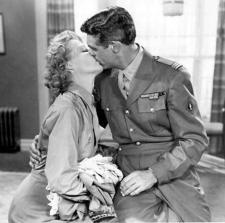
                Their route to matrimony begins with a feverish motorcycle with a sidecar adventure with Catherine donning slacks to drive.  Sheridan did some of the stunts which included the accidental demise of a goose.  As in all romantic comedies of this time period, they end up in the same hotel room and misunderstandings ensue to postpone the inevitable coupling.  Oh, and they are supposed to be on a mission to bring in a valuable lens maker who is now a black marketeer.  They find him and love.  Their first kiss is in a hay stack.  Three weddings later (don’t ask), we get to see Anne Sheridan in a night gown.  She fills it nicely.  They would have lived happily ever after except that Catherine gets orders back to the States and would you believe the law covering military spouses assumed they would be females?  So here comes the big payoff for sitting through this long snooze fest – the sight of Cary Grant in drag!  Go back in a time machine so you can get a thrill out of this.


Trust me, this is actually Cary Grant
                Cary Grant enjoyed making this movie and is quoted as saying it was the best comedy he had done up till then.  Sure!  And “The Green Berets” was John Wayne’s best war movie.  The movie is terrible no matter what Grant said in his hepatitis induced delirium.  It feels like it is lasting longer than the war when it is actually only 105 minutes.  Parts are redundant and all of it is predictable (except the stunning sight of Grant in drag).  The movie gets worse as it goes along.  Just when you think it can’t get any more tedious, it does.  The acting is average.  Sheridan is game and holds her own, but Grant appears to be going through the motions and does not even attempt a French accent.  I did not find they had much chemistry.  The biggest problem is the movie is just not that funny.  I smiled a few times, but never laughed out loud.  Apparently audiences howled at the sight of Cary as a female.  And they guffawed over Milton Berle in a dress back then, too.  Different times.  Back when war brides were topical I suppose the movie was humorous.  However, if you want to see a WWII comedy that holds up, watch “The Miracle of Morgan’s Creek”.

GRADE  =  D

Wednesday, August 15, 2012

CLASSIC OR ANTIQUE? Destination Tokyo


            Part of the ever popular submarine subgenre, “Destination Tokyo” firmly takes its place in the middle of the pack.  Released in 1943, it has to be viewed with the ongoing war as context.  Part of the fun in watching it is to look for overt propaganda.
                A narrator sets the stage by outlining a secret mission that the U.S.S. Copperfin is going to undertake.  It will have to pick up a commando crew that includes meteorologist Lt. Raymond (John Ridgely) which they will proceed to drop off in Tokyo Bay to send weather reports to the Doolittle Raiders.  Did I mention that this is not based on a true story?
                The sappy alarm comes off early as Capt. Cassidy (Cary Grant) writes home to his wife.  This is followed by the first bout of lame sailor banter that is embarrassingly inauthentic.  The pummeling continues with Christmas carols by the crew.  Gag!  It is fun to see the Skipper’s father (Alan Hale, Sr.) as Santa.  One of the crew is a wolf named Wolf (John Garfield) who we see putting the moves on a babe via flashback.  Live vicariously, males in the audience.  In what seems like an unorthodox script move, a discussion (there are a lot of discussions) on God leads to the revelation that the pharmacists mate named Pills (William Prince) is an atheist!
                The first action piece is an attack by two Japanese float planes.  What are the chances that the sub shoots down both?  100%  A Japanese parachutes and when Mike (Tom Tully) tries to help him aboard, the Jap stabs him.  Dirty Nip!  This is who we are fighting, audience.  An unexploded bomb nestled in the sub is defused by Cassidy who apparently is a bomb defusing expert.  Its suspenseful, but I was confident the bomb would not blow up the sub at this point in the movie.
Cassidy being debonair
                Back to the schmaltz, Cassidy plays a recording from his wife.  He gives a speech about how Japanese kids are given a dagger at age 5 and can field strip a machine gun at age 13.  We’re fighting to put roller skates (not ice skates - you could slash someone with those) in their hands at age 5.  The speech seems to have been influenced by lack of oxygen.  More talking, more carbon dioxide.  Crossing the Pacific montage.
                They sneak into Tokyo Bay behind a Japanese cruiser and land the commando team.  Wolf goes along in case they meet any ladies.  We get the obligatory Tokyo Rose appearance.  Meanwhile a sailor has appendicitis and dies a horrible and painful death.  Just kidding – Pills uses a book and makeshift instruments to remove it.  (This is based on several actual incidents.)  Good scene.  In a big letdown, they escape the bay with little trouble.  Cassidy watches the Doolittle Raid through his periscope.  Front row seat.  The bombers bomb some models of a city. 
                Lucky for Jimmy Doolittle and his boys, the Copperfin sinks a carrier which is launching fighters to attack the Raiders. (I am not making this up.)  You don’t suppose there is a depth charging in store for our plucky crew, do you?  Guess who is converted from being an atheist?  In a departure from clichés, there are no rivets popping, leaks springing, going below the maximum depth, releasing a dead body, etc.  The sub sinks a destroyer with a straight on bow shot thus inspiring future submarine movie captains.
                Next thing we know the sub is back in San Francisco.  Why not finish up with more talking as all the main characters discuss their future plans?  Cassidy’s wife is waiting for him, naturally.  Smoochy, smoochy.
                “Destination Tokyo” is an average sub movie.  The acting is good although Grant underplays a bit.  The dialogue is sappy, but not cringe-worthy.  There is a lot of it, however.  The plot is ridiculous and yet the movie was nominated for Best Original Screenplay!  Anyone who disagreed with that was a Jap-lover.  The movie drags and saves most of the action for the last half hour.  We get little of the dysfunctionality among the crew so common in sub movies, but the movie could have used some.  The Jap-baiting is not overboard.  The special effects are not bad for 1943.  The shipboard routines were so authentic that the Navy used the movie as a training film.  Kudos for that.
                Classic or Antique?  Antique
Grade =  C

the trailer


the full movie

Monday, July 25, 2011

#57 - Notorious (1946)


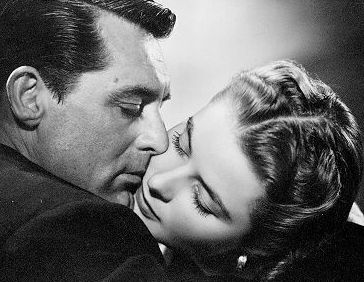
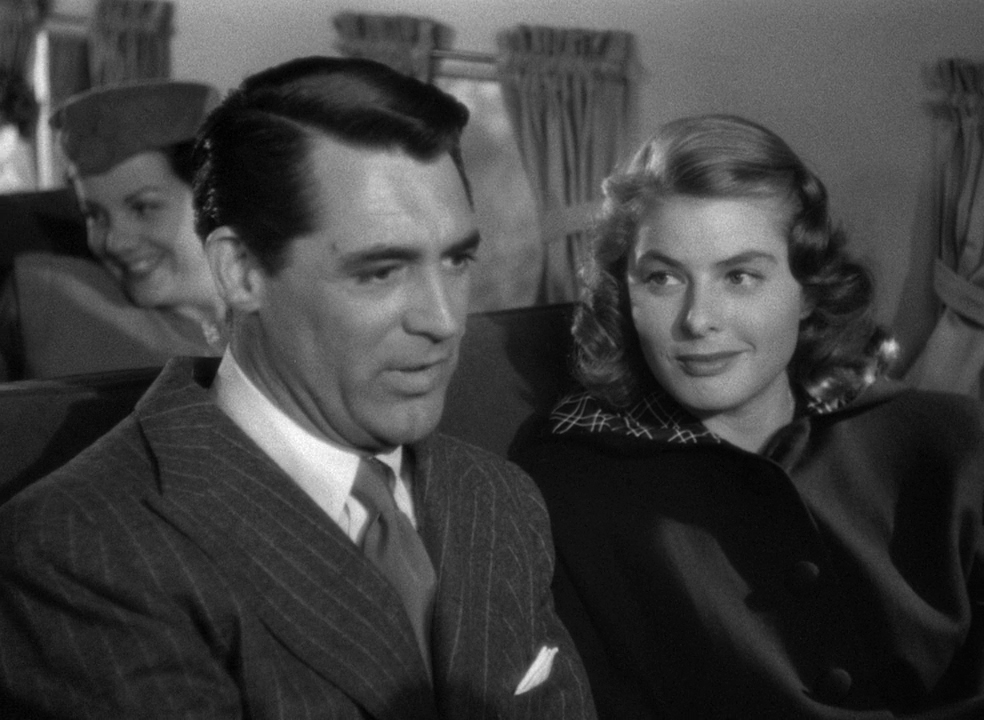
BACK-STORY:  “Notorious” is a classic Hitchcock film released in 1946.  It was shot in crisp black and white and has many of the iconic Hitchcock touches.  It was one of four movies where Hitchcock teamed with Cary Grant and his second picture in a row with Ingrid Bergman (the first was “Spellbound”).  The film was a big hit and was nominated for two Academy Awards – Claude Rains for Best Supporting Actor and Ben Hecht for Best Original Screenplay.  Leopoldine Konstantin (Rains’ mother) made her only appearance in an American movie.  She was actually only four years older than Rains.  Another problem that the magic of movies handled was Rains being several inches shorter than Bergman.  This was overcome with ramps and elevator shoes so well that in the movie Grant and Rains appear to be the same height.  The use of uranium for an atomic bomb as the MacGuffin the plot needed supposedly was prescient by Hitchcock and Hecht and got Hitchcock tailed by the FBI for a while.  The movie has a famous two and a half minute kissing scene where Hitchcock circumvented the Production Code rule of maximum of three seconds of lip-locking by having Grant and Bergman nuzzle between smooches.  This actually works on film.
this does not count toward the three second rule
OPENING:   Alicia Huberan (Bergman) is the daughter of a Nazi spy who commits suicide after a guilty verdict in a Miami court in 1946.  Alicia is a playgirl who is trying to escape her familial shame through affairs and booze.  An FBI agent named Devlin (Grant) is enlisted to recruit her to infiltrate a nest of Nazi friends of her father who are up to no good in Rio De Janiero.
SUMMARY:  Alicia reluctantly agrees to the incredibly dangerous mission.  To complicate matters, she and Devlin fall in love (rather quickly).  The mission is for Alicia to cozy up to her old boyfriend Sebastian (Claude Rains) who is the leader of the gang.  Since he has fallen in love with Alicia, Devlin is torn between duty and love.  Being a patriotic agent, he chooses duty but is quite petulant about it.  To hide his true feelings and to harden Alicia to her task, he coldly treats her like a loose woman.  The underlying tension is that he wants her to back out of the assignment and she wants him to ask her to back out.  As my wife would say, they were not communicating their feelings.  Good thing, otherwise we would not have had this movie.  Here is a sample of their non-communicating:
Devlin: I can't help recalling some of your remarks about being a new woman. Daisies and buttercups, wasn't it? Alicia: You idiot! What are you sore about, you knew very well what I was doing! Devlin: Did I? Alicia: You could have stopped me with one word, but no, you wouldn't. You threw me at him! Devlin: I threw you at nobody. Alicia: Didn't you tell me what I had? Devlin: A man doesn't tell a woman what to do; she tells herself. You almost had me believing in that little hokey-pokey miracle of yours, that a woman like you could change her spots. Alicia: Oh, you're rotten. Devlin: That's why I didn't try to stop you. The answer had to come from you. Alicia: I see. Some kind of love test. Devlin: That's right.
Ouch!

"How could she choose Cary Grant?"
                Sebastian has always been in love with her and falls under her spell with little effort on her part.  He even defies his creepily domineering mother who is immediately suspicious of this competitor for her son’s affections. Alicia secretly meets with Devlin and their conversations are venomous as each lets their bitterness flow.  But there is a job to do and Alicia reports a strange incident involving a wine bottle that may be a clue to what the Nazis have up their sleeves. 
                Alicia marries the blushing groom and takes residence with the mother-in-law from Hell.  Devlin convinces her to host a grand party so he can have access to the wine cellar.  And, oh by the way, can you get the key from Sebastian?  In the wine cellar, Dev and Alicia discover that some of the bottles have uranium in them (what food would that go with?).  They are almost caught by Sebastian and only a steamy fake kiss fools him.  However, Sebastian pieces together several clues to figure the love of his life is betraying him. It’s time to enlist the aid of mommy and endure the I-told-you-sos.  Mom’s solution is to slowly poison Alicia through her daily coffee.
CLOSING:   Alicia looks increasingly bad at her meetings with Devlin until finally she is bedridden and on her way out.  Dev gets suspicious and barges in to see her.  He rescues her right under the noses of the perplexed Nazis (who of course have not been told by Sebastian that he allowed a spy into their gang).  Sebastian wants to go with Dev and Alicia because his friends are not going to be happy with someone who now has cooties, but Dev is unsympathetic and decides apparently that having a potential Nazi stool pigeon in FBI custody is not a good idea.
RATINGS:
Action – none
Acting – 9 ( even Alfred who does a great job downing a drink at the grand party )
Accuracy – not applicable
Realism – 5
Plot – 7
Overall -  6
WOULD CHICKS DIG IT?  Did I mention it has Cary Grant in it?  Nuff said.  The love story is sizzling and the dialogue is crackling.  There is a lot of chemistry between the leads.  It is edge of your seat suspenseful at times.  Your girl might even clutch your arm at times.  However, you’re likely to also get punched in that arm with comments like “You men are all alike” when there are scenes of Dev being mean to Alicia because he can’t reveal his true feelings.  Guys, if your wife has mother-in-law issues, this movie is bound to make your mother look pretty damn good.
ACCURACY:   Obviously, “Notorious” is not based on a true story so accuracy is not an issue.  It is true that some Nazis did escape to places in South America like Rio, but there is no evidence they were working on an atomic bomb.  This part of the plot is actually a little silly.  What exactly were these Nazi’s going to do with their wine bottles full of uranium?  Don’t think on this too much.  Nazis + uranium = bad
CRITIQUE:    I am a big Hitchcock fan, but I have to swim upstream and state that I do not think this is one of his best films.  It is well written and well acted.  It has its moments of standard suspense.  For example, the “will they get caught in the cellar” scene.  Nothing special there.  The rescue is anti-climatic, although leaving Sebastian behind to face his comrades is a nice touch.
                The movie explores some interesting themes.  One of these is trust.  Devlin has a hard time trusting Alicia and Sebastian trusts her too readily.  Another is the theme of love versus duty.  Dev is torn between his love for Alicia and the mission of using her for national security.  He comes down on the side of the mission which makes the movie one of the first post-WWII espionage movies to emphasize the get your hands dirty nature of intelligence work.  Interestingly, the Cold War had not kicked in yet so Hitchcock was a little ahead of the curve on this dynamic.
                By far the best reason to watch the film is the dialogue and acting.  The sparring between Alicia and Devlin is priceless.  Grant and Bergman are at the top of their games, but Rains is outstanding as well.  He portrays a sympathetic Nazi who ironically is more in love with Alicia than Devlin is.  He also has those terrible mommy issues that we can sympathize with.  You almost feel sorry for him.  He is a cultured, urbane Nazi sap.  As his mother, Konstantin is one of the great villains of filmdom.
CONCLUSION:   This is the second Hitchcock film on the list and it is even less of a war movie than “Foreign Correspondent”.  I have no idea what the panel was thinking here.  Even the loosest definition of war movie would not include this movie.  But the astounding thing is this movie is eight places higher than “Casablanca”!  How can that be justified?  No one in their right mind would argue that “Notorious” is superior to “Casablanca” as a film.  I doubt even Hitchcock would make that argument.  Given that fact and the fact that “Casablanca” is clearly more of a war movie than “Notorious”, how do we end up with these rankings?!