“Stalingrad”
is a small unit movie.A platoon of
German soldiers goes from rest and recreation in Italy to the maelstrom of
Stalingrad.They are led by the
idealistic Lt. Witzland.They will all
become disillusioned quickly as they find the fighting to be vicious and unit
winnowing.Encounters with evil German
officers lead to Witzland and his core group being assigned to a penal
battalion.Eventually, they are
“allowed” back into the shit and end up among the last survivors of the
siege.The plot is an admirable attempt
to depict the hardships of German soldiers at Stalingrad, but it is rife with
clumsy plot developments.It is a small
world in the city as characters reappear in totally unrealistic ways.As a battle movie, it is all micro.You learn little of the big picture.It is a small unit movie that poorly develops
the main characters.GRADE=C(7)
“Westfront
1918” is a German film that was released in 1930. It concentrates on four German soldiers in the
closing months of the war.They won’t
all survive as the movie is unrelentingly realistic about the situation for
Germans on the Western Front.The plot
follows the classic formula of rest and exposition followed by action.It hits several targets that were established
by it and “All Quiet…” (released the same year and also banned in Nazi
Germany).There is bonding between the
new soldier and the veteran.There is as
poignant home front leave.And there is
the combat that shows the futility of war.All of the incidents are believable and the characters represent
archetypes of soldiers in the German army.GRADE=A(9)
ACTING
“Stalingrad”
is anchored by the usually reliable Thomas Kretschmann, but his character lets
him down.Witzland’s character arc from
idealistic, ambitious officer to cowardly pacifist is just not believable.The rest of the performances are nothing
special.The characters are not fleshed
out well.The movie is hurt by a
caricature of an evil German played with menacing woodenness by Dieter
Okras.GRADE=B(8)
“Westfront
1918” is more about the war than about the soldiers.The characters are not well developed and the
actors tend to fall back on their silent movie emoting.Fritz Kampers (The Bavarian) and Gustav
Diessi (Karl) are the standouts.GRADE=C(7)
CLICHES
“Stalingrad”
has the new guys passing by the wounded at the railway station scene.The new lieutenant has to gain respect.One soldier receives a “Dear Hans”
letter.Witzland goes from idealism to
cynicism.He and others earn redemption.There is a cartoonish evil German.GRADE=C(7)
“Westfront
1918” avoids most cliches.One of the
main characters dreams of a future with a girl he meets.Guess what happens to him.Although it concentrates on four soldiers, it
is not a small unit movie with dysfunction in the group.The home front trip by Karl takes an
unexpected turn.The quartet includes a
jolly fat guy.GRADE=A(9)
COMBAT
There
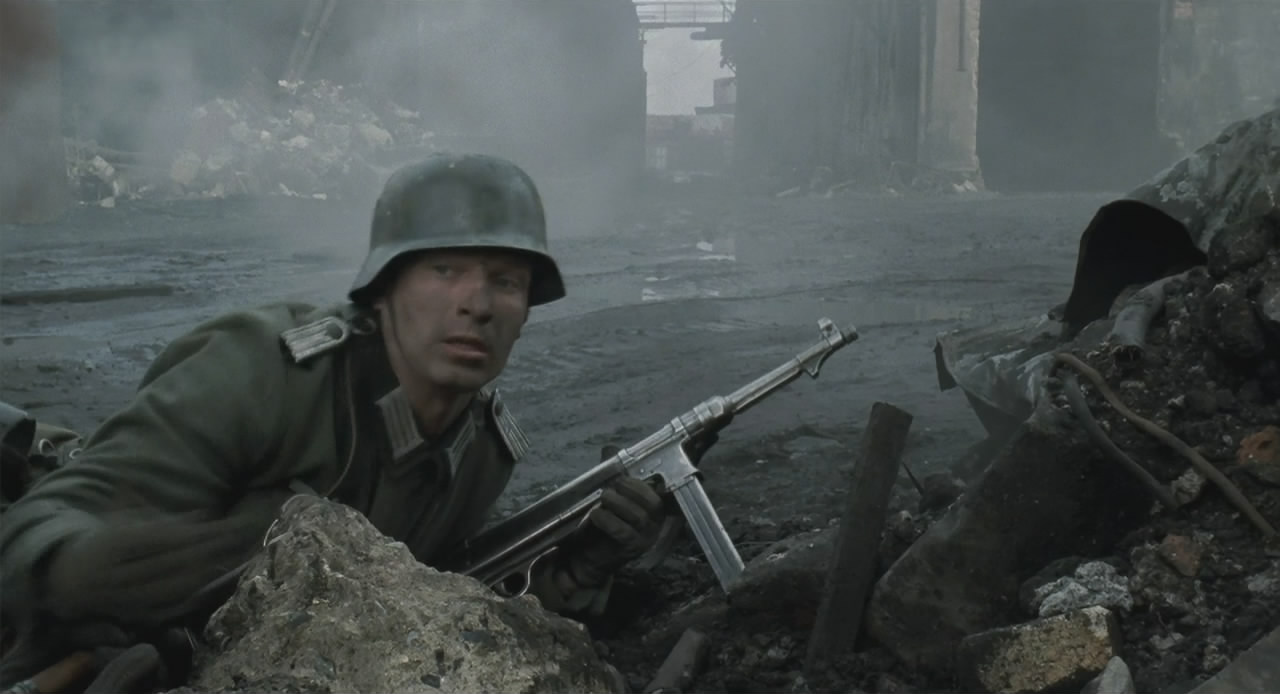
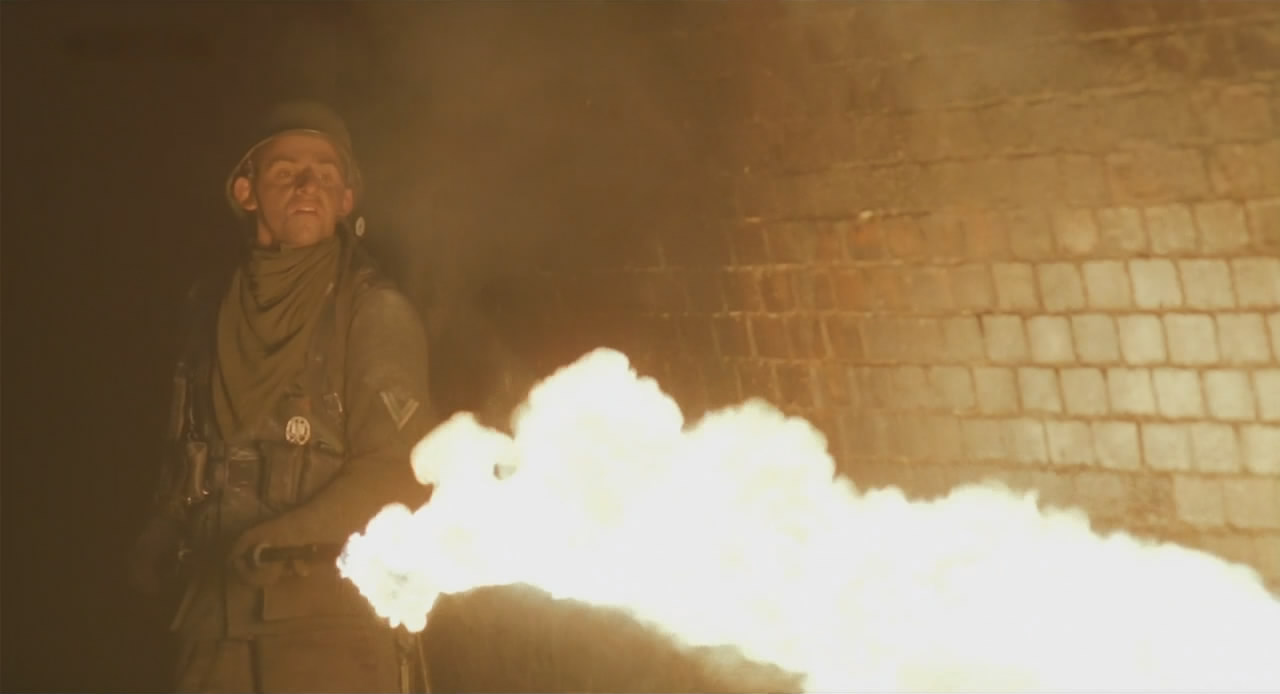
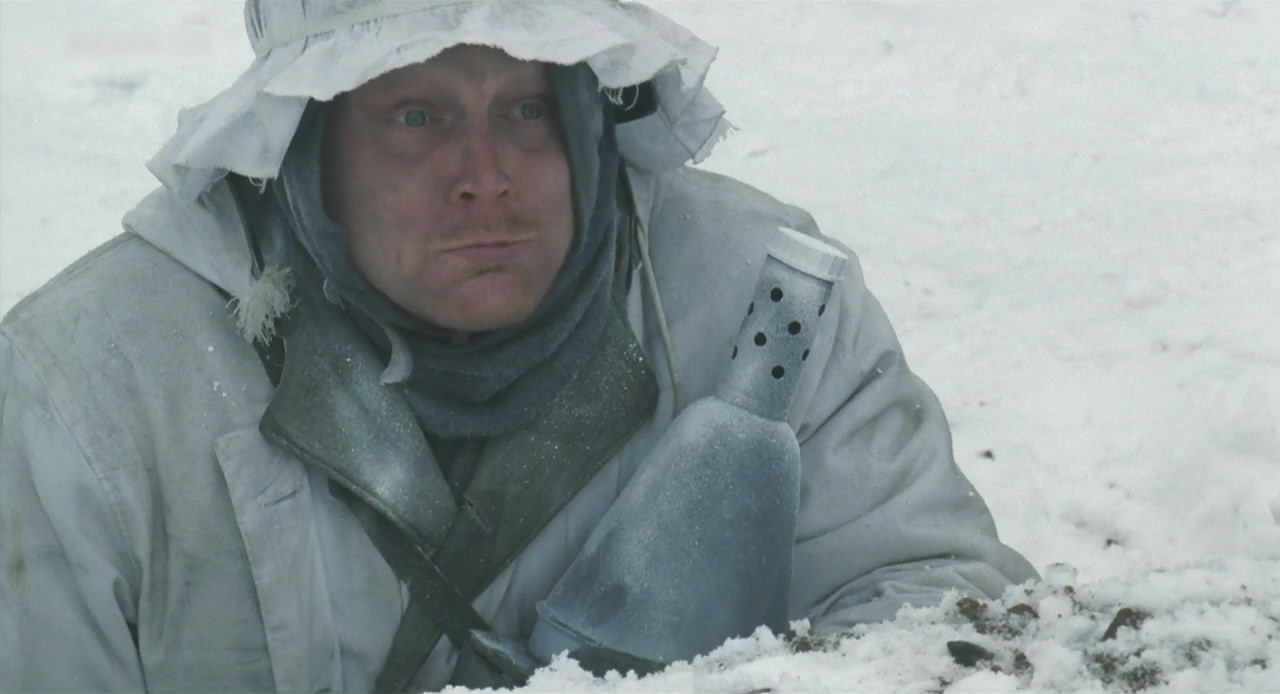
are only two combat scenes in “Stalingrad”.The first is a German assault on a factory.It is competently done, if simplistic.The rubble is authentic.The tactics are sound.A flame-thrower is used.There is a friendly fire incident.However, it is unclear how they were able to
clear out the building.The second scene
is a Russian tank attack against Germans in fox holes.It features Molotov cocktails and sticky bombs.It’s a visceral scene, but unrealistic as the
tanks do not use their guns and end up retreating for no good reason.GRADE=B(8)
“Westfront
1918” does not have a lot of combat.There
is a great long combat scene that includes lots of grenade throwing, poison
gas, and some really cool tanks lumbering toward the German lines. The
movie has some of the best bombardment effects of any war movie.GRADE=B(8)
FINAL SCORE:Westfront
191833Stalingrad30
ANALYSIS
I
know most would think the highly regarded “Stalingrad” would defeat an obscure
WWI movie overshadowed by “All Quiet”.It’s interesting to note that both are German movies that are realistic
in depicting low moments in German history.They deserve credit for that, but especially “Westfront” because it came
out when it was daring to take a harsh brush to the recent war.It has a more cohesive plot than the 1993
movie.“Stalingrad” is a very overrated
film.Critics tend to overlook the
numerous plot and character flaws.I
have seen both movies more than once and clearly “Westfront 1918” is the better
movie.
SYNOPSIS:"Stalingrad" is a bleak film about
a German squad caught in the Russian city towards the end of the siege.
BACK-STORY:“Stalingrad” was a major German production
released in 1993.It was directed by
Joseph Vilsmaier.It is in the German
language.I found nothing of particular
interest anecdotally.
Belle and Blade=5.0
Brassey’s=4.0
Video Hound=N/A
War Movies=N/A
Military History=#23
Channel 4=#58
Film Site=no
101 War Movies=yes
Rotten Tomatoes= no
HISTORICAL ACCURACY:
The
movie is fictional and does not attempt to give an overview of the battle.It could be set in any number of urban combat
scenarios.As a depiction of the trials
of a typical squad of Germans caught up in the battle, it is fairly accurate.The weapons and equipment are
authentic.
OPINION:“Stalingrad” is an
admirable attempt to depict the battle from the perspective of a squad of the
losers.We follow them from the sunny
beach in Italy to the frozen rubble of Stalingrad.They become recognizable personalities.The unit is heterogeneous, but not too
stereotypically so.It reminded me of
“Platoon” in this respect.However, it
does have some archetypes like the cynical veteran sergeant (Rohleder), the
idealist (Reiser), the naïve novice (Muller), and the ambitious officer
(Witzland).Unfortunately, the acting is
pedestrian and the character development is flawed.Rollo should have been a strong character,
but he does not develop into the insubordinate anti-hero he could have
been.This was disappointing.Perplexing is more the word for Witzland’s
evolution.He starts as a martinet,
becomes an officer on the make, and then suddenly gets sensitive towards the
enemy and ends up a deserting pacifist.While unorthodox, this arc is ridiculous.
The small unit dynamics are
realistic and the soldier talk seems true to form.The interaction between the soldiers is not
forced.It is instructive to see that
the non-S.S. soldiers behaved like soldiers from any World War II army.Remember that not all German soldiers were
Nazi fanatics.The movie also throws in
a female Soviet soldier and a boy soldier, but the roles come off as attempts
to humanize the Germans because they treat these enemy well.In reality, the Wehrmacht was not exactly
sensitive toward those two types.Plus
their appearances in the narrative are too plot enhancing.Speaking of which, the whole Bad German role
was dripping with cliché.
The
plot is not smooth.It does not
integrate the big picture into the small world of the squad.It is one thing to depict the “fog of war”,
but the audience should have an idea of why things are disintegrating.Too many incidents in the plot foreshadow
future developments.This is the kind of
movie that when an enemy character suddenly is injected into the plot and then
exits, you know they will be reappearing.It was apparently a small world in Stalingrad.
The
themes are appropriate.Vilsmaier is
interested in filming the futility of war.What better way to make this point than focus on a German squad at
Stalingrad?There’s no debating the movie
is solidly anti-war.It also tends to be
anti-military.Although Witzland and
Musk are shown in a positive light, Haller (Bad German) is meant to represent
the German officer corps.The other
theme is comradeship.In this respect,
the film does not break any new ground and does not compare well to movies like
“Platoon”.The interplay is average in
realism.
In
conclusion, I had heard great things about this movie and I had every reason to
believe I would enjoy it.It appeared on
the surface to be my kind of war movie.Plus I am fascinated by the Battle of Stalingrad and have read books on
the subject.I was shocked at how
disappointing the movie was.It is very
overrated.Sources that I trust rate it
as a great war movie.They are
wrong!It is not even the best movie
about Stalingrad.That would be
“Stalingrad: Dogs, Do You Want to Die?”
BACK-STORY:“Stalingrad” was a major German
production released in 1993.It was
directed by Joseph Vilsmaier.It is in
the German language.I found nothing of
particular interest anecdotally
OPENING:Words on the screen tell us that
it is the summer of 1942.The Germans
are in the middle of their second major summer offensive in the Soviet
Union.The goal is the Caspian Sea and
the Caucasian oil fields.The Sixth Army
under Gen. Von Paulus is advancing on Stalingrad which will result in the “most
brutal battle of the century”.While
these momentous events are taking place, a squad of veterans from North Africa
are enjoying an Italian beach.Their
beloved Lt. is being replaced by a Lt. Witzland (Thomas Kretschmann) who is
green, an aristocrat, and gung-ho.He
makes an immediate impression on his new charges when he denies the seasoned
Sgt. “Rollo” Rohleder a medal because he refuses to button his collar at the
decoration ceremony.We could be looking
at a Stransky vs. Steiner dynamic ala “Cross of Iron”.
Witzland rethinking his career path
SUMMARY:The squad must have done
something bad off screen because next thing you know they are being sent to the
Eastern Front.On the train, they are
overconfident and brag about kicking Russkie ass.This attitude is probably due to having
recently tangled with the British.They
are about to find out that the Russians are tougher than the Brits and freezing
cold is rougher than desert heat.
When
they arrive, we have the obligatory ”in with the new, out with the old
loading-the-wounded-on-the- vacated-railway-cars” scene.The actors are told to be sobered by this
sight when in reality these veterans would have seen plenty of death in North
Africa.Speaking of “Cross of Iron”,
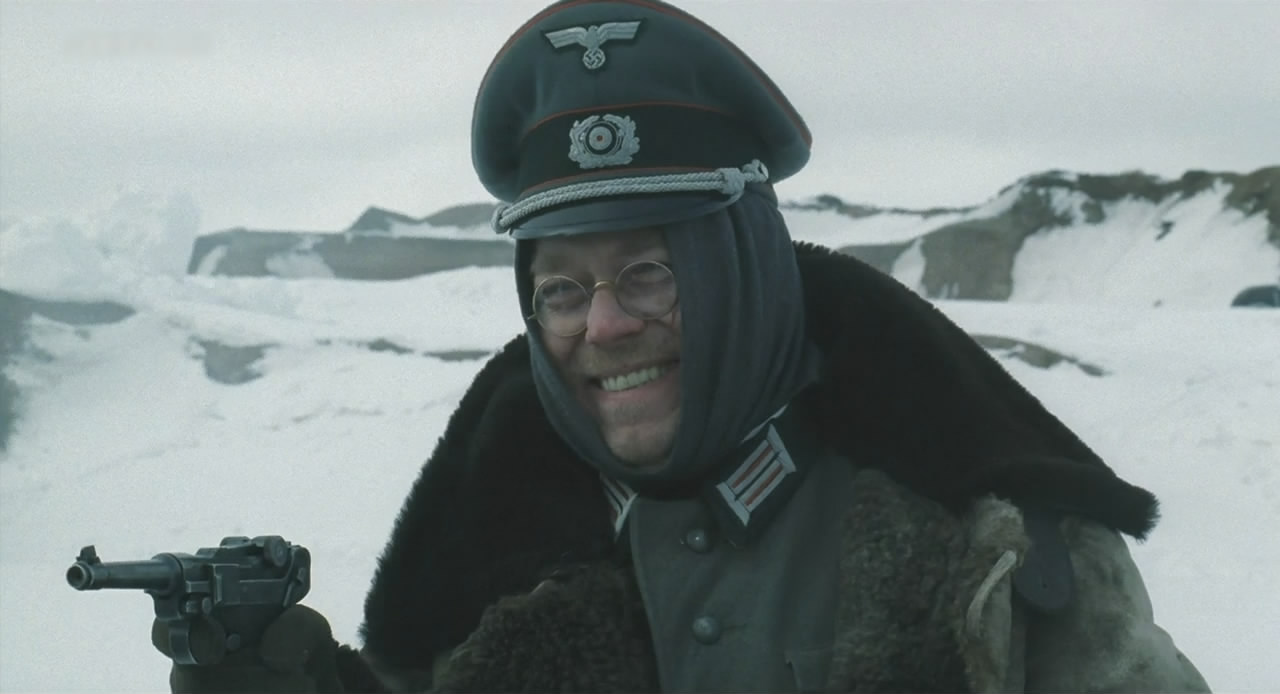
Witzland has a run in with a sadistic Nazi officer named Haller who is abusing
prisoners.This ‘bad German” will
reappear several times throughout the film.
Reiser with a flammenwerfer
The
squad is attached to a unit commanded by the charismatic Capt. Musk (Karel
Hermanek).They are tasked to capture a
factory.The first death elicits the
shock and disbelief you would expect from rookies, not North African vets.They capture the factory with the aide of
flame throwers.There is confusion (“the
fog of war”) and a friendly fire death.One of the men admits he “shit his pants”.Only 162 of the original 400 man unit survive
to try to hold the position.
With
Soviets just a block away, our boys show typical cameraderie.The most introspective is Reiser (Dominique
Horwitz) who tells a newbie “If you start to think, you go crazy; so I don’t
think”.Witzland decides to defy
standing orders and offer a truce to recover the wounded from “no man’s
land”.Humaneness comes to a shattering
close when one of the Germans opens fire.In the chaos, Witzland captures a Russian boy-soldier named Kolya in a
move that makes no sense other than as a plot point.
Still
holed up in the factory, Rollo receives a “Dear Johan” letter.Witzland decides to lead a patrol to find a
way out.This command decision makes no
sense (why would he leave his unit behind?), but soon becomes clearly a method
to advance the plot. He gets separated
from the rest and runs into a female Soviet soldier named Irina.Witzland takes her captive, but she pushes
him into a sewage pool (including bobbing corpses) and gets away.What was the point of this encounter?
Bad German is armed and evil
Reunited
with the group, Witzland and the others make it to the hospital where they
force an orderly to work on a wounded friend.“Bad German” suddenly arrives and puts them under arrest.What are the odds?They are put in a penal battalion and four
weeks later are hunting for mines.Capt.
Musk arrives and offers them a chance for redemption.All they have to do is defeat a large force
of Soviet tanks.Piece of cake!
You want me to do what with this anti-tank mine?
They
are in fox holes defending a perimeter when the tanks arrive.Their main weapon is sticky bombs that they
have to attach to the tank’s undercarriage.Lucky for them the tankers are either out of ammunition or feel it’s
unsporting to use their main guns!Kind of
like in “Saving Private Ryan” when the tanks did not use their machine guns in
the bridge scene.In a huge upset, the
Germans beat off the attack and then abandon the position to return to their
hut for some more exposition.Apparently
no need to worry about another attack in that sector.
Sorry, Kolya: orders are orders
They
are put under Bad German’s command and are ordered to act as a firing squad for
some Russian prisoners.Oh, no!Is that Kolya?They reluctantly obey orders.This is the last straw.Reiser decides to desert and Witzland and
Muller join him.They make it to the
airport and fake being wounded, but in the chaos they are not able to board the
last plane out.They return to the hut.
Irina did not enjoy being a sex slave
CLOSING:As they await the inevitable surrender, a
plane drops a crate of supplies in a nearby field.The guys are gorging on food when Bad German
arrives out of the blue and
threatens to shoot them as looters.He shoots Muller and seems to think his Naziness
will cow the desperate, feral, vengeance-minded men.Wrong!Before he dies, he reveals that he has a man-cave replete with goodies
nearby.The boys hasten to the lair
where they find a mountain of looted goods and a sex-slave tied to a bed.OMG – it’s Irina!No wonder the script allowed her to escape in
the sewer.Witzland frees her and plays
the gentleman.He prevents the others
from raping her (although they don’t seem very keen on it anyhow).Suddenly, Capt. Musk starts ranting about
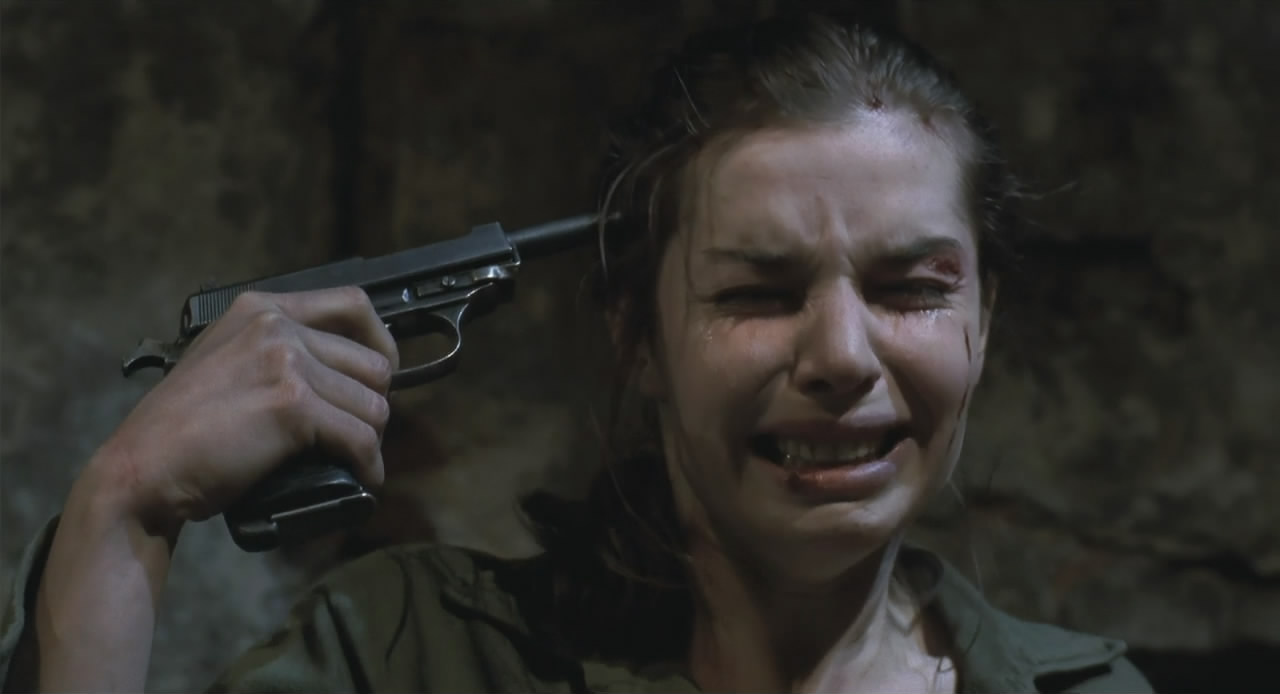
them being deserters and wants to return to the front.Otto commits suicide.Reiser and Witzland head off with Irina
leading.Rollo sticks around with the
dying Musk.The trio encounter Soviet
soldiers and those expecting a happy ending will be disillusioned.
RATINGS:
Acting =C
Action =7/10
Accuracy =B
Plot =C
Realism =B
Overall =C
WOULD CHICKS DIG
IT?The film is not
aimed at a female audience, but it does have a major female character and it is
not graphic in violence or language.Not
exactly a date movie, but more appealing than most war movies.
HISTORICAL
ACCURACY:The Battle of
Stalingrad was the turning point in Europe in the Second World War.It was the decisive battle on the Eastern
Front.It was precipitated by Hitler’s
attempt to finish off the Soviet Union with a grand offensive that would
capture the Caucasian oil fields and the strategic city of Stalingrad.The Sixth Army commanded by General Von
Paulus was tasked with capturing the “city of Stalin” on the Volga River.Things went well at first with the army
sledge-hammering its way into the city and eventually controlling 90 % of
it.The losses were enormous on both
sides.Although the Germans cut their
way to the banks of the Volga and thus divided the city, the Red Army put up a
spirited resistance.The Soviets created
strongpoints and forced the Germans to come to grips which negated their tanks,
artillery, and air power.Buildings,
including factories, changed hands numerous times.The city was turned into rubble which
naturally favored the defenders.
In
November, 1942, Marshal Zhukov launched Operation Uranus which entailed pincer
offensives north and south of the city that resulted in the encirclement of the
Sixth Army within the city.The Germans
were gradually whittled down.Rations
were cut to a bare minimum.The soldiers
were forced to make a watery soup using the bones of dead horses that they dug
up.The winter added to the
hardships.Hitler refused to allow any
thought of a breakout, especially after Luftwaffe commander Goering promised to
supply the city via air drops.Goering’s
bravado was a pipe dream as the actual tonnage of supply drops was woefully
short of the minimum requirements.
Hitler
approved an attempt to break through to the city led by General Von
Manstein.Manstein’s spearhead got to
within thirty miles of the city, but Von Paulus (sensing Hitler’s disapproval)
refused to launch a break out attempt to link up with the relief force.The Sixth Army’s fate was sealed.Eventually 91,000 Germans surrendered.
The
movie is fictional and does not attempt to give an overview of the battle.It could be set in any number of urban combat
scenarios.As a depiction of the trials
of a typical squad of Germans caught up in the battle, it is fairly
accurate.The weapons and equipment are
authentic.
CRITIQUE:“Stalingrad” an admirable attempt
to depict the battle from the perspective of a squad of the losers.We follow them from the sunny beach in Italy
to the frozen rubble of Stalingrad.They
become recognizable personalities.The
unit is heterogeneous, but not too stereotypically so.It reminded me of “Platoon” in this respect.However, it does have some archetypes like
the cynical veteran sergeant (Rohleder), the idealist (Reiser), the naïve
novice (Muller), and the ambitious officer (Witzland).Unfortunately, the acting is pedestrian and
the character development is flawed.Rollo should have been a strong character, but he does not develop into
the insubordinate anti-hero he could have been.This was disappointing.Perplexing is more the word for Witzland’s evolution.He starts as a martinet, becomes an officer
on the make, and then suddenly gets sensitive towards the enemy and ends up a
deserting pacifist.While unorthodox,
this arc is ridiculous.The small unit
dynamics are realistic and the soldier talk seems true to form.The interaction between the soldiers is not
forced.It is instructive to see that
the non-S.S. soldiers behaved like soldiers from any World War II army.Remember that not all German soldiers were
Nazi fanatics.The movie also throws in
a female Soviet soldier and a boy soldier, but the roles come off as attempts
to humanize the Germans because they treat these enemy well.In reality, the Wehrmacht was not exactly
sensitive toward those two types.Plus
their appearances in the narrative are too plot enhancing.Speaking of which, the whole Bad German role
was dripping with cliché.
The
movie is technically sound.The
cinematography is average after the opening battle which featured some
hand-held and point of view.The music
is sadly trite.The movie does get the look of
Stalingrad.The dead bodies.The rubble.The sewer system.However, much
of the movie is set outside the city on snowy plains.I feel the movie wimped out on showing the
real hellish nature of the battlefield. Showing a character in a sewer with bobbing
corpses was not enough.
The
plot is not smooth.It does not
integrate the big picture into the small world of the squad.It is one thing to depict the “fog of war”,
but the audience should have an idea of why things are disintegrating.Too many incidents in the plot foreshadow
future developments.This is the kind of
movie that when an enemy character suddenly is injected into the plot and then
exits, you know they will be reappearing.It was apparently a small world in Stalingrad.
The
themes are appropriate.Vilsmaier is
interested in filming the futility of war.What better way to make this point than focus on a German squad at
Stalingrad?There’s no debating the
movie is solidly anti-war.It also tends
to be anti-military.Although Witzland
and Musk are shown in a positive light, Haller (Bad German) is meant to
represent the German officer corps.The
other theme is comradeship.In this
respect, the film does not break any new ground and does not compare well to
movies like “Platoon”.The interplay is
average in realism.
CONCLUSION:I bought a DVD copy of
“Stalingrad” before I started this blog project and held off watching it until
I reached its place on the Greatest 100 list.This means I had been looking forward to viewing it for over two
years.I had every reason to believe I
would enjoy it.It appeared on the
surface to be my kind of war movie.Plus
I am fascinated by the Battle of Stalingrad and have read books on the
subject.I was shocked at how
disappointing the movie was.It is very
overrated.Sources that I trust rated it
as a great war movie.They are wrong!The best way to prove my point is to compare
it to its closest equivalents.It is
absolutely inferior to “Cross of Iron” and “Enemy at the Gates”.COI is much better at small unit dynamics and
has much more vivid characters.Rollo
cannot carry Steiner’s boots.As far as
EATG, the plot is much stronger and the rubble is more rubblier.Not to mention the female and youth characters
are much more compelling.
I
think a case can be made for “Stalingrad” being in the 100 Best War Movies
mainly because of its subject matter – a German squad in the Battle of
Stalingrad.However, the execution of
the concept is flawed.
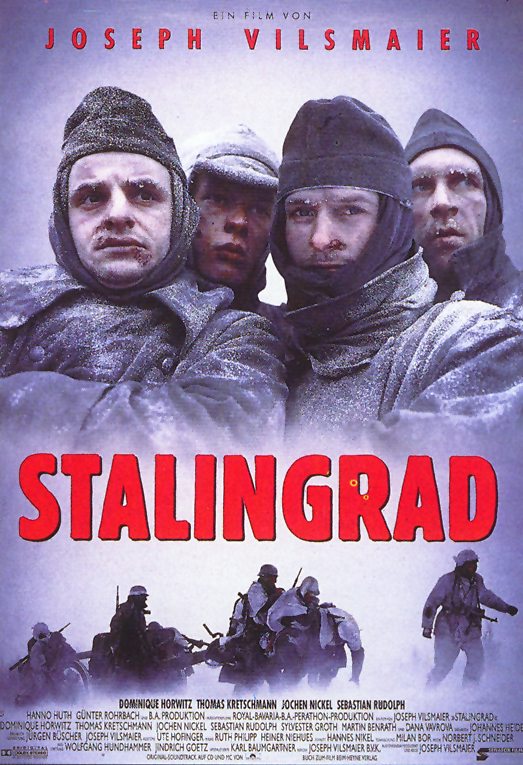
POSTER: The poster does convey the fact that it is hard to distinguish the various characters. You alos get the impression that it is not the feel good movie of the year. Grade = B