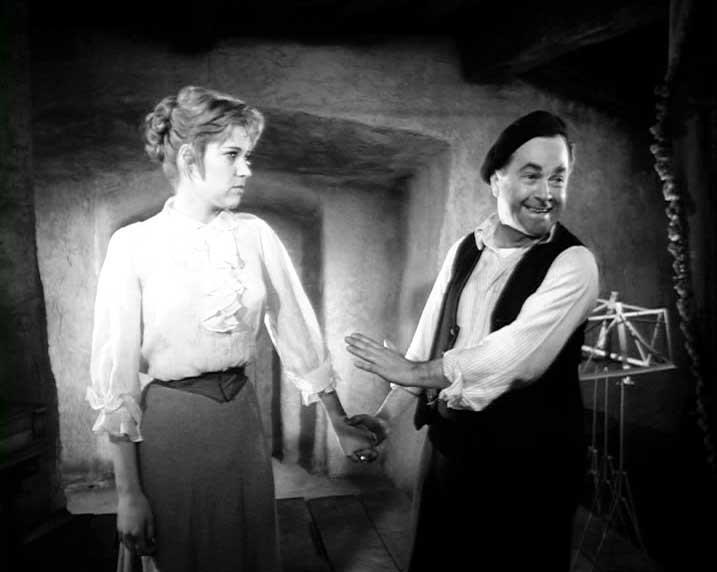
“The Hook” is a Korean War movie
set in the closing days of the war.It
was directed by George Seaton (36 Hours) and written by Henry Denker (Time
Limit).It was based on the novel L’Hamecon
by Vahe Katcha.The title of the
movie is the translation of the book title.It stars Kirk Douglas, three years after “Spartacus”.The man did not let superstardom go to his
head as this movie is about the opposite of “Spartacus” when it comes to budget
and prestige.It was dedicated to “the
individual man.For in the brief and
quiet interludes between the loud and terrible noises of war, he is capable of
great and revealing moments of nobility.”
In June, 1950,merchant ship captures a downed North Korean
pilot.Sgt. Briscoe (Douglas) is ordered
to kill the prisoner.Although he
believes orders are orders and does not want to jeopardize his career, he is
unable to carry out the task.He then
tries to get Private Hackett (Nick Adams) or Private Dennison (Robert Walker)
to do the job.Hackett is Briscoe’s
lackey (his “private private”) and Dennison is a sensitive type who reads books
about Korean culture.There is no Animal
Mother anywhere to be found, so the execution is not going to come easy.Meanwhile, the freighter is in dangerous
waters which adds to the tension.
This movie is a forgotten
gem.There are not a lot of good movies
about the Korean War, but some of the good ones were minor productions like
this and the aforementioned “Time Limit”.In fact, it shares a similar vibe to that movie.Both have the feel of plays and focus on
morality.This is especially apparent in
the dialogue.There are some good lines
like when the captain says:“It’s a
sickness of this century that everyone must be right and everyone else must be
wrong.”The theme is the effect of war
on humanity.An individual’s humanity.In this case, three individuals.As the movie puts it:“This is the story of men in war, not men at
war.And the two are not the same.”It is very micro and concentrates on just
three men and how they handle a moral dilemma.The trio are well-cast and the acting is outstanding.Adams and Walker were underrated actors and
they hold their own with Douglas.Douglas plays one of his more complex characters.Briscoe is a heel, but he handles a difficult
situation in a realistically human way.Douglas taking this role is another example of the risk-taking that sets
him apart from John Wayne.
If you are a Kirk Douglas fan,
you might want to catch this largely forgotten film.It is a thought-provoking and suspenseful
little movie.While a bit preachy, it is
a welcome addition to the truly anti-war film fellowship.
Kirk Douglas was one of my favorite actors. He could play any role (except a wimp) and did not mind playing characters that were dislikeable, unlike John Wayne. I read once that Wayne told him not to play Van Gogh in "Lust for Life", but Douglas was willing to take controversial roles. He made a lot of war movies and war movie lovers from my generation have probably seen most, if not all of them. Here is the list:
He was more than just an actor. He made important movies. "Paths of Glory" was a movie he insisted on making. His stint in the Navy in WWII on an anti-submarine warfare vessel made him aware of the horrors of war. Although he volunteered after Pearl Harbor, he did not hate the Japanese and could empathize with crewmen of subs that might undergo a depth charging from his ship. This influenced him making one of the greatest anti-war movies of all time. When Kubrick wanted an upbeat ending, Douglas insisted on sticking with the firing squad.
But my favorite of his movies is "Spartacus". I showed it so many times in my Western Civ class that I have the dialogue memorized. It is an almost perfect movie and he was the main reason for that, not Kubrick. But more than perfect entertainment, it is a historically significant film because he insisted the blacklisted Dalton Trumbo be given screenwriting credit. This was a gutsy career move and helped drive a stake into McCarthyism. Watch the movie "Trumbo" to get a better appreciation for Douglas.
We will not see another actor like him.
The
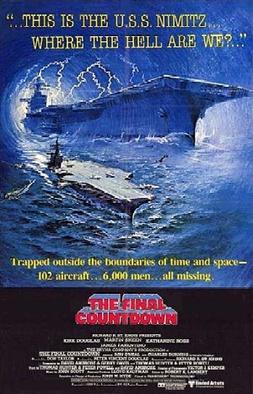
Final Countdown(1980)
"The Final Countdown" was Douglas' last war film. It is a alternative history science fiction film that also falls
in the war movie genre.Originally, it
was entitled “The Last Countdown” and used the Bermuda Triangle to transport
the aircraft carrier to the Mediterranean before the assassination of Archduke
Franz Ferdinand which started WWI.When
producer Peter Douglas (Kirk’s son) got his hands on the screenplay, he changed
it to Pearl Harbor.He hired Don Taylor
to direct.Taylor is familiar to war
movie fans more for his acting in films like “Stalag 17” where he plays
Dunbar.Douglas got full cooperation
from the Navy which saw the movie as a recruiting booster.It allowed Douglas to spend two months on the
USS Nimitz.48 members of the crew got
acting credits for the film and some had speaking roles.The Navy had no problems with the script and
was pleased with the finished product.The three Zeros were supplied by the Commemorative Air Force (originally
called the Confederate Air Force).These
were replicas adapted from AT-6 Texans and they had previously been seen in
“Tora! Tora! Tora!”The climactic scene
showing the attack on Pearl Harbor was footage from that earlier film.The rock band Europe was inspired to write
its hit song because it liked the title.
The
movie is set in 1980…at first.The USS
Nimitz is at Pearl Harbor when a civilian observer named Lasky (Martin Sheen)
comes aboard to inspect the ship for his employer who designed it.He must be bad luck because soon after his
arrival the carrier goes through a vortex.The special effects are cheesy, but satisfactory.Capt. Yelland (Kirk Douglas) calls for
general quarters so the viewing public can see how efficiently run a modern
carrier is.Something is hinky as the
carrier has lost communications with its escort ships.And it is picking up “The Jack Benny Show”.After a bit of head-scratching, Yelland
realizes the date is December 6, 1941.He now has a decision to make.Should he change the course of history by destroying the Japanese
fleet?It’s a bit more consequential
than Marty McFly sleeping with his mother.
If you are going to make a time travel movie
involving an aircraft carrier and Pearl Harbor, you need to make it more fun
than this movie.“The Final Countdown”
is too serious, and yet it does not get serious about the implications of
defeating the attack.Yelland does not host
a discussion of the consequences.And
then we don’t get to see if he was right.The movie’s payoff is a bit lame and proves that the plot existed mainly
to reveal who Lasky’s mysterious boss is.It’s not worth the wait.The
movie is focused on showing off the ship and setting up the twist ending.To bring drama to the ship a foghornish
Senator (Charles Durning), his curvaceous secretary (Katherine Ross), and a
Zero pilot are brought aboard.The
acting is as wooden as a WWII carrier deck.Not Douglas, of course, because
he is his usual reliable self.The
character would have been better as a Halsey instead of a Spruance. The best
actor is the USS Nimitz. It’s an awesome
ship and is run efficiently.We see a
lot of procedures including takeoffs and landings.Unfortunately, the Navy did not insist on a
blaring rock soundtrack to goose recruitment.Instead, the movie relies on patriotic pablum.There’s a lot to be proud of if you are an
American.You certainly would not have
to worry if the Japanese fleet of 1941 were to attack Pearl Harbor again.
To
write this review, I went to the excellent Guts and Glory by Lawrence
Suid to see how much military cooperation the film got. Some of our best war movies had a lot of
trouble getting the Pentagon to help by giving free or cheap use of weapons,
facilities, and personnel. Cooperation
always comes with vetting of the script.
The Pentagon wants a positive portrayal in exchange for the
goodies. Often it will demand changes in
the script. These changes usually dilute
the entertainment potential of the film so sometimes the filmmaker revolts and
goes without cooperation. It is telling
that the script for “The Final Countdown” raised no red flags from the
Navy. This might explain why the
finished product is not as gonzo as the premise. In fact, the movie would have been more
entertaining if it were made by the Scyfy Channel without Navy cooperation.
“SPARTACUS” TRIVIA: I Am Spartacus! Making a Film, Breaking the Blacklist by Kirk Douglas
1.The screenwriter, Dalton Trumbo, was a member of the “Unfriendly Ten” which were nine screenwriters and one director (Edward Dmytryk) who were brought before the House Unamerican Activities Committee to testify about communists in the movie industry. Congressman J. Parnell Thomas headed the witchhunting committee which included Richard Nixon. Trumbo refused to answer the question: “Are you a member of the Communist Party?” and was sent to prison. Kirk Douglas was not enough of a star to be part of the Committee for the First Amendment which included Humphrey Bogart, Lauren Bacall, Gene Kelly, Danny Kaye, and John Huston. Stars that supported HUACs efforts included Gary Cooper, Robert Montgomery, George Murphy, and Adolphe Menjou (Douglas’ co-star in “Paths of Glory”). In an act of karma, Thomas ended up in prison himself for padding his payroll. He went to the same prison that two of the “Hollywood Ten” (Lester Cole and Ring Lardner, Jr.) were sentenced to. 2.Novelist Howard Fast wrote the source novel. He was a communist and went to prison for contempt of Congress. In prison, he began researching the life of Spartacus. Upon release, he was under surveillance from J. Edgar Hoover’s FBI. Hoover accumulated over one thousand pages in his file. When the novel was finished, Hoover put pressure on publishers to not publish it. Fast ended up self-publishing. Later, Fast broke with the Communist Party after Khrushchev revealed Stalin’s crimes. Douglas became interested in a film about Spartacus and optioned the book for just $100, but Fast insisted on writing the screenplay. Douglas agreed, but was skeptical of Fast’s ability to write a competent screenplay. Douglas was right. Fast’s first draft was terrible and Douglas secretly brought in Trumbo who was writing under the name Sam Jackson. 3.The movie almost did not get made because there was already a movie about Spartacus in production. It was to be based on the novel “The Gladiators” and was to star Yul Brynner. 4.Douglas approached Sir Lawrence Olivier while they were co-starring in “The Devil’s Disciple”. Olivier was interested in directing. In an awkward development, Olivier assumed he would be playing Spartacus. When Olivier decided not to direct, Douglas reluctantly turned to Anthony Mann. Douglas fired Mann (under pressure from Universal, but with Douglas’ agreement) because Mann was in over his head and had lost control of the cast, especially Peter Ustinov who was rewriting most of his lines. 5.The first choice for Varinia was Jeanne Moreau (Christine in “The Train”), but she turned it down. Jean Simmons (a friend of Douglas) pushed hard for the role, but Douglas insisted that he wanted an actress that did not have an English or American accent. He ended up settling on an unknown German beauty named Sabine Bethmann. 6.Douglas brought Stanley Kubrick in to replace Mann even though they had not enjoyed working together on “Paths of Glory”. Kubrick convinced Douglas to dump Bethmann by proving to him that she was incapable of showing emotion. (Her movie career collapsed after this.) Simmons got her chance and it worked out even though the production was set back when she had a health crisis that lasted five weeks. 7.Kubrick was a prick to work with. At one point, the horse-bound Douglas physically threatened him in order to get him to stop wearing the same clothes every day. They had several major disagreements on the script. For instance, Kubrick did not want to include the “I am Spartacus!” scene! Douglas insisted on it, thank God. Douglas was apoplectic when he learned that all his time on the crucifix ended up on the cutting room floor. He was not going to be seen in that final scene. Douglas won on that one also. On the other hand, Douglas was concerned about having to say the line: “I have never had a woman”. He felt it would result in giggles from the audience. It didn’t. 8.The biggest dispute was over the overarching theme of the movie. Douglas and Trumbo wanted the “Large Spartacus” – the slave revolt was a major threat to the Roman Republic and after winning several spectacular victories, was overwhelmed by three Roman armies. Kubrick and the studio wanted the “Small Spartacus” – Spartacus led a jail break that only had the goal of escaping from Italy, but was defeated by one Roman army. After the first underwhelming rough cut, Trumbo wrote a brilliant critique which steered the film back towards the Large Spartacus. However, Universal had the final cut and we ended up with Medium Spartacus. 9.Olivier agreed to play Crassus partly because the movie was to open with narration by Crassus. This was latter cut. 10.Trumbo threatened to quit over rewrites. He could not be on the set because not only was it a secret that he was writing the screenplay, but he literally could not come on the studio lot. Douglas mollified him by promising him screen credit using his real name and 5% of the profits. During a discussion about whether to credit Trumbo, Kubrick offered to take the credit! I told you he was a prick. 11.The movie was supposed to cost $5 million, but ended up at around $12 million. Part of the overrun was due to adding an expanded final battle scene. Franco provided 8,000 Spanish soldiers (at $8/day), but insisted that none of them being shown dying on screen! 12.John Gavin (Caesar) went to a Notre Dame at Michigan State football game and got the crowd to yell “I am Spartacus!” for his tape recorder and this is the sound that was used in the scene. 13.That’s Woody Strode, not a dummy, hanging upside down through numerous takes. 14.Douglas broke Charles McGraw’s (the trainer) jaw when filming the soup-drowning scene. The cut that appears in the movie involves a stunt double. 15.The actor who gets his arm cut off in the final battle was an amputee with a prosthetic arm. Douglas refused to do more than three takes. 16.Douglas had to talk the prudish Simmons into taking off her bra for the bathing scene. 17.Universal made 42 cuts to the movie before releasing it. These included: no severing pf an arm, we don’t see Gracchus’ suicide, no montage of other battles (not even the map and narration), and of course, no “snails and oysters” scene. In general, the studio cuts reduced Spartacus’ historical significance because the powers did not want the rebellion to appear to have had a chance to succeed. This might have inspired communists! 18.The “snails and oysters” scene was discovered years later, but the audio was so bad it had to be recreated. Tony Curtis came in to do his lines again, but Olivier had passed away so Anthony Hopkins did his voice, extremely well.
“Cast a Giant Shadow” is a
pro-Israel movie released in 1966.Hollywood was looking for a way to put America into the heroic story of
Israel’s founding.It found an opening
with the tale of an American soldier named David “Mickey” Marcus.The movie is based on fact.“The major events actually happened…. The
major characters actually lived.”Take
that with a grain of salt.
Around Christmas time in 1947,
Marcus (Kirk Douglas) is recruited by an Israeli to help train the new Israeli
army called the Haganah.Although Marcus
insists he’s an American, he decides to go.It will not be the first time he abandons his long-suffering wife (Angie
Dickinson).She is used to playing
second fiddle to war.Marcus led
paratroopers in WWII Europe.The movie
flashes back to liberation of the Dachau concentration camp just in case you
forgot what the Jews had gone through.
When Marcus arrives in Israel,
it is under attack from several Arab nations.He is transported in an armored bus through an Arab occupied town.He is chaperoned by a sexy Jewess named Magda
(Senta Berger) who is married, but open to flirting.They visit an Arab chieftain who is
entertained by a belly dancer to contrast to the Jews who are constantly
engaged in communal singing and dancing.Marcus is viewed with suspicion by his new comrades until he helps
rescue refugees coming in by ship and participates in a lame attack against a
Syrian supply depot.Is it possible to
have too many explosions?Yes.One positive development is Magda’s husband
is killed, so end of that complication.The relationship develops as Marcus rescues Magda from an ambush.Unfortunately, Kirk Douglas cannot rescue
Senta Berger from being a really bad actress.Marcus has to leave her when she needs him because his needy wife has
had a miscarriage.
When Marcus returns he brings a
mercenary pilot named Vince (Frank Sinatra) to be the Israeli air force.When Egyptian tanks attack a kibbutz, Vince
flies a Piper Cub and drops seltzer bottles on the Egyptian soldiers causing
them to panic.This is followed by a
jeep attack which uses feigned retreat to lure the tanks into an ambush by
anti-tank guns.Marcus is promoted to be
the first Israeli general and put in charge of the relief of besieged
Jerusalem.A failed attack on a fortress
blocking the road to the city is fairly well-staged and enhanced by
flame-throwers.Marcus then decides to
build a road around the fortress.Teamwork.And communal singing and dancing ensue.
The film is a pretty good
tutorial on the founding of Israel.Naturally it is very pro-Israel, but it does not make up the
basics.Marcus did have a background
with the paratroopers in WWII, but his role was enhanced for the movie.During WWII he was a valuable member of Civil
Affairs and helped with several key negotiations including the surrender of
Italy.He did parachute into Normandy
and participated in some of the fighting before his superior pulled him out.He supervised the cleaning out of the
concentration camps after the war and did visit Dachau, but not in the
circumstances depicted in the film.He
was approached by an Israeli official in New York in December, 1947 and asked
to find Israel a military adviser to train the nascent Haganah.When Marcus could not find anyone, he
volunteered himself.His wife was not
amused.Marcus entered Palestine under
the name “Michael Stone” and did a tour to determine the needs of the Israeli
forces, which were many.He wrote a military manual based on the U.S. Army manual and gave valuable
advice about strategy.He did have to
return home when his wife was ill.Marcus did lead a force of jeeps and half-tracks against an Egyptian
tank force that had invaded the Negev.It is very unlikely a mercenary pilot dropped seltzer bottles on
tanks.After a failed attack on Latrun,
Marcus was appointed the first aluf (equivalent of a Brigadier General) to
unify the forces working to relieve Jerusalem.Marcus planned a second attack which also failed and then he came up
with idea of what he called the “Burma road”.His death is accurately depicted in the movie.He was “the last casualty before the truce".
The movie was a worthy attempt
at a biopic of a hero.Marcus was the
first soldier buried at West Point who died fighting for another country.It also made sense to make a movie about the
founding of Israel.The movie is not
“Patton” however.It is not a warts and
all portrayal.That does not mean Marcus
was a loose cannon, but it does mean the movie is very pro-Israel.That is totally to be expected from a
Hollywood movie made in the mid-sixties.The casting lends itself to the vibe as we see cameos by actors like
Sinatra who probably wanted to be supporters of the cause.John Wayne was recruited to bring war movie
gravitas.
The movie is technically
sound.The cinematography is
adequate.Elmer Bernstein provides a
good score.The movie has a lot of
singing in it which gets to be a bit schmaltzy.The set pieces are nothing special.Director Melville Shavelson had never directed a war movie and it shows.The violence is typically non-graphic for a
movie of that period.The acting tends
to be hammy.Topol as an Arab chieftain
is especially embarrassing. Sinatra is
slumming.Wayne plays Wayne.Douglas is his usual reliable self and is
obviously sincere.The dialogue does not
help the actors.The movie is stuffed
with lines that are memorably sappy.I
was forced to pay attention to catch the bon mots.Here are my favorites:
-“We’ve been knocking off a lot of guys who
have been making soap out of my relatives.” (Marcus at Dachau)
-“War gets you
more excited than I do.”(Mrs. Marcus)
-“You couldn’t
advise a taffy bowl without slugging somebody.”(Wayne to Marcus)
-“ The olive
branch has not worked around here since Noah ran the Ark into a mountain.”
(Marcus)
-“This has got to be the biggest bluff since
the invention of falsies.” (Vince about his air attack)
-“Did it make
sense for a guy with a steady job building pyramids to march his people into
the Red Sea?”
-“I’ve been so
angry at the world ever since I was circumcised without my permission.”
(Marcus)
The
plot is themey.It hammers away at the
“war is addictive” theme.Marcus is not
the first cinematic soldier who prefers his job to his wife.You do feel sorry for Mrs. Marcus.Especially since the movie throws in the
romance subplot with Magda.Angie
Dickinson’s role is almost a cameo.The
real “get” by the casting director must have been Senta Berger.She was a hot sex symbol at that time (coming
off of “Major Dundee”), but not exactly known for her acting ability.The romantic subplot shoe-horns the requisite
soap opera elements, but ends up leaving the audience unfulfilled in a twist
that would not have been a twist in 1966.Another theme is that of the underdog.You certainly root for the Israelis.You would be standing and cheering at the end if it weren’t for…
In
conclusion, “Cast a Giant Shadow” is a movie that needed to be made, but it
only ended up being average.It’s too
sincere and simplistic.It does not
belong in the Best 100 War Movies list.
Has it been four years? Time flies. I went back to my first post and did not know whether to laugh or cry. My plan was to review one of the 100 Greatest per week and be done with my project in two years. Well, it has now been four years and I am still not done yet! In my defense, I did not originally plan to review other war movies as well. I certainly do not regret that decision. I like the variety I have managed on this blog. And truthfully, I think subconsciously I am reluctant for this amazing journey to end. However, one more to go. Then all I'll have left is all the war movies I have not reviewed yet and the compilation of my own 100 Best War Movies list. That should keep me occupied for another four years. I would like to thank all the people who have come along for the ride and I hope you will continue to frequent this site.
#2 -Paths of Glory(1957)
BACK-STORY:“Paths of Glory” was Stanley Kubrick’s first
great film.The fact that he also
directed several other movies on the 100 Greatest list (“Spartacus”, “Dr.
Strangelove”, “Full Metal Jacket”) makes a case for his being the greatest war
movie director.The movie was based on
the novel by Howard Cobb which was published in 1935.The teenage Kubrick had read the book in his
father’s study. Kubrick had trouble
getting funding because of the depressing nature of the plot.This problem was solved when Kirk Douglas was
brought on board.His production company
took on the task and Douglas was paid 1/3 of the approximately $1 million
budget.He was not in it for the money
as Douglas was committed to the project in principle.The movie was a critical smash, but only a
modest success at the box office and predictably did not do well in
Europe.In fact, it was banned in France
for two decades.Incredibly, the movie
received zero Academy Award nominations and is not on AFI’s 100 Greatest Movies
list!
OPENING:The movie is set on the Western Front in France
in 1916.A narrator summarizes the
futility of the war up to that point.It
is a stalemate.French Army Chief of
Staff Gen. Broulard (Adolphe Menjou) visits Gen. Mireau (George MacReady) at
his chateau.Broulard orders an attack
on an impregnable German position called the “Ant Hill”.Mireau is at first against the insane,
suicidal assault, but Broulard uses flattery and promotion bribery to bring him
around.He does not have to remind
MacReady that he will be safely witnessing the attack from a bunker.
SUMMARY:Mireau visits the trenches to get some face-time
with his beloved cannon fodder.In an
amazingly long tracking shot with no cuts, he buddies up to his men by
repetitively asking them “Hello, soldier, ready to kill more Germans?”When he encounters an obviously shell-shocked
soldier, MacReady huffs that there is “no such thing as shell-shocked” and he
slaps him ala Patton.Mireau meets the
regimental commander Col. Dax (Douglas) in his bunker.(Douglas gets his obligatory shirtless
scene.)He informs the skeptical Dax of
the attack.Mireau is optimistic that
the casualties will only be around 60%!That figure is arrived at by adding 5% from their own barrage + 10% in
no man’s land + 20% through the German wire + 25% taking the position.The men will “absorb bullets and shrapnel and
by doing so make it possible for others to get through”.Dax explodes and quotes Samuel Johnson:“Patriotism is the last refuge of a
scoundrel.”When Mireau suggests that
Dax take a furlough, Dax backs down and promises to take the “Ant Hill”.
A night patrol is ordered to reconnoiter
the position.Lt. Roget (Wayne Morris)
takes two men with him and then proceeds to panic and kill one in a friendly
fire incident.The steaming dead body of
Lejuene is the only graphic shot in the movie.Afterwards, Cpl. Paris (Ralph Meeker) confronts the drunken Roget, but
is apprised of the fact that officers hold all the cards.Roget:“ Who’s word do you think they are going to believe- or accept?”
The attack the next day is one
of the great combat scenes in war movie history.It begins with another long tracking shot as
Dax moves through the trench like Mireau did, but without the faux
bravado.The assault is a tour de force
in battle cinematography as a camera on a dolly tracks Dax and the cannon
fodder through a hellish landscape.It
is obvious to everyone, except the spectating Mireau, that the attack has no
chance of success.Dax leads the men
across no man’s land.(It took 60 men,
eight cranes, and three weeks to turn a German farm into the scarred landscape
of trench warfare.)That 60% figure is
looking optimistic as men go down left and right.It is futile like many an attack in the war.Roget’s unit does not even leave the
trench.Mireau orders the French
artillery to open fire on them, but the battery commander refuses without a
written order.The incensed general vows
revenge for the failed assault.“If
those little sweethearts won’t face German bullets, they’ll face French ones!”
Follow this whistle, dogs
At the chateau, Broulard, Mireau,
and Dax negotiate how many men need to be court-martialed for cowardice pour encourager les autres. Broulard:“There are few things more stimulating than seeing someone else
die.”Mireau is talked into being
reasonable and accepting only three sacrificial lambs - one from each
company.Broulard is in a jocular mood
throughout and Dax is aghast.The scene
foreshadows “Catch-22” and “MASH”.
Roget tabs Paris to get rid of
the eyewitness to his cowardice.Arnaud
(Joe Turkel) is chosen by lottery.Ferol
(Timothy Carey) is chosen because he is a social misfit.Dax volunteers to be their defense
attorney.The trial is held in the
chateau.A no-nonsense general serves as
judge and it is apparent he is set on the end result with as little court room
theatrics as possible.Each patsy gets
his time on the stand, not that it will make any difference. Ironically, none
was a coward and even Paris (whose unit did not leave the trench) had wanted to
attack, but was knocked unconscious by a corpse falling on him.Dax gives an impassioned closing argument
which includes the line “miscarriage of justice”.Guess what the verdict is.
The trio now have doom hanging
over them like a muddy trench coat.Paris ruminates about how a cockroach has a better future than him,
resulting in Ferol smashing it and deadpanning:“Now you have the edge on him.”When a priest comes to visit, Arnaud attacks him. Paris intervenes and
punches him, resulting in a skull fracture.A doctor repairs Arnaud enough for him to be executed.After Dax is informed about Mireau’s attempt
to bombard his own men, he confronts Gen. Bourland to attempt blackmail.It is unclear whether this ploy will
work.Surely they won’t execute these
innocent men.
Sorry, happy ending
insisters, for the good of the war effort and to avoid future mutinies (mission
not accomplished!), these dudes must die.The men are led to the posts.Actually, the unconscious Arnaud is carried on a stretcher.If you ever have to stage an execution by
firing squad, this movie acts as a good tutorial.
In the afterglow of the
spectacle, Broulard and Mireau eat heartily in the chateau.Bourlard:“This one had a certain splendor to it.”Dax arrives.On cue, Broulard
brings up the bombardment order.There
will have to be an inquiry.Mireau
realizes he’s not heading for promotion after all.He insists that he is “the only completely
innocent man in this affair.”OMGsomeone please slap that man!When Mireau stomps off, Broulard offers the
promotion to Dax.Dax fumes and calls
him a “degenerate.”Broulard’s riposte
is that Dax is an “idealist”.Oh, snap!
CLOSING:Dax gets word that the battered unit is heading
up to the front again.He passes by a
cantina where a German girl (the future Mrs. Kubrick) sings “The Faithful
Hussar” to a crowd of soldiers.The
hoots and catcalls are transformed to tears as the men hum along.There is still some humanity in this inhumane
war.
WOULD CHICKS DIG IT?Yes.It is
not your typical war movie.There is
only the one graphic corpse and there is no blood.The acting is stellar and Kirk Douglas takes
off his shirt.There is only one female
character, but she is significant and closes out the film.If your significant other enjoys bravura
movie-making, she will enjoy the visual treats the movie.
HISTORICAL ACCURACY:Howard Cobb was inspired by a newspaper story
about an incident in the war where four French poilu were executed for unit
cowardice.After the war, their families
sued and two families were rewarded one franc each and the other two got
nothing.It was not uncommon in the
French army and others (not including the A.E.F.) to execute men to strengthen
the will of others. The scenario in the movie is only indirectly related to the famous mutinies by French soldiers in the war. The refusal to follow orders to continue wasteful attacks occurred wholesale in the army in 1917 after Nivelle's Chemins des Dames offensive to win the war came far short of the optimistic palaver fed to the troops. There were some executions initiated by Petain as part of his otherwise empathetic diffusing of the situation. It is safe to assume that among the 10% of men who were court-martialed and executed, there were undoubtedly some who did not deserve death. The French government would have agreed with Mireau that the tonic might be harsh for a few, but effective for the masses.
the three men held reponsible for not taking the untakeable
CRITIQUE:This was only Kubrick’s fourth film, but you can
clearly see the style that made him one of the great directors.The cinematography by Georg Krause is
magnificent.“Bridge on the River Kwai”
took that Oscar, but you could argue that “Paths to Glory” is superior and
certainly deserved a nomination.Speaking of which, although it could be argued that “Bridge” is the
overall better film, no one in their right mind would say today that the
nominees “Peyton Place”, “Sayanora”, “Witness for the Prosecution”, and “Twelve
Angry Men” were more deserving than “Paths”.Especially those first two!The
movie is famous among film buffs for the long tracking shots (especially the
battle scene) and Kubrick’s abrupt cuts.He is not big on fades in this movie.The interior scenes with their baroque mise en scenes and the deep
focusing are a clinic.We also get a lot
of off centered shots.Disconcertingly
to modern war movie lovers, the film lacks the frenetic cutting used to add to
the fog of war.In “Paths of Glory”, you
know what is going on during a battle.You are not lost or confused.
The
musical score is sparse, but Gerald Fried (who went on to score “Gilligan’s
Island”!) encouraged the use of snare drums in war movies.The closing song was of Napoleonic vintage
and ends with the lines:“Oh please
Mother, bring a light /My sweetheart is
going to die”.Coincidentally, Louis
Armstrong had a hit with a version of it one year before the movie was
released.
The acting is outstanding.Douglas is his usual charismatic self, even
more so because he was passionate about the project.His Dax is one of the great anti-authority figures
in war movie history and ahead of his time in the genre.He runs the gamut of that stereotype.Sarcasm, slow-burns, seething, and finally
snapping.The supporting cast is not
intimidated.MacReady and Menjou are
all-time slimy.Morris (who was a highly
decorated ace in WWII) creates one of the great cowards in war movie
history.Ralph Meeker does his best work
in an underrated career.The most
fascinating character is Ferol.The
eccentric Carey plays him to the hilt and his scene stealing aggravated the
rest of the cast.For instance, when he
is being led by the Father to the execution and he bites into his arm - that
was unscripted and almost got him punched in the face by the bemused Emile
Meyer.Carey was fired towards the end
of the 64 day shoot and a double had to be used for the confession scene.
Steal one more scene and maybe those won't be blanks
The movie is not subtle in its themes.It has been described as an anti-war movie,
but it is more appropriately labeled as an anti-command movie.The battle scene is certainly horrific, but
it is only seven minutes and no major character is killed.The real focus of the plot is the machinations
of the generals.Broulard and Mireau are
loathsome, but fairly representative of high command in the war.Obviously, French high command in particular
(Broulard resembles Joffre), but all of the belligerents in general.It is no secret that the tactics used in the
war were pigheaded, but the script enlightens about the use of court-martials
to “motivate” the common soldiers.A
related theme is the dominance of the officer class over the enlisted.Not only are most officers motivated by
promotion (as opposed to the grunts just trying to survive), they use their
position to wriggle out of culpability.The only caveat I have with the themes is the ending cantina scene tends
to dilute them.The movie would have
been better served ending with the executions.However, considering the rumors that Douglas had to prevent Kubrick from
giving the men a reprieve, it could have been much worse.Having a tearful singalong by the cannon
fodder signals that war goes on.By the
way, contrast the females at the end of “Paths of Glory” and “Full Metal
Jacket”.‘Nuff said.The songs have a similar vibe, though.
Kubrick: Okay, if I can't have a happy ending, at least I want to end with a scene featuring this chick I want to go to bed with.
How realistic is it in military matters?The trenches are a little too wide, but that
was to facilitate those awesome tracking shots so all is forgiven on that
score.The night patrol seems typical,
although fratricide by a cowardly leader was uncommon.The main battle sequence is so well done that
I show it in my American History class to prepare my students for their letter
from a soldier at the front assignment.(The other clips are from “All Quiet”, “Sergeant York”, and “The Lost
Battalion”.) Special kudos to the German police officers who were the extras
and did some of the better dying in a war movie. The sound effects bear
mentioning.The whining of the artillery
shells and the resulting explosions add to the impression of Hell on Earth.
CONCLUSION:“Paths of Glory” is one of the great war movies
and definitely belongs in the top twenty.I think #2 is a bit high, but I do not have a major problem with
it.It sets out to make an impression
and it succeeds perfectly.Kubrick plus
Douglas is a winning combination, as seen in “Spartacus”.It is more court room and behind the scenes
oriented than most war movies, but it does have one of the great combat scenes
to balance that.Considering some of the
laughable inclusions on the list, “Paths” is comfortably placed.I can see where it would be a movie that the
eclectic panel of military experts and cinema experts could agree on.


_poster.jpg)
.jpg)