I promise I will get to the second round of the Submarine Movie Tournament soon, but I just felt I needed to post this now since it is topical.
As
some are aware, based on my recent review, I was not impressed with Christopher
Nolan’s new “Dunkirk”. I had waited for
months for the movie’s release and although skeptical at first, I gradually
bought into the buzz and expected to like it.
It was a huge disappointment. I
found myself in the distinct minority of viewers who were not impressed by
it. The movie has gotten rave reviews
from most and made a ton of money. There
are critics who feel the movie is one of the best of this year. Some have
talked of Academy Award nominations. At
least one reviewer has called it the best war movie ever made. If I had not been doing war movie reviewing
for the last seven years, I might have questioned my sanity. However, I am comfortable in my assessment,
partly because I have seen a better movie about Dunkirk.
Before
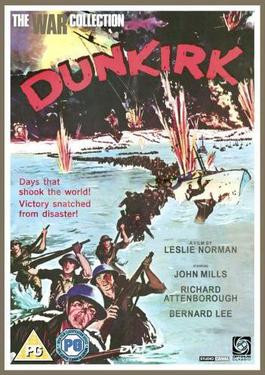
going to see Nolan’s movie, I reacquainted myself with the 1958 version
directed by Leslie Norman (“The Long and the Short and the Tall”). I had not seen it since the early months of
my blog. The film was #89 on Military
History magazines “100 Greatest War Movies” list. Although I read two histories of Dunkirk in
preparation for seeing Nolan’s movie, rewatching the 1958 movie also helped
with refreshing my memory of what happened in Operation Dynamo. Little did I know that this classic black and
white movie would contribute to my disappointment when I left the IMAX.
“Dunkirk”
covers the period from May 26 – June 4, 1940.
It opens as though you are in a London theater watching a newsreel chronicling
the “Phoney War” situation. One theme
that is established is that the British public was in denial about the German
threat. The movie juxtapositions footage
of the Nazi war machine (accompanied by martial music) with shots of smiling British
soldiers (to the tune of harmonica music).
If that is too subtle for you, two British vaudevillians (Flanagan and
Allen playing themselves) sing “We’re Going to Hang Out the Washing on the
Siegfried Line” intercut with an animated map showing the German invasion of
France.
The
movie has two storylines – civilian and military. The civilian perspective is portrayed by
Charles Foreman (Bernard Lee) and John Holden (Richard Attenborough). Foreman is a journalist who represents those
voices in the wilderness that tried to warn the public of the dangers of
unpreparedness. Holden is a small
business owner who is benefitting from war contracts, but is confident the war
will not affect anything but his bottom line.
The military component is a small section (the British equivalent of an
American squad) that are on the run after being separated from their unit. Led by Corporal Binns (John Mills), they
eventually make their way into the Dunkirk perimeter. This “lost patrol” witnesses refugees being
strafed and moves on to find succor from an artillery battery. When they leave, they see the effect of
Stukas on a last ditch stand.
While
Binns and his comrades are avoiding the Germans and working their way to
Dunkirk, Operation Dynamo is put into action.
A call for “small boats” to aid in the evacuation nets the patriotic
Foreman and the peer-pressured Holden.
Holden is reluctant to go, not just because he feels his buckle business
is crucial to the war effort (and his boat is six inches too short), but
because he has a wife who insists his place is at home with her and their new
baby. She’s never seen a war movie, so
she expects him to choose her over his bros.
It’s a small war (and a shrinking perimeter) so these two storylines are
bound to intersect on the beach of Dunkirk.
Each
of the storylines features a character arc.
Holden evolves from a milquetoast collaborator-in-waiting to a heroic
yachtsman. Binns is your cinematic
soldier who has leadership thrust upon him.
Already chafing at wearing the stripes of a corporal, Binns is reluctant
to shoulder the leadership of his small band.
He will be forced to go from being one of the grumblers to being of the
brass. Both arcs are simplistic and predictable, but necessary for the picture’s
goals. The goals included reminding a
Cold War audience of the dangers of underestimating an enemy and the need for
teamwork in the face of an existential threat.
A reference to 1930s Britain choosing butter over guns is an obvious
plea to 1950s Britain to not make the same mistake. These goals will naturally be reached with
the signature British traits of stoicism and stiff upper lips. Traits required in 1950s British war films.
Unlike
Nolan’s film, Norman foregoes the RAF component and limits himself to the small
boats and the small unit. (He does
manage to thrown in the canard that the RAF did little to defend the beach and
mole.) However, he does include tastes
of the bigger picture. There are scenes
where the camera pulls back to show the decision makers. For instance, we see Gen. Gort making the
decision to evacuate in spite of French wishes.
Adm. Ramsey demands the Royal Navy rescind its orders pulling most of
the destroyers out. (A scene filmed in the actual command bunker in Dover.)
The
movie is well made. It makes use of the
British war movie repertory cast. Mills
is solid in an unchallenging role. Foreman
and Attenborough are adept at playing the two strains of British
civilians. Holden’s transformation is a
bit pat and were the movie to be remade, he would stay a villain. But this was the 1950s, not the 1960s. No one else is given much of a chance to
shine. Binns’ section is pretty generic,
but Robert Urquhart is fine as Binns’ nagging mate. You have the stripes – lead! The cinematography stands out. The interior scenes feature a lot of deep
focus. The exterior scenes blend in
actual footage, not quite seamlessly, but well enough to prevent any wish that
CGI would have been available. The best
effects are in the area of sound. There
is a lot of realistic aerial and artillery bombardment and the noise that goes
with them. This is especially true of
the harassment of the beach. The extras
do a good job reacting to death from above.
While
the plot does not break any new ground and the movie has a stodgy agenda, it
does avoid overt patriotism and propaganda.
Most importantly, it is strong historically. It makes an excellent companion to Nolan’s
picture. It is best to see it
first. Where Nolan made the decision to
concentrate on personal storylines exclusively, screenwriter David Divine gives
both a micro and macro view. His
personal stories may not have the visceral impact of Nolan’s, but he has a
better balance in telling the story of Operation Dynamo. (It is noteworthy that
the name of the operation is not mention in Nolan’s film.) On the other hand, Norman’s film could easily
have been named “Operation Dynamo”.
Where you can glean the basics of Dunkirk from Nolan, Norman is more
tutorial. Binns’ men represent the “odds
and sods” who were cut off from their units in the chaos of the German
penetration of the Ardennes Forest. The
artillery battery stands in for all the units who made suicidal stands to buy
time. Binns and the others first attempt
to escape via the mole, but end up on the beach relying on a small boat to pick
them up. Foreman and Holden exemplify
all of the small boat captains that risked their lives to cross the Channel. Their actions were typical. The movie also throws in some anecdotal
morsels like the leaflets encouraging the British to give up and the medical
personnel drawing lots to see who would stay with the wounded. Divine can be criticized for omitting any
references to the French, but I have no real problem with that. If the French wanted to be lionized, they
should have been more supportive of the operation. (I am aware they did the lion’s share of
defending the perimeter towards the end, but to me that was more along the
lines of surrendering with a fight than an act of sacrifice for an ally.)
“Dunkirk”
is not a great movie. It is too inside
the box to achieve that accolade. It is,
however, a classic that holds up well and deserves the renewed interest that
should come its way. (You can see it on
You Tube for $1.99.) I do not normally
prefer older movies over modern war films.
The classics were constrained by technology and censorship which made realism
a bigger challenge than with modern efforts. While “Dunkirk” falls into the Old School, it
manages to not be obsolete because it is historically sound and still tells an
entertaining story well. It’s this
fidelity to history that gives it its main edge over Nolan’s film.
GRADE = B+