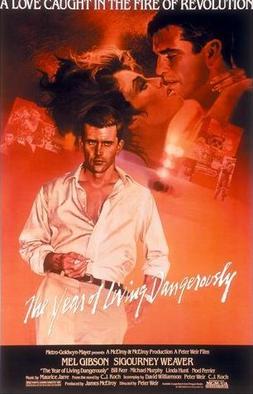
What
war movie that begins with the letter Y best exemplifies the war movie
genre? I have chosen "The Year of Living Dangerously" because it
represents the subgenre of war journalism and it is one of the best in
that subgenre.
“The
Year of Living Dangerously” is a member of the journalists at war
subgenre. It is an Australian film directed by Peter Weir (Gallipoli,
Master and Commander). It was based on the novel by Christopher Koch who
based it loosely on the experiences of his journalist brother during
the attempted overthrow of Sukarno in Indonesia in 1965. The title comes
from the phrase “living dangerously” which was a favorite of Sukarno’s.
He used it in his Indonesian Independence Day speech in 1964. The movie
was to be shot in Indonesia, but the plot caused the government to
refuse that option. The movie was banned in Indonesia until the year
2000. Instead, Weir moved to the Philippines where the production
received death threats from Muslims because of a perceived anti-Islam
bent. The last week of the six-week shoot was moved to Australia. The
movie ended up costing $6 million which at the time made it the most
expensive Australian movie ever made
The provocatively titled “Civil War”
was released this weekend, on the 163rd anniversary of the start of
the First American Civil War. The movie has secession in common with the first
civil war, but little else.The movie
has been proceeded by rumors that it would be a commentary of the present political
situation in America today.There is a
fear that America is heading for a civil war, especially if Trump loses in the upcoming
election.However, possibly in a move to
not alienate half of its potential audience, the movie does not take a stand on
current politics.Writer and director
Alex Garland made sure of that by crafting a movie that could not possibly
happen in America in any foreseeable future.There is more chance of a purge than of this type of civil war.
The movie begins with a red
herring.The President (Nick Offerman)
rehearses for a televised speech that will proclaim “mission accomplished.”It turns out that a series of hints tells us
the President is blowing smoke. We are 14 months into the war.Texas and California have formed the Western
Alliance to depose the third-term President.Those two states agreeing on anything is proof positive that the movie
is a fantasy.There is also an alliance
led by Florida with the same goal.But
the movie concentrates on the Western Alliance and its advance on Washington, D.C.
The movie focuses on a quartet of war
journalists that are on a mission to interview the President.All four are stereotypes from war journalism
movies. Lee (Kirsten Dunst) is the veteran photojournalist who won a Pulitzer
Prize for a photograph of the Antifa Massacre.We don’t know if Antifa was doing the massacring or the victim of
it.Like I said, the movie does not take
sides. She is calloused, but suffers
from PTSD.Jesssie (Cailee Spaeny) is
the cub reporter who idolizes Lee and wants to be just like her.Sammy (Stephen McKinley Henderson) is the wise
old print journalist who sees the trip as one last fling. Joel (Wagner Moura) is Lee’s partner.He plays the journalist who is an adrenaline junkie.The kind that smiles when the bullets whiz
by.
The movie is a road trip.It’s 857 miles to D.C. and there will be some
stops along the way. Their car is the only one on the interstate and there is a
stretch of highway that looks like the Highway of Death outside Kuwaiti City in
the Persian Gulf War.On the other hand,
the movie informs us that much of the country is minding its own business.(That’s the one thing that is predictive of
the coming civil war.)They stop at a
gas station where they fill it up with $300 of Canadian money because U.S. currency
will only buy a sandwich.They are
treated to two men being tortured.They
are journalists, so of course they just observe, they don’t get involved. Lee:“We report so other people can ask.”They take pictures in the middle of a
firefight.Prisoners are executed, but
it makes for great shots. They stay at a
refugee camp.They witness a sniper
duel. They are confronted by some soldiers that question whether they are “real
Americans.” And finally, they embed with the Western Forces army for its
assault on Washington.The now trio is still
determined to get that interview.
There is a subgenre of war movies
that focuses on war journalism.There
are a few good movies in this group. Films like “A Private War”, “Whiskey Tango Foxtrot”, “The Year of Living Dangerously”, “Salvador”, “Under Fire”, “The Quiet American (2002)”, and “Welcome to Sarajevo.”These films have created cliches that you see in most of the subgenre
and “Civil War” is no different. Lee and Jessie are near a suicide bombing and
Lee immediately starts taking pictures of the dead bodies. That evening the
press is gathered at the hotel to party hard. War journalists are like fighter
pilots, they drink a lot. Lee and Joel
always head in the direction of the gunfire. Lee has PTSD, but she is dedicated
to getting the next great shot.The
quartet risks their lives getting as close to the fighting as possible.They are not interested in helping anyone
that is wounded.That’s not their
job.The plot is predictable and breaks
no new ground. If you want to see all the cliches in one movie, but with some
great scenes, this movie might be for you. It concludes with a combat porn
scene featuring the Lincoln Memorial and the White House.
I made sure I did not read much
about the movie before seeing it, so I was surprised that it avoided being
topical. In preparing this review, I
read where Garland chose Texas and California to emphasize that the war was a
war to overthrow a corrupt dictator that ordered the killing of American civilians.Unfortunately, that is not apparent in the film.We learn nothing about what brought on the
war and how it got to the point that Washington was being attacked.Even at the end of the movie it is not clear
that the President is the villain.The
film is just a war journalism movie with a deceptive title.
Obviously, the movie is not based on
reality, but it still could have been realistic.It’s this flaw that ruined the movie for me.
I don’t mind the cliches and predictability because few viewers will have seen
most of the movies I have listed so most will not shake their heads at another
combat junkie, PTSD, cynical journalist.The problem is that the third act goes off the rails with several plot
developments that make no sense.For
instance, one of the quartet gets wounded in a place that could not possibly
have happened. And to jump higher over the shark, the other three do nothing to
try to save him. I know journalists aren’t supposed to care about victims, but
this person was a friend of theirs.The
concluding scene in Washington is good combat porn, but it leads to a ludicrous
climax in the White House.
Garland’s script is structured
around the old chestnut of the rookie journalist going from naive hero worshipper
to cynical clone, all in a few days. Jessie’s character arc is too unbelievable
and it’s embarrassing to see her evolution intersect with Lee’s sudden devolution.The movie does have some strengths.The soundtrack has songs that advance the
gonzo nature of the journalists. It uses photos effectively to give us a camera
eye view.The two combat scenes are
well-done and exciting.And there is a
lot of military hardware on display with the only obvious CGI being the flock
of choppers.
I can only recommend the movie to
those who are not already familiar with the war journalism subgenre.It is not one of the better movies in that
group.Go see it only if you want the
entertainment. Don’t see it if you are looking for wish fulfillment or to confirm
your worst nightmare.
“The
Year of Living Dangerously” is a member of the journalists at war
subgenre.It is an Australian film
directed by Peter Weir (Gallipoli, Master and Commander).It was based on the novel by Christopher Koch
who based it loosely on the experiences of his journalist brother during the
attempted overthrow of Sukarno in Indonesia in 1965.The title comes from the phrase “living
dangerously” which was a favorite of Sukarno’s.He used it in his Indonesian Independence Day speech in 1964.The movie was to be shot in Indonesia, but
the plot caused the government to refuse that option.The movie was banned in Indonesia until the
year 2000.Instead, Weir moved to the
Philippines where the production received death threats from Muslims because of
a perceived anti-Islam bent.The last
week of the six-week shoot was moved to Australia.The movie ended up costing $6 million which
at the time made it the most expensive Australian movie ever made.
The
movie takes place in 1965 during the days preceding and the days of the
attempted coup.Guy Hamilton (Mel
Gibson) arrives in Djakarta as a journalist hoping to make a name for himself
in the hot zone du jour.The press corps
is competitive (as you would know if you have seen any war journalist movies)
and he is not exactly welcomed.However,
a photographer named Billy Kwan (Linda Hunt) befriends him and shows him the
ropes and acts as his guide through the maze that is Sukarno’s capital.Billy suffers from dwarfism, but he is very
intelligent and a huge asset for Hamilton’s ambition.They form an intriguing pair as Kwan’s
idealism is in conflict with Hamilton’s realism.They are both danger junkies (another war
journalist movie trope).Kwan hooks
Hamilton up with interviews with key players, including members of the
communist opposition.He also hooks him
up with a lady friend of his named Jilly (Sigourney Weaver). They start off on
the wrong foot, of course.But Billy
comments:“And so it begins.”Speaking of tropes, Michael Murphy plays the
stereotypical horn-dog journalist.His
motto:“That’s why we have penicillin.”Hamilton has bigger dangers to worry about
than VD.He wants to be in the thick of
any army vs. communists conflict.Be
careful what you wish for.
The
main reason to see the movie is not to see two of the beautiful people have a
romance in the midst of political turmoil.It is to see the fifth billed actor who won an Oscar for Best Supporting
Actress.Linda Hunt was making her major
motion picture debut.She ends up being
the first woman to win an Oscar for portraying a member of the opposite
sex.She also was the first Australian
to win an Oscar.No, that was not Paul
Hogan.She is remarkable, especially
when you know she was far from the first choice for the role.Several men had been considered before Weir
saw a photo of her and gave her a screen test.Billy Kwan is the only main character who is not a stereotype.He manipulates the romance of Guy and Jilly
for unclear reasons.The ensuing romance
is simply not that interesting.It takes
the expected arc and seems to be bored with its own predictability.A weakness of the Billy Kwan end of the story
is the transformation of Billy from a supporter of Sukarno to a disillusioned
ex-supporter is not realistic.It does
result in a shocking moment in the film, but it seems to be manipulative.And the feel good ending that comes soon
after means the film does not end strong.
“The
Year of Living Dangerously” is only in the middle of the pack when it comes to
war journalism movies.It is worth
watching for the power coupling of Gibson and Weaver and the brilliant debut of
Hunt.However, it is not really about
journalism and the romance is too predictable.And as far as it being set in an historical event, who really cares
about the attempted coup to overthrow a strongman in Indonesia?Clearly the Indonesians, but few others, even
history buffs like me.
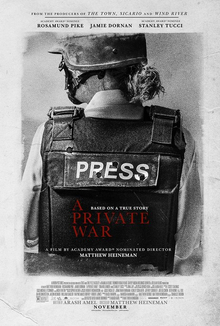
“A Private War” is a
biopic of famed (within the journalism community) war correspondent Marie
Colvin. It fits squarely in the war
journalism subgenre. It was directed by
Matthew Heineman and stars Rosamund Pike.
She was nominated for a Golden Globe for her performance. It also was nominated for the original song
“Requiem for A Private War” by Annie Lennox.
Stick around for the closing credits to hear it. It’s quite good. The movie was inspired by an article entitled
“Marie Colvin’s Private War” by Marie Brenner in Vanity Fair. It’s a good read and proves that the movie is
pretty accurate. It includes remarkable
incidents in this remarkable woman’s life that were not covered in the film.
The movie is a
full-circle movie in the biopic tradition.It begins in Syria in 2012.The
camera pans upward to reveal a city of rubble from which Colvin is
reporting.Off screen, she is being
interviewed.She proclaims that the
reason she put herself in dangerous situations like Homs, Syria is to get people
to care about the plight of the civilians in war.Her mantra was not to acknowledge the fear
until the job was over.Suddenly, we are
in London eleven years earlier.It is
established that Colvin is a famous journalist and she is fearless.She goes to Sri Lanka to visit a rebel
village where the people are starving and dying from diseases.She does not care about the military
situation.But she does have to embed
with the military to get to her stories.Unfortunately, this arrangement often puts her in the line of fire.She gets caught in a fire-fight and loses an
eye.From here on, she wears an
eye-patch.She is also distinguished by
her colorful bras that remind her that she is not a male correspondent.She does crave the rush of adrenaline and is
addicted to war like the male correspondents.She also drink a lot like them.What
separates her is her focus on the women and children.In one powerful scene she witnesses
distraught parents as their little boy dies from shrapnel.
The movie globe-trots.Colvin is in Iraq in 2003 where she meets
photographer Paul Conroy (Jamie Dornan) who she teams up with.They go behind the lines to uncover a mass
grave.She returns to England with a
understandable case of PTSD and spends some time in a facility.She’s a mess.She chain-smokes (I counted 16) and is an alcoholic.And she is a war junkie, of course.“I hate being in a war zone, but I feel
compelled to see it for myself.”After
being “cured”, its off to Afghanistan and its IEDs. Then to Libya during the
chaos of the civil war against Gaddafi.She interviews the dictator, who obviously likes her.And finally, she is in Homs, Syria.
“A Private War” is one
of the better war journalism movies.It
is also a good biopic.I was not
familiar with Marie Colvin before watching it and this makes me feel bad
because she died covering a war that I and most Americans don’t care
about.Rosamund Pike is quite good and
daring in her portrayal.She has a scene
where she goes full-frontal to show the physical effects the war has had on
Colvin.The rest of the movie deals with
the emotional effects.I’ve already
mentioned her various problems.Although
accurate, she does behave like most male war correspondents from other war
journalism movies.If you have seen
movies like “Salvador”, “Under Fire”, “The Killing Fields” or the recent “Whiskey,
Tango, Foxtrot”, you already know war correspondents crave the risk of
chronicling war.It is above average in
the subgenre because of the performance of Pike and the direction of
Heineman.The narrative structure is
intriguing, but it can be aggravating.Although the movie does specify the time and place, the jumps are
jarring.There is usually no background
explaining how she got where she is.It
is unclear how she got out of the mental facility, for instance.The home front scenes are used to establish
the downward spiral theme, but the memorable scenes are the ones when she and
Paul are in a war zone.For these
scenes, the cinematography sometimes shifts to a war footage style that is
effective in putting the audience with her.There is a recurring flashback to a dead girl, but I did not get the
full significance until I read the article.
The cast is fine.Dornan is perfect as Conroy.He is brave, mainly because he lets her talk
him into insane acts.Refreshingly, the
movie does not have them fall in love and go to bed.Tom Hollander plays her editor and it is a
schizophrenic portrayal as Sean Ryan egged her on at times and yet seemed to be
genuinely worried about her.It is clear
that she was going to do what she wanted to do, no matter what.Stanley Tucci is wasted in the role of her
lover.
The home front scenes
tend to be a bit melodramatic, but the war zone scenes make the movie into
clearly a war movie.You can see where
the adrenaline came from.She and Paul
are often under fire.It is obvious why
she had more reason for PTSD than a regular soldier.She was in the shit plus she witnessed the
effects of war on innocent civilians.And she deeply cared about bringing their stories to the world.The movie is as accurate as you could expect
for a biopic.
In conclusion, “A
Private War” is a strong biopic of a strong, independent woman. She deserved this movie and hopefully it will
accomplish what she strove for – world attention to the effects of war on civilians.
GRADE= B
HISTORICAL ACCURACY: I
was surprised to find that Colvin was an American.The movie certainly leads you to believe she
is British.Not because of the
accent.Pike does an amazing job
mimicking Colvin’s deep voice.Must have
been due to all the cigarettes.She got
a job with The Sunday Times on London and from 1886-1995 she was a Middle East
correspondent.She famously was the
first to interview Gaddafi after the U.S. tried to kill him in a bombing
raid.He hit on her during the
interview.She interviewed Yasir Arafat
twenty-four times.Starting in 1995, she
became the papers chief Foreign Correspondent.She went to Chechnya, Sierra Leone, Zimbabwe, and East Timor.In East Timor, she was responsible for saving
1,500 women and kids besieged by rebels.The movie covers the last eleven years of her life.It is admirably accurate in covering the
events it chooses to highlight.She did
lose her eye when an RPG landed near her in Sri Lanka.She spent the rest of her life wondering if
she made a mistake by standing up and identifying herself as a journalist.She did meet Conroy on the border of Iraq,
but she sought him out.He was famous in
the journalism fraternity for trying to use a homemade boat to cross into Iraq.
She nicknamed him “Boatman”.They did
witness the uncovering of a mass grave, but they did not work together for
another seven years.She did go in a
mental facility for her PTSD.The
movie simplifies the interview with Gaddafi, she was actually one of three
journalists that talked to him and Conroy was not with her.In 2012, she crossed into Syria on the back
of a motorcycle and ended up in Homs.She did do her last broadcast on BBC, Channel 4, ITN, and CNN.The movie uses the footage of Anderson
Cooper.Her death is close to what the
movie shows, but it omits that French photojournalist Remi Ochlik was also
killed by the artillery shell.Conroy
was wounded.Similar to the movie, they
had an opportunity to avoid the situation.In reality, they had left the area in anticipation of an assault, but
Colvin decided to return when the attack did not materialize.Midway through the tunnel, Conroy had second
thoughts, but Colvin said she was going on no matter what and Conroy caved.Her two loves in the movie are fictional
characters based on real people.Her
husband was Patrick Bishop.They were
married twice and both were dysfunctional.Her lover at the time of her death was Richard Flaye.His personality was similar to Shaw’s from
the movie.Kate Richardson is a composite
of all the young journalists that Marie helped.Norm Coburn is a composite for the several journalist friends/rivals
that Marie lost over the years.In
particular, he represents Tim Hetherington (“Restrepo”) who died in her arms
after being wounded in Libya.