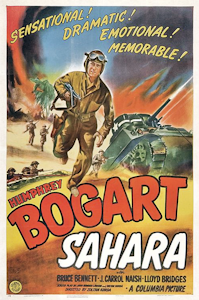
BACK-STORY: “Sahara” was released in 1943, two months after the surrender of Italy. It is dedicated to the IV Armored Division which was training in the Borego Desert of California where the movie was filmed. The Army provided equipment for the production including the M3 Lee tank. Most of the Germans are played by American tankers. The movie is based on an incident in the Soviet photoplay “The Thirteen”. It earned three Oscar nominations – Sound, Cinematography, and Supporting Actor (J. Carrol Naish).
OPENING SCENE: In the Libyan desert, a lone tank named “Lulu Belle” gets a radio message to retreat southward in the face of the German (Rommel) breakthrough after the fall of Tobruk. “Good luck and scram!” They come under realistic artillery fire. The engine breaks down (cliché alert - #25), but being Americans they fix it with a wrench. The tank crew is led by Sergeant Joe Gunn (Humphrey Bogart) and he loves his tank saying that Lulu Belle is “like a dame, if you don’t feed her she doesn’t go anywhere”. They head south.
SUMMARY: They encounter the survivors (five Englishmen and a Frenchman) from a field hospital who decide to go with them. The movie now becomes a “who will survive?” suicide mission war film. At one stop, to change the fuel mixture, a young Lloyd Bridges shows off a picture of his girlfriend (cliché #1). Guess who is the first to die? They pick up a Sudanese soldier named Tambul (Rex Ingram) who has an Italian prisoner (Naish). Gunn is unmoved by the Italian’s pleading and showing of pictures of his family. They leave him behind, but Gunn changes his mind soon after (cliché #18).
A German plane strafes them, but misses the tank on all four passes. They fire once and shoot him down! The pilot is captured. He is your stereotypical arrogant jerk Nazi. He does not want the black guy to frisk him because he is inferior. (Could this foreshadow something? Stick around) Guess who is mortally wounded by the strafing? Hint: his pretty girlfriend will be very sad.
They plunge on to take refuge at the ruins of an old water hole through a realistic sand storm. This is possibly the driest movie ever. Make sure you have water handy while watching it. There is a well at the ruins, but it has only a slight drip of the precious liquid. They collect it in mess tins and each gets three swallows, including the prisoners (message: we are humane no matter what). We get the typical soldier talk about back home.
They ambush a German scout car capturing two Germans and Joe bribes the weaker with water to reveal an entire battalion is heading their way desperate for water. (Guess what his fanatical Nazi comrade does to him when he gets a chance?) Should they commit suicide by staying to defend the no-water hole against 500 Germans or turn tail and run? Gunn argues for staying. He insists that the audience will feel short-changed if there is not a big fight with lots of Germans getting killed. Just kidding. He actually plays the patriotic card by mentioning London, Moscow, Bataan, and Corregidor. (If you don’t recognize these references, a 1943 audience sure did).
Waco (Bruce Bennett) goes off in the scout car to get the cavalry. Meanwhile, our heroes prepare for the siege by digging in and placing German mines. The Germans come swarming forward and don’t even have to step on the mines for them to explode. They are forced to retreat. Gunn offers to trade water for food and later water for weapons in order to buy time and fool them on how much water they have. In one of the lulls, the German pilot (blonde, blue-eyed Kurt Krueger) argues with Giuseppe. The Italian claims that Italian soldiers only wear the uniform, they don’t give their souls. He speaks passionately about the evils of Hitler and the enslavement of his people. The German stabs him, naturally. He tries to escape but Tambul kills him in an appropriate way (in actual filming Ingram almost killed Krueger before “cut” was called).
The siege continues including mortar fire from the Germans. One by one, the good guys go down as we approach the over/under number. Joe keeps spirits up with statements like “we are doing it because we are stronger than them…They have never known the dignity of freedom.” Occasionally we cut away to the now on-foot Waco gamely pressing on.
FINAL SCENE: The Germans launched their last assault that will overwhelm the only two survivors (one is Bogart, of course), but instead of attacking they throw down their weapons and beg for water! Too bad there is no water. But wait, it turns out that a mortar explosion opened up a vein of water and it is now gushing out. The cavalry finally arrives. The movie closes with Joe reciting the names of the dead heroes as sappy music swells. A reference is made to the British holding at El Alamein.
RATINGS:
Action - 6
Acting – 9
Accuracy – 7
Realism – 6
Plot – 8
Overall – 8
WOULD CHICKS DIG IT? Not if they insist on female characters. The acting is good. It stars Humphrey Bogart as Humphrey Bogart. It has moments of talkiness. It is not non-stop killing. In general, I would have to say it does not have a lot of appeal to modern females.
CRITIQUE: “Sahara” is very much a product of its times. It is a classic black and white, made during WWII war movie. It fits solidly into the “small unit fighting against great odds” sub-genre. It is also a good example of a siege movie (similar to “The Alamo”). Although it was filmed at a time that the Allies were still unsure of victory, it is not heavy on propaganda. It does have its preachy moments and certainly taps into patriotism, but it is not heavy-handed.
One of the fascinating aspects of “Sahara” is the Italian character Giuseppe. One wonders if the timing of the movie (it was filmed during the Italian army’s collapse in North Africa and just prior to Italy’s surrender) led to the rather sympathetic treatment of Italians. It appears that the film-makers realized that the Italians were no longer a threat and the healing process could begin with this movie. Contrast the fanatical Nazis who are robotic followers of Hitler to the pitiable Italian who was merely a dupe of Mussolini. Naish’s nomination as Best Supporting Actor is also a statement about attitudes toward Italians in 1943. Another intriguing character is Tambul. Here we have a black man portrayed in a positive light. He is intelligent and brave - rare for a 1940s movie. Kudos to the screenwriter.
One flaw in the movie is the numerous clichés. (See my post on war movie clichés.) I found six classics in this movie. Some cannot really be faulted because they were so ingrained in old-school war movies that thinking outside the box would have been highly unorthodox. For example, having soldiers get shot with no bullet hole or blood is just the way it was in 40’s movies. Asking for the actors to sweat realistically in the desert is another pipe dream. (I read about how the make-up artist gave them a sweaty look, but I saw little evidence of this on the screen.) Hell, the actors in “The Thin Red Line” are not sweating on tropical Guadalcanal and that movie was made in 1998!
ACCURACY: The movie is loosely based on the fact that in June, 1942 a small detachment of American tanks joined the British 8th Army to get experience in desert warfare. I doubt any got into any combat implied by the opening of the movie. But when I saw the movie I assumed Hollywood had forced an American tank into the British army, so I was pleasantly surprised to find there was some justification for the scenario.
Since the siege was not based on an actual battle, I have no complaints about it. It is highly unrealistic, however. A very small group holding off 500 (equipped with mortars) can only happen in Hollywood. Also, I would assume any competent German commander would have maneuvered his force in a way that would have made it impossible for a few men to defeat attacks at several points. I admit that if enemy commanders used this common sense tactic, there would be no “siege against great odds” movies. That would be a shame because it is an interesting sub-genre.
CONCLUSION: “Sahara” is the rare made-during-wartime war movie that holds up years later. Its strengths are in the acting and the plot. It does not go overboard in patriotism and propaganda. The characters are interesting, if a bit stereotyped. Gunn’s trickery in faking the German commander into thinking they have plenty of water is fun. Although unrealistic in the outcome of the siege, most of the good guys don’t survive which is logical. Joe Gunn is a good role model for leadership. He is strict, but not stubborn.
I do not know where “Sahara” will end up on my list, but I think Military History magazine was justified in including it in the top 100. It is well worth the watching.
Next: #82 - A Walk in the Sun