Saturday, December 18, 2010

# 79 - RUN SILENT, RUN DEEP


BACK-STORY: This movie is based on the best seller by Edward L. Beach, Jr. (a WWII sub commander). It was produced by Burt Lancaster and cast him (a rising star) with Clark Cable (whose start was fading). The two reportedly did not get along well during the shoot with Gable upping the cost of production with his 9 to 5 work rate. This dysfunction may have added to the realism of the movie which is based on a personality conflict between the two leads. The technical advisor was a retired Rear Admiral. The movie had the full cooperation of the U.S. Navy including use of a sub for exterior shots, equipment for interior shots on the set, and submariners to train the actors.  It was released in 1958 to critical acclaim, but less than boffo box office.  It is in black and white.


OPENING SCENE: We are in the Bungo Straits off the coast of Japan in 1942. We see a Japanese convoy through a periscope. Two torpedoes are fired, but a Japanese destroyer suddenly appears and although the sub makes a crash dive, the next thing we see is the crew shipwrecked.

SUMMARY: The movie resumes one year later. The sub commander Richardson (Gable) has a desk job but is obsessed (Capt. Ahab style) with “Bungo Pete”, the destroyer captain who sank his boat (and others). The admiral decides to give Richardson command of the U.S.S. Nerka whose captain is retiring. The problem is the executive officer Bledsoe (Lancaster) is deserving of the command and popular with the crew. Bledsoe is naturally resentful of being bypassed.

     Richardson announces to the crew that they are going to Area 7, the most dangerous patrol area. This is in spite of specific orders to avoid the area. (Why did the Navy give him command and then forbid him to hunt his whale?) The crew is not happy. (It includes Don Rickles in his film debut). They are even more unhappy when Richardson turns out to be a martinet who drills them constantly (“dive! dive!”) The crew becomes mutinous when Richardson avoids easy targets because he wants to enter the Bungo Straits undetected.

     Part of the training has been to be able to pull off a risky and difficult “rapid bow shot” on an incoming destroyer. The idea is to approach the destroyer head-on, dive and then put a torpedo up the enemy’s throat. When the opportunity arrives, they sink a Japanese tanker and destroyer in a scene that features realistic acquisition of targets and firing sequences. Not unique for a sub movie, but well done. Suddenly, the crew is a big fan of the captain. Nothing like success to change warrior’s minds.

     Things go sour again as Richardson, having proven the bow shot will work, returns to his strategy of avoiding contact until they find Bungo Pete. Bledsoe confronts Richardson about violation of orders relating to not entering the straits. Richardson argues that a captain can “redefine” orders. It is obvious he is out for revenge. Bledsoe fears his obsession is putting the crew at risk. However, Bledsoe squelches mutinous talk among the officers.

     They locate a convoy escorted by Bungo Pete’s Akikaze. Even though a plane is picked up on radar, the captain insists on attacking on the surface. They sink a tanker, but have to crash dive as the plane attacks. They fire the bow shot at the Akikaze, but the torpedo doubles back and nearly hits them. The sub undergoes your standard cinematic depth charging (better than most) during which Richardson suffers a skull fracture. They release trash and three dead crewmen through a torpedo tube to make the Japanese think they are goners. The Japanese (having not seen any American sub movies) fall for this cliché.

     The captain is now physically unable to command, but refuses to step down. (According to inside reports, Gable balked at his character being removed from command for mental incapacity because that was not Clark Gablesque, so the director gave his character the skull fracture.) Richardson threatens court-martial when they get back, but Bledsoe assumes command and turns the boat around.

     In the ward room, Tokyo Rose announces the sinking of the U.S.S. Nerka. Bledsoe decides to go back now that the Japanese think they are dead. They attack a convoy on the surface in daylight! They sink the Akikaze, but suddenly here comes a torpedo that barely misses. It turns out that the earlier runaway fish was actually fired by a sub working with the Akikaze. What follows is a cat and mouse game between the two subs. Each is running silent, running deep. Finally, the Nerka surfaces to force the issue by sinking several tankers. The Jap sub illogically surfaces also. It hides behind a tanker, but Bledsoe determines that the ship is shallow draft and thus a torpedo could go under her and hit the sub, which it does.

FINAL SCENE: A plane attacks dropping bombs as they crash dive with Richardson collapsing after yelling “clear the deck”. Next thing we see, the captain is being buried at sea! They must have run out of film. By the way, the captain’s death conveniently avoids the messy court-martial.

RATINGS:

Action – 7

Acting – 9

Accuracy – 7

Realism – 7

Plot – 7

Overall – 7

WOULD CHICKS DIG IT? Probably more than most war movies. The leads are famous for their appeal to females. They are definitely most women’s ideal of a man. The personality conflict dynamic might be interesting to females who are not interested in a movie that would be all action. However, the movie has no significant female characters and no romance (unlike the book).

CRITIQUE: “Run Silent Run Deep” is overrated. The acting talent awed many critics into overlooking the many unrealistic elements in the plot. The movie does an outstanding job showing the inner workings of a sub, but is shaky on tactics. There is too much surface attacking in daylight. This would have been suicidal with warships escorting a convoy (and planes in the vicinity). Especially against a foe like “Bungo Pete”.

     Little things pile up in this movie. Depth charges exploding as close as those in the movie would have been devastating. Giving a clearly revenge-minded officer a new command and then telling him to stay away from his obsession, strains credulity. The mood swings of the crew are a little perplexing. I do not feel a WWII sub crew would have whined about going into a dangerous area. The Jap sub would not have surfaced to protect the convoy. Five Japanese planes on two passes cannot hit a sitting duck?

     Although the special effects were supposedly cutting edge in 1958, They look decidedly fake today. The subs are obviously models in a swimming pool. Any competent remake of this movie would be superior to the original.

ACCURACY: The movie is based on a novel which is not about any particular submarine or incidents in WWII. The screenplay makes some significant changes from the plot of the book. The book covers a longer span of time starting with Bledsoe and Richardson being captain and exec on an earlier boat. There is a romantic subplot involving the triangle of the two men and Bledsoe’s wife. Bledsoe is something of a cad in the book. Bledsoe dies on another sub before Richardson takes on Bungo Pete. After sinking the villain, Richardson rams the life-boats. The movie skips the atrocity for obvious reasons.

      There was an Akikaze which was a destroyer that escorted convoys. She went down when she blocked a torpedo aimed at the carrier Junyo. However, the idea of a special Japanese unit consisting of an elite destroyer working with a sub flies against history. The Japanese were notoriously poor in anti-submarine tactics. Beach’s book gives them way more credit than they deserve (including a ship filled with ping pong balls so it was unsinkable), so the movie is just amping it up for entertainment value.

     The below the surface inner workings of a sub are commendably portrayed. The setting is appropriately claustrophobic. The effects of a depth-charging on people in a metal coffin are realistic. However, the tactics are wrong in some instances. Subs did not have the capability of firing torpedoes at each other if both were submerged. It would be impossible to sink a sub by firing a torpedo under a ship. No regular ship would have a shallower draft than a sub! If the torpedo could pass under the ship, it would definitely also pass under the sub.

CONCLUSION: “Run Silent, Run Deep”  was one of my favorite books as a teenager. This movie does not do justice to the book. The movie became a showcase for two legendary actors.  In fact,  the acting by the whole cast is noteworthy. Rickles even adds some humor. (He gets to offer a guy “a cookie”.)  However, the acting and melodrama to not completely overcome the inaccuracies and unrealistic tactics. The movie is certainly entertaining and better than average in the submarine subgenre. Speaking of which, here are some of the classic sub clichés you get in this movie:

1. The captain and the exec disagree on how to run the boat.

2. The captain is obsessed with his target.

3. During a depth charging, the sub springs leaks.

4. To fool the enemy, debris and dead bodies are shot out of a torpedo tube.

5. Two subs pass perilously close under the water.

6. Someone gets caught on deck during a crash dive.


Next up:  #78 - The Desert Fox

Thursday, December 16, 2010

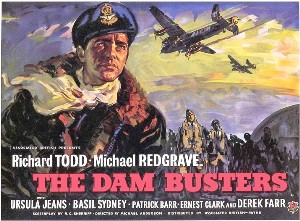
DUELING MOVIES: “The Dam Busters” vs. “633 Squadron”


VS.


     These movies have a lot of similarities. They both are British and deal with special missions that will “hasten the end of the war” and are suicidal. TDM deals with a bombing raid on some German dams to flood the Ruhr Valley and 633 deals with an attack on a German rocket fuel factory in Norway. Both cover the training for the mission and end with a very suspenseful attack. TDM is about an actual historical event whereas 633 is loosely based on the exploits of Mosquito squadrons (there was no 633 Squadron or raid on a rocket fuel plant). Both open with iconic theme music. ( I prefer 633 on this ).

     TDM spends more time on the scientific development of the special bombs to be skipped into the dam faces. A main character is the scientist in charge of the project. It intersperses training scenes with scientific experiments. 633 includes the obligatory training sequences, but throws in a romance between the squadron commander Grant (Cliff Robertson) and a resistance leader’s sister. It also ramps up the action by adding scenes involving the Norwegian resistance.

     The bombing scenes are well handled in both movies. Similarly, both squadrons must run a gauntlet of German anti-aircraft fire through a narrow valley. Interestingly, apparently George Lucas was influenced by both movies for his attack on the Death Star in "Star Wars".

     Although it was made 9 years later and had access (you would assume) to better movie technology, 633 looks more fake than TDB. 633 had authentic Misquitoes available and used them, but the attack scene is obviously models. 633 also revs up the melodrama, but not to good effect. The whole subplot with the resistance hero Erik Bergman (a miscast George Chakaris – chosen for his appeal to teenage girls, apparently) is ridiculous. The raid to kill him in Gestapo headquarters before he can talk is just an excuse for some more aerial action. 633 also ups the suicide quotient to top TDB. Of course, since it’s not based on an actual raid, they can kill anyone they please. They can also throw every obstacle to success you can think of. For example, Bergman gets captured. Another example, the Resistance is not able to take out the defenses.

     633 has more female appeal. Not just because Chakaris was so dreamy. You have several female characters and some romance, albeit schmaltzy. There is even a female Gestapo agent and Rosie the barmaid (hey, teenage boys need someone to watch ,too). TDB is more of a “just the facts, maam” movie.

     It will come as no surprise that in both films success comes down to the last bombers. Both end with a requiem for the fallen. Question: was it worth it? Answer: TDM – they knew what they were risking. 633 – you can’t kill a squadron.

Winner: “The Dam Busters” is much superior to “633 Squadron”.

Saturday, December 11, 2010

#80 - The Third Man


BACK-STORY: “The Third Man” is a classic film noir released in 1949. It foreshadowed the boom in that genre in America in the 50s. It is a British film, however. It was directed by the acclaimed Carol Reed and is considered his greatest film. The screenplay is by Graham Greene. The British Film Institute in 1999 designated it the greatest British film of the 20th Century. It was awarded the top prize at Cannes and won an Academy Award for Cinematography (a no-brainer) and was nominated for Director and Editing. It was set and filmed in Vienna, including the scenes in the famous sewer system. The remarkable score is done with a musical instrument called a “zither”. The opening theme was an international hit. The movie was a hit with both critics and audiences. The rumors that Orson Welles actually directed are not true. He did have a lot of influence over the dialogue of his character, however.
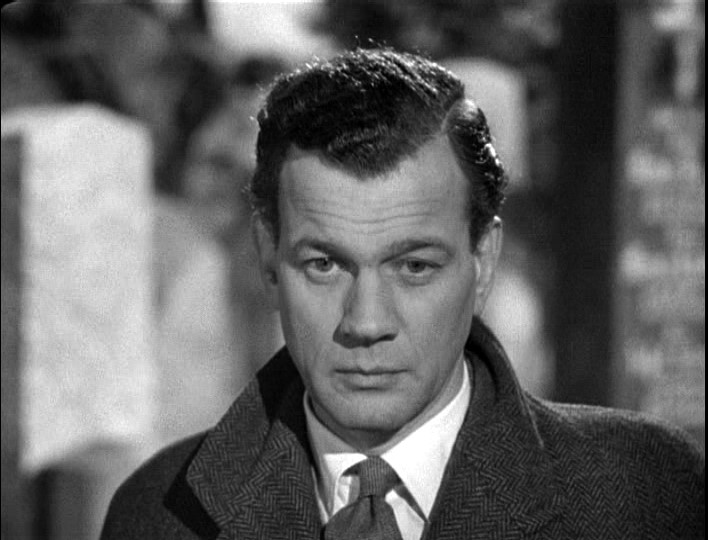
Holly Martins (thanks C)
OPENING SCENE: A narrator explains that the American novelist (pulp Westerns) Holly Martins (Joseph Cotten) has come to Vienna to meet his old friend Harry Lime (Welles). Martins arrives at a train station and goes to Lime’s home to be told he is dead from being hit by a lorry. He goes to the funeral and there is an intriguing female there (naturally). A British Major Calloway (Trevor Howard) gives him a ride back to town and Martins reveals that he and Lime had been childhood BFFs. Calloway breaks the news that his BFF was a notorious black marketer. “He was about the worst racketeer that ever made a dirty living in this city”.

SUMMARY: Martins meets a creepy “Baron” who describes the accident, but Holly is suspicious. Later, he hooks up with Lime’s girlfriend Anna (Alida Valli), the female at the funeral. She thinks his death was not an accident. An eye-witness ( a porter) tells them there was a “third man” at the death which contradicts the Baron. Holly now suspects murder.

     Meanwhile Anna is taken back to Calloway’s office because she has false papers that allowed her to move from the Russian zone to her present apartment. She is grilled, but released. They go to a bar where they encounter the Baron and a guy named Popescu (the second man) who insists there was no third man. The porter tells them to see him later that night and he will tell them more. Surprise, he is murdered right before Holly and Anna arrive and they have to flee a menacing crowd after a little boy fingers them. Holly is whisked off in a car which leaves the audience feeling he is being taken for a ride – he is, but just to a lecture he has agreed to give. He has to flee again when Popescu implies that he better stop his snooping. He runs through the bleak streets of Vienna. (There is a lot of running in this movie.)

     Holly goes to Calloway with his story, but being a typically arrogant British officer, he is unreceptive. He goes into detail about Limes racketeering. It seems that Harry was selling stolen penicillin and to make it worse, he diluted it leading to deaths and mental illnesses. A slide show convinces Holly that Harry is evil.

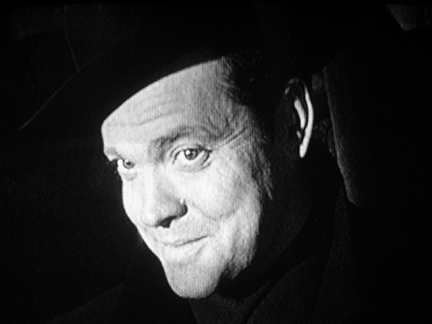
Harry Lime
     Holly goes to Anna’s. Her cat leaves. Anna says it only liked Harry. Holly follows the cat and in one of the great moments in film history, the cat goes to a smiling man in the shadows of a doorway – it’s Lime making his first appearance in the movie. Lime runs away (of course) and Martins loses him. It turns out that Harry has a secret entrance to the sewer system and he travels through the tunnels under the city.

     Calloway now believes Lime is alive and it is proven when his body is exhumed and it is someone else. Anna is arrested to coerce her into revealing Lime’s whereabouts, but she refuses to cooperate. Martins and Lime meet at the famous Vienna Ferris Wheel that dominates the sky-line. They talk while riding. It turns out that Harry is a sociopath. He wants Holly to join his enterprise and when Holly shows pangs of morality, Harry points to the dots of people below their feet and asks why should they care about them. He is charming, but creepy and menacing. He sums up the situation in the war-ravaged Vienna in a classic quote (added by Welles). “You know what the fellow said; in Italy, for thirty years under the Borgias, they had warfare, terror, murder, and bloodshed, but they produced Michelangelo, Leonardo Da Vinci, and the Renaissance. In Switzerland, they had brotherly love, they had 500 years of democracy and peace – and what did they produce? The cuckoo clock”. Good point – if it wasn’t for WWII we would not have penicillin (or the atomic bomb). They part unamicably.

     Martins makes a deal to rat out Lime in exchange for the release of Anna. When she finds out what her freedom cost, she leaves Holly at the train station. Harry is having second thoughts so Calloway brings him to a hospital to show him child victims of the tainted penicillin. He is back on board as their “dumb, decoy duck”.

the Vienna sewers
FINAL SCENES: Anna warns Harry when he comes to the rendezvous with Holly and he flees to his lair. The police are ready for this and the noose tightens as Harry runs through the tunnels in one of the most famous scenes in movie history. In one brilliant take, Lime stops and listens to the echoes of footsteps to try to decide which tunnel to take. Harry is like a caged animal and he shoots a British sergeant before being shot himself by Calloway. Lime tries to pry open a grate to get out and we see his fingers (actually Reed’s since Welles refused to film in the sewers) touching freedom, but no more. Martins reaches him and Harry nods as if to say “go ahead, finish it”. Holly does.
     In the final scene, Martins waits for Anna at the funeral, but in a refreshing departure from the typical Hollywood ending, she walks past him without acknowledging him.

RATINGS:
Action - 5
Acting – 10
Accuracy – N/A
Realism – 7
Plot – 8
Overall – 9

WOULD CHICKS DIG IT? It depends on whether your significant other is into film noir or mysteries or great acting or excellent film-making. If she hates war movies, have no fear because this is not a war movie. Convince her it is on a list of great war movies, let her enjoy it and then you might get her to watch a few real war movies before she figures out they are not like “The Third Man”.

CRITIQUE: I do not care what anyone says, this is not a war movie by any stretch of the definition. It is a movie set in post-war Vienna, true. I can accept movies set on the home front during the war, but not after the war. I make exceptions for movies like “The Best Years of Our Lives” because they deal with the after effects of a war on warriors. Neither Martins nor Lime appear to have fought in the war and even if they had, it is immaterial to the movie. The movie could be described as a Cold War movie, but then a ton of spy movies would have to be included as war movies. I cannot agree to that. It is my opinion that Military History magazine made a bad decision to include this movie.

     With that said, this is undoubtedly one of the great movies of any genre. The score, the cinematography, the setting, the acting; all great. The contrast of the main characters is fascinating. Martins is a naïve, bumbling gumshoe wannabe. Lime is a charmingly amoral villain. He reminds me of the current Bernie Madoffs of the world. Or, cinematically, Gordon Gecko. Our modern Harry Limes do not scuttle around in the sewers, however. Anna is in love with a dead man and then still loyal to his resurrected but evil real persona. Theirs is a doomed love triangle. Calloway is the dogged, proper British officer who needs to bring sick children into the picture to convince Martins and the audience to turn its back on the disarming Lime.

     One major negative – there is no way Harry Lime walks into that ambush. When he last talked to Holly it was obvious Holly was not going to join him. For the script to build him up as a criminal mastermind and then have him naively put himself in jeopardy is not realistic!

ACCURACY: Accuracy is not really an issue in this movie. The setting is true to life. Vienna was divided, like Berlin, into four occupation zones. The city was in sad shape and a thriving black market undoubtedly existed. I am sure there were unscrupulous racketeers like Harry Limes. It has been posited that Greene based his character on the real-life British spy named Kim Philby. Philby turned out to be a Soviet double agent that defected to the Soviet Union. The fictional Limes bears little resemblance to Philby, however. No big deal.

     In an interesting historical touch, Vienna did have a special police unit that patrolled the sewer system hunting criminal activities. The producers of the film used some of these off-duty officers in the sewer chase scene.

CONCLUSION: Do not watch this movie because it is a great war movie. Watch it because you love movies and want to be able to say you have seen one of the masterpieces of film history. Enjoy the weird camera angles and zither music. Try finding another movie that has both of those.

Next:  #79 -  "Run Silent, Run Deep"


Monday, December 6, 2010

#81 - Ballad of a Soldier


SUMMARY: "Ballad of a Soldier" is a Russian movie set in 1942 on the Eastern Front. Alyosha becomes a hero by destroying two German tanks. His reward is a pass to return home. Thus begins an odyssey which sees him interact with various people. The young, humane soldier has a positive effect on those he meets. The backdrop is the desperation of the Great Patriotic War. His most significant encounter is with a young woman named Shura. They have an awkward, chaste, and endearing "affair". He finally arrives home having used up all of his leave getting there.

BACK-STORY:
“Ballad of a Soldier” was a Soviet film released in 1959. It is a significant example of the movies made during the period after the death of Stalin and the rise of Khrushchev. The new Soviet dictator loosened the reins on Soviet cinema which resulted in some remarkably non-doctrinal films. In the case of “Ballad”, it helped that Khrushchev was a fan of the director Grigori Chukhrai and allowed even more leniency in censorship. Chukhrai made the daring decision to cast two inexperienced leads, but it paid off. The movie quickly acquired international acclaim including an Oscar for its screenplay. It is one of the most beloved Soviet-era films.

CRITIQUE: This is not so much a war movie as a movie set in war. It is certainly interesting and well worth the viewing, but I think it is a tad overrated. It almost seems the critics went overboard in accolades in order to encourage the new cinema that was coming out of Khrushchev’s Russia. Plus, compared to the pompously patriotic films under Stalin, this movie must have been bracingly refreshing.

There is some good cinematography, but some of it is a little artsy. We get lots of close-ups of stoical Russian faces. There are numerous long shots. There is lots of scenery from moving trains.

Some of the characterizations are not true to human nature. For instance, one of the guards Alyosha encounters is armed with a rifle and bayonet, yet turns out to be a pushover who can be bribed with  canned meat when he could clearly have taken whatever he wanted. But most perplexing is the portrayal of the Russian officers, starting with the general. I’m not saying all Russian officers were tyrants, but certainly a majority were. The movie has all of them being nice to the enlisted men. This strains credulity.

On the plus side, the main characters are likeable. We want Alyosha and Shura to fall in love and live happily ever after. We root for him to get back to his mother. We cheer when the crippled soldier’s wife welcomes him back without flinching. We are incensed that Pavlov’s wife is cheating on him. The movie takes some unexpected turns. It does a great job showing the spirit of the Russian people.

ACCURACY: “Ballad of a Soldier” is fictional so accuracy is not really an issue. My only complaint is the portrayal of the Russian officers.

CONCLUSION: I would never have watched this movie if I had not started this project, so I am thankful for having been exposed to something different. Watching a Soviet war movie was not on my list of to-dos. I definitely enjoyed it, but I do not think it is a great war movie. I am not even sure if it is a war movie. It certainly fits better into the journey genre. It’s not the Iliad, it’s the Odyssey.

RATINGS:

Action = 4/10
Acting = C+
Accuracy = D
Realism = C+
Plot = B+

Overall = C+

I have now worked my way through the first twenty (actually 19 because I still have not seen "Dunkirk") on Military History's 100 Greatest War Movies.  Here is my reworking of the list (with the Military History rank in parentheses):

99 – Ben Hur (96)

98 - Foreign Correspondent (86)

97 - The Life and Times of Colonel Blimp (87)

96 - The Thin Red Line (100)

95 - Ballad of a Soldier (81)

94 - Guns of Navarone (93)

93 - Northwest Passage (97)

92 - Thirty Seconds Over Tokyo (98)

91 - They Were Expendable (99)

90 - Desert Rats (88)

89 - Battle of Britain (90)

88 - Midway (92)

87 - Manchurian Candidate (85)

86 - Sahara (83)

85 - A Walk in the Sun (82)

84 - A Bridge Too Far (94)

83 - Dr. Strangelove (84)

82 - Breaker Morant (91)

81 - Last of the Mohicans (95)