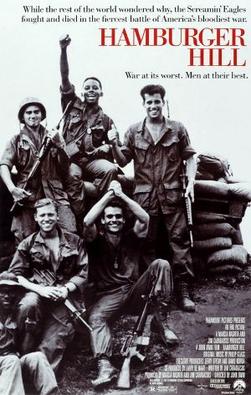
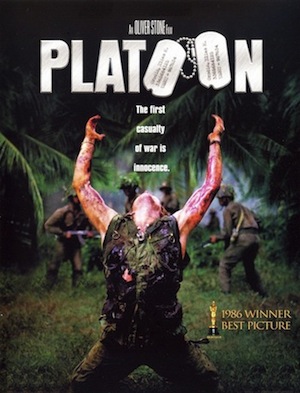
VS.
CLICHES
“Hamburger Hill” has several classic war movie clichés. Some are particular to the Vietnam War. There is a scene that emphasizes the cluelessness of the media about the true nature of the war. The soldier who is short is doomed to die before he can enact the joyful homecoming that he brags about. Two standards are updated for the war. A character receives a “Dear John” letter, but his girl friend advances one of the film’s themes by explaining that she is jilting him because of her anti-war college friends. There is the trite appearance of “Hanoi Hannah” who makes the obligatory reference to their unit. We also get the guy who talks about the car he is going to buy back in “the world”. Even though the movie focuses on the five replacements, that does not stop it from killing them off. On the other hand, the unit is not overtly heterogeneous and the grunt who shows off his girl friend’s picture does not die. C
“Platoon” also has several classic war movie clichés. In fact almost immediately we get a double dose with the fat guy ensuring his doom by showing off a picture of his girl. The movie helped establish some uniquely Vietnam tropes. The LT is green and incompetent. The sergeants run the platoon. There is a psycho in the unit who enjoys the killing. The incompetent leader calls in the wrong coordinates, resulting in a friendly fire incident. In one refreshing twist, the short-timer (King) is evaced before the final battle. The unit is heterogeneous, but not in a barracks identification scene sort of way. C
FIRST QUARTER SCORE
Hamburger Hill = 7
Platoon = 7
DIALOGUE
The dialogue in HH could be described as stilted and it tries too hard to sound authentic to the way the grunts talked. I have read a lot of eye-witness accounts and found several of the lines and the sincerity with which they were uttered to be laughable. There is a monologue by Worchester about his experience back home that is painful to listen to because it is so melodramatic. On the positive side, for those who have not read a lot on the war, you do get the greatest slang hits. C
“Platoon” was written by a combat veteran and although Stone can be faulted for excesses in many of his movies, his dialogue is restrained in this film. He interweaves slang into the soldier speak in a natural way. There are some fine dialogue driven scenes like when Elias explains the evolution of his war view to Taylor. The companion scene with Barnes in the doper’s bunker nicely bookends this. There are some great lines and they are spread a out among the characters. Some are critical of Taylor’s narration, but I feel that although flowery at times, it does add to the theme of lost innocence. A
HALF TIME SCORE
Hamburger Hill = 14
Platoon = 16
IMPLAUSIBILITIES
HH does not have any glaring implausibilities. The most ridiculous moment is a key moment in the film. Worcester recounts his return to the states and the litany of abuses he encountered. It is a montage of urban myths about the treatment of returning vets. Hippies throw dog poop on him, a hippie is shacked up with his wife, and everyone he meets is hostile. This is gross exaggeration pushed by the anti-anti-war movement. The film fulfills the short-timer must die by putting McDaniel on point. This would have been highly unlikely in reality. Similarly, when Duffy takes a bullet in the shoulder, he is not sent back off the line. The movie offers a lame excuse for this. As is typical for most war movies, artillery fire support is called in much too close to the friendlies. B
Much of the implausibilities in “Platoon” are designed to advance the main plot theme of the dysfunctional platoon dynamics. The whole idea of a platoon divided not only between two sergeants, but divided into dopers and boozers is clearly a plot device. Resolving this with two fragging incidents is pure Hollywood. However, most of the incidents that develop the theme are plausible, including the atrocity. B
THIRD QUARTER SCORE
Hamburger Hill = 22
Platoon = 24
EDUCATIONAL VALUE
You can learn a few things from HH.
1. The Chieu Hoi program encouraged VC to defect to the ARVN. (In the movie, the defector is NVA and he is helping the U.S. Army.)
2. The NVA were nicknamed “Nathanael Victor” as opposed to “Charlie” for the VC.
3. The NVA were respected by the Americans and were worthy adversaries.
4. Contact with a single enemy would bring an American unit to ground.
5. New guys (FNGs) were not welcomed with open arms.
6. There were racial tensions in units, but the closer to the front line, the more the men put color behind them. There was an unofficial segregation of the races in the rear areas.
7. The Battle of Hamburger Hill is pretty accurately portrayed, but the movie flubs a teachable moment by not including a post script pointing out that the hill was abandoned soon after its bloody conquest. Probably purposefully because this historical fact clashed with the theme of flogging the anti-war movement. B
Although not based on an actual battle, Stone insists the incidents and characters in his film are based on his Vietnam experience. Taken as just a tutorial on the Vietnam experience, “Platoon” teaches a number of things to an audience not well-read on the subject.
1. Replacement soldiers (i.e. Cherries) were treated like dirt.
2. Sergeants ran the platoons in many cases.
3. Every soldier knew how many days that they had left in their tour.
4. If a Vietnamese civilian ran, it was assumed they were the enemy and you could shoot them.
5. Villages were burned if they were considered sympathetic to the Communists.
6. Some soldiers injured themselves to get out of combat.
7. Volunteers felt they were fighting for our society and freedom.
8. Latrine waste was burned using kerosene.
9. Drug and alcohol use was common in rear areas.
10. Young Americans sometimes committed atrocities due to stress or revenge.
11. The Vietnam War gave some sociopaths an outlet. A
FINAL SCORE
Hamburger Hill = 30
Platoon = 33
ANALYSIS
This is my fourth March Madness tournament and once again the #1 seed does not win. I suppose this is partly explained by using “Rotten Tomatoes” for the seeding. My theory is that generic movie critics look at war movies differently than I do. I’m a lot more specific to what makes a movie good within the genre. That is not to say that HH is not a very good movie. It deserved to be highly seeded. On the other hand, “Platoon” was criminally seeded at #5. Four Vietnam War movies better than “Platoon”? No way. I am aware that the film is polarizing and its victory will upset people, but I think that I am on firm ground here. Fire away.