Wednesday, April 16, 2014

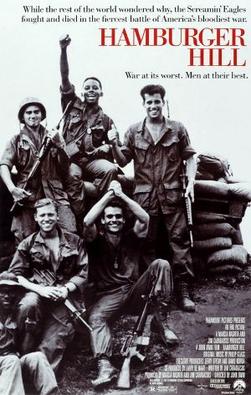
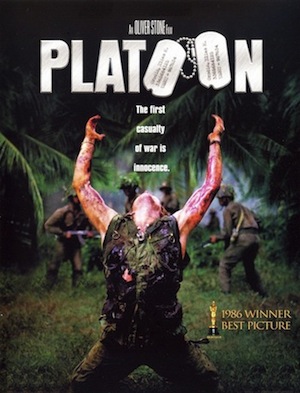
HAMBURGER HILL (1) vs. PLATOON (5)


VS.


CLICHES
“Hamburger Hill” has several classic war movie clichés. Some are particular to the Vietnam War. There is a scene that emphasizes the cluelessness of the media about the true nature of the war. The soldier who is short is doomed to die before he can enact the joyful homecoming that he brags about. Two standards are updated for the war. A character receives a “Dear John” letter, but his girl friend advances one of the film’s themes by explaining that she is jilting him because of her anti-war college friends. There is the trite appearance of “Hanoi Hannah” who makes the obligatory reference to their unit. We also get the guy who talks about the car he is going to buy back in “the world”. Even though the movie focuses on the five replacements, that does not stop it from killing them off. On the other hand, the unit is not overtly heterogeneous and the grunt who shows off his girl friend’s picture does not die. C

“Platoon” also has several classic war movie clichés. In fact almost immediately we get a double dose with the fat guy ensuring his doom by showing off a picture of his girl. The movie helped establish some uniquely Vietnam tropes. The LT is green and incompetent. The sergeants run the platoon. There is a psycho in the unit who enjoys the killing. The incompetent leader calls in the wrong coordinates, resulting in a friendly fire incident. In one refreshing twist, the short-timer (King) is evaced before the final battle. The unit is heterogeneous, but not in a barracks identification scene sort of way. C

FIRST QUARTER SCORE

Hamburger Hill = 7
Platoon = 7


DIALOGUE

The dialogue in HH could be described as stilted and it tries too hard to sound authentic to the way the grunts talked. I have read a lot of eye-witness accounts and found several of the lines and the sincerity with which they were uttered to be laughable. There is a monologue by Worchester about his experience back home that is painful to listen to because it is so melodramatic. On the positive side, for those who have not read a lot on the war, you do get the greatest slang hits. C

“Platoon” was written by a combat veteran and although Stone can be faulted for excesses in many of his movies, his dialogue is restrained in this film. He interweaves slang into the soldier speak in a natural way. There are some fine dialogue driven scenes like when Elias explains the evolution of his war view to Taylor. The companion scene with Barnes in the doper’s bunker nicely bookends this. There are some great lines and they are spread a out among the characters. Some are critical of Taylor’s narration, but I feel that although flowery at times, it does add to the theme of lost innocence. A

HALF TIME SCORE

Hamburger Hill = 14
Platoon = 16


IMPLAUSIBILITIES

HH does not have any glaring implausibilities. The most ridiculous moment is a key moment in the film. Worcester recounts his return to the states and the litany of abuses he encountered. It is a montage of urban myths about the treatment of returning vets. Hippies throw dog poop on him, a hippie is shacked up with his wife, and everyone he meets is hostile. This is gross exaggeration pushed by the anti-anti-war movement. The film fulfills the short-timer must die by putting McDaniel on point. This would have been highly unlikely in reality. Similarly, when Duffy takes a bullet in the shoulder, he is not sent back off the line. The movie offers a lame excuse for this. As is typical for most war movies, artillery fire support is called in much too close to the friendlies. B

Much of the implausibilities in “Platoon” are designed to advance the main plot theme of the dysfunctional platoon dynamics. The whole idea of a platoon divided not only between two sergeants, but divided into dopers and boozers is clearly a plot device. Resolving this with two fragging incidents is pure Hollywood. However, most of the incidents that develop the theme are plausible, including the atrocity. B

THIRD QUARTER SCORE

Hamburger Hill = 22
Platoon = 24


EDUCATIONAL VALUE

You can learn a few things from HH.
1. The Chieu Hoi program encouraged VC to defect to the ARVN. (In the movie, the defector is NVA and he is helping the U.S. Army.)
2. The NVA were nicknamed “Nathanael Victor” as opposed to “Charlie” for the VC.
3. The NVA were respected by the Americans and were worthy adversaries.
4. Contact with a single enemy would bring an American unit to ground.
5. New guys (FNGs) were not welcomed with open arms.
6. There were racial tensions in units, but the closer to the front line, the more the men put color behind them. There was an unofficial segregation of the races in the rear areas.
7. The Battle of Hamburger Hill is pretty accurately portrayed, but the movie flubs a teachable moment by not including a post script pointing out that the hill was abandoned soon after its bloody conquest. Probably purposefully because this historical fact clashed with the theme of flogging the anti-war movement. B

Although not based on an actual battle, Stone insists the incidents and characters in his film are based on his Vietnam experience. Taken as just a tutorial on the Vietnam experience, “Platoon” teaches a number of things to an audience not well-read on the subject.

1. Replacement soldiers (i.e. Cherries) were treated like dirt.
2. Sergeants ran the platoons in many cases.
3. Every soldier knew how many days that they had left in their tour.
4. If a Vietnamese civilian ran, it was assumed they were the enemy and you could shoot them.
5. Villages were burned if they were considered sympathetic to the Communists.
6. Some soldiers injured themselves to get out of combat.
7. Volunteers felt they were fighting for our society and freedom.
8. Latrine waste was burned using kerosene.
9. Drug and alcohol use was common in rear areas.
10. Young Americans sometimes committed atrocities due to stress or revenge.
11. The Vietnam War gave some sociopaths an outlet. A

FINAL SCORE

Hamburger Hill = 30
Platoon = 33


ANALYSIS

This is my fourth March Madness tournament and once again the #1 seed does not win. I suppose this is partly explained by using “Rotten Tomatoes” for the seeding. My theory is that generic movie critics look at war movies differently than I do. I’m a lot more specific to what makes a movie good within the genre. That is not to say that HH is not a very good movie. It deserved to be highly seeded. On the other hand, “Platoon” was criminally seeded at #5. Four Vietnam War movies better than “Platoon”? No way. I am aware that the film is polarizing and its victory will upset people, but I think that I am on firm ground here. Fire away.

Monday, April 14, 2014

THE FINAL FOUR


The Final Four is set.

Hamburger Hill (1)
Platoon (5)

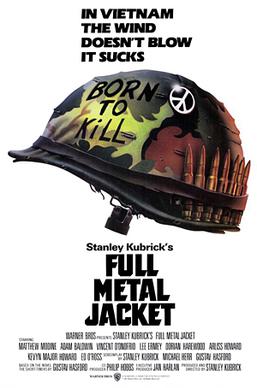
Full Metal Jacket (3)
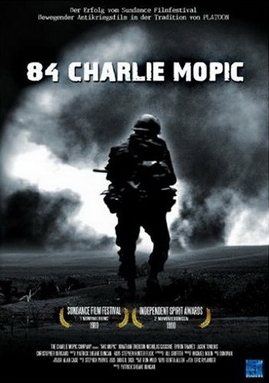
84 Charlie MoPic (7)

Two very intriguing matchups! Hopefully I will have time in my crowded weekend to post the next round. Thanks to everyone who has stuck around this long. I appreciate it.

Here is a preview of the categories:
Cliches
Dialogue
Implausibilities
Educational Value
 
 
VS.


CLICHES
I went back and reviewed my old post on war movie clichés (which I need to update) and found few that apply to “Full Metal Jacket”. One that appears is the main character (Joker) is an intellectual who is above all the militaristic macho behavior and is snarky. And, of course, the fat guy dies (albeit in a unique way). The drill sergeant is an a-hole. Not one, but two, BFF couples are decoupled (Joker/Cowboy & Animal Mother/Eight Ball). The noncombatant who wants to get in the s*** (Joker and Rafterman) learn that its not called the s*** for nothing. However, for the most part the movie is not only free of clichés, but even flips some standard tropes. For instance, Joker does not turn Pyle into a competent soldier. There is no redemption arc for Pyle. There are no boot camp enemies that become buddies. The boot camp unit and the Lust Hogs are not overtly heterogeneous. The movie did contribute to purely Vietnam War movie clichés: A member of the unit is a psycho who revels in killing (Animal Mother). B

“84 Charlie” has a few clichés. The unit is pretty heterogeneous. There is a wiseacre and a hick. Another cliché is one of the BFFs dies, but not saving the other. It has the Vietnam trope of the sergeant running the unit instead of the Lieutenant. However, in this case the LT is stereotypically green, but not incompetent. We do have a short-timer (Easy), but he does not die. Most of the characters that die are not predictable. B

FIRST QUARTER SCORE

Full Metal Jacket = 8
84 Charlie MoPic = 8


DIALOGUE

Obviously FMJ is most remembered for the foul-mouthed DI. His dialogue is the one thing everyone remembers about the movie. Since R. Lee Ermey was a drill instructor, the words spewing out of his mouth are authentic to the type. The rest of the dialogue in the film is not bad, it’s just forgettable in comparison. The soldiers have the rough camaraderie of Vietnam grunts. Joker’s first confrontation with Animal Mother is typical of this. The Vietnam locker room slams are amusing. The movie does not go overboard on the Vietnam slang. One weakness is the narration by Joker is flat. B

84 CM has surprisingly good dialogue for a low budget film. This is important because the movie is very dialogue driven. The soldiers speak like American grunts. It is natural sounding. Their jokes are appropriately low brow. The dialogue is peppered with Vietnamisms, but it does not lay it on thick in a showy way. They use the catch-phrase “there it is” without making a big deal out of it (compare this to Hamburger Hill’s use of “it don’t mean nothing”). The interviews with the men are heart-felt, but not schmaltzy. The screenplay was written by a vet (who later wrote “Courage Under Fire”). A

HALF TIME SCORE

Full Metal Jacket = 16
84 Charlie MoPic = 17


IMPLAUSIBILITIES

FMJ: 1. The same prostitute that Joker encounters in Da Nang shows up in Hue. Hue during the Tet Offensive – the go-to place for prostitutes. 2. That sniper is an amazing shot with a standard AK-47. 3. Were the Marines that desperate for recruits to put up with Pyle all the way through boot camp? For a Kubrick film, there is not too much that is implausible in the film. B

84 CM: 1. The sarge points his M-16 at the LT. This is the only thing I can think of. A

THIRD QUARTER SCORE

Full Metal Jacket = 24
84 Charlie MoPic = 26


EDUCATIONAL VALUE

Things you can learn about the Vietnam War from FMJ: 1. Marine boot camp was mentally and physically abusive (but not as bad as the movie depicts). 2. A “blanket party” could be used to punish a troublesome recruit. 3. “Stars and Stripes” had a party line that it pushed. 4. American soldiers had a low opinion of the ARVN. 5. Civilians were executed by the Communists in Hue. 6. American soldiers in Vietnam would go to great lengths to rescue wounded comrades. 7. Hue was destroyed in the process of retaking it. 8. Vietnamese prostitutes were “honny”. B

Things you can learn from 84 CM: 1. Soldiers would duck tape their gear to cut down on noises. 2. The film shows various booby traps like punji stakes. 3. Americans called the VC “Chuck”. 4. Officers wanted combat duty to enhance promotion. 5. Soldiers used C-4 to heat their MREs. 6. Marijuana use was discouraged in the bush. Most importantly, the viewer gets a good picture of what a LRRP was like. A

FINAL SCORE

Full Metal Jacket = 32
84 Charlie MoPic = 35


ANALYSIS

This upset came down to the fact that 84CM is a better story about the Vietnam War and the soldiers that fought it. Placing the audience with them from a POV standpoint was genius. That one cinematography stunt makes up for all the big budget fireworks Kubrick throws at us. That is not to say that FMJ is not a great movie. Some of the things that make it a near masterpiece make it an unrealistic account of the war. It is the kind of movie experience you hope to have when you settle into your seat in the multiplex, but it does not take you into the screen like 84 MoPic does.
 

Thursday, April 10, 2014

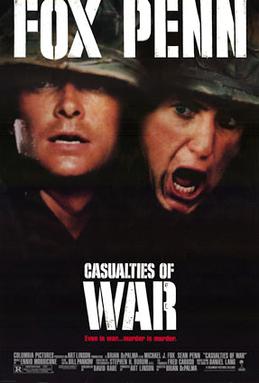
FULL METAL JACKET (3) vs. CASUALTIES OF WAR (6)


VS.


CHARACTERS
“Full Metal Jacket” has one of the iconic characters in Vietnam War movies. Gunnery Sergeant Hartman, as played by R. Lee Ermey, is mesmerizing. He is the main reason the first third of the movie is so strong. However, I do need to point out that Ermey was basically playing himself and many of his lines came directly from the novel “The Short Timers”. “Pyle” is another iconic character. His evolution from sad sack to boot camp graduate to psycho is fascinating and chilling. The rest of the characters are fine, if unspectacular. Modine’s “Joker” has the right amount of cynicism, panache, and wit to anchor the last two thirds. Having a writer for “Stars and Stripes” get involved in the fighting in Hue was a grand idea. Of the “Lust Hog” squad, Cowboy is a likeable and sympathetic character, but “Animal Mother” is the standout. B

“Casualties of War” is a character driven movie. There are only six significant characters in the film and each is distinct. Although based on a true story, it is obvious Hollywood differentiated the characters to service stereotypes. Still, it’s an interesting mix. Fox’s Eriksson is appropriately naïve and principled. Clark is the psycho creep meant to represent young American boys corrupted by the war. Brule is the country hick. Diaz is Eriksson without the guts to resist peer pressure. The problem is Penn’s Meserve. His eccentric performance drains the character of credibility. His sudden change from savior to sociopath is loopy. C

FIRST QUARTER SCORE

Full Metal Jacket = 8
Casualties of War = 7


BEHAVIOR

FMJ is not meant to be a realistic take on soldier behavior, but it actually is fairly authentic. The boot camp scenes were accused of going over the top and were one reason why the Pentagon declined to cooperate with the film. However, in reality Marine training was harsh and not only verbally, but physically abusive. The military also objected to the language which is ridiculously prudish since the grunts in the film talk very much like soldiers. The behavior of Joker and Rafterman as correspondents feels right. The camaraderie of the men conforms to the macho attitude of American boys in Vietnam. The banter is not forced like in “Hamburger Hill” and the lusty humor is characteristic of the U.S. military for most of the 20th Century. The behavior of the Lust Hogs in Hue seems spot on to me. B

COW deals with an actual atrocity, but the incident was atypical. It is unfair to lightly assume American soldiers would kidnap a girl for sexual purposes and with the intent of murdering her at the end. This was also extremely unlikely behavior for a LRRP. The behavior of the men is an aberration. In fact, this was one sorry ass patrol. If the movie was not based on an actual atrocity, I would be tempted to complain about the caricatured depiction of American soldiers by a clueless liberal. C

HALF TIME SCORE

Full Metal Jacket = 16
Casualties of War = 14


WEAPONS AND TACTICS

The weapons highlighted in FMJ are authentic, with a fairly significant exception. In boot camp the recruits use M-14s and it is the weapon used on Hartman. However, in Vietnam the actors are armed with M-16s, not the appropriate M16A1s. Animal Mother is armed with a M-60 and although shooting from the hip was rare, it was not unbelieveable. It does seem unlikely that Joker would have been designated to fire an M-60 during the sapper assault on his base, but it’s possible. As far as tactics, the actions by Americans in Hue leave something to be desired. When the unit, supported by tanks, is entering the city and encounters fire, they proceed forward without calling in artillery fire on the suspected enemy position. This would have been unlikely considering the tendency of the Americans to plaster any threats, especially after casualties had resulted. The duel with the sniper has a truer feel to it. You would expect the men to go to great lengths to rescue a wounded comrade even if he was clearly sniper bait. C

COW gets the M16A1s right. The squad also has an M-79 (Eriksson) and an M-60 (Clark). In an early scene, Eriksson hits an incoming grenade with is M-79. Unbelievably, this incident actually happened. As far as tactics, the movie has some problems. This is apparent from the beginning when Eriksson is sent off to defend part of the perimeter by himself and armed with an M-79. The foliage is thick and it is ridiculous to think he could have done anything with that weapon. The movie covers the tactics used on the mission fairly closely. The problem is that the tactics shown in the film are not true to a normal LRRP mission. These guys go stumbling around in the jungle like a herd of elephants. At one point, Brule shoots at a water buffalo and Meserve does not seem to mind (at least in the book, he scolds him). Their “love shack” is laughably indefensible. The final “battle” is pure Hollywood and far from the actual incident. What the Hell is the gunboat doing there? D

THIRD QUARTER SCORE

Full Metal Jacket = 23
Casualties of War = 20


ACCURACY

FMJ is not meant to be historically accurate. It is based on a novel, but Hasford was a correspondent in Vietnam and supposedly based the book on personal experiences. The Joker character is apparently based on him. The boot camp segment is realistic as to Marine boot camp in 1967. If anything, the movie underplays the physical abuse. (The DI in the book is more brutal.) The “Stars and Stripes” reporting strategy is accurate. Da Nang was one of the targets for the opening Tet attacks (note the fireworks in the background –nice touch). As far as Hue, civilians were executed by the Communists. There was a sniper problem as part of the urban house-to-house combat although the movie does not refer to a specific incident. Last, but not least, there were hookers in Vietnam that offered to sucky sucky for ten dollars. My only real problem is I doubt the sniper could have been that accurate using a standard AK-47 from that distance. C

COW is based on an atrocity investigated by a reporter for the New Yorker magazine. I read the resulting book and the movie is very hit and miss. The opening scenes that are designed to establish Meserve as a hero who cracks are patently Hollywoodized. He did not save Eriksson’s life, thus creating a dilemma for Eriksson later in the movie. However, the kidnapping and rape are accurate up until the murder which was not nearly as dramatic and action packed. The fire-fight that transpires parallel with the murder is way overblown. In actuality (true to Vietnam), the skirmish resulted in the search for one KIA. Boring! The court-martials are accurate although the cover-up is clichéd. Oh, and there was no fragging incident. B

FINAL SCORE

Full Metal Jacket = 30
Casualties of War = 28


ANALYSIS

This was closer than I anticipated although “Casualties of War” has its fans. I call them Brian DePalma fans. It is a good little movie and tells a story that needed to be told. Watching it reminds one of how Hollywood takes interesting stories and makes them more interesting by playing fast and loose with the facts. Did I mention John Reilly’s character was added? Ironically, “Full Metal Jacket” does the opposite by taking a fictional story and making it less entertaining than the source material. Even though the screenplay could have been better, it is still an outstanding film. It is uneven, but its strengths were enough to defeat a pesky underdog. It will be interesting to see if its weaknesses cost it in the next matchup.

Tuesday, April 8, 2014

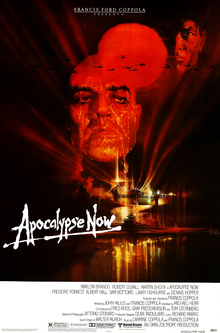
APOCALYPSE NOW (2) vs. 84 CHARLIE MOPIC (7)


VS.


CHARACTERS
“Apocalypse Now” has some strong characters. Two are in the top ten Vietnam War movie characters – Willard and Kurtz. Willard is the burned out assassin who is questioning his avocation. Kurtz is the Pattonesque commander who is obsessed with surfing. Kurtz is the classic scene-stealer and Willard is the rock that the story buffets. The crew of the patrol boat are distinct characters and likeable, but none grab your attention. On the other end are Kurtz and the photojournalist. Kurtz could have been a mesmerizing figure, but Marlon Brando’s lethargic performance drains the character. The same happens with Dennis Hopper’s photojournalist as the actor plays him as the opposite of lethargic. C

“84 Charlie MoPic” is a heterogeneous small unit movie. It has only seven characters with speaking roles. Each character is given a distinct personality and there is little stereotyping. The strongest characters are OD and Easy. OD is the tough as nails sergeant who cares deeply (in an alpha male way) for his men and is very averse to strangers messing with his unit dynamics. Easy is the humorous radio operator who is short not only in time left but in his tether. It is noteworthy that the LT is honest about his promotion quest and starts out incompetent and ends up growing into leadership. The others all have their moments in a movie that is intimate. A

FIRST QUARTER SCORE

Apocalypse Now = 7
84 Charlie MoPic = 9


SOLDIER BEHAVIOR

“Apocalypse Now” is not meant to be a realistic portrayal of soldier behavior. Bizarre would be the best way to describe much of the behavior. Willard seems to behave as an operative would and the crew of the boat are typical of young Americans thrust into a war they do not understand. However, everyone they run into is not typical. Anyone familiar with the USO shows knows that the soldiers did not riot when they saw a sexy woman. At no time in the war did American soldiers toting suitcases wade out to a patrol boat (heading deeper into dangerous territory) to escape from their post. Oh, and no soldiers surfed deep in VC territory. I’ll give it a default C because it is supposed to be bizarre. C

“84 Charlie MoPic” is one of the best movies when it comes to soldier behavior. The dialogue is natural and is not filled with slang the screenwriter found in a Vietnam Soldier’s Dictionary. The viewer is on a long range patrol with the squad and we see and hear a realistic depiction of that kind of mission. The bonding of the men is true to the situation. OD and Cracker are best friends even though they are of different races. Each character represents an archetype well. The only false note is ODs belligerence toward the LT. A

HALF TIME SCORE

Apocalypse Now = 14
84 Charlie MoPic = 18


WEAPONS AND TACTICS

“Apocalypse Now” is unique in centering the movie on a PBR. The armament displayed is accurate for a patrol boat in Vietnam. The crew uses the twin Browning .50 calibers (Lance) as well as the shielded .50 cal (Chef). There was also a mounted M60 that Mr. Clean is firing when he is killed. In the ville assault, the Hueys (belonging to the Philippine Army) are armed appropriately. The movie does a good job of depicting the variety of weapons available on Hueys. We see the M-6E3 weapons system, a mini-gun, the M3 Aerial Rocket Artillery, among others. The infantry are predominately armed with M-16s, but the curved clips should not have been so prevalent. There is one notable use of the M-79 grenade launcher by The Roach to silence the gook in the wire. As far as tactics, it’s not that kind of movie. The ville assault is ramped up on steroids. A napalm strike would have been called in to silence the incoming fire on the surfers, but it would not have been F-5s. (Obviously the Pentagon did not provide appropriate air craft for the film.) B

“84 Charlie MoPic” was written by a Vietnam veteran, but I could not find out anything about his experiences. The weaponry is fine. Cracker carries a shot gun and a sniper rifle. Hammer has the “pig”. Pretty Boy has a M-79. The rest are armed with M-16s. The movie is tactically sound. The squad is dropped off by chopper and then hump through the boonies. Their noise discipline is wanting, but the movie is dialogue driven so it’s understandable. They discover a NVA base camp and call in artillery. They set up their own booby traps for the egress. They rush a group of VC blocking their path after discussing the options. This makes sense. B

THIRD QUARTER SCORE

Apocalypse Now = 22
84 Charlie MoPic = 25


ACCURACY

Francis Ford Coppola once claimed his movie was a realistic view of the war. He could not have been serious. Although clearly fictional, very little that happens in the movie could actually have happened in the Nam. The central premise of a rogue colonel with his own private army is not even loosely based on anyone. The most inaccurate scene is the bridge sequence. The panicked Americans trying to escape and the whole premise of the bridge being destroyed and rebuilt each day is ludicrous. C

“84 Charlie MoPic” is not based on an actual LRRP mission, but it does adhere to a typical mission. The goal of locating an enemy base camp fits one of the roles assigned to these patrols. Having the veteran sergeant take charge instead of the new LT is realistic. The sniper incident fits enemy sniper tactics. The decision to call in a fire mission and then diddy mao is accurate. B

FINAL SCORE

Apocalypse Now = 30
84 Charlie MoPic = 33


ANALYSIS

I am a big fan of “Apocalypse Now”. It is a flawed masterpiece and a great movie in spite of its flaws. With that said, it is not a great Vietnam War movie. It is Joseph Conrad’s “Heart of Darkness” placed in a Vietnam setting. The surrealistic approach used by Coppola in several scenes makes for mesmerizing viewing, but pulls it further away from reality. “84 Charlie MoPic” could not be more different. It is amazingly good for such a low budget film and the no name actors are much better than anyone could have expected. The movie feels right and the POV style really works well. You feel like you are on the mission and care about the men more than your typical “who will survive?” film. This result will appear to be a huge upset, but not to those who have seen this obscure gem of a movie.