Sunday, April 27, 2014

ANTIQUE or CLASSIC: The Fighting 69th


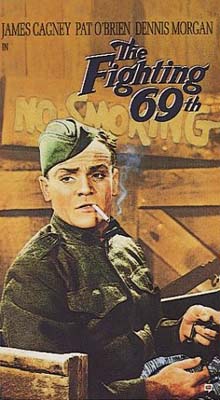
       “The Fighting 69th” was released in 1940, just in time to get us fired up about WWII.  Along with “Sgt. York”, the pair formed a potent propaganda / patriotic duo.  It must have been tough to be a Nazi leaving those theaters.  You just wait dude, we don’t want to have to kick your ass, but if we get into this fight…  “The Fighting 69th” was directed by William Keighley (this was his only war movie, thank goodness).  It was a huge box office hit so it must be a great movie, right?
                The movie opens to the strains of “Garry Owen” (oh please let this movie be as good as “They Died With Their Boots On”).  A crawl dedicates the film to the 69th Regiment and the Rainbow Division.  The Rainbow Division was famous for its multi-ethnicity and the 69th was all-Irish so mixed message much?  The opening scenes are at Camp  Mills for training.  We meet four historical characters:  the heroic Col. William “Wild Bill” Donovan (George Brent), the saintly Father Duffy (Pat O’Brian), the poet Joyce Kilmer (Jeffrey Lynn), and worst soldier in regimental history Jerry Plunkett (Jimmy Cagney).  Actually, Plunkett is a fictional character.  He is from Brooklyn so I don’t have to tell you he’s an asshole.  Before even being sworn in he has already been insubordinate, arrogant, and cowardly.
                Training camp montage.  Check.  Fight with another unit.  Check.  In this case, the 69th gets into a brawl with the 4th Alabama because the Rebels kicked their butts at Marye’s Heights in the Battle of Fredericksburg in the Civil War (true story) over fifty years ago.  Hopefully by 1940 audiences in the South were not rooting for the Germans in the movie.  The fight gives Donovan the opening to give a speech about how we’re all Americans now.  Tactical training.  Check.  Lame soldier barrack’s banter.  Check.
                They unbelievably bring Plunkett with them to France!  He’s still an asshole, but he’s Father Duffy’s project.  Saving this guy’s soul will really get the notice of St. Peter.  They go on a long march through the mud to reach the front line.  This was based on the famous Mud March of eighty miles and the movie gets the grumbling right (not the G-Rated nature of it, of course).  In the first combat, Plunkett panics and fires off a flare which brings down an incredibly accurate artillery barrage which collapses a dugout killing a bunch of men.  (Based on the Rouge Bouquet incident featured in a Kilmer poem.)  He also throws a grenade that lands in their trench killing some more Americans.  Plunkett runs away.  Irredeemable, right?  Fragging-bait, correct?  Tell that to Father Duffy who apparently feels that saving Plunkett’s soul is more important than the numerous lives he has taken and will take.
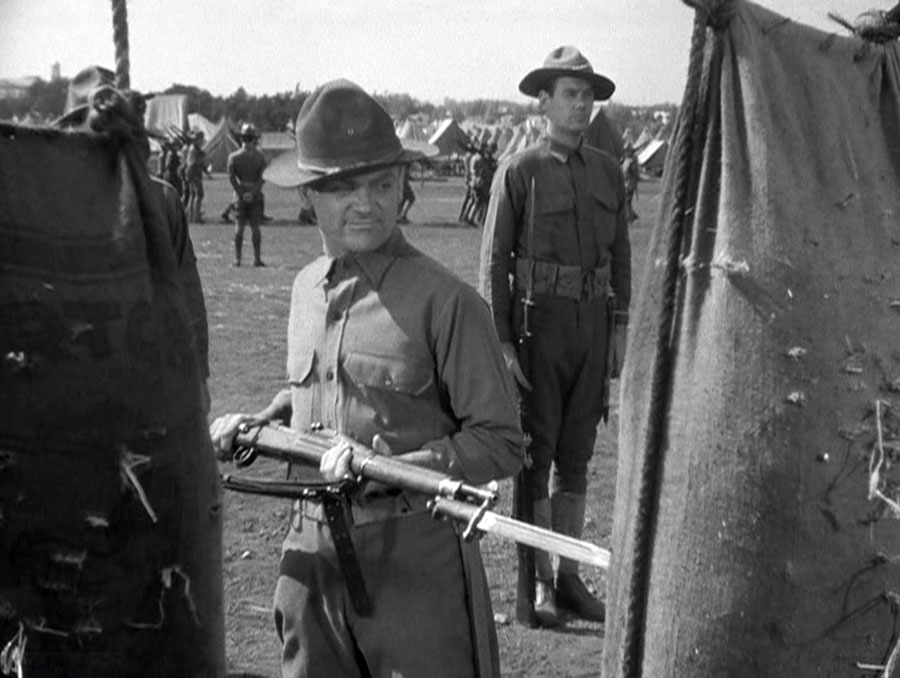
Bet on the bag

                Donovan decides to volunteer Plunkett for a dangerous patrol.  He may be a great leader, but as a judge of character…  Surprise, Plunkett turns coward and gets more men killed including Joyce Kilmer (the “Trees” poet, for Christ’s sake).  Now even Father Duffy wants to kill that son of a bitch, right?  Wrong.  But the U.S. Army does.  It’s going to be hard for Plunkett to find redemption while under arrest and scheduled for execution.  But this is Hollywood-hard which means distinctly possible.  Guess the rest and don’t be afraid to think inside the box.
Duffy and Doofus

                If I was coming out of a 1940 theater, I would probably have been fired up and thought it was the greatest movie since “The Lost Patrol”.  I also would have wanted to convert to Catholicism (if I wasn’t already a Catholic).  However, since it is now 2013 and there is no world war looming on the horizon, I find I am less than enthralled with “The Fighting 69th”.  Plus I’ve seen an awful lot of good war movies and this ain’t one of them.
                You have to give the film credit for portraying three significant figures from WWI and being pretty true to the people.  Father Duffy was thrilled with his depiction so we can’t fault the movie for canonizing him.  The movie is very religious.  At one point, Donovan kneels before him and Duffy says a prayer for the unit.  Donovan gets his due as one of the great combat leaders of WWI.  He did lead patrols like the film shows and was inspirational.  I cannot vouch for him giving speeches similar to the film.  Joyce Kilmer became the most famous American poet/warrior as a result of the movie.  His death was not as depicted.  He was killed by a sniper on a scouting expedition.  As far as Plunkett is concerned, I guess he was a composite of five guys:  1.  a gangster wannabe who washed out in boot camp  2.  an insubordinate wiseass private  3.  a coward who ran away at the first shot  4.  a soldier executed for killing several comrades  5.  a brave warrior.  Just kidding, he was totally a Hollywood creation.  In the real world, one of his comrades would have killed him early on.
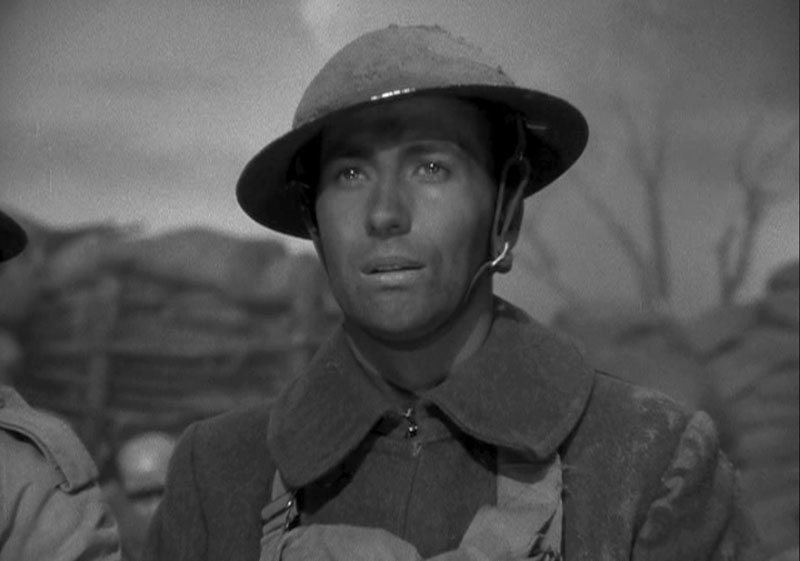
Kilmer:  "What rhymes with asshole?"
                The movie has some positives.  The trench and dugout sets are authentic looking.  The combat is above average, but certainly not anything to get excited about.  There is not a lot of it.  This is not an action film.  The artillery bombardments are noisy and explosive.  No man’s land is semi-nightmarish.  You won’t be on the edge of your seat unless you are sitting in a theater in 1940.  The climactic battle is strong and death-filled with one very cliché demise.  The acting is good except for the inevitable scene-chewing by Cagney.  The plot is a bit of a mess.  The movie does not know whether it wants to be the story of a unit (like “Glory”) or the story of Father Duffy (like “Mister Roberts”) or the redemption tale of Plunkett (like “The Red Badge of Courage”).
                In conclusion, once again we have a popular movie that is very much of its time.  It’s a curio.  It was an important movie that helped prepare America for involvement in another world war.  With that said, there is no way you can watch it in the 21st Century and think you are watching a great movie.  Put it in a time capsule, not your DVD player.

grade =  C


Tuesday, April 22, 2014

BOOK / MOVIE: Incident at Muc Wa / Go Tell the Spartans (1978)


                “Go Tell the Spartans” is a Vietnam War film released in 1978 (the same year as “Coming Home” and “The Deer Hunter”).  It was directed by Ted Post and is based on the novel Incident at Muc Wa by Daniel Ford.  The movie was shot in California with a shoe-string budget.  It is set in South Vietnam in 1964 during the period when the U.S. was still in an advisory role.  “In 1964, the war in Vietnam was still a little one – confused and far away.”
                Maj. Barker (Burt Lancaster) is in command of a base at Panang.  Barker is a war-weary veteran of WWII and Korea who is just putting in time.  He is cynical and not interested in “playing the game”.  His executive officer Capt. Olivetti (Marc Singer) is ambitious and hoping to advance his career by earning a Combat Infantry Badge. (They thought small back then.)  They command a motley group of ARVN and peasant farmers (who he refers to as “gooks”).  They get some help (whether they want it or not) from some new arrivals.  Barker interviews each as a form of character background.  Sgt. “Oleo” Oleonowski (Jonathan Goldsmith) is a tightly-wound veteran who has served well under Barker in the past.  Lt. Hamilton (Joe Unger) is a shavetail who wants to “see the elephant”.  Cpl. Abraham Lincoln (Dennis Howard) is a drug addicted medic.  He is put rooming with the alcoholic Oleo.  (At least in “Platoon” the dopers and drunks were segregated.)  Cpl. Courcey (Craig Wasson) is a draftee who volunteered for combat in Vietnam.  Barker is irritated, yet intrigued by Courcey.
                Gen. Harnitz arrives to order Barker to establish an outpost at Muc Wa.  Muc Wa had been a French outpost that was wiped out in 1954.  Harnitz’s rationale is that since the French lost Muc Wa and lost the war, logically if the U.S. wants to win the war, we have to hold Muc Wa.  When Barker points out that the site is not strategically important, Hartnitz counters:  “I don’t give a shit what the actual conditions are, the book says do it”.  He also mentions that just because the French were defeated there means nothing because we are the USA - we don’t lose.
                Barker sends a motley crew of Americans, ARVN, and some militiamen to rebuild and garrison Muc Wa.  Hamilton is suffering from dysentery and unsure of command, so Oleo is actually calling the shots (not that unrealistic for Vietnam).  Courcey is turning out to be a bleeding heart liberal and insists on befriending a refugee family and bringing them inside the wire.  Their Vietnamese guide Cowboy (Evan Kim) claims they are Cong.  How can you know?  Muc Wa includes an old French cemetery with a placard that reads:  “Stranger, tell the Spartans that we remain here in obedience to their orders.”  There are 302 French buried there.  (What a coincidence – there were 300 Spartans killed at Thermopylae.)   
                The unit sends out patrols and lays ambushes at night.  Lt. Hamilton gets killed trying to rescue one of Oleo’s men.  Oleo snaps over this and commits suicide.  Meanwhile, back at the base, Barker is assigned a nerd who will manage the “Incident Flow Priority Indicator”.  This MacNamaraish scheme will determine which outpost is statistically most likely to come under attack.  Barker is skeptical, but when Muc Wa rises to the red level, he takes steps to avoid disaster.    He sends his glory-seeking exec to take command.  To work up a relief convoy, he has to wheel and deal with the local South Vietnamese commander.  He bribes him with howitzer shells.  When asked if the U.S. might ask for the rounds back, Barker correctly points out that the U.S. never asks for anything back.
                A human wave night attack is barely defeated by the Muc Wa defenders.  It’s fairly good action and the body count is high.  It helps when you don’t have to reload.  They fire mortars that land ten yards away.  More is coming and so is Barker until Hartnitz turns around his convoy because the book now says to cut your losses over an unimportant outpost.  He does want the white guys evacuated so Barker choppers in.  When Courcey learns that the ARVN, militiamen, and refugees are on their own, he refuses to abandon them.  He’s a good American.  Guess who stays behind with him when the chopper leaves?
                The movie is distinctly low budget (Lancaster put up $150,000 to finish production) and that is the main reason it got lost in the glut of 1978 Vietnam War movies.  It has a made-for-TV feel for it.  This is emphasized by the soundtrack.  Filmed in California, Muc Wa does not look like it is in a jungle setting.   The cast (other than Lancaster) is low rent and it shows in the acting.  If it was not for Lancaster being great, the movie would not even be a blip.  He has one of his best performances.  He is totally comfortable in the role and perfectly portrays a veteran officer whose career was blunted by a sexual transgression (which he describes comically at length).  Because of that weakness for “pudenda” (as he quaintly calls it), he is forced to take orders from lesser men like Hartnitz.  He also does not give a crap and is not beyond threatening a general if necessary.  The rest of the acting sometimes drifts into terrible.  Howard, in particular, gets to play high and sing the Gettysburg Address from a tower until a mortar round thankfully shuts him up, but does not kill him.  Boo.
                The film tries hard to show how we were nuts to get stuck in Vietnam.  It is the rare Vietnam movie that is set in the advisory period.  Part of the reason it did not make a splash in 1978 had to be that audiences did not want to know how screwed up Vietnam was before we even started fighting.  The movie is very anti-war and it is not a feel good movie.  It is sincere and it deserves credit for being pretty realistic.  For instance, aside from Courcey (who is depicted as a naïve chump – the family turns out to be Cong), all the Americans look down on the Vietnamese people.  They are referred to as “slopes” and “gooks”.
               The book was written by a war correspondent who was in South Vietnam in 1964.  He later wrote a nonfiction account of America's early involvement in the war.  The movie is substantially different than the novel mainly in the characters.  Most significantly, screen writer Wendall Mayes beefed up the Barker role to attract a big name and it lured the 65 year old Lancaster.  In the book, Barker is like an office manager doing his job with little enthusiasm.  There is no druggie medic.  Olivetti is more of a womanizing jerk who is full of himself.  Hardnetz is a buffoon who is obsessed with doing things by the book  and there is no back-story creating dysfunction between him and Barker.  Barker is cowed by him which is very different than in the movie.
                The book is much more female-friendly and Mayes’ decision to remove two major characters is puzzling.  A radical journalist named Rebecca goes all the way to Vietnam to try to reconnect with Courcey (and to be hit on by Olivetti).  Granted, this is ridiculous, but we do get the hippie outlook and some unrequited romance.  The other female is a sexy teenage girl (called “Butterfly”) in the refugee family who Ski (as Oleo is called in the book) marries and gets pregnant.  They shack up (literally) at Muc Wa.  This relationship starts creepy and ends sweetly.  In the movie, Oleonowski is totally against allowing the family into the outpost.
                The main character in the novel is Courcey.  He is much more multi-dimensional than in the movie.  He does start off quoting from the book in his opening interview with Barker in the movie and he does sympathize with his Vietnamese charges.  In the book, he grows into leadership and becomes a good warrior.  He is the actual commander of Muc Wa and gradually comes to feel possessive.
                The novel has the luxury of going into more detail.  The time frame is much longer.  Muc Wa does not even exist when they arrive and they have to build it from the ground up.  The outpost is much larger than in the movie.  In fact, the Viet Cong capture half of it before the climactic battle.  Ski has time to develop a relationship with Butterfly.  Courcey has time to develop a relationship with an elderly militiaman called Corporal Old Man.
                The book is more satirical than the movie.  For instance, Gen. Hartnetz visits Muc Wa and Barker orders them to stage an attack to show off the defenses.  Courcey takes a unit out into the bush, but they do not do the show assault because a larger Viet Cong unit happens along and attacks the outpost.  Hilarious. 
                The book and movie make a good pair.  They are both low budget, but sincere.  Neither are great, but they are worth experiencing.
BOOK =  B
MOVIE = B

Thursday, April 17, 2014

THE CHAMPIONSHIP MATCH

Here are the other rounds:

ROUND 1

Boys in Company C (11) vs. Casualties of War (6)
84 Charlie MoPic (7) vs. We Were Soldiers (10)
Bat-21 (9) vs. Go Tell the Spartans (8)
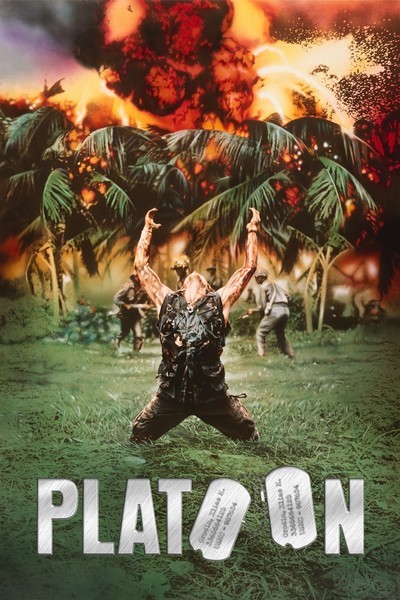
Platoon (5) vs. Siege of Firebase Gloria (12)
The Deer Hunter (4) vs. The Green Berets (13)
Full Metal Jacket (3) vs. Platoon Leader (14)
Apocalypse Now (2) vs. The Tunnel Rats (15)
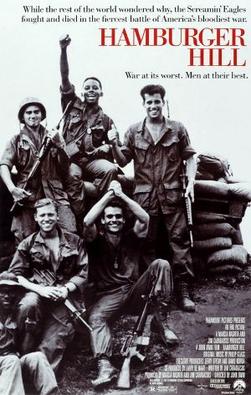
Hamburger Hill (1) vs. Under Heavy Fire (16)

ROUND 2

Hamburger Hill (1) vs. Go Tell the Spartans (9)
The Deer Hunter (4) vs. Platoon (5)
Apocalypse Now (2) vs. 84 Charlie MoPic (7)
Full Metal Jacket (3) vs. Casualties of War (6)

ROUND 3

Final Four #1
Final Four #2


CHAMPIONSHIP
 
 
MATCH


VS.


The survivors of this intense competition are “Platoon” and “84 Charlie MoPic”. One is a blockbuster that won the Best Picture award and the other is on the other end of the spectrum. One had a substantial budget, acclaimed director, and famous actors. The other has none of this. One is the best known Vietnam War movie. The other is virtually unknown. This is David versus Goliath! As per the tournament rules, the final match-up is a summary of all the categories (because there is no way I can think of four more) and to ensure I do not show favoritism in the finals. So here it is:


ACTING                                            Platoon = 10                 MoPic = 9
PLOT                                                 Platoon = 9                   MoPic = 9
COMBAT                                          Platoon = 9                   MoPic = 8
REALISM                                         Platoon = 8                   MoPic = 10
CHARACTERS                               Platoon = 9                    MoPic = 9
BEHAVIOR                                     Platoon = 9                    MoPic = 9
WEAPONS AND TACTICS          Platoon = 8                    MoPic = 8
ACCURACY                                    Platoon = 8                   MoPic = 8
CLICHES                                         Platoon = 7                   MoPic = 8
DIALOGUE                                     Platoon = 9                   MoPic = 9
IMPLAUSIBILITIES                     Platoon = 8                   MoPic = 9
EDUCATIONAL VALUE              Platoon = 9                   MoPic = 9

FINAL SCORE

PLATOON = 103
84 CHARLIE MOPIC = 105


ANALYSIS

I have to say truthfully that I am shocked by the results of the tournament. I know that seems fake because I set the rules and do the reviews, but I seriously did not see this coming. When you look at the field, two things were apparent from the beginning. First, there are some great Vietnam War movies and several have strong claims for being the best. They also have fan bases that insist they are the best and their challengers suck. Second, there are some movies in the field that had no chance of winning. In between, there was a little movie called “84 Charlie MoPic”. I first saw this movie on PBS more than thirty years ago. I managed to tape it on VHS and even showed it to my classes occasionally. I had not seen it for decades. Thank God for You Tube! If ever there was a forgotten gem, this is one. I hope this tournament encourages people to view this movie. (I have posted the You Tube link below). By the way, I personally think “Platoon” is the best Vietnam War movie. I also think Florida had the best basketball team this year.

 
 84 Charlie MoPic


HAMBURGER HILL (1) vs. UNDER HEAVY FIRE (16)


VS.


***  THIS MATCH SLIPPED THROUGH THE CRACKS.  I BET EVERYONE WAS WONDERING WHO HAD WON THIS MATCH.


 ACTING

“Hamburger Hill” has a cast of actors who were unknown at the time, but some were at the start of significant careers. The cast is likeable and does not perform like a bunch of rookies. They are a bit too sincere in spots and their line readings sometimes indicate they do not understand the slang they have memorized. Although there was no Dale Dyeish “boot camp”, they do not look like actors playing soldier. Dylan McDermott is good as the sergeant who leads by example on and off the battlefield. His contract specifically mentioned “don’t touch the hair”. The standout in the cast is Courtney Vance as Doc. He chews a little, but it is a memorable performance. It was the first significant film role for both as well as the underused Don Cheadle. The only weak performance is Steven Weber as the platoon sergeant. B

“Under Heavy Fire” has a similar cast of unknowns, but they will remain that way. The “big” star is Casper Van Dien as the troubled, but ruggedly handsome Capt. Ramsey. You know you are in trouble when you wish that Casper would have given the others acting lessons. Carre Otis, as a documentary film bunny, succumbs to his charms. She is also ruggedly handsome. The rest of the cast should have gone to acting camp. They are typically sincere, but fortunately they save the foaming for the end. D

FIRST QUARTER SCORE
Hamburger Hill = 8
Under Heavy Fire = 6


PLOT

HH is a battle film that has two distinct parts. The first half deals with character development and tutoring the audience on what the soldiers had to go through. We are supposed to relate to the five FNGs and empathize with them. The second half is the payoff with the battle. Intense action interspersed with soldier campfire banter and bitching. The expository moments advance the theme that the home front can kiss these soldiers’ asses. The movie is clearly anti-anti-Vietnam War (as opposed to pro-war). The plot is the standard “who will survive?” variety. Don’t get too attached to the men. B

UHF has a daring plot. It starts twenty years after the war with a group of vets returning to Vietnam with a documentarian in tow. Meeting them there is their ex-commander who went from “Most Likely to Succeed” to “Most Likely to Make Us Bleed” during their time together. The first scene introduces us to a friendly fire episode for which Ramsey is blamed. The film effectively uses flashbacks to gradually flesh out the arc that led to the unit dysfunctionality. This builds to … a reenactment of the friendly fire incident! The movie closes poorly. B

HALF TIME SCORE
Hamburger Hill = 16
Under Heavy Fire = 14


COMBAT

HH has a high quantity of combat. It reminds a lot of “Pork Chop Hill”. There is an intense opening combat scene and then a patrol mission, but the core of the movie is the sequence of frontal assaults up the titular hill. The violence is graphic and the deaths are random and unpredictable. There is some pretty gory stuff, including decapitations. The film manages to avoid being repetitive. Probably only “We Were Soldiers” has higher quality and that could partly be explained by the higher budget. A

UHF does a good job with combat considering the production values. One thing you can be sure of – if it’s a flashback, there is going to be some action. The incidents portrayed are a greatest hits compilation. For instance, there’s a patrol with the trio of mortars incoming, spider holes, and a sniper. There is a briskly paced tunnel scene. The big set piece is in Hue during the Tet Offensive. The urban combat is pretty good and leads to an atrocity that sets up the full circle return to the friendly fire incident. There is little shooting from the hip and few hands thrown up in the air deaths. B

THIRD QUARTER SCORE
Hamburger Hill = 25
Under Heavy Fire = 22


REALISM

HH is one of the more realistic Vietnam War movies. The soldier behavior and camaraderie is on target for the army midway through the war. The bonding versus racial tensions is well played. The only discordant note comes from the dialogue put in the actors’ mouths. The screenwriter uses every slang term ever uttered in the Nam to the point that the dialogue feels forced. The battle is one of the more famous ones from the war and the movie is solid in its realistic depiction of it. One could complain about the exaggerated mortality rate, but that’s a war movie sort of thing that will always be with us. Besides, the actual battle did have a high casualty rate (just not Hollywood high). B

UHF has some problems with reality. Some of the combat scenes evidence either an ignorance of combat or more likely a disregard of reality for entertainment purposes. For example, when confronted by an NVA tank, Ramsey calls for a Skyraider to drop its fuel tank which the unit fires at causing an explosion that destroys the target! The behavior of the main characters both in the war and upon their return is the biggest problem. They are too melodramatic and one dimensional in response to the stresses they encounter. This leads to the laughable reenactment scene which degenerates into a cartoonish standoff. By the way, when you are shot an inch above the heart, you don’t run around unaffected like Ramsey does. D

FINAL SCORE
Hamburger Hill = 33
Under Heavy Fire = 28


ANALYSIS

This match was a lot closer than I anticipated. I had never seen “Under Heavy Fire” before and assumed that it’s seeding at #16 meant it was the worst movie in the tournament. It by no means is a good movie, but it does take a different approach to the war. Unfortunately, friendly fire was a fact of life in Vietnam (“Hamburger Hill” has a scene where American helicopters fire on their own men) and to use an incident as the framework for a military mystery was intriguing. Of course, with the low budget and the poor actors, the idea did not match the execution, but it was a nice try. The categories used for this match-up did not lend itself to the strength of UHF. It uses a lot of POV footage which is overdone, but still effective. As far as HH, it may not deserve the #1 seed (which is based on generic movie reviewers), but it is still one of the more highly thought of Vietnam War movies. It has no spectacular elements like “Apocalypse Now”, “Full Metal Jacket”, or “Platoon”, but it also does not have some glaring weaknesses. It is a balanced movie overall.