Showing posts with label World War I. Show all posts

Friday, October 28, 2022

All Quiet on the Western Front (2022)


            Well, the day has finally arrived.  More than five years after I first heard of a remake of “All Quiet on the Western Front”, it is now streaming on Netflix.  It is a German film and is correctly entitled “Im Westen Nichts Neuss.”  This is appropriate because the novel by Erich Remarque is about German infantrymen in WWI.  The previous two versions – Lewis Milestone's Best Picture winner and the 1979 made-for-TV movie, were American pictures. Both did not show an American bias, but this new version promised to be better at showcasing the hardships German soldiers went through.  Edward Berger directed with an undisclosed, but probably hefty, Netflix budget.  Berger is a noted TV series director in Germany.  He co-wrote the screenplay.  The film was shot in Czechoslovakia.  It has been submitted by Germany for consideration for a nomination for Best Foreign Language Film at the next Oscars.

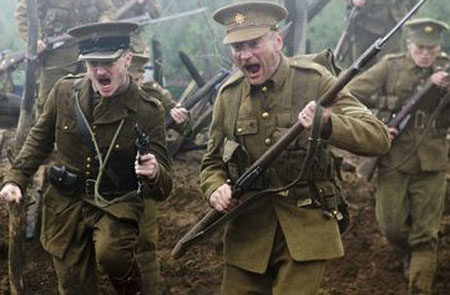
            The movie opens with a warning of “strong bloody war violence and grisly images”.  You had me at “bloody”.  A den of foxes in a woods shows the influence of Terance Malick (“The Thin Red Line”) on the cinematography (and the view that war does not harm wildlife and forests).  The camera moves to corpses littering no man’s land and then we are in the trench for a “Paths of Glory” journey through the trench pre-attack.  The over the top includes the oft-seen soldier killed as he climbs the ladder.  The “Paths” influence continues as we track a soldier named Heinrich as he avoids the random deaths to reach the French trench where he is last seen using his entrenching tool for hand-to-hand combat.  It’s a great combat scene, but sadly brief.  The revelation that Heinrich was killed starts a series of scenes moving his uniform from his corpse to women washing all the dead men’s uniforms to seamstresses repairing them to Paul (Felix Kammerer) and his school mates being handed them.  The boys are thrilled with their threads of glory.  The movie forgoes the usual boot camp segment to rush them to the front seemingly ill-prepared.  It is spring 1917.  Their first job is baling out the trench because of the constant rain.  Ludwig speaks for them all when he grumbles: “Somehow this is not how I imagined it.”  A sentiment soldiers of every war would agree with.

            The rest of the movie enlightens those who are not familiar with the Great War with scenes that reflect common soldier experiences.  The film makes an effort to bring something new to the table.  I mentioned the use of the entrenching tool as a weapon.  Paul has to collect dog tags from the dead.  A unit of replacements are victims of gas.  But for the most part, there is little that hasn’t been shown in other movies, especially the other two versions.  Davis clearly aimed his movie at Netflix viewers who would be seeing their second WWI movie (the other being “1917”).  The big difference is this film intercuts with the politics of the last part of the war.  Daniel Bruhl (who was originally tabbed for the Paul character but got aged out by the time production began) plays Matthias Erzberger, a Social Democrat (insert hissing from the generals) who is in contact with French Gen. Foch.  He is attempting to arrange an armistice.  This subplot necessitates Paul  making it to the end of the war.  This results in one of the worst endings of any prestigious war movie. 

            I recently watched the other versions of “All Quiet” for a comparison of scenes to each other and to the book.  I also listened to the book (the Audible version is outstanding).  It is one of my favorite novels and I have seen the movies at least four times each.  I couldn’t wait to add the new movie to my project.  Since the two earlier versions are both very good movies that cover the book well, I was intrigued to see how the new movie would handle the book.  Early word was that Davis’ version was outstanding and a worthy challenger to the other two.  The trailer had a lot of war movie fans salivating.  I am sorry to report you can towel off.

            I have had a hard time deciding how to approach this review.  Do I review it as a WWI movie or do I review it as an “All Quiet on the Western Front” movie?  So, I’ll do both.  As a WWI movie, it is logical to compare it to “1917”.  That film was overrated, but had the amazing cinematography to set it apart.  It is a much better movie than this movie.  The only strength is the combat scenes. One of them features French tanks and flamethrowers and is as graphic as the warning says.  This was an odd creative decision because if Davis meant his film to be the 21st Century version of the novel brought to screen, he created an R-rated movie that students can not watch.  The rest of the movie has a poor flow to it.  Scenes end abruptly.  But the biggest problem is the Erzburger subplot brings the film to screeching halts whenever it leaves Paul and his mates.  My theory was the film did not want to lose its star Daniel Bruhl, so his lame political machinations were added.  Catastrophically, the creation of this subplot was responsible for the inexcusable final chapter for Paul.  (Think “We Were Soldiers”, but worse.)

            When I did my usual research, I looked at Wikipedia.  It says the movie has received “critical acclaim for faithfulness to the source material.”  You have got to be f’in kidding me.  If you were to see this movie with a different title, you would be hard-pressed to realize that it was another version of the novel.  Any student using this movie for a book report instead of reading the book will surely get a big fat F.  I would have to theorize that Davis watched the other two versions and decided he could not compete.  Of course, he could have taken the attitude that many haven’t seen the other two, so he would cover the main scenes and possibly better them.  Nope.  Other than Paul and Kat (Albrecht Schuch), the other characters barely register.  The movie is essentially a buddy film, not a buddies film.  Amazingly, most of the iconic scenes from the 1930 film are absent and some of the ones that are recreated are minor scenes. The few times that the movie uses the book, the scenes are far inferior to the other films.  For example, the charming liaison with the three French girls does not involve a river and only Frantz Muller goes!  The camera does not go with him.  My favorite scene did make it - Paul and the wounded Frenchman in the shell crater.  This being the 21st Century, Paul stabs him 6 times!  The movie dispenses with Paul’s anguished response to what he has done.  Don’t hold your breath for the muddy field, the beat-down of Himmelstoss, the graveyard, Kimmerich’s boots (this movie moves a scarf from soldier to soldier), the Catholic hospital.  Paul does not return home on leave!  So much for contrasting the home front delusions with the realities of the front.  Instead, cover the disagreements between the generals and the politicians.  Yawn.

            As far as the acting, you will read some touting of Kammerer, but when you are out-acted by Richard Thomas…  The rest of the cast is not even well-known in Germany.  They must have saved money by cutting Himmelstoss, Kimmerich, Kantorek, Detering.  Kropp and Muller are blink and you miss them.  Bruhl is misused in a role that calls on him to mope. Technically the movie is eye-opening.  The combat features tracking shots and puts you in the middle of no man’s land.  The deaths are blood-chilling in their randomness.  When the soldiers reach the trench, all humanity is lost.  Wounded and unthreatening still gets you shot or bayoneted.  This is not a movie for children.  Although oddly, there is no swearing.

             I don’t want to discourage you from seeing the movie.  Watch it and make up your own mind.  Keep in mind this reviewer is very familiar with the previous movies and the book, so I am passionate about the subject. But I have seen hundreds of war movies and many WWI movies, so I feel I can weigh in on whether this movie holds up to the better movies in the subgenre.  If you have not seen "The Lost Battalion”, “Beneath Hill 60”, “Paths of Glory”, “Journey's End”, and “Gallipoli”, watch them ahead of this.  If you want a movie from the German perspective, try “Westfront 1918”.  And please watch the other two versions.


GRADE  =  C  (compared to other WWI movies)

GRADE =  F  (compared to 1930 & 1979)

Sunday, May 15, 2016

Westfront 1918 (7) vs. Beneath Hill 60 (10)


VS.


PLOT:  “Westfront 1918” is the story of four German soldiers in the closing days of the war.  They are in the same unit and are stationed on the Western Front.  Two of them have romantic scenarios.  One falls in love with a French mademoiselle and the other has wife problems when he returns home on leave.  The plot effectively depicts soldier as well as civilian life  It includes the extended home front scene, a cabaret scene and several combat scenes.  It is unpredictable other than the clear implication that things will not end well for the main characters.  Director Georg Pabst brings a sober realism to his work.  A fact that was not appreciated by Joseph Goebbels.  GRADE  =  A

“Beneath Hill 60” is the true story of Australian mining engineer Oliver Woodward and his mining unit on the Western Front in 1916.  Their claustrophobic endeavor is to dig a tunnel under German lines to literally blow a hole in the enemy defenses.  The movie features dueling arcs as we follow Woodward’s courtship of a lass through flashbacks while the movie advances toward the climactic explosion.  Along the way, the small unit of diggers is fleshed out and the soldier experience is realistically portrayed.  GRADE  =  A

FIRST QUARTER SCORE:  Westfront  -  9    Beneath  -  9

ACTING:  “Westfront” has a limited cast of solid German actors.  There are really only four main roles in the film and yet there is not a lot of character development for the actors to work at.  The acting is noted only for what it is not.  It is not the typical scene-chewing style of the early talkies.  None of the performances are squirm-inducing.  Karl the cuckold (Gustav Diessl) and the jolly Bavarian (Fritz Kampers) stand out, but the acting is not what makes the movie memorable.  GRADE  -  C

“Beneath Hill 60” is well acted, especially by Brendan Cowell as Woodward.  He has a lot of charisma, but underplays the role.  He makes Woodward a likeable character who has some tough decisions to make.  The supporting cast provides excellent work.  You care about the men and some of the deaths are powerful.  GRADE  -  A

HALFTIME SCORE:  Beneath  -  18    Westfront -  15

COMBAT:  “Westfront” has about 13 minutes of combat.  There is a French raid on their trench that has more grenades than any other WWI movie that I can recall.  The masterpiece comes at the end of the movie when the French make a major attack that goes on for over eight minutes.  This scene has more grenades, but throws in some lumbering tanks.  It is realistically chaotic and the shell-shock the lieutenant gets is well-earned.  GRADE  -  A

“Beneath Hill 60” also has 13 minutes of combat. Although the movie concentrates on the tunnel construction, it does manage to get some action in.  In fact, there is even some combat underground as both sides are countermining.  The director throws in a nifty night raid on a German machine gun position.  GRADE  -  B-

THIRD QUARTER SCORE:  Beneath  -  25    Westfront  -  24
  
ANTI-WAR:   Goebbels’ banning it should tell you something about “Westfront 1918”.  It is one of the most anti-war movies ever made.  The death rate of the main characters is very high.  One of them is killed in a man-to-man death match in a shell crater.  When his body is later seen by his buddies, all they see is one of his arms above ground.  They toss some dirt on it.  The movie gets bleaker as it moves along. Even the home front scene is depressing.  In the charnel house of a hospital in the closing scene, a character sums up the horrific war with the line: “It’s everyone’s fault.”  GRADE  -  A+

“Beneath Hill 60” is not designed as an overtly anti-war film.  There are some heart-tugging deaths, but they are not of the futile variety.  The movie is more anti-command, as it has the clueless general you see in so many WWI movies.  There are no suicidal attacks.  GRADE  -  B-

FINAL SCORE:   Westfront 1918  -  34     Beneath Hill 60  -  32

MATCH ANALYSIS:  I am a big fan of both of these films and it is a shame either has to exit the tournament this early.  I have a feeling that because of the seeding we will have at least one movie that makes the second round that will be inferior to “Beneath Hill 60”.  It just ran into a classic that holds up even against a modern war movie.  I do not reflexively bow before the old school “masterpieces”, but “Westfront 1918” is a great movie that has unfortunately been overshadowed by “All Quiet on the Western Front”.

Saturday, May 16, 2015

SHORT STORY READALONG: British Gunners as Cave Dwellers


                Our latest selection is a primary source about the Royal Artillery on the Western Front in WWI.  It is a story by Corporal E.H. Bean.  He served in combat until he was wounded and invalided back to blighty.  The story takes him from England through his return.  It is basically a collection of vignettes that give a taste of life in the artillery.  One day he is England, the next day he is at the front.  It happened that quick for many British soldiers.  Now that I think about it, that was not that different than what American soldiers sent to Vietnam went through. 

                Two things stand out in his tale.  One is that it sucked to be an artillery horse.  Bean makes it clear that horses were very vulnerable to artillery barrages.  Another memorable passage was the genesis of the title of the story.  His unit spends five days billeted in some caves near Soissons.  It was an eerie alternative to the trenches.  The overall vibe of the story is typically British.  Bean and his comrades have stiff upper lips throughout.  He even says “the British soldier has the happy knack of making himself at home in all kinds of odd places…”  When he is wounded he remains cheery.

                If the story was fiction, you would be groaning at times.  It is not very exciting, but it is educational.  You learn about the Royal Artillery and what it was like to be a horse pulling the artillery pieces.


GRADE =  C

Next selection:  The Canoe Fight

Saturday, January 31, 2015

SHORT STORY READALONG: "The Aviator" by Hornell Hart


This is the begging of my War Short Stories Readalong.  So here we go on our journey through some of the best war-related short stories.  First up - "The Aviator" by Hornell Hart.  It first appeared in a magazine called "Short Stories from Life" in 1916.  The story is about a French aviator who is attacking a Turkish fort in 1916.  It is apparently based on an incident in the Gallipolli Campaign. A French cruiser is bombardind the fort at night.  Meanwhile, the aviator is piloting his monoplane in an attempt to take out the powder magazine in the fort.  The refrain  "the French Government declines to accept your services" keeps running through his mind.  It appears that the hero was rejected by the military (Gen. Joffre) because of some diplomatic blunder.  Don't ask what a diplomat is doing flying a warplane or how he got the plane or why he would be using nitro-glycerine as an explosive.  Too much carping because the story is actually tres cool.  It has a smidge of Luke Skywalker taking on the Death Star.  The aviator is on a suicide mission to follow a searchlight to the powder magazine.  The story has a superbly ironic ending that is not like "Star Wars", but maybe is more realistic and certainly is more anti-war.   The story is very interesting and a good start for the readalong.  It is quite short, but you may have to read it twice because it has some subtle elements to it.  I read some other reader's views on it and some of them were wrong about what happens in the story.

GRADE =  A-

Next up -   The Battle of Lake Borgne - by George Cary Eggleston

Friday, July 25, 2014

MINI-REVIEW: MY BOY JACK (2007)


                “My Boy Jack” is a television production of the play by David Haig that premiered in 2007.  Haig wrote the screenplay and stars as Rudyard Kipling.  In a great marketing move, Harry Potter was cast as Kipling’s son Jack.  The movie does not include the full third act of the play which carries the story into the 1930s. 

                The movie opens in Great Britain in 1914.  When WWI breaks out, chip-off-the-old-block Jack is insistent on enlisting for the great adventure.  Rudyard is not only supportive, but upset when Jack can’t get in because of bad eyesight.  Kipling is working at the Propaganda Ministry and is pushing for all good Englishmen to donate their sons.  When the first casualty figures come in he argues that publishing them will have the salutary effect of shaming men into joining the Army.  Putting his son where his mouth is, the elder Kipling pulls strings to get Jack into the big show.  Jack’s mother (Kim Cattrell) is upset, but British females have stiff upper lips, too.  Jack goes off to boot camp and becomes an effective and popular officer.  He still needs daddy’s help to get fast-tracked into the big upcoming push at Loos.  Can you guess what happens to the poster boy for dead meat?
the Kiplings

                “My Boy Jack” is a commendable work.  It manages to breaks the bonds of the stage and yet retains the quality dialogue.  The scenery around the Kipling home is beautiful and the trench set is realistic.  The movie makes a point of shifting back and forth from the Western Front to the home front.  Quite a contrast!    We also get the shifting perspectives of the two male Kiplings.  Not as much of a contrast here as both are gung-ho.  The combat scene features “Band of Brothers” style cinematography and is well-done.  It is a powerful scene as it intercuts with the Kiplings learning of the fate of their son.  Now on to the big question – how is Daniel Radcliffe?  He is actually pretty good, although Haig takes the acting honors.  Radcliffe’s performance bodes well for the upcoming “All Quiet…” 


This ain't quidditch
The story is meant to be thought provoking, but it is a bit simplistic and pulls its punches in the end.  It ends up not being as anti-war as it should have been.  Instead of contrasting the patriotism of Rudyard to the motherly instincts of his wife, the movie has Mrs. Kipling stoically accepting her son’s death and Rudyard justifying it.  The play goes up to the storm clouds of WWII and has Kipling wondering whether his son died in vain.  The movie is an accurate retelling of the Kiplings in WWI, so I guess Rudyard was a poor father, in my opinion.  I feel that it’s one thing to support the war effort, it’s another thing to pull strings to get your son in harm’s way.  If he’s going to get killed, don’t abet it.

GRADE  =  C+
HISTORICAL ACCURACY:  Kipling was  strong supporter of British entry into WWI.  He volunteered to work for the propaganda ministry and he wrote popular pamphlets boosting the war effort.  He glorified the military and described the war as civilization versus barbarism and the Germans were less than human.  As the work progressed, he became critical of the army, complaining that it had not learned the lessons from the Boer War.  The movie includes a seen where an old general tells Kipling the lessons were "speed, surprise, and variety".  (I don't believe that old vet had been to the Western Front.)  He really pushed for young men to enlist and basically tried to shame them into joining.  He did not make an exception for his own son, like a lot of politicians did.  John (nicknamed Jack in the movie) did fail his physicals due to myopia.  The movie makes it clear that the army and navy were correct to turn him down.  Rudyard visited Lord Roberts, former CINC, to get John into the Irish Guards.  (It's not like Kipling did not know stories could have unhappy endings - see "The Man Who Would Be King".)  John was killed in the Battle of Loos in 1917.  His death actually came six weeks after his eighteenth birthday, not the day after.  He was last seen stumbling blindly (told you so, said the army and navy doctors) forward in no man's land.  The movie concocted a scenario depicting him charging a machine gun.  It's unlikely he died like Col. Shaw of the 54th Massachusetts.  His parents did spend a lot of effort trying to locate the body, but it was not identified until 1992.  The movie accurately portrays Rudyard shouldering some of the blame, but he did not become a pacifist. 

Monday, July 21, 2014

FORGOTTEN GEM? Company K (2004)


            “Company K” is a WWI movie based on a novel by William March.  March serialized his semi-autobiographical accounts in a magazine from 1930-32.  It was published in book form in 1933 and hailed as a landmark in American war literature.  The novel is unusual in that it is a series of 113 vignettes involving a Marine company.  March had been a Marine on the Western Front.  He is represented by Pvt. Joseph Delaney (Ari Fliakos) in the movie.  He is trying to exorcise demons by writing a book about his and his mates’ experiences in the Great War.  In particular, Delaney is haunted by the death of a nonthreatening German.

                The movie is difficult to summarize because it is very episodic in nature.  There is no plot to speak of.  Some of the vignettes are interesting and some are not.  Most hammer the anti-war theme.  For example, in one episode a soldier sees Jesus in no man’s land at night and says:  “Damn it, you should be ashamed.  How long will you let this go on?”  The most significant sequence involves the execution of some German prisoners.

                I do not even know if this movie even appeared in theaters.  It is very low budget and it shows.  The acting is poor because you get what you pay for.  None of the actors make an impression.  This is the only movie Fliakos has made.  The technical aspects are what are to be expected.  The sets look like they are recreated trenches.  There is no mud.   The soundtrack is poor.  Unfortunately, there is little action even of a campy nature.  One interesting thing about the film is it was rated R for absolutely no reason.  There is no bad language, no nudity, and no graphic violence.

                In conclusion, read the book instead.

 
GRADE  =  D

Sunday, April 27, 2014

ANTIQUE or CLASSIC: The Fighting 69th


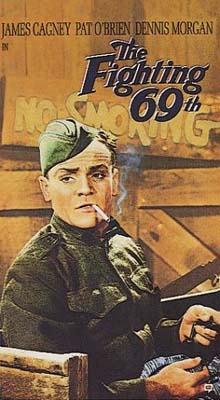
       “The Fighting 69th” was released in 1940, just in time to get us fired up about WWII.  Along with “Sgt. York”, the pair formed a potent propaganda / patriotic duo.  It must have been tough to be a Nazi leaving those theaters.  You just wait dude, we don’t want to have to kick your ass, but if we get into this fight…  “The Fighting 69th” was directed by William Keighley (this was his only war movie, thank goodness).  It was a huge box office hit so it must be a great movie, right?
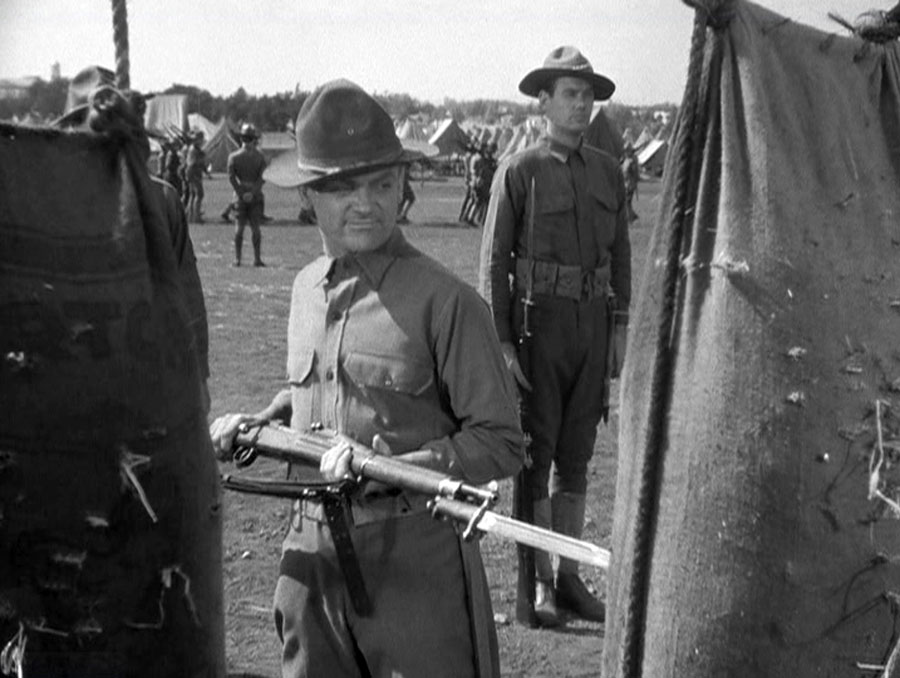
                The movie opens to the strains of “Garry Owen” (oh please let this movie be as good as “They Died With Their Boots On”).  A crawl dedicates the film to the 69th Regiment and the Rainbow Division.  The Rainbow Division was famous for its multi-ethnicity and the 69th was all-Irish so mixed message much?  The opening scenes are at Camp  Mills for training.  We meet four historical characters:  the heroic Col. William “Wild Bill” Donovan (George Brent), the saintly Father Duffy (Pat O’Brian), the poet Joyce Kilmer (Jeffrey Lynn), and worst soldier in regimental history Jerry Plunkett (Jimmy Cagney).  Actually, Plunkett is a fictional character.  He is from Brooklyn so I don’t have to tell you he’s an asshole.  Before even being sworn in he has already been insubordinate, arrogant, and cowardly.
                Training camp montage.  Check.  Fight with another unit.  Check.  In this case, the 69th gets into a brawl with the 4th Alabama because the Rebels kicked their butts at Marye’s Heights in the Battle of Fredericksburg in the Civil War (true story) over fifty years ago.  Hopefully by 1940 audiences in the South were not rooting for the Germans in the movie.  The fight gives Donovan the opening to give a speech about how we’re all Americans now.  Tactical training.  Check.  Lame soldier barrack’s banter.  Check.
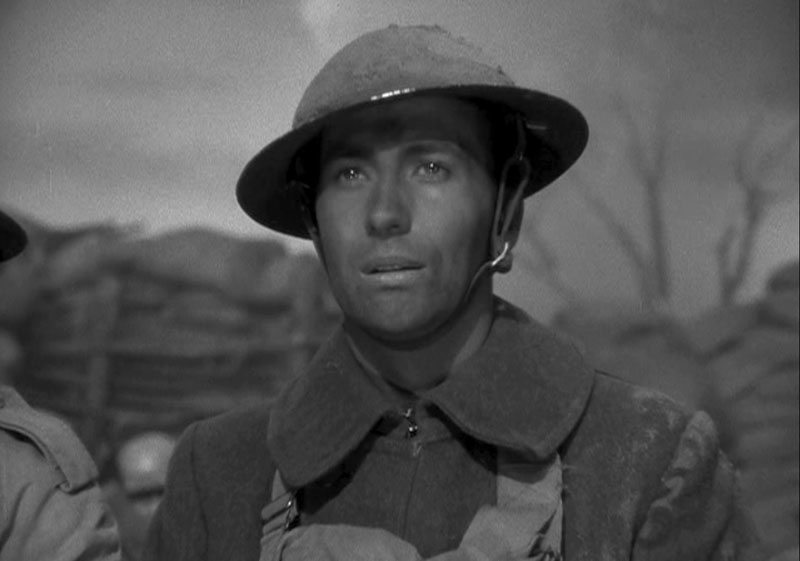
                They unbelievably bring Plunkett with them to France!  He’s still an asshole, but he’s Father Duffy’s project.  Saving this guy’s soul will really get the notice of St. Peter.  They go on a long march through the mud to reach the front line.  This was based on the famous Mud March of eighty miles and the movie gets the grumbling right (not the G-Rated nature of it, of course).  In the first combat, Plunkett panics and fires off a flare which brings down an incredibly accurate artillery barrage which collapses a dugout killing a bunch of men.  (Based on the Rouge Bouquet incident featured in a Kilmer poem.)  He also throws a grenade that lands in their trench killing some more Americans.  Plunkett runs away.  Irredeemable, right?  Fragging-bait, correct?  Tell that to Father Duffy who apparently feels that saving Plunkett’s soul is more important than the numerous lives he has taken and will take.
Bet on the bag

                Donovan decides to volunteer Plunkett for a dangerous patrol.  He may be a great leader, but as a judge of character…  Surprise, Plunkett turns coward and gets more men killed including Joyce Kilmer (the “Trees” poet, for Christ’s sake).  Now even Father Duffy wants to kill that son of a bitch, right?  Wrong.  But the U.S. Army does.  It’s going to be hard for Plunkett to find redemption while under arrest and scheduled for execution.  But this is Hollywood-hard which means distinctly possible.  Guess the rest and don’t be afraid to think inside the box.
Duffy and Doofus

                If I was coming out of a 1940 theater, I would probably have been fired up and thought it was the greatest movie since “The Lost Patrol”.  I also would have wanted to convert to Catholicism (if I wasn’t already a Catholic).  However, since it is now 2013 and there is no world war looming on the horizon, I find I am less than enthralled with “The Fighting 69th”.  Plus I’ve seen an awful lot of good war movies and this ain’t one of them.
                You have to give the film credit for portraying three significant figures from WWI and being pretty true to the people.  Father Duffy was thrilled with his depiction so we can’t fault the movie for canonizing him.  The movie is very religious.  At one point, Donovan kneels before him and Duffy says a prayer for the unit.  Donovan gets his due as one of the great combat leaders of WWI.  He did lead patrols like the film shows and was inspirational.  I cannot vouch for him giving speeches similar to the film.  Joyce Kilmer became the most famous American poet/warrior as a result of the movie.  His death was not as depicted.  He was killed by a sniper on a scouting expedition.  As far as Plunkett is concerned, I guess he was a composite of five guys:  1.  a gangster wannabe who washed out in boot camp  2.  an insubordinate wiseass private  3.  a coward who ran away at the first shot  4.  a soldier executed for killing several comrades  5.  a brave warrior.  Just kidding, he was totally a Hollywood creation.  In the real world, one of his comrades would have killed him early on.
Kilmer:  "What rhymes with asshole?"
                The movie has some positives.  The trench and dugout sets are authentic looking.  The combat is above average, but certainly not anything to get excited about.  There is not a lot of it.  This is not an action film.  The artillery bombardments are noisy and explosive.  No man’s land is semi-nightmarish.  You won’t be on the edge of your seat unless you are sitting in a theater in 1940.  The climactic battle is strong and death-filled with one very cliché demise.  The acting is good except for the inevitable scene-chewing by Cagney.  The plot is a bit of a mess.  The movie does not know whether it wants to be the story of a unit (like “Glory”) or the story of Father Duffy (like “Mister Roberts”) or the redemption tale of Plunkett (like “The Red Badge of Courage”).
                In conclusion, once again we have a popular movie that is very much of its time.  It’s a curio.  It was an important movie that helped prepare America for involvement in another world war.  With that said, there is no way you can watch it in the 21st Century and think you are watching a great movie.  Put it in a time capsule, not your DVD player.

grade =  C