Monday, May 30, 2016

PATHS OF GLORY (2) vs. WESTFRONT, 1918 (7)


VS.


REALISM:  “Paths of Glory” is a realistic depiction of the state of the French army in 1916.  Although not a true story, it is an accurate indictment of French command and tactics.  The big battle is as close as a WWI movie comes to the horrors of crossing no man’s land under a torrent of shot and shell.  The subsequent court-martial of three soldiers is designed to punish the unsuccessful unit.  This is not particularly realistic, but did happen.  All of the armies used the threat of execution to “motivate” the men.  Where the movie is strongest is its portrayal of the brass.  Generals Broulard and Mireau represent the crass attitude some French generals had toward their charges.  The pigheaded frontal tactics are spot on.  The execution of men for cowardice in spite of extenuating circumstances is sadly not an aberration.  GRADE  -  A

“Westfront, 1918” does a good job enlightening the audience about conditions on the Western Front.  Director Georg Pabst was famous for his sober realism.  The trenches and no man’s land look like you might see in a documentary.  The movie adds little touches that indicate the screenwriter knew his war.  There is a messenger dog.  The soldiers spend time picking lice.  A main character gets shell shock.  GRADE  -  A

FIRST QUARTER SCORE:  Paths  -  9    Westfront  -  9

DIALOGUE:  The dialogue in “Paths” is crackling.  This is a good thing because the movie is mostly a courtroom drama which means it is dialogue driven.  Broulard is a loathsome character not just for what he does, but also for what he says.  The whole cast gets to share in the many quotable lines in the film.  When Broulard asks if his men are men or mice, Dax responds:  “If I had the choice between mice and Mausers, I’d take the mice.”  When Paris ruminates about his life prospects compared to a roach, Ferrol smashes the roach and says:  “Now you have the edge on him.”  The contrast between what the idealist Dax says with regard to the war and what the generals say leaves little doubt about the nature of the war.  GRADE  -  A+

“Westfront” is not dialogue driven.  It has a dearth of standout quotes, although the final conclusion of “it’s everyone’s fault” is a great summation of the war.  The movie is more interested in depicting the soldier experience at the front and in combat than in giving them voices.  Considering this, we can be thankful that what dialogue there is is not sappy.  The men talk like soldiers probably because many of the actors were veterans.  GRADE  -  B

HALFTIME SCORE:  Paths  -  19    Westfront  -  17

SOLDIER BEHAVIOR:  “Paths” is not a movie about soldier life.  It spends much of its time on the behavior of the commanders.  The three condemned soldiers well-represent the common poilu.  However, there is little coverage of the men in the trenches.  The behavior of the men pre-battle, during the battle, and after the battle is a tutorial on the French army in 1916.  The “lambs led to slaughter” aspect is predictive of the mutinies that roiled the army one year later.  The most telling scene is the final scene where a hooting crowd at a cantina is silenced and brought to tears by the singing of a German chanteuse.  GRADE  -  B

“Westfront” was released the same year as “All Quiet” and has similar themes.  It concentrates on a small group of men, too.  An advantage “Westfront” had was it was a German movie about German soldiers.  That might explain why it is more cynical and bitter than Milestone’s film.  It is just a matter of degree as both films are excellent in showing the bonding and comradeship that occurs in the trenches.  “Westfront” depicts the reluctance of soldiers to volunteer.  A rare occurrence in a war movie.  It also gets the exhaustion of war right.  GRADE  -  A

THIRD QUARTER SCORE:  Paths  -  27    Westfront  -  26

ENTERTAINMENT:  It is amazing that “Paths” was not a big hit when it was released.  It is a classic mainstream war movie.  It has the big battle scene for combat junkies. It is drama without the melo.  The acting is great, as is the dialogue.  It tugs the emotions of the audience effectively.  It has no weaknesses.  You are entertained when you watch it, but you also feel you have accomplished something by watching it.  It is a bucket list movie.  GRADE  -  A+

“Westfront” is also a must-see war movie.  A must-see for war movie fans.  Unlike “Paths”, it was not aimed at the general public.  Pabst could not have conceived of the project as a box office magnet.  His direction ended up making the movie very entertaining from my perspective, but the unremitting grimness reduced its allure to the average viewer.  Note that it came out the same year as “All Quiet” and yet many less people have seen it.  This is a shame, but not surprising considering that “All Quiet” is more traditionally entertaining than Pabst’s work.  Part of the reason for this is “Westfront” does not flow smoothly from scene to scene.  It is a character-centric film that lacks in character development a bit.  GRADE  -  B

FINAL SCORE:  Paths of Glory  -  37
                           Westfront, 1918  -  34

MATCH ANALYSIS:  This was a match between two of the best WWI movies.  Hopefully,  the game performance of “Westfront” will encourage more to watch it.  It probably deserved to go further in the tournament, but ran into a behemoth.  “Paths” will be tough to beat, but the upcoming categories might uncover some weaknesses.  So far, it has shown no chinks in its armor.  It is telling that both these movies offended the powers that be in the nations of the armies they depict.  Kudos to both of them for this badge of honor.   

Sunday, May 29, 2016

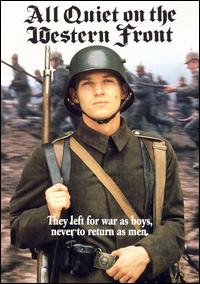
ALL QUIET (1979) (12) vs. SGT. YORK (4)


VS.


REALISM:  “Sergeant York” is as realistic as you can expect for a movie made in the Forties that was aimed at lauding a true American history.  The movie has verisimilitude in its interiors.  The country store and the York home are examples of the attention to detail put in by the set designer.  The hillbilly characters and life style is also real.  The movie is realistic in its portrayal of the ignorance of the backwoods to events in Europe and the pacifism that turned to patriotism upon U.S. entry.  The military scenes are less true to reality.  Boot camp is depicted as similar to a fantasy camp.  The movie is not interested in making the military look like a questionable occupation.  The combat is fine in showing the attack York participated in.  A lot of effort (and explosives) went into recreating no man’s land.  York’s individual exploit is fairly close to what actually happened with some Hollywood touches that war movie lovers will notice right away.  GRADE  -  B

“All Quiet…” is as realistic as Remarque’s book is.  The film takes all its scenes from the novel.  Although it was a made-for-TV movie, effort has gone into making the sets realistic.  The trenches, bunkers, and no man’s land are outstanding.  The arc of Paul and his classmates from naïve patriots looking forward to a great adventure to jaded veterans is appropriate.  The attitude of home front civilians also rings true.  No movie could better present the effect of the war on the German soldiers’ morale.  It is also outstanding in portraying the strong bonds between soldiers, especially those who go to war together.  GRADE  -  A

FIRST QUARTER SCORE:  All Quiet  -  9     York  -  8

DIALOGUE:  “Sergeant York” is full of hillbilly talk.  It is truly quaint, but the actors pull it off and it adds to the feel of the film.  A typical line is “war is agin the book”.  It helps that the actors, led by Gary Cooper, manage to pull off the accent with aplomb.  Being a patriotic movie, the dialogue is not biting.  However, it does not make you shake your head much.  The worst it gets is the exchanges between York and the cliché Brooklynite.  GRADE  -  B

“All Quiet…” mirrors the dialogue of the book which is all you need to know.  Paul gets the lion-share of the lines and also does some narration.  The narration is appropriately somber and cynical.  “My knowledge of life is limited to death”.  The banter is natural.  The bond between the men is apparent from the way they talk to each other.  GRADE  -  A

HALFTIME SCORE:   All Quiet  -  18    York  -  16

SOLDIER BEHAVIOR:  “Sergeant York” does not have much on soldier behavior.  Heck, it does not even get to boot camp until the 1:15 mark of the film.  The movie is a biopic so it concentrates on one soldier.  And he is not a typical soldier.  He has to be convinced to fight.  GRADE  -  C

“All Quiet” tells the tale of a small unit of German soldiers from boot camp through the last days of the war.  Remarque was a soldier in the Great War and we can assume he put his personal experiences into his book.  The training camp scenes show that the German experience was similar to other armies.  Paul and his mates do not robotically shed their civilian attitudes toward authority which shows that German young men were not that different to other nationalities going through cinematic boot camp.  When they reach the front they are taken under the wing of the veteran Kat and learn the real deal.  The movie is best when it is in the dugout with the men.  They deal with the rats, lice, and other problems.  What they endure cement their bonds to where when Paul returns home, he realizes his real home is at the front.  GRADE  -  A

THIRD QUARTER SCORE:  All Quiet  -  27    York  -  22

ENTERTAINMENT:  “Sergeant York” was perfect entertainment for its time and audience.  It is old fashioned, but pushes all the right buttons.  The main character is a hero who overcomes personality flaws by finding the Lord.  It is a classic redemption story.  There is a romance that is predictable, but heart-warming.  The movie is filled with interesting characters and anchored by Cooper’s spot-on portrayal of Hollywood’s version of a backwoods hero.  Along with the character study, we conclude with a thrilling combat scene.  What is not to like?  Especially if you are old.  GRADE  -  A

If you consider the novel to be entertaining, and I suppose some people find it too depressing to be entertaining, you have to like “All Quiet” (1979).  The movie takes many of the scenes from the book and commendably recreates them.  The cast is outstanding and Richard Thomas gives best performance of his career.  Keep in mind that this movie brought the novel to the small screen so it was free entertainment.  The flash back format gives the narrative some pizazz. The theme of lost innocence is clearly explored.  It is an anti-war movie for the Vietnam generation.  GRADE  -  A

FINAL SCORE:  All Quiet  -  36
                           Sgt. York  -  31

MATCH ANALYSIS:    I have made no secret that I feel the remake of the classic original is shamefully underrated.  I do not understand why people disrespect it.  It is possible to like the 1931 version and appreciate the updated version.  There is something to be said for modern war movies if the plot is good and the acting is satisfactory.  The technology gives them an advantage in translating the war experience to the screen.  In “Sergeant York” we have an example of a classic that holds up well over the years, but in this tournament it was hurt by its being predominately a biography more than a war movie.  It barely made the second round due to that fact.  It stood little chance against a competent rendering of the greatest war novel ever written.   


Friday, May 27, 2016

THE BIG PARADE (3) vs. THE LOST BATTALION (11)

Well, we are now through the first round and there were some upsets. We have a #12 seed moving on - All Quiet (1979). Here are the second round match-ups.

#1 - All Quiet (1931)
#9 - Oh! What a Lovely War

#12 - All Quiet (1979)
#4 - Sergeant York

#11 - Lost Battalion
#3 - The Big Parade

#7 - Westfront, 1918
#2 - Paths of Glory


VS.


REALISM:   “The Big Parade” is weak on realism.  The soldiers go through little hardship, other than stale cake from home.  The first part of the combat payoff has the Americans advancing in lines through a forest.  This is actually a true depiction of the naivete of the American army in its early battles.  We had learned little from the experiences of the British and French.  And the filmmakers had learned little of the effects of machine gun fire on lines of men.  The night attack is also shown in lines which would have been appropriate even in crossing no man’s land, but it is staged at night.  This would have been uncommon.  The artillery fire is the most realistic thing about the combat.  GRADE:  Big Parade  -  C

“The Lost Battalion” is above average in realism.  The weak moments can be attributed to its made-for-TV nature.  The trench and no man’s land are authentic, but some of the fighting defies logic.  For instance, in some of the fighting, the Americans leave cover to confront the superior German forces in the open.  During artillery bombardments, they do not hunker down.  There is more hand-to-hand fighting than would have occurred.  On the other hand, the hardships the men went through are accurately depicted.  The film includes the lack of food and ammunition and the suffering of the wounded. GRADE  -  B

FIRST QUARTER SCORE:  Battalion  -  8    Parade  -  6

DIALOGUE:  Being a silent movie, the dialogue that makes the title cards is sparse.  Most of the dialogue spoken by the actors must be inferred.  This is a good thing because I can guess that if we had to listen to all of it, it would not be an improvement.  At least it is not flowery.  It just is not special.  The attempts at jokes are uniformly lame.  GRADE  -  C

“The Lost Battalion” throws in a lot of faux soldier banter.  The screenwriter picked up a copy of “Early 20th Century Brooklyn Slang” and sprinkled his research throughout the film.  The interchanges between Gaedecke and Rosen smack a lot of those between Rivera and Friedman in “A Walk in the Sun”.  The combat may be R-rated, but the dialogue is decidedly PG-13.  Much of it is pious.  The words put in the German officer’s mouth are what Hollywood can imagine a sympathetic German saying about the amazing Americans.  GRADE  -  B-

HALFTIME SCORE:   Battalion  -  14    Parade  -  13

SOLDIER BEHAVIOR:  “The Big Parade” skips over training and plunks the trio on the Western Front.  Their billeting at a French farm is all fun and games.  Like living in a frat house, there are pranks and ribbing in a lame sort of way. Their naivete is not far from the cluelessness of the newcomers from across the Atlantic.  The movie gets the camaraderie right and the way the war brought men of different backgrounds together. However, the film is not really interested in giving the audience an accurate picture of what the soldiers went through.  Go to France, make some friends, fall in love!  GRADE  -  C

“The Lost Battalion” does attempt to show how the soldier’s lived.  The movie splits time between command decisions and soldier interaction before going full combat mode.  The comradeship is apparent.  The movie makes a point of having the veterans instruct the newbies.  Much of this is patronizing to anybody familiar with the AEF, but for the average viewer it is instructive.  The screenwriter gets the brash attitude of the Yanks down.  But some of the characters are not gung-ho.  GRADE  -  B

THIRD QUARTER SCORE:  Battalion  -  22     Parade  -  19

ENTERTAINMENT:  “The Big Parade” is mainly a romance set in war with a buddy picture aspect thrown in.  It is not aimed at the macho combat groupies.  It is pretty good entertainment for a silent movie that wants to please both males and females.  If the men can sit through the character and relationships development, they get a fairly kick-ass combat payoff.  It holds up well over the years, but it is not something you could show students with any success whatsoever.  You must like classic films to like “The Big Parade”.  GRADE  -  B

“The Lost Battalion” is almost the exact opposite movie from “The Big Parade”.  For instance, there is not a single female in the movie. It is definitely a movie aimed at a male audience.  Unless you are a female who is hot for Rick Schroder.  Some of the movie comes close to combat porn.  It is amazingly intense and graphic.  If you enjoyed the opening to “Saving Private Ryan”, you will enjoy much of “The Lost Battalion”.  The fact that it is a true story accurately rendered makes it more entertaining than it otherwise might be.  GRADE  -  A

FINAL SCORE:  Lost Battalion  -  31
                           Big Parade  -  27

MATCH ANALYSIS:  I am a big fan of all war movies, no matter the era.  “The Big Parade” is one of the best silent movies set in WWI.  I was impressed with it the first time I saw it, but it does not improve with repeat viewings.  It is Old School which can be a good thing.  However, since the plot is dusty, it has a hard time going up against a modern war movie with a competent plot.  A movie like “The Lost Battalion” (even one with a made-for-TV budget and the constraints of that medium) has huge advantages in cinematography and effects.  When you look at the quantity and quality of the combat and the surprisingly good acting, it is not surprising that it won comfortably.

Wednesday, May 25, 2016

ALL QUIET ON THE WESTERN FRONT (1930) (1) vs. PRIVATE PEACEFUL (16)


VS.


PLOT:  “All Quiet…” is a faithful rendering of the most famous war novel.  This makes the plot outstanding.  For those of you who are reading this from another planet, the movie is the story of Paul Baumer and his mates as they try to survive on the Western Front.  Paul goes from naïve schoolboy to cynical veteran.  The men go through boot camp and then it’s off to the front to experience what the war is really like.  Under the tutelage of a wizened old vet, Paul and the boys learn the ropes.  Along the way they find out that war sucks and few survive.  It’s heart-felt and heart-breaking.  It has several iconic combat scenes.  GRADE  -  A+

“Private Peaceful” is based on a young adult novel.  It is the tale of two brothers and the girl they both love.  She chooses the older Charlie which breaks Tommo’s heart.  The war separates the couple, but reunites the brothers.  Tommo and Charlie are lower class lads who go off to the Western Front where they are harassed by evil sergeant Hanley. He is a stock villain who does everything but twirl his mustache.  The plot builds to the execution of one of the boys for disobeying orders.  It concludes with a trite twist ending.  GRADE  -  C+

FIRST QUARTER SCORE:  All Quiet  -  10    Peaceful  -  7

ACTING:  The only real flaw in “All Quiet” is in the acting.  The cast is not special.  Lew Ayres was not a big star and did not get top billing.  His performance is much too overwrought.  Top billing went to Louis Wolheim who played Kat.  He and Slim Summerville (Tjaden) are the only main actors who don’t chew scenery.  There are several moments in the film where the acting causes giggles.  Although a talkie, the film is distinctly silent in its acting.  Even Ayres, who became a star from his role as Paul, is cringe-inducing at times.  GRADE  -  C

“Private Peaceful” stars the up and coming Jack O’Connell as Charlie and he brings a lot of charisma to the role.  The rest of the cast is not well known, but they are fine.  John Lynch foams at the mouth as the despicable Hanley, but the role was written for that.  GRADE  -  C

HALFTIME SCORE:  All Quiet  -  16     Peaceful  -  13

COMBAT:  It may surprise many that “All Quiet” has only 11 minutes of combat. The quality is high, however.  The big set piece trench warfare scene is a classic.  It is the best at showing the back and forth of trench assaults.  The French evict them in spite of their machine guns and rifle fire, they retreat to their reserve trench, a barrage forces the French back, the Germans counterattack and take the French trench, but they withdraw and everyone is back where they started from!  The scene features some vicious hand-to-hand fighting and one indelible shot of severed hands on the barbed wire.  Combat is secondary to the hardships and rare moments of humanity that Paul and the others undergo.  GRADE  -  B

“Private Peaceful” has only 5 minutes of combat and what there is is small scale.  It is also unrealistically staged.  The no man’s land is merely a field.  No shell craters.  No reason to scare the kiddies.  Besides, it’s a tale of two brothers and their girl friend.  The only part combat plays is to set up the court-martial.  You would think it was a play.  GRADE  -  D

THIRD QUARTER SCORE:  All Quiet  -  24    Peaceful  -  18

ANTI-WAR:  “All Quiet” is based on the most famous antiwar novel ever written.  And the movie surely brings the vibe to the silver screen.  This theme that the war was a terrible mistake kicks in from the very first scene and is consistently permeating the film throughout even the home front scene.  The movie includes Paul’s stay in the hospital which is another form of horror.  The body count is reflective of an anti-war movie.  The anti-command sub-theme is exemplified by the Himmelstoss character.  By the way, Lew Ayres became a conscientious objector in WWII due to his involvement in the movie.  GRADE  -  A+

“Private Peaceful” is meant to be anti-war in a lecturing sort of way.  Being aimed at a young audience, the theme is simplified and unsubtle.  The movie does not really show the horrors of trench warfare.  The big tear-jerking moment is the result of villainy that could have been found in civilian life.  If anything, the movie is more anti-upper class.  The Peaceful family is trod upon by their local landlord.  GRADE  -  C

FINAL SCORE:  All Quiet  -  34
Private Peaceful  -  24


MATCH ANALYSIS:  Hey, I had to go through the motions, okay?  This was truly a mismatch.  It was a lightweight up against a heavyweight and it got pummeled.  “All Quiet” is a classic that is arguably still the best WWI movie ever made.  “Private Peaceful” will be forgotten soon.  Not that it was the 16th best movie in the tournament.  There were definitely worse contenders.