Thursday, July 13, 2017

SUB MOVIE: Crash Dive (1943)


                “Crash Dive” is a mid-WWII sub movie directed by Archie Mayo (his only war movie).  It starred Tyrone Power who had enlisted in the Marine Corps.  His trip to boot camp was delayed so he could finish the film.  He did not make another movie until 1946.  The sacrifices women had to make for the war effort!   Power would eventually retire as a Major in the Marine Corps Reserve.  The movie had the full cooperation of the Pentagon which hoped for a recruiting boost from it.  Mayo was allowed to film at New London Submarine Base, but no newer subs were allowed to appear on film.  The film was made in technicolor, which indicates its importance as far as the studio was concerned.

                The movie raises a red flag immediately when it plops a PT boat in the middle of the Atlantic.  Lt. Stuart (Power) picks up survivors of a u-boat sinking, spots the u-boat, and sinks it with depth charges.  None of those things happened in the Atlantic during the entire war.  Stuart is a huge fan of PT boats.  If he could, he would marry one.  However, his admiral uncle persuades him (for the good of recruitment) to join the silent service.  He is sent to New London, Connecticut and assigned exec to Lt. Commander Dewey Connors (Dana Andrews).  While on leave he puts the moves on a teacher named Jean (Anne Baxter) who is taking some girls on a field trip to Washington.  At first, Jean is turned off by the wolfish Stuart, but he persists in a predatory way.  He is so successful that the school marm goes out on the town with him, leaving the girls alone in a hotel room.  Then she guiltily rushes home, thus ending the girls’ trip early.  Did I mention she is engaged to Connors?  That’s right, she’s a slutty school teacher.  Stuart may be a sexual predator, but at least he does not know that Jean is engaged to his CO.

                The USS Corsair (with black mess mate on board) goes on patrol in the Atlantic.  Apparently it is the entire Atlantic sub fleet as every other boat should be in the Pacific.  They encounter a Swedish freighter, but it opens fire.  It’s a Q-ship!  Those dastardly Nazis.  Luckily, the Q-ship is a terrible shot and cannot hit a stationary sub before it crash dives.  Instead of putting a torpedo in the helpless ship, Connors hides on the bottom.  He uses the classic expelling debris trickery to escape.  He and Stuart bond through the depth charge experience.  They are best friends when they return to base for a binge of fruits, vegetables, and milk!  This all becomes awkward when they found out that they have something in common – Jean.  She’s in love with Stuart by now, for plot purposes.  The command dysfunction cliché kicks in just in time for their special mission to destroy the Q-ship base.  If you think the love triangle is ridiculous, wait for one of the most ludicrous commando raids in sub movie history.  Try to stick around for Stuart’s paean to every type of ship in the US Navy.  Young men, I may love PT-boats and submarines, but there are other options.  Buy war bonds!

                “Crash Dive” is a propaganda and patriotic soufflé.  It is very fluffy and looks good in its glorious technicolor, but it is not very filling.  In fact, the technicolor is the only thing that stands out.  Everything else is second-rate.  The script could hardly have been worse.  It attaches the dusty love triangle to unbelievable sub action.  It does reinvent the love triangle a bit by having the female be the weak leg and having all three legs intact at the end.  I do not think the screenwriters (and most of the audience) bothered to consider that Jean betrays Connors for a man that manipulated her and she falls in love with that guy.  But he’s Tyrone Power, so it’s okay.  Even Connors accepts that fact.  With the love triangle sucking the air out of the movie, there is no room for depiction of sailor life.  The film does develop an interesting relationship between the black steward and the crusty Chief.  And it gives the steward some action.  This for a 1943 movie.  Kudos!  The acting is not a detriment.  Power, Baxter, and Andrews are solid, although Power is forced to give that gag-inducing speech at the end. 

                “Crash Dive” is in the “one Oscar club” of sub movies along with “The Enemy Below”, “Torpedo Run”, “U-571”, and “Hunt for Red October”.  In this case the award was for Best Visual Effects and maybe they were awesome in 1943, but they are underawesome today.  The Q-ship base set is particularly fake-looking.  And the raid on that base is so full of pyrotechnics and expenditure of ammo that you would swear you were watching a John Woo film.  A bad John Woo film.  The fire and explosions build to one of the most laughable scenes in sub movie history as Connors pilots the semi-submerged sub past a shore battery.  Try not to chortle.  And try not to believe that anything in the movie is historically accurate.  The movie insults my intelligence.  Why place PT-boats and subs in the Atlantic?  I can understand putting the smoochy stuff in New London, but all oceans look alike so why isn’t the Corsair in the Pacific with its brethren?  The Germans had Q-ships, but so did the Japanese and the idea of an island base in the Atlantic is crazy.  I can only assume the studio felt the public wanted roasted Nazis more than dead Japs in 1943.

GRADE  =  D

Wednesday, July 12, 2017

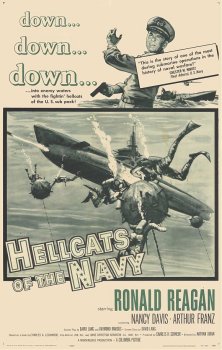
SUB MOVIE: Hellcats of the Navy


                “Hellcats of the Navy” claims to be based on the nonfiction book by ComSubPac Charles Lockwood and Hans Christian Adamson.  The book is about Operation Barney which was the attempted infiltration of Japanese waters with the American equivalent of a wolfpack.  The movie is loosely based on the mission. It was directed by Nathan Juran and starred Ronald Reagan in his second to last movie role.  The movie is famous for the pairing of Reagan and his second wife Nancy (billed as Nancy Davis).  It was their only movie together.  The screenplay was by blacklisted Bernard Gordon, which is ironic considering Reagan’s pro-blacklist stance.  The production had the full cooperation of the Navy.  It was allowed to film at the San Diego naval base and on board a submarine.  To emphasize the cooperation, Chester Nimitz introduces the film with some vague reference to America taking the war to Japanese home waters. 

                The USS Starfish is off the coast of Japan on a mission to disarm a mine and bring it back.  A frogman named Barton (Harry Lauter) is abandoned when Commander Abbott (Reagan) has to crash dive because of a Japanese destroyer.  It’s the right decision, but it is complicated by the fact that Lauter was putting the moves on Abbott’s ex-girlfriend.  The exec, Lt. Commander Landon (Arthur Franz), feels Abbott was personally motivated by his decision to leave Lauter.   When they return to Guam, Abbott is reunited with nurse Helen (Nancy) who is not upset that her new beau is gone.  She prefers the mule to the wolf.  The Starfish’s next mission is to take out an island via commando raid.  Ridiculous explosions ensue.  Explosions for explosions sake. They have an ill-fated encounter with a Japanese sub, but Abbott manages to bring back charts of a mine field so it’s all good.  Back at base, Abbott turns in a scathing fitness report that wrecks Landon’s career due to the belief that he is a wimp who cannot make tough decisions.  This from the man who just lost his boat and sixteen men because he disobeyed orders.  In spite of the bad blood, Landon will continue as his exec so he can redeem himself. 
                The brass sends a trio of three-sub wolfpacks to Japan’s inner waters.  Abbott’s sub traverses a mine field with the obligatory cable scraping.  He sinks seven ships in five minutes in a harbor.  Elect this guy President!  But wait, there’s more.  On the way out, the boat gets a net wrapped around the propeller.  Guess who strips down to untangle the net?  And yet Nancy has to keep her starched white nurse’s uniform buttoned to the chin throughout the movie (and probably through the production).   While Ronnie may have thought of himself as being the equivalent of Burt Lancaster, he would be damned if Nancy was going to be Deborah Kerr.  In one of the silliest scenes in war movie history, Abbott gets caught in the net.  An approaching destroyer gives Landon the chance to redeem himself by diving with Abbott still entangled.  Just doing what you dared me to do, skipper.  Plus payback, sweet!  In a “screw you, cliché” development, Abbott survives to continue his zombielike romance with Helen.  Hurray?

                In my recent binging of sub movies, I have come to the conclusion that the percentage of sub movies that are below average war movies is very high.  This is surprising because you would think the cramped confines of a sub would lend themselves to dramatic tension, character development, and ensemble acting.  Interiors should be relatively easy to recreate, although filming in cramped quarters can be hell.  The special effects are a problem and it is difficult to avoid the look of fakery, but the audience is usually understanding of that.  The subgenre lends itself well to the action followed by exposition format of many war movies.  It has the advantage of combining the visceral thrill of sneaking up on an enemy and stabbing them by way of a torpedo and land combat in the form of commando raids. In other words, you can see ships blow up and stuff blow up.  And depth chargings work much better for drama than artillery bombardments.  And yet, so many sub movies blow it.  Since there are so many well-established clichés, it is difficult for a sub movie to be original and high quality.  Most sub movies do not achieve either of these. “Hellcats of the Pacific” is especially bad because it does not even try to be creative or top-notch.

                There is nothing quality about the film.  If not for the pairing of the Reagans, it would be totally forgettable.  The acting is terrible.  Reagan is stiff and Nancy matches him.  You can see why Helen was attracted to Barton, but not what he saw in her.  This love triangle is reminiscent of the equally lame one in “Operation Pacific”. The Reagans’ scenes together are hard to bear.  The dialogue is atrocious.  The plot makes little sense.  In this case, the movie cribs from “Torpedo Run”.  Don’t ask why you would want to steal from two bad sub movies.  The effects fit the film well.  They are terrible, too.  The models are particularly fake looking.   As usual, the depth charges are incredibly accurate.  They result in “Star Trek” type jostling of the crew.

                There would be some compensation if the movie was historically accurate.  You would think the involvement of Lockwood as technical adviser would have insured an acceptable degree of accuracy.  Not to  mention the rare appearance of Chester Nimitz himself.  So how accurate is it?  There was an Operation Barney.  In July, 1943, Lockwood sent three subs in to the La Perouse Strait and then into the Sea of Japan.  They charted the mine fields, but did not find much to hunt.  Later the acclaimed Wahoo under the command of the famous “Mush” Morton was sunk in the area.  It was assumed the loss was due to a mine.  Lockwood vowed revenge and put Operation Barney into motion.  Hydeman’s Hellcats (a trio of three-sub wolfpacks) would take advantage of the new FM sonar tech that allowed them to detect mines.  The operation took place in June, 1945 and resulted in a disappointingly low total of 28 Japanese ships sunk.  One sub, the Bonefish, was lost.   As you can deduce, the movie is not exactly a documentary. 
  
                If you have not seen “Hellcats of the Navy”, only watch it if you are insane enough to try to watch every sub movie.  Who would do something like that?  You might also watch it if you want to get drunk.  Take a drink every time you groan.


GRADE  =  F

Tuesday, July 11, 2017

SUB MOVIE: Up Periscope (1959)


                “Up Periscope” came at the end of the boom in sub films in the 1950s.  It was directed by the prolific Gordon Douglas (“Bombers B-52”).  It was based on the novel by Robb White.  The technical adviser was Adm. Charles Lockwood who commanded our sub force in the Pacific in WWII.  All of the underwater scenes were from “Destination Tokyo”.  The movie was James Garner’s second big dip into movies after “Darby’s Rangers”.  He was still appearing in the TV series “Maverick”.

                The movie is set in the South Pacific in 1942.  Lt. Braden (Garner), a frogman, is wooing a gal named Sally.  Before he is rousted for a secret mission, he finds out Sally is actually an intelligence agent who was checking him out for security purposes.  Ouch!  That marriage proposal sure seems awkward now.  Meanwhile, the sub Barracuda is returning from a failed patrol with an unhappy crew.  it seems Commander Stevenson (Edmund O’Brien) followed orders and stayed on the bottom as a juicy Jap fleet passed by.  Adding to the crew’s frustration is the belief that an injured mate died because the sub stayed on the bottom.  Stevenson gets a chance at redemption when Braden’s secret mission comes along.  He is ordered to deliver Braden to a Japanese held island so he can steal a code book and thus win the war.  When they arrive, the by-the-book Stevenson is averse to going in close so Braden is not on a suicide mission.  He and Braden butt heads over Stevenson’s cautious approach.  On the way to the island the sub has encounters with a plane and a destroyer.  Braden gets to swim ashore and steal the code book and blow stuff up.  Spoiler alert: We win the war!

                I have seen a lot of sub movies in the last month.  It never ceases to amaze me how often common sense sub tactics are tossed out the window either for entertainment purposes or just out of plain apathy.  “Up Periscope” is a good example of this.  There was no reason for the Barracuda to stay on the bottom as the Japanese fleet passed by (other than to get the injured sailor killed for dramatic purposes).  There was no indication the Japanese were aware of the sub’s presence, so why could it not simply leave the area?  Later, when a destroyer attacks, the Captain releases oil to fool it, but he does this while still viewing through the periscope!  He also releases a “false target shell” which is described as “an explosion of bubbles” to fool sonar.  This was a new one on me.  Stevenson decides to enter the lagoon because there is a ship outside.  Shouldn’t that have had the opposite effect?
                Aside from the bull crap, the movie is weak in most aspects.  The special effects are disappointing.  Are you telling me that sixteen years after “Destination Tokyo”, director Douglas had to rely on footage from that film?  Talk about lazy.  The interiors are too modern looking and far from claustrophobic.  There is little sailor behavior or banter.  Only two characters are developed.  Luckily, these characters are in capable hands.  Garner shows the wit and charisma of the leading man that he would evolve into.  O’Brien is good as the unlikeable captain.  His blockheaded insistence on following orders does not fit the most celebrated sub captains, but maybe he is going to be one of the numerous ones who were canned early in the war.  His redemption arc is typical Hollywood, but having him report himself for violating orders is a silly post script.

                “Up Periscope” is a fairly entertaining movie if you are not familiar with the submarine subgenre.  If you have seen a lot of sub movies, it comes off as almost a parody of the subgenre due to its overload of clichés.  It ties “U-571” for most clichés in a sub movie.  At least it does not take them to ridiculous extremes like “U-571”.  It does not pile them into a bonfire of ludicrousness.  Although I give it credit for restraint in its unoriginality, it is still an average film that should have been much better.  The 1950s were a fertile period for sub movies and yet the last of the run did not advance the subgenre at all.  Hell, it had to borrow from a 1943 movie.


GRADE  =  C


Sunday, July 9, 2017

SUB MOVIE: Torpedo Run (1958)


                “Torpedo Run” was directed by Joseph Pevney who had been in the Signal Corps in WWII.  His other war movie was “Away All Boats”.  The Navy cooperated with the movie and the technical adviser was Adm. Charles Lockwood (commander of Submarine Force Pacific).  He should have been ashamed of the product he advised on.  The movie was unbelievably nominated for an Oscar for Best Visual Effects.

                The movie opens in the South Pacific in 1942. Lt. Commander Doyle (Glenn Ford) of the Grayfish is morose over the fact that his family was in the Philippines when it fell.  He later finds out they are alive.  That’s the good news.  The bad news is they are on a transport that is screening an aircraft carrier named the Shinaru.  The Shinaru led the attack on Pearl Harbor and is the number one target for any submarine.  Even though he knows his family is on the transport (don’t ask), Doyle decides to take the shot despite the reasonable admonitions of his exec and best friend Sloan (Ernest Borgnine).  It will take an amazing shot to hit the aircraft carrier instead of the innocent civilian-laden transport.  He does not pull it off.  Sloan consoles Doyle by telling him “Jane would have wanted you to try”.  Yeah, right.  Of course, this fits the cinematic Navy where skippers always put their job ahead of family.  He can’t bring his family back, but Doyle can get revenge against the carrier.  The rest of the movie covers his quest against his great white whale.  Sloan is along for the ride even though he questions Doyle’s obsession.  In fact, he turns down his own boat to stay with Doyle.  This is the same Doyle who considers him to be a back-stabber.  Awkward!

                 Dear Admiral Lockwood, what the hell were you doing during the production of this movie?  Did you feel it was a good idea to approve a script where an obviously mentally unstable skipper is allowed to take a sub out again?  Hey Admiral, would a captain risk killing a transport full of civilians?  Sure.  Would a sub sink a net tender, thus alerting every destroyer in a harbor?  Sure.  Could a sub fire a torpedo into an anti-sub net and then negotiate the hole?  Sure.  Would a sub negotiate a mine field by sheer luck?  Sure.  Could a Japanese destroyer block all six torpedoes heading for a carrier?  Sure.

                “Torpedo Run’ is a two man show.  Glenn Ford plays an a**hole.  I’m not sure if that was the intention, but let’s face it.  And this guy has a loyal best friend, an unquestioning crew, clueless superiors, and a dead family.  I’m a big Ford fan, but he is terrible in this film.  He pouts and smirks his way through the film.  Ernest Borgnine is better, but he has to play the saintly Sloan.  No one else in the cast makes an impression.  Nor do they get a chance.  The movie could not care less about the crew.  It could also not care less about reality.  This is one aggravating and anti-intellectual war movie.  The plot is chock full of implausibilities.  The tactics are laughable, as I tried to point out to Adm. Lockwood.  As far as the special effects, it must have been a pretty uncompetitive year at the Academy Awards.  Fake miniatures in a swimming pool are not very impressive.  Even in glorious technicolor.

                How does this movie get made in 1958?  In my recent Submarine Movies Tournament, it was the ninth sub movie to be released.  Not only does it not improve on the previous movies, it is possibly the worst.  It does manage to avoid most of the established clichés, but it substitutes incidents that are inane and poorly executed. 

GRADE  =  D