“Screaming Eagles” is an homage to
the American paratroopers who dropped the night before D-Day. It was a black and white drive-in movie.Director Charles Haas made a living making
B-rated movies.This was his only war
movie.He was allowed to film at Fort
Benning, Ga.Richard Case, a veteran of D-Day
with the 101st Airborne, acted as a technical adviser.Also on set was Werner Klingler, a German
director who had a role in the film.
“This is the story of 15
paratroopers of Company D, 502nd Paratrooper Regiment, 101st
Airborne”.(For you Band of Brothers
fans, their unit was the 505th.)Right before D-Day, a platoon receives replacements that includes Pvt.
Mason (Tom Tryon).He’s a jerk with a
chip on his shoulder.Everyone in the
barracks, except Corliss (Martin Milner), takes an instant dislike to him.He does not ingratiate himself when he
trashes the barracks after getting a Dear John letter.Lt. Pauling (Jan Merlin) convinces the men to
give him another chance.Before he can
earn redemption, they get the word to go.Their mission is capture and hold a bridge.Footage of paratroopers boarding a plane.
Typical banter on board.Practicing with
those clicker thingies.No one yells
“Geronimo!”They land 20 miles from the
bridge.SNAFU.Mason is blamed for starting a firefight that
gets the popular Cpl. Dreef killed.This
guy just keeps digging his hole deeper.As penance, he is put in charge of the blinded Lt. Pauling.They attack a house where they find a comely
French lass named Marianne (Jacqueline Beer – 1954’s Miss Universe
runner-up).They decide to Trojan Horse
a German truck to get to the bridge.
“Screaming Eagles” seems awfully
quaint compared to Band of Brothers.It
is closer to an episode of Combat!, but worse.It does have a decent cast going for it.Tryon has ben largely forgotten, but he was a second tier star in the
1960s.This was his second movie.He went on to co-star in “The Longest Day”
and “In Harm’s Way”.He was a good
actor, but he has little to work for here.Mason is your classic a**hole who no one wants in his fox hole.Weirdly, he is set up for redemption that
doesn’t come because he is not allowed to do anything heroic.The cast is decent for a low budget
film.I mentioned a young Martin Milner,
but Robert Blake is also in it.Jacqueline Beer’s role smacks of stunt casting, but she is not an
anchor.(She reminds of Denise Darcel in
“Battleground”.)Ms. Beer only made
three movies and is probably most famous for being Thor Heyerdahl’s (of Kon
Tiki fame) second wife. Her Marianne
earns her place on the poster with a feisty attitude and genuine support for
the boys.Surprisingly, there is no time
for romance, or even a kiss.
The biggest problem with the movie
is it is just not that entertaining.The
mission is unrealistic and the way they carry it out defies credulity.I know it’s not a documentary, but we can
expect some effort if you are honoring real heroes.The combat is poorly staged.It looks like some boys playing soldier on a
sound stage.All the vehicles are
obviously American with German markings.There is too much reliance on footage.The film even uses footage of Germans moving, as though they couldn’t
get enough uniforms and extras to shoot that. The best I can say for it is it lasts only 79
minutes.Band of Brothers “Day of Days”
only lasts 49.That is a much better
investment of your time.
BACK-STORY:“Battleground” was the first significant WWII movie to come
out after the war and it proved there was still an audience for war films
provided they were excellent and realistic.The film wisely avoided the flag-waving of pictures made during the
war.Because of the timing and the
grittiness, the studio was skeptical about its potential and it almost was not
made.The suits proved wrong as the
movie was a huge hit and is now considered a classic.It was released in 1949 and directed by
William Wellman (“Wings”, “The Story of G.I. Joe”).Robert Pirosh based the script on his own
experiences in the Battle of the Bulge.Twenty
members of the 101st Airborne were used as extras. They were put through acting boot camp. The film won Oscars for Cinematography and Original Screenplay (Pirosh). It was nominated for Picture, Director, Editing, and Supporting Actor (James Whitmore).
OPENING:A crawl quotes a German general in stating that Bastogne has
to be taken for the German offensive to proceed.This is the story of the “Battered Bastards
of Bastogne”.That story begins in an
Army camp somewhere in France in December, 1944.A replacement named Layton (Marshall
Thompson) is thrust into a tent full of veterans.This will be a small unit movie.The unit is the typical mix of heterogeneous
Hollywood soldiers:the intellectual
(Jarvess), the ladies’ man (Holley), the hick (Abner), the old dude (Pop), the
Hispanic (Rodrigues), the malingerer (Kippton), the newbie (Layton), and the
gruff sergeant (Kinnie).Surprisingly,
no one is from Brooklyn.
SUMMARY:The members of I Company are looking forward to leave in
Paris.They are just as surprised as
Eisenhower when the party-pooping Germans launch their offensive in the
Ardennes Forest.They pile into a trucks
grumbling.“We get all the dirty
details”.It really sucks for Pop
(George Murphy) who is scheduled to go home.He is joined in dead meat land by the guy who showed the picture of his
wife and kids (Hanson).On the way to
Bastogne, they spent the night in the home of a buxom Belgium named Denise
(Denise Darcel).“Hubba, hubba” resounds
through the theater.Holley hits on her,
naturally. Will the movie overcome this forced attempt at sex appeal?
Before leaving the town, the
paratroopers have their obligatory encounter with demoralized retreating
Americans.The movie now adds “who will
survive?” as a theme.When they reach
the outskirts of Bastogne, they are ordered to dig in.Before finishing their fox holes, they are
ordered to move and dig in again.This
is the Army, after all.Soon the snow
comes.Rodrigues (Ricardo Montalban) is from
California and is thrilled to see his first snowfall.There is a brief, but realistic
bombardment.You can compare this to the
effects in the “Band of Brothers” Battle of the Bulge episodes to see how far
effects have come.People sitting in a
1949 theater would have crapped in their pants.One of the group, Bettis (Richard Jaekel), runs away and gets a cushy job
in Bastogne slinging hash.By now Layton
has taken up smoking – Hollywood’s symbol of coming of age.
A patrol is sent out and
Rodrigues is wounded.They are forced to
leave him hidden in a snow fort under a wrecked jeep.Wouldn’t it be ironic if he freezes to death
in the wonderful snow?The surviving
members of the unit are now guarding a railroad line when they come under
attack.Holley, who is now in command,
panics and runs but comes to his senses and sets up a flanking attack that gets
pay back for the whittling down of the unit.The fire fight is intense, but brief and the Germans give up too easily.
The next scene is in the
appropriately rubbleized Bastogne.There
is a ridiculous (but mercifully short) reunion with Chesty McBelgian that is used
to show that Layton is not only a smoking veteran, but a “playa” as well.If you’ve seen the “Bastogne” episode of
“Band of Brothers”, you can guess what happens to the only female character.
This being a movie about the
Battle of the Bulge, the “Nuts” Reenactment Requirement Act of 1945 comes into
play as the required reenactment of McAuliffe’s famous quote is thrown in.The producers also complied with the
amendment to the act which requires appearance of the Germans disguised as
Americans causing trouble behind the lines.The Germans drop propaganda leaflets similar to those dropped in “Pork
Chop Hill”.Give up and get hot chow! Alas, no appearance by "Axis Sally".
A chaplain conducts a mass for a group of soldiers (including
a black!).You may have heard there are
no atheists in fox holes.The theme of
the sermon is “was this trip necessary?”Answer:yes.Reason:the Nazis started this war and thus we had to fight it to stop
fascism.By the way, it would be better
to stand up to them earlier next time.Do you
hear me, Cold War America? Amen.
Things are getting desperate.Bastogne is bombed to rearrange the rubble and bring the ironic death of
Bettis.The men are down to their last
bullets.It’s beginning to have a Custer
feel when suddenly the sun comes out, immediately followed by the air
force.C-47s air drop supplies.Spam – are you f****** kidding me!Oh, here’s some ammo, too.Now we can counterattack through a montage
using actual footage of Americans kicking ass.
CLOSING:Spoiler alert:we win
the Battle of the Bulge.Our surviving
heroes (including the two dead meat candidates) wearily watch the
reinforcements marching eastward.They
march westward singing about Jody (WWII soldier slang for home front Don Juans)
stealing their girlfriends.This brings
the movie full circle from an earlier scene that seems to have inspired
“Stripes”.
RATINGS:
Acting -8
Action -5
Accuracy -6
Plot -8
Realism -7
Overall -7
WOULD CHICKS DIG
IT?It is a good, old-fashioned war
movie.That might appeal to some
females, but probably they need to be over 50 years old.There is nothing offensive in it, unless you
consider the inclusion of a big-breasted blonde for obvious reasons to be
offensive.The cast is appealing.Thompson and Johnson were the Brad Pitt and
Johnny Depp of that time.Okay, perhaps
that is an exaggeration, but they were leading men and cute.
HISTORICAL
ACCURACY:The movie is not meant to
be about the Battle of the Bulge.It is
instead the story of the soldiers who fought in that battle.In that respect it is accurate.The soldier talk and grumbling is PG-13
authentic.The little touches like
digging a fox hole and then having to move and dig another one are realistic (but certainly not unique to the Battle of the Bulge).
The movie is accurate in the general aspects of the unit's experience in the battle. The 327 Gliderborne Infantry was rushed by truck to Bastogne. It was stationed along the southern perimeter. The German surrender ultimatum did come through its lines and it was a 327th officer who interpreted "Nuts!" to mean "Go to hell!" for the Germans.
The
movie fails as a history lesson when it comes to the battle.The Germans are too passive which results in
a dearth of action.The rare action
scenes are too brief and too pat. In reality the 327th had numerous intense fire fights and serious fighting defending the village of Marvie. They sometimes confronted German tanks, a fact that the movie chooses to overlook.The
movie gives the impression that what the soldiers went through was not nearly
as bad as it actually was.The movie
does accurately reflect the snow and the fear, but not the combat.The movie implies that it was the sun and the
spam drop that caused the Germans to give up.There is no reference to Patton’s army cutting its way through to the
town. Lastly, contrary to the much deserved relief the survivors get at the end, the 327th was sent eastward as part of the American counterattack.
The
appearance of the German commandoes was obligatory because they were a fixture
of the battle,but inaccurate because
they were nowhere near Bastogne.The
“Nuts!” incident is faithfully rendered, however.
A minor
quibble would be with the scene where the men throw away their gas masks as
they enter the battle.That would have
occurred long before.
CRITIQUE:The movie is very entertaining.It achieves its objective of humanizing the
soldiers.The soldier interaction and
talk are the best thing about the movie.What they say and how they react are realistic given the restraints of
1940s movies.None of the main
characters are gung-ho.They complain a
lot.They have a stock phrase – “I’ve
found a home in the Army”.They all have
their moments of human weakness.Several
run away or think about running away at various moments.As Jarvess (John Hodiak) says, “things just
happen and then afterwards you try to figure out why you acted the way you
did.”The unit is slightly dysfunctional,
but they are comrades. This is not "Platoon". It is much closer to "A Walk in the Sun".
The
movie has some themes.One is the fog of
war.Jarvess sums up their involvement
in the biggest battle in American History thusly:“I guarantee my wife knows what’s going on in
the battle.All I know is what’s going on
in the 2nd Squad of the 3rd Platoon of I Company." Veterans watching this movie in the theater must have nodded their heads in agreement. Another theme is the veteranization of Layton, but his taking up smoking and womanizing is too quick (compare this to the more realistic arc of Paul Baumer in "All Quiet on the Western Front").
The
greatest strength of the movie is the actors.The ensemble is very likeable.Several of the main characters have a trait that is endearing.Abner sleeps with his boots off. Kippton clicks his false teeth.(Douglas Fawley lost his teeth to an
explosion on an aircraft carrier in the Pacific.)
The
dialogue stands out as well.Pirosh,
being a veteran, knew how soldiers talked.He obviously had to clean up the language, but he gets the complaining
and humor down pat. There is a cute running gag involving Holley and some eggs that taps into the futility of trying to live a normal life in war.These guys say some
funny things which is appropriate because American soldiers have a reputation
of maintaining their sense of humor in the most trying circumstances.Here is an example:
Holley:Yeah, they really shoulda sent out a bigger
patrol.
Rodrigues: Do you want to goof off? Holley: Who said anything about
goofing off? Rodrigues: Nobody. I'm just
saying, the best way is to tell them you heard voices talking in German. Jarvis: Let's say we heard voices
talking in Japanese and let G-2 figure that out.
By the way, I just watched “MASH”.It also won the Oscar for Best
Screenplay.However, much of the
dialogue in that comedy was improvised by the actors.Although the movie is funny, the funniest
lines are coming from actors trying to be funny.Army doctors in Korea were not that
funny.The “Battleground” actors are
reciting dialogue from a veteran and it sounds more authentic. It's not forced.
The
cinematography also won an Oscar, but the blending in of archival footage is
not seamless.Some of the real footage
is mundane.The producers made the
decision to shoot the movie on a soundstage which is remarkably lifelike, but
still obvious.There is little sound
track which is unusual, but refreshing.
CONCLUSION:“Battleground” is fondly remembered by many war movie
lovers.Some have it in their top
10.Some go so far as to call it
superior to “Saving Private Ryan”.When
it came out in 1949, it certainly deserved the acclaim it received.It’s now sixty years later and I have to say
it is overrated.The action is lacking
and is unrealistic.It has its charms
and is a must see, but does not belong at #36.
POSTER: I am trying out this new feature. I have noticed that with many war movies you can't judge a film by its poster. As a service to my public I will tell you how close the poster is to the actual movie. This one is a howler. First, Denise gets prominent placement in spite of her limited screen time. Also, why is she wearing a ballroom dress? Second, there are no helmet waving charges in the movie. Third, are those two upper guys dancing a jig? Lastly, the tag line of "the guts, gags, and glory of a lot of wonderful guys" is completely off message and must have caused Wellman to vomit. Grade: D
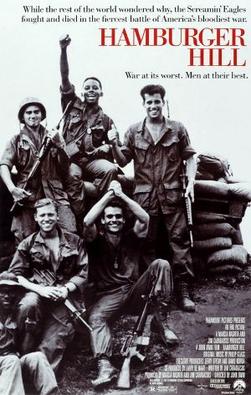
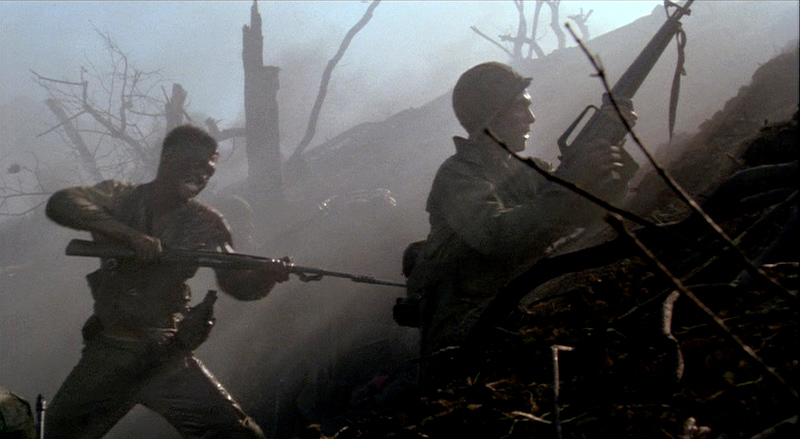
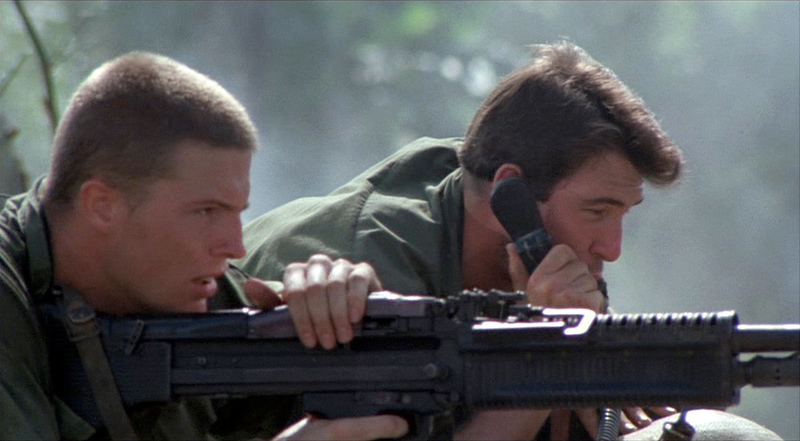
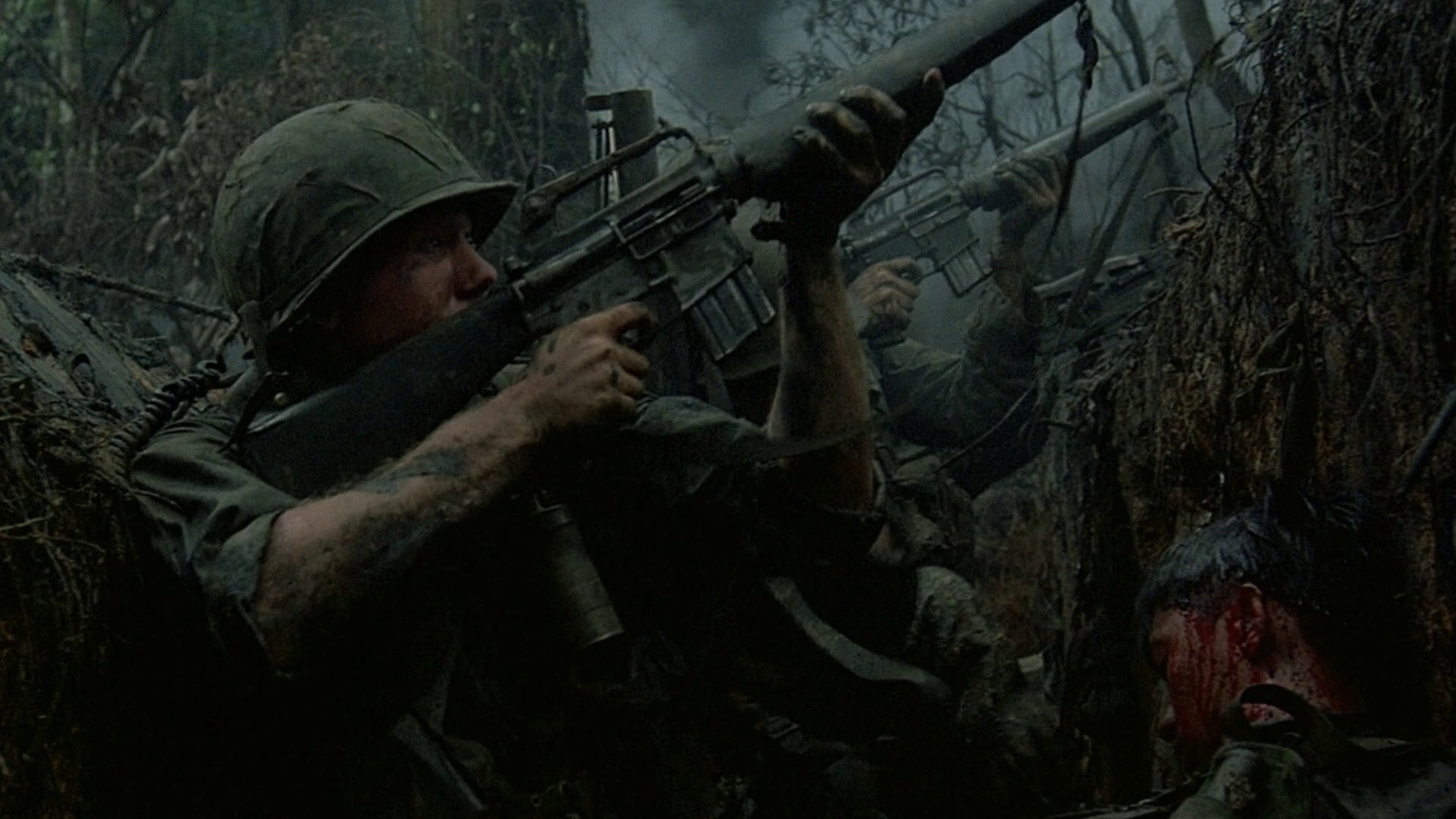
“Hamburger Hill” is a war movie about the famous Vietnam War battle. It was released in 1987 and chronicles the 101st Airborne’s assault on Hill 937 in the Ashau Valley in May, 1969. The script was written by a “Screaming Eagles” veteran who served in Vietnam in 1968-69. The director, John Irvin (who did the stylistically similar “When Trumpets Fade”) had done documentaries in Vietnam. He cast a group of unknown actors, some of whom have gone on to big careers.
Dylan McDermott playing army man
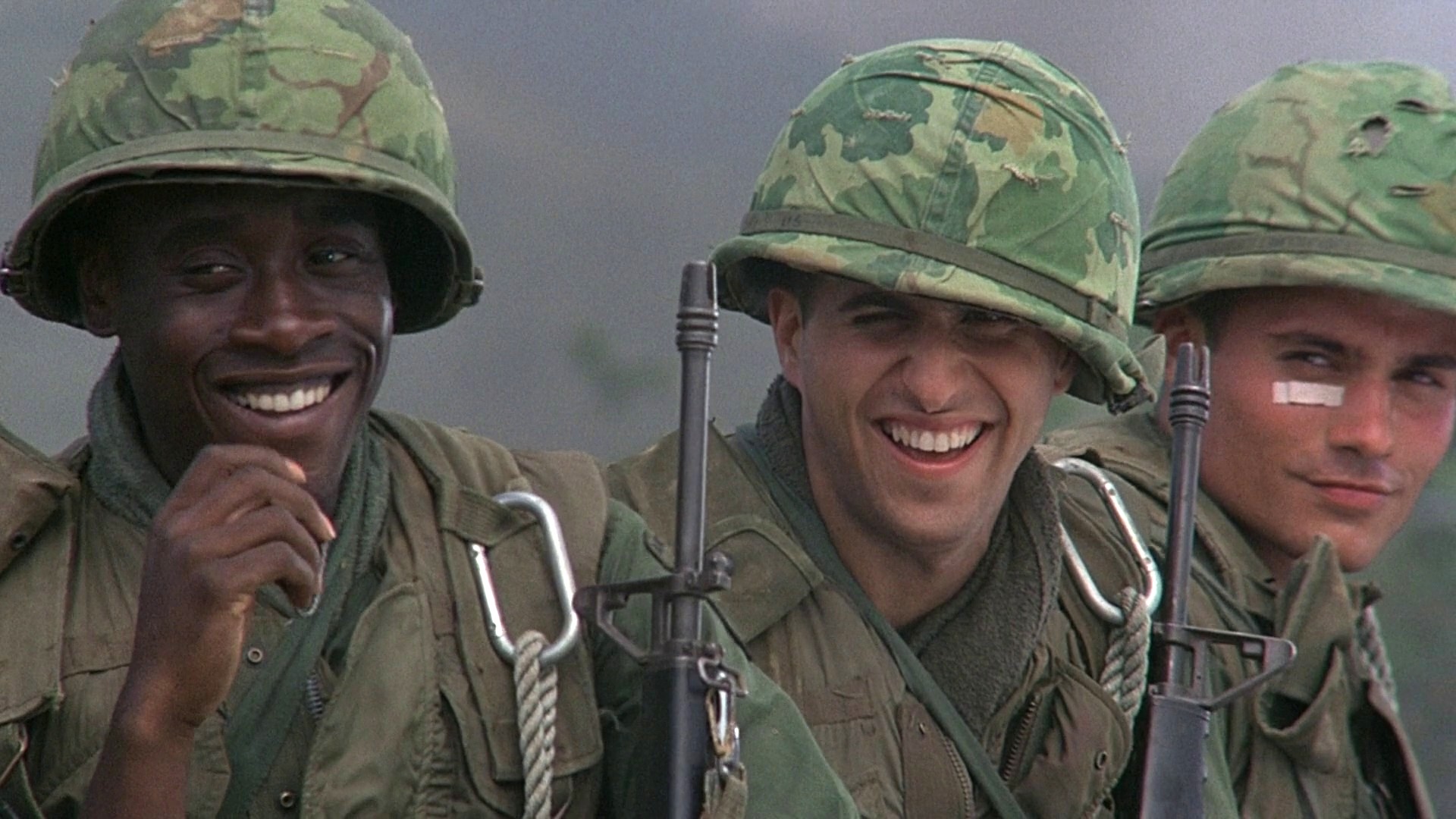
The movie opens with Company B evacuating the Ashau Valley with their tail between their legs. Five replacements (FNGs) arrive to the typical cold shoulders, but they quickly blend in. The movie fits squarely in the who-will-survive sub-genre. It is also a typical small unit dynamics film. It displays some similarities to "Platoon" in this respect except that the unit is not divided. The squad has some black/white issues, but realistic to a front line unit they are tamped down by the more pressing need for group respect for survival purposes. There are two sergeants like in "Platoon", but they are not adversarial. One is gung-ho (Worcester – Steven Weber) and the other is cynical (Frantz – Dylan McDermott), but they are best friends. There is also a green LT, but he is not a worm and does not figure in the film.
the face of "Nathaniel Victor"
The first half of the film is basically a tutorial on the indoctrination of a “cherry”. The five FNGs are taught hygiene and to respect “Nathaniel Victor” (the North Vietnamese). They are taken to the local brothel. They quickly learn a second language – the grunt slang combined with Vietnamese phrases. The unit even has its own pet phrase – “It don’t mean nothin’”. (To be followed by “Not a thing”.) This phrase is said seventeen times in the movie. This dialogue includes most of the greatest hits of grunt slang. The movie should have captions for those who are not familiar with Vietnam War lingo, however.
one of these actors was ill-used, but had the last laugh
The second half deals with the assaults up Hill 937. This is combat at its rawest followed by periods of down time for more camaraderie. Each post-assault scene has a defining moment. One of these is the tuning in to “Hanoi Hannah”. Another has Biletsky (Tim Quill) listening to a tape from his patriotic girlfriend (apparently the only pro-war civilian left in America). More typical of the film’s theme is a “Dear John” letter to Bienstock (Tommy Swerdlow) from an ex who has been brainwashed by hippies. The film hammers away at the implication that the soldiers have been abandoned by the home front.
Frantz is bayoneted
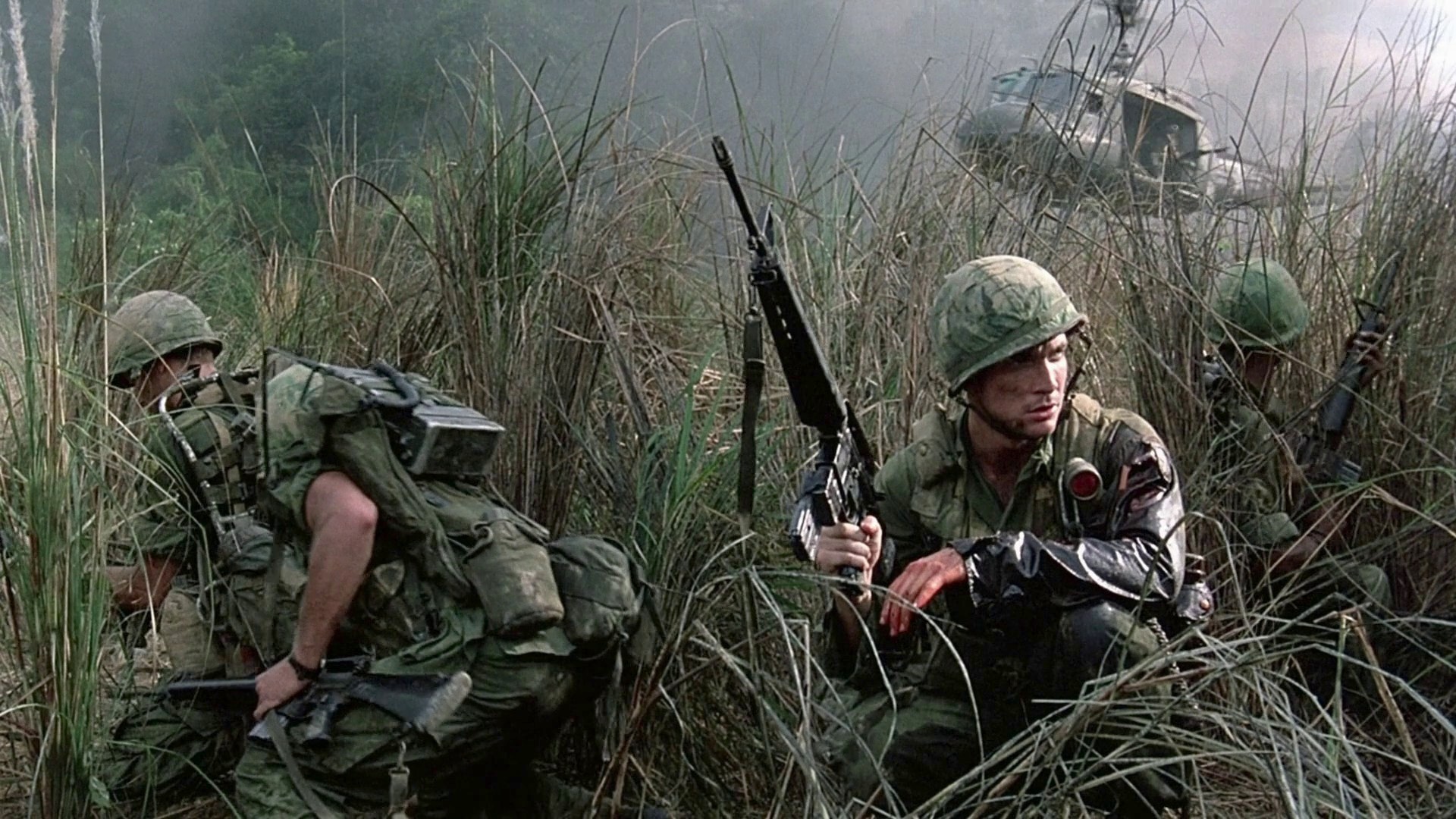
The battle begins on May 11 and it is obvious from the start that few in the squad will survive. The movie covers the battle by days. The fighting each day is tragically similar. Frontal attacks uphill against a fanatical enemy who has the advantage of the high ground and bunkers. Although the full force of American firepower is brought to bear in the form of aerial and artillery bombardment (this is a loud movie), every assault except the last is thrown back. The deaths are brutal and graphic. Heads blown off, etc. Most of them are random and quick, but the medic “Doc” (Courtney Vance) gets an old school send-off that is well played. One of the assaults is memorable for its slog up the muddy hillside and the subsequent sliding back downhill by the men. Finally, the hill is taken in an “I’ve had enough of this shit!” charge. Our surviving three main characters sit exhaustedly under what’s left of a tree. One of the survivors is Biletsky who two days earlier had been evaced for a serious wound.
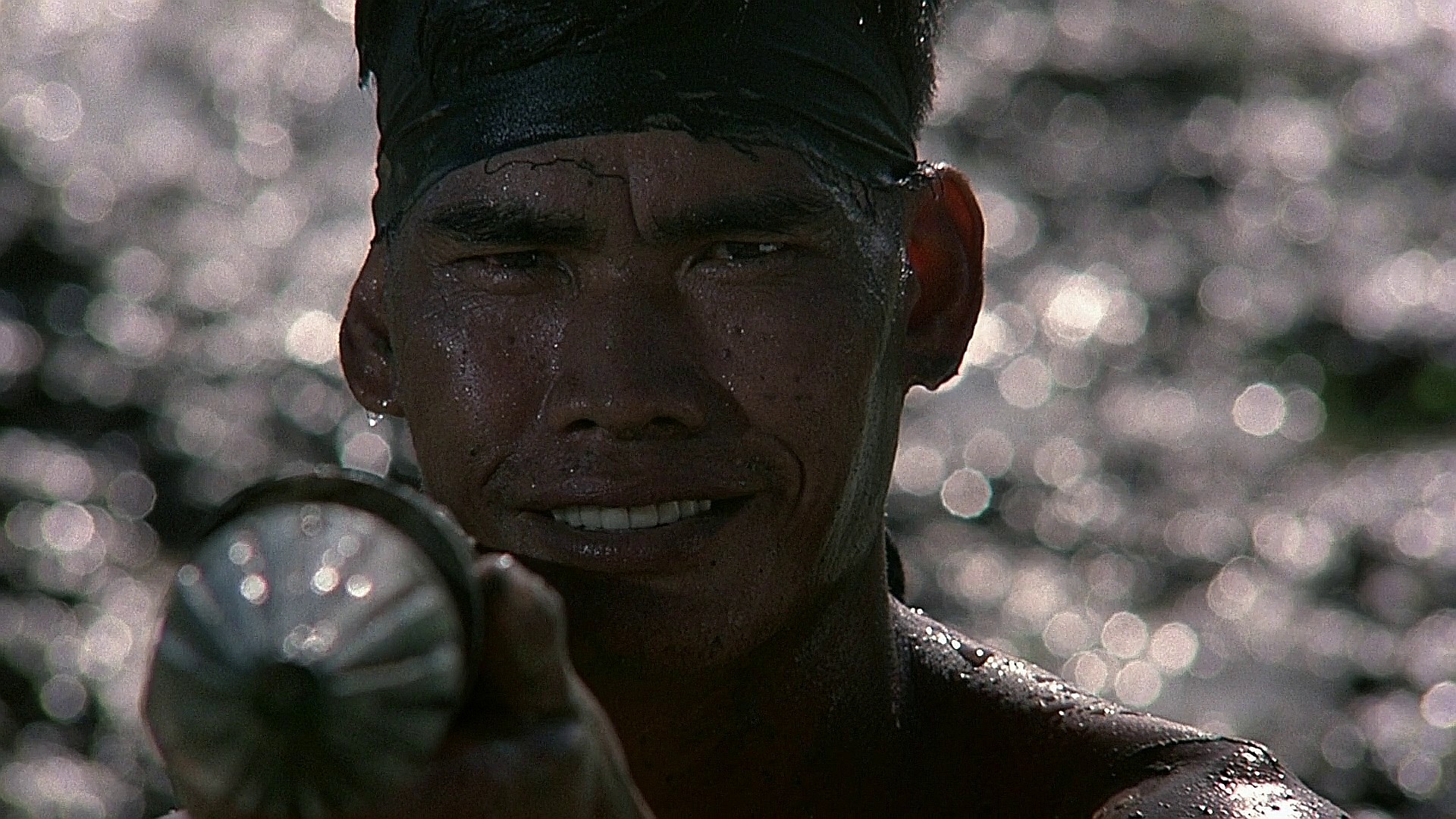
NVA in a bunker
HH is considered by some to be the best Vietnam War movie. It isn’t, but it is certainly in the top five. It is also lauded by many as the most accurate Vietnam War movie. It has a stronger claim to that title. The recreation of the battle is as close as you could ask for. It even has one (there were at least three) of the friendly fire by choppers incidents (although in reality the fire was rockets, not machine guns). Although you might assume the high casualty rate was Hollywoodized, the battle was actually very brutal and costly. Read about it and wonder if we would accept a repeat in Afghanistan. Irvin gets the sights and sounds right. One flaw is you get none of the big picture. What is the plan? Why this hill? What are the other companies doing? The movie also does not put a face on the enemy. They are obviously tough and worthy opponents, but that is all we know. Another similarity to "Platoon".
"Hello, I'm calling to confirm my 10 o'clock hair appointment"
The acting is satisfactory. One head-scratcher is the waste of the best actor in the group (Don Cheadle) in a small part. One thing you will notice is the compromise made on battlefield griminess. The men do sweat and have dirt on their faces, but nice hair. (Memo to the make-up artists: don’t touch the hair.) The actors relay what a screenwriter thinks a grunt would say, but you get the impression they do not understand all the phrases. They're just mouthing phrases. The movie works best in this respect if you have not seen a lot of Vietnam War movies. I found some of the dialogue to be forced and cringe-inducing.
There are some clichés as is to be expected from a movie of this type. We get the “a fight breaks out because a guy make’s a sexual remark about a girlfriend picture”. However, the guy who showed the picture does not end up dying so that cancels it out. Unfortunately, someone violates the rule about bragging about their future plans with predictably dire results.
war is a dirty business
One thing that sets this movie apart from most other Vietnam War movies is it is anti-anti-war. There are several sledgehammer moments where the home front is crucified for not supporting the troops. In one piling on monologue, Worcester recounts a trip back home. 1. He had dog feces thrown on him by hippies. 2. His wife was screwing a pacifist. 3. His friendly bartender was being harassed as the father of a deceased “baby killer” and became a heroin addict. We get it! The proof of this thematic goal is the unbelievable lack of a post script explanation that after all the effort to take the hill, it was abandoned to the enemy. Since most of the audience would not have known this, the omission is a clear admission by Irvin of his political agenda. In this respect, it strays furthest from its cousin “Pork Chop Hill”.
“Hamburger Hill” is a good movie. Unlike most of its competitors (Platoon, Apocalypse Now, Full Metal Jacket), it deals with an actual battle. This makes its main rival “We We Were Soldiers”. In that respect, it does a better job on grunt life. The combat is not as good, however.
Cracker? Probably. It is much better than some of the crap I have had to watch.