After having viewed and reviewed the first 60 movies on Military History Magazine's "100 Greatest War Movies" list, here is my opinion on where the movies should be ranked. The numbers in parentheses are the Military History rankings.
BACK-STORY:“Battleground” was the first significant WWII movie to come
out after the war and it proved there was still an audience for war films
provided they were excellent and realistic.The film wisely avoided the flag-waving of pictures made during the
war.Because of the timing and the
grittiness, the studio was skeptical about its potential and it almost was not
made.The suits proved wrong as the
movie was a huge hit and is now considered a classic.It was released in 1949 and directed by
William Wellman (“Wings”, “The Story of G.I. Joe”).Robert Pirosh based the script on his own
experiences in the Battle of the Bulge.Twenty
members of the 101st Airborne were used as extras. They were put through acting boot camp. The film won Oscars for Cinematography and Original Screenplay (Pirosh). It was nominated for Picture, Director, Editing, and Supporting Actor (James Whitmore).
OPENING:A crawl quotes a German general in stating that Bastogne has
to be taken for the German offensive to proceed.This is the story of the “Battered Bastards
of Bastogne”.That story begins in an
Army camp somewhere in France in December, 1944.A replacement named Layton (Marshall
Thompson) is thrust into a tent full of veterans.This will be a small unit movie.The unit is the typical mix of heterogeneous
Hollywood soldiers:the intellectual
(Jarvess), the ladies’ man (Holley), the hick (Abner), the old dude (Pop), the
Hispanic (Rodrigues), the malingerer (Kippton), the newbie (Layton), and the
gruff sergeant (Kinnie).Surprisingly,
no one is from Brooklyn.
SUMMARY:The members of I Company are looking forward to leave in
Paris.They are just as surprised as
Eisenhower when the party-pooping Germans launch their offensive in the
Ardennes Forest.They pile into a trucks
grumbling.“We get all the dirty
details”.It really sucks for Pop
(George Murphy) who is scheduled to go home.He is joined in dead meat land by the guy who showed the picture of his
wife and kids (Hanson).On the way to
Bastogne, they spent the night in the home of a buxom Belgium named Denise
(Denise Darcel).“Hubba, hubba” resounds
through the theater.Holley hits on her,
naturally. Will the movie overcome this forced attempt at sex appeal?
Before leaving the town, the
paratroopers have their obligatory encounter with demoralized retreating
Americans.The movie now adds “who will
survive?” as a theme.When they reach
the outskirts of Bastogne, they are ordered to dig in.Before finishing their fox holes, they are
ordered to move and dig in again.This
is the Army, after all.Soon the snow
comes.Rodrigues (Ricardo Montalban) is from
California and is thrilled to see his first snowfall.There is a brief, but realistic
bombardment.You can compare this to the
effects in the “Band of Brothers” Battle of the Bulge episodes to see how far
effects have come.People sitting in a
1949 theater would have crapped in their pants.One of the group, Bettis (Richard Jaekel), runs away and gets a cushy job
in Bastogne slinging hash.By now Layton
has taken up smoking – Hollywood’s symbol of coming of age.
A patrol is sent out and
Rodrigues is wounded.They are forced to
leave him hidden in a snow fort under a wrecked jeep.Wouldn’t it be ironic if he freezes to death
in the wonderful snow?The surviving
members of the unit are now guarding a railroad line when they come under
attack.Holley, who is now in command,
panics and runs but comes to his senses and sets up a flanking attack that gets
pay back for the whittling down of the unit.The fire fight is intense, but brief and the Germans give up too easily.
The next scene is in the
appropriately rubbleized Bastogne.There
is a ridiculous (but mercifully short) reunion with Chesty McBelgian that is used
to show that Layton is not only a smoking veteran, but a “playa” as well.If you’ve seen the “Bastogne” episode of
“Band of Brothers”, you can guess what happens to the only female character.
This being a movie about the
Battle of the Bulge, the “Nuts” Reenactment Requirement Act of 1945 comes into
play as the required reenactment of McAuliffe’s famous quote is thrown in.The producers also complied with the
amendment to the act which requires appearance of the Germans disguised as
Americans causing trouble behind the lines.The Germans drop propaganda leaflets similar to those dropped in “Pork
Chop Hill”.Give up and get hot chow! Alas, no appearance by "Axis Sally".
A chaplain conducts a mass for a group of soldiers (including
a black!).You may have heard there are
no atheists in fox holes.The theme of
the sermon is “was this trip necessary?”Answer:yes.Reason:the Nazis started this war and thus we had to fight it to stop
fascism.By the way, it would be better
to stand up to them earlier next time.Do you
hear me, Cold War America? Amen.
Things are getting desperate.Bastogne is bombed to rearrange the rubble and bring the ironic death of
Bettis.The men are down to their last
bullets.It’s beginning to have a Custer
feel when suddenly the sun comes out, immediately followed by the air
force.C-47s air drop supplies.Spam – are you f****** kidding me!Oh, here’s some ammo, too.Now we can counterattack through a montage
using actual footage of Americans kicking ass.
CLOSING:Spoiler alert:we win
the Battle of the Bulge.Our surviving
heroes (including the two dead meat candidates) wearily watch the
reinforcements marching eastward.They
march westward singing about Jody (WWII soldier slang for home front Don Juans)
stealing their girlfriends.This brings
the movie full circle from an earlier scene that seems to have inspired
“Stripes”.
RATINGS:
Acting -8
Action -5
Accuracy -6
Plot -8
Realism -7
Overall -7
WOULD CHICKS DIG
IT?It is a good, old-fashioned war
movie.That might appeal to some
females, but probably they need to be over 50 years old.There is nothing offensive in it, unless you
consider the inclusion of a big-breasted blonde for obvious reasons to be
offensive.The cast is appealing.Thompson and Johnson were the Brad Pitt and
Johnny Depp of that time.Okay, perhaps
that is an exaggeration, but they were leading men and cute.
HISTORICAL
ACCURACY:The movie is not meant to
be about the Battle of the Bulge.It is
instead the story of the soldiers who fought in that battle.In that respect it is accurate.The soldier talk and grumbling is PG-13
authentic.The little touches like
digging a fox hole and then having to move and dig another one are realistic (but certainly not unique to the Battle of the Bulge).
The movie is accurate in the general aspects of the unit's experience in the battle. The 327 Gliderborne Infantry was rushed by truck to Bastogne. It was stationed along the southern perimeter. The German surrender ultimatum did come through its lines and it was a 327th officer who interpreted "Nuts!" to mean "Go to hell!" for the Germans.
The
movie fails as a history lesson when it comes to the battle.The Germans are too passive which results in
a dearth of action.The rare action
scenes are too brief and too pat. In reality the 327th had numerous intense fire fights and serious fighting defending the village of Marvie. They sometimes confronted German tanks, a fact that the movie chooses to overlook.The
movie gives the impression that what the soldiers went through was not nearly
as bad as it actually was.The movie
does accurately reflect the snow and the fear, but not the combat.The movie implies that it was the sun and the
spam drop that caused the Germans to give up.There is no reference to Patton’s army cutting its way through to the
town. Lastly, contrary to the much deserved relief the survivors get at the end, the 327th was sent eastward as part of the American counterattack.
The
appearance of the German commandoes was obligatory because they were a fixture
of the battle,but inaccurate because
they were nowhere near Bastogne.The
“Nuts!” incident is faithfully rendered, however.
A minor
quibble would be with the scene where the men throw away their gas masks as
they enter the battle.That would have
occurred long before.
CRITIQUE:The movie is very entertaining.It achieves its objective of humanizing the
soldiers.The soldier interaction and
talk are the best thing about the movie.What they say and how they react are realistic given the restraints of
1940s movies.None of the main
characters are gung-ho.They complain a
lot.They have a stock phrase – “I’ve
found a home in the Army”.They all have
their moments of human weakness.Several
run away or think about running away at various moments.As Jarvess (John Hodiak) says, “things just
happen and then afterwards you try to figure out why you acted the way you
did.”The unit is slightly dysfunctional,
but they are comrades. This is not "Platoon". It is much closer to "A Walk in the Sun".
The
movie has some themes.One is the fog of
war.Jarvess sums up their involvement
in the biggest battle in American History thusly:“I guarantee my wife knows what’s going on in
the battle.All I know is what’s going on
in the 2nd Squad of the 3rd Platoon of I Company." Veterans watching this movie in the theater must have nodded their heads in agreement. Another theme is the veteranization of Layton, but his taking up smoking and womanizing is too quick (compare this to the more realistic arc of Paul Baumer in "All Quiet on the Western Front").
The
greatest strength of the movie is the actors.The ensemble is very likeable.Several of the main characters have a trait that is endearing.Abner sleeps with his boots off. Kippton clicks his false teeth.(Douglas Fawley lost his teeth to an
explosion on an aircraft carrier in the Pacific.)
The
dialogue stands out as well.Pirosh,
being a veteran, knew how soldiers talked.He obviously had to clean up the language, but he gets the complaining
and humor down pat. There is a cute running gag involving Holley and some eggs that taps into the futility of trying to live a normal life in war.These guys say some
funny things which is appropriate because American soldiers have a reputation
of maintaining their sense of humor in the most trying circumstances.Here is an example:
Holley:Yeah, they really shoulda sent out a bigger
patrol.
Rodrigues: Do you want to goof off? Holley: Who said anything about
goofing off? Rodrigues: Nobody. I'm just
saying, the best way is to tell them you heard voices talking in German. Jarvis: Let's say we heard voices
talking in Japanese and let G-2 figure that out.
By the way, I just watched “MASH”.It also won the Oscar for Best
Screenplay.However, much of the
dialogue in that comedy was improvised by the actors.Although the movie is funny, the funniest
lines are coming from actors trying to be funny.Army doctors in Korea were not that
funny.The “Battleground” actors are
reciting dialogue from a veteran and it sounds more authentic. It's not forced.
The
cinematography also won an Oscar, but the blending in of archival footage is
not seamless.Some of the real footage
is mundane.The producers made the
decision to shoot the movie on a soundstage which is remarkably lifelike, but
still obvious.There is little sound
track which is unusual, but refreshing.
CONCLUSION:“Battleground” is fondly remembered by many war movie
lovers.Some have it in their top
10.Some go so far as to call it
superior to “Saving Private Ryan”.When
it came out in 1949, it certainly deserved the acclaim it received.It’s now sixty years later and I have to say
it is overrated.The action is lacking
and is unrealistic.It has its charms
and is a must see, but does not belong at #36.
POSTER: I am trying out this new feature. I have noticed that with many war movies you can't judge a film by its poster. As a service to my public I will tell you how close the poster is to the actual movie. This one is a howler. First, Denise gets prominent placement in spite of her limited screen time. Also, why is she wearing a ballroom dress? Second, there are no helmet waving charges in the movie. Third, are those two upper guys dancing a jig? Lastly, the tag line of "the guts, gags, and glory of a lot of wonderful guys" is completely off message and must have caused Wellman to vomit. Grade: D
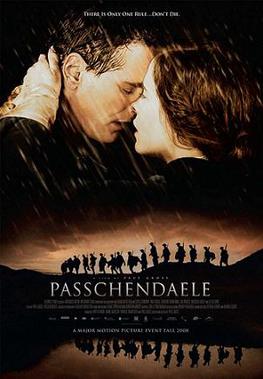
“Passchendaele” is a Canadian movie written, directed, and starred in by Paul Gross. It was the most expensive Canadian movie when released in 2008. The movie begins with an impressive set piece that has Sgt. Michael Dunn’s (Gross) unit in house to house fighting. With “Saving Private Ryan” type cinematography, the action is intense. It culminates with Dunn stabbing a German in the face and then being wounded by an artillery shell. He ends up in the hospital as the sole survivor. This incident was based on a story told to him by Gross’ grandfather. The story inspired the movie.
Mike is sent back to Canada to recuperate from shell shock and to recruit. He meets a nurse named Sarah (Caroline Dhavernas). She is a morphine addict who has been ostracized from the local community because her father joined the German army and died at Vilmy Ridge. Her brother David (Joe Dinicol) wants to enlist to clear the family honor, but is prevented by his asthma. The head of recruiting is a loathsome super-patriot named Dobson. He hates Mike (a coward) and David (a Hun). He enlists David, but Sarah mistakenly blames Mike. He returns to combat to protect him. Three months later, the foursome is on the Western Front. It’s a small world!
The Battle of Passchendaele arrives with Mike and David in the front lines. Specifically, a shell crater full of muddy water. Their unit is ordered forward, but in a misunderstanding the unit they are reinforcing assumes they are being relieved and withdraws leaving the much smaller unit in the front. It’s back to SPResque action. A soldier loses an arm, there is a stretch without sound. The blood and guts and mud and rain are realistic, but the artillery fire is much too accurate. Those Germans could hit a fly! The violence is very graphic, especially the hand-to-hand with whatever weapon is handy.
The scene takes a bizarre turn when David goes running to the German trench and leaps in. Is he a traitor or does he want to negotiate an end to the war? Before we can find out, an explosion lifts him out of the trench and onto a crucifix-shaped wooden form. Mike goes after him with every German on the Western Front shooting at him. One of them hits, but the German commander orders the army to cease-fire. The entire battle stops as Mike carries the cross back to his lines. He is doing his best Jesus imitation. Cue the rain ceasing, sun coming out, hawk soaring overhead.
“Passchendaele” is an entertaining, but implausible movie. You really have to suspend disbelief to enjoy it. The acting is pretty good and you have to admire their ability to keep a straight face. The combat is some of the best filmed and is a worthy Canadian attempt to replicate the feel of “Saving Private Ryan”. What sets the movie apart is the overt religiousity of the crucifix scene. Did I say overt? I meant heavy-handed and ridiculous.
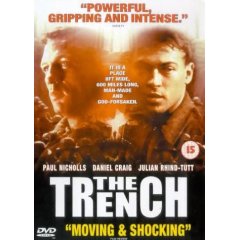
“The Trench” is a British movie released in 1999 and written and directed by Paul Boyd. It stars a pre-superstardom Daniel Craig. The movie is set in the Somme valley in 1916 in the days leading up to the battle. The action is confined to a trench and the movie has the feel of a play to it. It is fairly realistic in its look, but too sanitary and lacking in mud. It also has a lot of talking like a play. The soldiers sit around and chat in their thick British accents.
A British soldier looks through a loophole and describes the bucolic no man’s land. The trench faces a green hill. You wouldn’t think there would be snipers in all that green. Oops! The Colonel arrives to boost morale and get filmed doing it. He assures them “you’ll be able to go over the top with a walking stick”. Sure! Then we get more conversating. Unfortunately, most of it is boring. The soldiers are mostly stereotypes. Sgt. Winter (Craig) is gruff, of course. The captain is alcoholic and disillusioned, of course. Cliches are on display. For instance, Winter shows off a picture of his wife and kids. Several women in the audience faint from foreboding.
As the battle approaches, tensions rise. They will be in the first wave. The captain gives each company a soccer ball – first to kick it into the German line wins beer. One soldier shoots himself in the calf. I guess he doesn’t like beer. The bombardment begins which is bad enough, but the rum ration gets destroyed. The lieutenant provides his private stash of whiskey to give the men “Dutch courage”. Now it’s all about the waiting. The audience also waits to see if there will ever be any action in this movie.
“The Trench” would be better as a play. That way you would not expect any action. However, you would expect better dialogue and acting. The soldier talk is trite and boring and gives little insight into soldier life. The acting is average and even Daniel Craig is not at his best. He does dominate over the rest of the cast, however. The scenario is not realistic. The trench is too wide and pristine. They are supposedly in a very dangerous position, but other than a sniper shot, nothing really happens.
“Passchendaele” is a better movie than “The Trench”. They approach the war from different perspectives. “The Trench” wants to be about the soldiers. “Passchendaele” is aiming more at the stress of combat. It also is more melodramatic and romantic. Subtle, it isn’t. “The Trench” is too subtle. More importantly, “Passchendaele” does a better job giving the viewer an idea of what that battle was like than “The Trench” teaches about the Battle of the Somme.
"The General"(1926) is the classic Buster Keaton comedy set in the Civil War. Keaton plays a Southern railroad engineer named Johnnie Gray (get it?) who is turned down when he tries to enlist (and is not told it’s because he has an important job). He loses his girl because she thinks he is a coward. His locomotive, the General, is stolen by Yankee spies as part of a plan to take Chattannoga. Johnnie gives chase and comedy ensues. He rescues his engine and his girl (who had been kidnapped) and is in turn chased back to Rebel lines. He then takes part in the battle and emerges a hero.
“Tropic Thunder” (2008) is a spoof of actors, movie-making, and war movies. It was written, produced, and directed by Ben Stiller. It is set in Southeast Asia, where a movie about a Vietnam War prisoner of war escape is being made. The film is over-budget, behind schedule, and the director cannot control his actors. The studio head threatens to shut the film down. The director decides to shoot the movie “guerrilla-style” by placing the actors in the jungle and filming their actions. Has-been action star Tugg Speedman (Stiller) is captured by a drug gang and the other actors come to his rescue.
FIRST HALF: ACTING
“The General” is a tour-de-farce by Keaton. His stone-faced Johnnie is funny without speaking (which is crucial because the movie is silent). His body language and physical humor are amazing. Unfortunately, the rest of the cast is below par. His girlfriend Annabelle Lee (Marion Mack) is game (Keaton physically abuses her in some scenes), but not impressive. The rest of the cast are your typical silent movie actors with their white faces and their arms flailing.
“Tropic Thunder” is an interesting blend of top-notch comedians (Stiller, Jack Black, Danny McBride) and serious actors who prove their comedy chops (Robert Downey, Jr. and Tom Cruise). All of the main cast are excellent. Downey is hilarious as the method actor (ala Russell Crowe) that has his skin blackened to play an African-American soldier. Stiller is great as the obsolete action star (Stallone, etc.) who went “full retard” in his last role. Jack Black is his usual manic self as the drug-addled, flatulence-talented Eddie Murphy clone. The revelation is Cruise as the studio chief. His exuberant performance rocks the screen.
First Half Score: Tropic Thunder - 46 The General – 35
SECOND HALF: HUMOR
“The General” is old-school silent movie humor. Little of the dialogue is subtitled so the movie obviously relies on sight gags and slapstick. I counted 27 falls in the film (mostly by Keaton). Note: good drinking game – take a hit every time someone falls in this movie. It is not the most sophisticated humor you can find, but I guess people rolled in the aisles back then. Some of it is funny (there’s a bit with a sword that is amusing ), but some of it is just silly (e.g., a bit with a bear trap). Keaton’s physical performance (he did his own stunts) and facial expressions are commendable. He is one of the greats.
“Tropic Thunder” is a polarizing movie. I can see why some people were offended by it. There is a white man playing a black man and humor at the expense of retardation. Plus the language is very potty. However, if you admire a film with balls and a taste for lunacy, you should enjoy it. It has some gut-busting lines and situations. The actors are uniformly funny. As a satire of war movies, it is the gold standard. Anyone who has seen “Platoon” and “Apocalypse Now” has to admire the inspired skewering.
Second half score: Tropic Thunder - 48 The General - 32
ANALYSIS:
“The General” is rated #18 on AFIs list of 100 Greatest Comedies and “Tropic Thunder” is unlikely to make the top 100 the next time they come up with the list. However, just because a movie is a classic does not mean it holds up well. Unless you are very prudish, you cannot seriously argue that “The General” is funnier than “Tropic Thunder”. “The General” deserves credit for using an historical event (the Andrew’s Raid) for humor, but “Tropic Thunder” trumps that by making fun of the war movie genre. That makes it a greater war comedy than comedy.
As a post script, I would like to mention that this match-up was pure coincidence and yet we have the oldest great war comedy versus the most recent. This clearly shows how humor has changed over the decades. What we found funny in the 1920s is different than what we find funny today. I won't argue that humor today is better than back then, but I think Hollywood does reflect what society feels is funny. A movie similar to "The General" would be a flop today. We can enjoy classic comedies, but I find that they bring smiles, not laughs. Movies like "Tropic Thunder" bring laughs, but I feel guilty about some of the things I am laughing about (or at). Still a laugh is better than a smile.