Showing posts with label Ardennes Forest. Show all posts

Wednesday, December 27, 2017

POST #700 – Battle of the Bulge (1965)


                I’ve reached my 700th post and have decided to make it special by reviewing the first war movie I ever saw.  My family was living in Japan as my father flew a F-105 fighter/bomber in the Vietnam War.  My father took me and my brothers to see it in a theater off base.  It was a big deal for us even though, at age seven I did not get the big deal about Ultra Panavision.  At least I can now claim that I saw the movie in the format and environment (ultra wide screen) that it was meant to be seen in.  I don’t remember much about that first view, but naturally at that age I found it very entertaining.  And throughout childhood, its periodic appearances on TV always had the boys glued to the TV screen.  It wasn’t until later, after I became obsessed with history, that I began to reassess my opinion of it.  As with some of my childhood favorites, it does not hold up to scrutiny.

                “Battle of the Bulge” was directed by Ken Annakin (“The Longest Day”) and is a similar all-star battle epic.  It was filmed in Spain with the advantages of support from Franco’s military (he provided 500 soldiers and 75 vehicles), but the disadvantages of inaccurate terrain.  Robert Shaw had his first major role and was paid $250,000 (more than his total paychecks up to then).  That dollar figure is the same amount that was paid to recreate the town of Ambleve so the movie could rubbleize it.  The movie premiered on the 21st anniversary of the battle. 

                The movie opens with an overture.  For you non-baby boomers, that means that while you are settling into your seat you are treated to orchestral music.  This is followed by a narrator and the accuracy problems are off and running.  The narrator explains that it is December, 1944 and the Anglo-Americans are on the brink of victory.  The Ardennes Forest is a quiet sector.  Gen. Montgomery’s 8th Army is to the north of the forest.  (In the first example of sloppy history, the 8th was actually in Italy.)  Lt. Col. Kiley (Henry Fonda – continuing a tradition of casting actors too old for their roles) is scouting in a spotter plane and takes an incredibly accurate photo of a German officer in a moving car.  He later identifies the mystery man as a German tank savant named Col. Hessler (Shaw).  Hessler is on his way to a meeting with a general who surprises him with der Fuhrer’s plan to launch a go for broke offensive in the Ardennes.  The target is the port of Antwerp and the plan will depend on poor weather to keep Allied air grounded.  He will have 50 hours of fuel, queue the countdown clock.  Hessler is no Nazi fanatic, but he does love a challenge so he is on board.  He is, however, skeptical of his young, green tank commanders until they break into a rousing rendition of “Panzerlied” (“Panzer Song”).  As a child, I was ready to enlist in the panzers at this point.  Meanwhile, Kiley is trying to convince his overconfident superiors that a major attack is imminent.  He is derided by the mustache twirling Col. Pritchard (Dana Andrews).  In an “I’ll show you by getting myself killed” move, he visits a bunker on the Siegfried Line where Maj. Wolenski (Charles Bronson) shrugs empathetically.  What do you want me to do?  Here come the Germans!! 

                Now that the shooting has commenced the movie jumps between several characters.  Hessler and his aide Conrad (Hans Christian Blech) attack the city of Ambleve and head for the Meuse River while ever aware of their dwindling fuel supplies.  Kiley goes from intelligence officer to combat soldier.  Lt. Schumacher (Ty Hardin) leads German commandoes disguised as Americans in causing chaos behind American lines.  Sgt. Guffy (Telly Savalas) finds the battle an inconvenience impacting his black market operation.  He commands a Sherman tank and the screen when he is on it. He does have to share the screen with a bunch of tanks in the climactic battle.

                “Battle of the Bulge” may be a all-star battle wannabe, but the cast is nowhere near “The Longest Day”.  The acting is less than stellar also.  Fonda is comfortable as the ex-cop who butts heads with the brass, but his character is put in some ridiculous situations including getting shot down by tanks firing their main guns.  He has to be everywhere to glue together the American arcs.  “The Longest Day” did not stretch any of its characters like that.  Col. Vandervoort did not plan the invasion, paratroop behind the lines, and land on Omaha Beach.  Shaw is good as the war-loving Hessler.  Blech makes a fair foil for Hessler, but their relationship is not realistic.  Savalas steals the show with his Guffy.  The character brings some forced comic relief and the required redemption arc.  He does a lot of scenery chewing, but at least he didn’t have to eat any snow.

                The problem with the movie is not just that it is an historical atrocity, but it is also laughably ridiculous.  Not one character is named after a real person, which must have been a dictate from the studio’s legal department.  (This was partly due to the fact that Columbia had green-lighted a movie called “16th of December:  The Battle of the Bulge” featuring Eisenhower, Montgomery, and Hitler.  John Wayne was set to play Patton.  Those who cry for a redo on the battle, should ponder what a make would have been like.)  Fortunately for the producers, events cannot sue.  The script shows a contempt for the historically knowledgeable, but an understanding of what passes as entertainment for the masses.  (The movie has an incredible 67% on Rotten Tomatoes.)  This explains why the snowless Spanish plains (perfect for Panavision) stand in for the snowy hills and dense forest of the Ardennes.  It also explains how most of the main characters end up at the gas depot.  The first big battle scene is adrenalin pumping, but if you have seen many war movies, you’ll laugh at some of the silliest deaths ever. (Those Spanish extras add a nice twirl to their touchdown signaling.) They must have story-boarded that scene using plastic army men.  The battle of Ambleve and the final tank battle are equally silly tactically.  But there are lots of explosions.  Accompanied by pompous epic movie music.  

                If the movie was entitled “Battle of the Bugle”, I would tell you to watch and kill some time while you eat your popcorn. (No need to cozy up by the fire, this isn’t the “Band of Brothers” episodes on the Bulge.)  But this is a war movie blog, so war movies are held to a higher standard here.  “Battle of the Bulge” might be the worst of the all-star battle epic subgenre.  Keep in mind that the subgenre includes “Pearl Harbor”, which is definitely superior to it.

GRADE  =  D-

HISTORICAL ACCURACY:  The movie has a disclaimer at the end that explains that in order to cover the battle, some names and places have been generalized and “action has been synthesized to convey the spirit and essence of the battle.”  But it also claims that the movie honors the participants in the battle.  Since the Battle of the Bulge was the biggest battle in American History and it was only 21 years old, there were still plenty of participants who could clearly remember the battle.  For instance, they could remember the freezing cold temperatures and frostbite-inducing snow.  The movie makes a mockery of the hardships they endured.  This must have been part of the reason why Dwight Eisenhower came out of retirement to tell the press that the movie was terrible.  You did not have to be a veteran to be offended by it.  Being an historically-informed person put you in the offended group.  It’s not like the battle was ill-covered by historians.  It was not like the Battle of Ia Drang for people seeing “We Were Soldiers”.

                The movie is not without some education value.  The first third does a fair job of outlining the situation before the German attack.  The American high command was complacent and overconfident.  However, there were some warning signs, just not like Kiley’s snooping.  The German plan was summarized well.  It was a last ditch gamble by Hitler. The target was Antwerp, but generally he was hoping to break through and cover as much ground and do as much damage as his forced could accomplish before fuel and clear weather became factors.  Much of the military leaders were skeptical of the plan and Hessler does not represent this group well.  The movie glosses over any concerns and basically uses the “Panzerlied” to make him a Kool-aid drinker.  Hessler is based on the real-life Joachim Peiper who was an SS commander who would have been drinking Kool-aid through the whole war.  The screenwriters made Hessler fictional because the regrettably still alive Peiper threatened to sue.  Poor decision by him and his lawyers as Hessler was a big upgrade to Peiper’s reputation.  For instance, Peiper ordered the Malmedy Massacre, while Hessler laments it.  The only other character that can even loosely be linked to a real person is Schumacher representing the famous Hitler fav Otto Skorzeny.  Skorzeny rescued Mussolini and then was given command of Operation Greif.  He deserves a movie of his own.

                The opening breakthrough is fairly accurate.  American forces were taken by surprise, but it was more due to the weather than the Tigers.  Wolinski’s unit was typical of the ass-whipping that many units received.  For a large-scale epic, the movie curiously concentrates on just Gen. Gray’s (Robert Ryan) division versus Hessler’s division.  Schumacher’s men are thrown in to exemplify Operation Greif.  Their activities like turning around signs are true, but their unintended effect of sowing confusion among American soldiers is not touched on.  Even Ike had to answer questions to prove he was a legit American. The movie gives them way too much credit.  They did not capture and hold any bridges.  The Malmedy Massacre was another no-brainer inclusion and it is satisfactorily rendered.  One quibble is that there was not a “Great Escape” moment with a machine gun in the back of a truck.  And, in this case, there was no snow on the ground – the bodies were covered by snow before their discovery.


                The assault on the town of Ambleve represents several towns that were taken under similar circumstances.  It is doubtful the Germans would have use tanks as artillery, but the movie shows virtually no artillery being used by either side.  It also does not give any credit to Allied air.  In the final battle, which is based on the Battle of Celles, air and artillery played a major role.  The depiction of Shermans suicidally sacrificing themselves to bleed the German tanks of their fuel is farcical.  In actuality, the victory was a combination of Shermans, artillery, and Typhoons pouncing on the already fuel deficient Germans.   The defense of the depot is pure Hollywood, but an appropriate bit of nonsense to close out the film. 

Wednesday, December 24, 2014

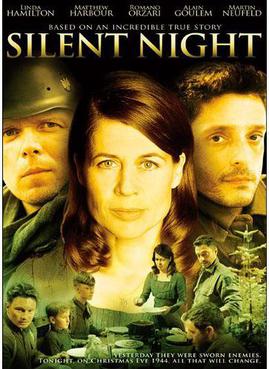
CHRISTMAS WAR MOVIE: Silent Night (2002)


                This year my Christmas selection is the movie “Silent Night”.  It was made for television (Hallmark) and released in 2002.  It was directed by Rodney Gibbons and stars Linda Hamilton.  It is based on a true story that is set in the Battle of the Bulge at Christmas time in 1944.  You can watch the entire movie on You Tube. 

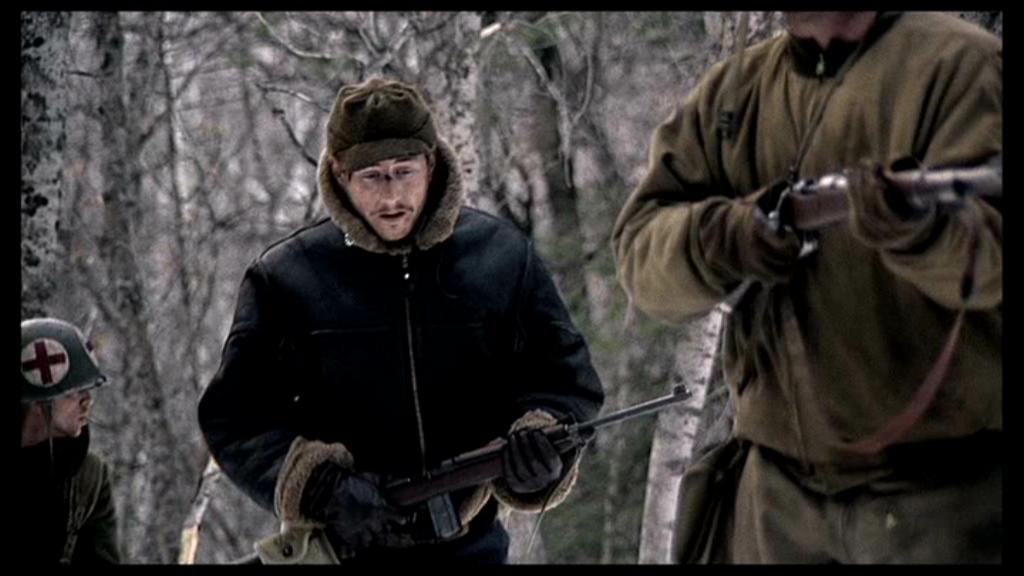
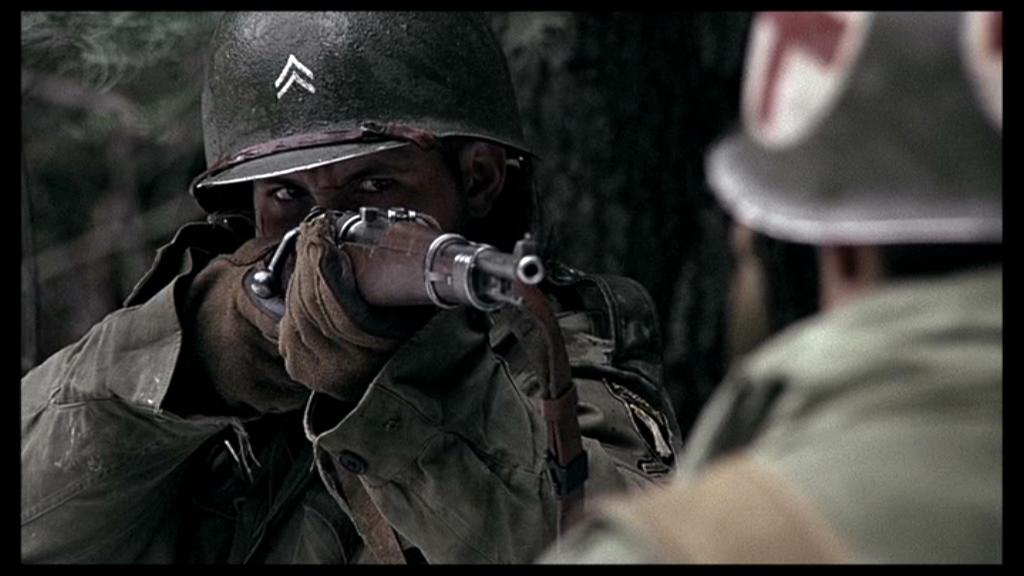
                The movie begins with an elderly German named Fritz reminiscing with a young American about his grandfather who he had met in the war.  The movie then proceeds into flash back mode.  Fritz (Matthew Harbour) and his mother Elizabeth Vincken (Linda Hamilton) are refugees from the fighting in the Ardennes.  Elizabeth thinks their cabin in the woods will be a safe haven from the war.  They plan on a quiet, uneventful Christmas eve.  That is ruined when three American soldiers barge in.  One of them is wounded (Michael Elkin as Pvt. Ridgin).  Sgt. Blank (Alain Goulem) is very distrustful of Elizabeth (and any German for that matter), but Pvt. Rassi (Romano Orzari) bonds with Fritz.  Three is a party, six is a movie as three Germans arrive to complicate matters.  Rassi bluffs them into surrendering, but then the forceful Mrs. Vincken insists that the opposing sides agree to a truce and leave all the weapons outside.  The deal is reluctantly agreed to with Blank and Lt. Klosterman (Martin Neufeld) both wink-winking.  Klosterman is a hard-core Nazi who implies that Elizabeth will be held accountable for not warning them about the Americans.  He also wonders why Fritz is not in the Hitler Youth at the ripe old age of 12.  Sgt. Mueller (Mark Antony Krupa) helps with Ridgin’s wound. 

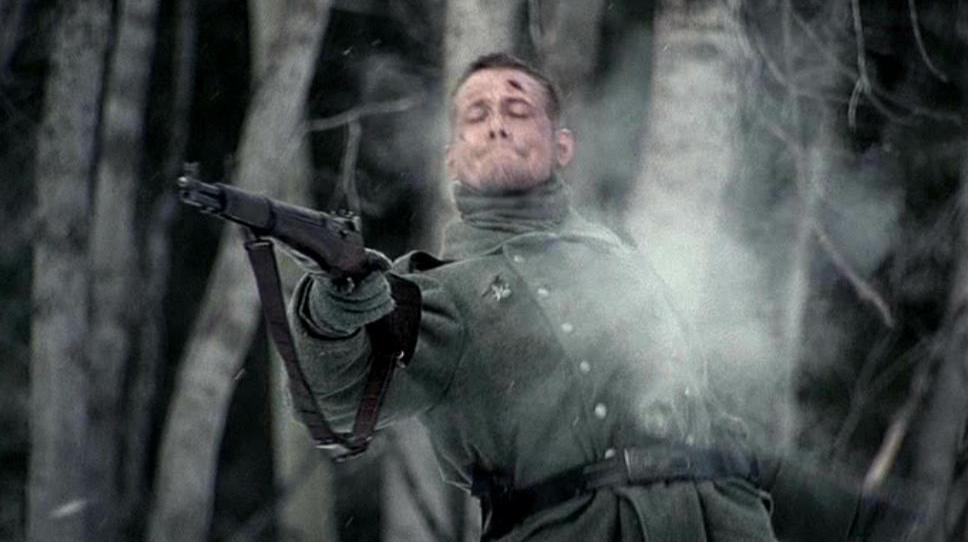
                A shared meal and conversations encourage empathy and camaraderie among the soldiers.  The sergeants make a connection over singing “Oh Christmas Tree” and Blank and Klosterman debate Nazism.  Next comes trimming the Christmas tree and the obligatory singing of “Silent Night”.  It all comes to a screeching halt when Klosterman notices Rassi has an Iron Cross souvenir.  Klosterman’s decorated brother was stripped when he was killed.  Not a good moment for Ridgin to enter with a pistol.  It's a "Midnight Clear" scenario.  The interlude comes to an end the next morning when an American MP arrives.  Or is he?

                “Silent Night” is a sweet little Christmas movie and should leave a warm spot even for Scrooges.  It is decidedly made for TV and if you are looking for action…  The acting starts out weak, but the actors seem to calm down and play it more naturally as the movie proceeds.  Hamilton is the only star and she anchors the film.  It would be interesting to know whether the real Elizabeth Vincken was critical of the Nazi regime.  In the movie, she openly questions the war and flat out tells Klosterman she will not allow her son to serve.  The other actors are no names who emote adequately.  The characters are stock (ex. the scrounger), but well-developed.  The dialogue is fine if a bit Hallmarkish.  At least it’s not mawkish.  The movie is not overtly religious, but it won’t turn you into an atheist.  There is certainly a strong theme of we are all humans after all.  The ending has a nice twist to it. 

                “Silent Night” is not in a league with “Joyeux Noel” or “A Midnight Clear”, but it is a nice choice if you want something that combines war and Christmas.  See the spoiler report below on how much of the story is true.

Grade  =  B-

HOW TRUE IS IT?  The basic scenario is true, but the details are enhanced for our viewing pleasure and so we won’t fall asleep.  The Vincken’s did take refuge in a cabin.  Three Americans did join them and one of them was wounded.  Unlike the movie, the Germans did not speak English.  Who wants to read subtitles in a made for TV movie?  The three Germans knocked before being invited in by Elizabeth.  She did require them to leave their weapons outside and they did agree to a truce.  One of the Germans did help with the wounded American.  The group shared a meal of stew.  The next day the two trios parted without incident.  Overall, acceptable artistic license for a movie that was not meant to be an important historical retelling.

For an alternative take, go to my friend’s blog:  All About War Movies  
 
THE FULL MOVIE


Wednesday, December 26, 2012

Saints and Soldiers


                “Saints and Soldiers” is “based on true events” centering on the Malmedy Massacre in the Battle of the Bulge.  It was a very low budget film (less than $1 million), but did well at film festivals winning numerous awards.  The cast is as low rent as you can get.  It was released in 2003.  It is the rare war movie that has overt religious overtones.
                The movie opens with the exhumation of bodies at Malmedy and then flashes back three weeks to the massacre.  The massacre breaks out when one of the Americans tries to escape and is shot.  Another G.I. grabs a gun and shoots a captor and the Germans open fire with machine guns.  (This is uncomfortably close to the way the S.S. defendants excused their actions at their trial.)  Some of the men successfully run away, but over 80 of the around 120 are killed and some of the wounded are executed with a bullet to the head. 
                The movie follows the quartet of Deacon (Corbin Allred), Gunderson (Peter Ashe Holden), Kendrick (Larry Bagby), and Gould (Alexander Niver).  Deacon is shell-shocked from an incident where he accidentally killed a family.  He is religious and often reads a book that turns out to be the Book of Mormon.  He gets into some interesting discussions with the atheist medic Gould.  Gould is from Brooklyn (of course, since this is a small unit movie).
Winley unhappily infantry
                The trek back to American lines is fraught with peril, naturally.  They spend some time in the floor space of a home when Germans arrive.  They hook up with a British pilot named Winley (Kirby Heyborne) who has valuable information that is needed back at headquarters.  They head out to “Saving Private Ryan” style music.  The soldier talk is realistic and helps with character development.  Kendrick and Winley dislike each other so we have the required dysfunctionality. 
Deacon to Gould:  "convert or die"
                They stay at the home of a French family.  Winley impatiently leaves in a snow storm. Germans arrive again.  When they attempt to rape the woman, Deacon shoots one, but the other escapes (but Deacon never misses, so what’s up?).  They can’t track him (in the snow?), but Winley arrives with the German in tow.  Deacon recognizes him as a fellow Mormon named Rudy from a pre-war mission.  What a small world!  Good thing Deacon sometimes misses.  Deacon sets Rudy loose in exchange for directions because it’s the Christian (I mean Mormon) thing to do.
Deacon returns fire
                Suddenly Germans open fire and Gunderson is killed.  A fire-fight ensues with SPR type graphics.  The grenade explosions are especially cool.  After frantic evading, they run into Rudy who shows them a jeep they can use.  They drive through no man’s land with both sides trying to kill them.  The jeep crashes and Deacon stays behind to give covering fire.  Gould and Winley make it, but Deacon does not.  Winley’s information, as we all know, allows the Allies to win the Battle of the Bulge.  Gould takes Deacon’s Book of Mormon.
                The no name cast acts well.  The movie also makes good use of numerous reenactors and authentic weapons.  The action scenes are surprisingly good considering the low budget.  They are obviously influenced by SPR.  The cinematography is fine.  The setting is snowy (it was filmed in Utah) which adds to the atmosphere, but is inaccurate as to the Malmedy Masssacre which was not snowy.
a contemplative Gould
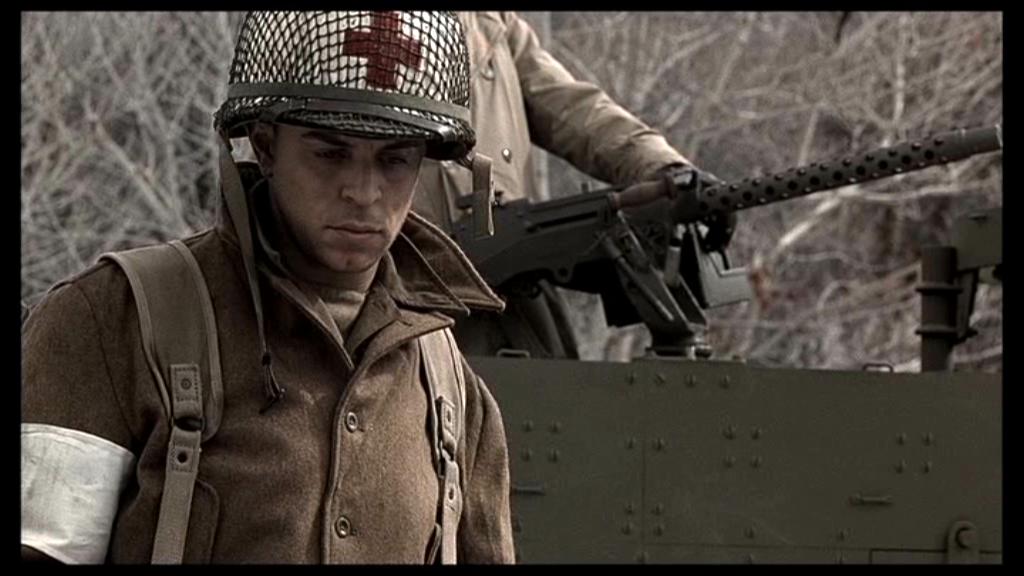
                The religious theme of the movie will not be for everyone, but I did not find it overbearing.  Although the movie was produced by a Mormon company and the ending seems to be aimed at recruiting converts, you have to listen carefully to catch that Deacon is a Mormon.  Most viewers will assume he is simply a Christian and that the book is a Bible.  Gould represents the atheist view gamely.
              As far as accuracy, the movie is pretty commendable.  The main characters are fictional, but some of the events are authentic.  There was an incident when a small group hid in a basement while Germans dined overhead.  there also was an account of an American who missed a German soldier and then later when he was captured, it turned out they were if the same faith.  The Malmedy Massacre is fairly close to the real thing.
                The movie does not belong in the 100 Best War Movies list, but it is well worth watching and you have to admire what they were able to produce for less than $1 million.
GRADE = B-

Friday, December 23, 2011

A CHRISTMAS WAR MOVIE: A Midnight Clear


     I thought with Christmas approaching I would suggest an X-Mas themed war flick. “A Midnight Clear” was released in 1992. Its cast consisted of several up and coming actors like Ethan Hawke, Peter Berg, Kevin Dillon, John McGinley, Frank Whaley, and Gary Sinise (his film debut). The ensemble cast is strong and the movie is a little gem that is not well-known. It cost less than $5 million to produce and made less than $2 million. It is based on the novel by William Wharton.


     The movie is set in the Ardennes Forest before the Battle of the Bulge. It is not a big picture movie. You get no idea how the battle is going. There is a “fog of war” surrounding the intelligence squad that is sent out to observe enemy movements from an abandoned mansion.  They are scared and unclear about what they are supposed to do. The mission is seemingly suicidal and their ex-mortician, current martinet Major Griffin (McGinley) has a habit of putting them in precarious positions. Speaking of a previous patrol, Will (the narrator Ethan Hawke) makes the following telling remark: “We lost half of our squad attempting one of [Griffin’s] map-inspired, ill-conceived recon patrols. When I say ‘lost’, I mean ‘killed’. Nobody in the Army ever admits that someone on our side is killed. They’re either ‘lost’ like Christopher Robin… ‘hit’, as in a batter hit by a pitched ball… or get ‘it’ like in hide and go seek. Or maybe they “get it”, as with an ambiguous joke.” Well said and true. In fact, much of the narration is cynical and critical of the Army.

     We get to know the squad well. They are typically heterogeneous except there is no country hick because this is an “intelligence” squad. They care about each other, but are not all BFFs. There is a flashback scene from boot camp as several of the boys attempt to lose their virginity with a good girl down on her luck. It is a sweet scene and tastefully done.

     The setting and mood of the movie could have easily fit a horror movie. On the way to the mansion, they come upon the corpses of a G.I. and a German in a death embrace. The chalet is eerie. It is empty except for a deer. The nights are particularly spooky. The first night Germans yell unintelligibly from the woods and the next day the Americans discover a German squad encamped in a hut nearby. That night the Germans come again to yell “Fuck Hitler” (later they insist they are not Nazis, just German soldiers – an accurate description of the dilemma of many German soldiers) and throw snow balls. The third night they rig up a Christmas tree and sing carols. Although fictional, the film harkens back to the famous Christmas Truce of WWI. (That reminds me to suggest "Joyeux Noel" as a companion to your Christmas viewing.) The perplexed Americans finally realize the Germans want to surrender, but they need for it to look like they put up a fight. Since “Mother” (Sinise) has recently suffered a breakdown, the guys decide to make him the “hero” of the skirmish so he can be sent home. Mother is to be kept in the dark about the whole affair. Nice plan, disastrous results. Watch the movie and see what happens.

     This is a remarkable movie. It is unlike any other war movie I have seen. It is spiritual (helped by the New Age musical score) and has a heart-tugging scene involving the bathing of a dead comrade that is hard to forget (and slightly homoerotic). It is also overtly religious in spots. Although a Christmas movie, there is also a strong reference to the Crucifixion. Some will not like this aspect of the movie, but I found it refreshing. Keep in mind that soldiers tend to be religious for obvious reasons, so why shouldn’t war movies occasionally have religious themes?

     The movie is very well acted. The squad is likeable and relateable. Each has a distinct personality. Each actor gets a chance to shine. No one dominates. The small unit dynamics are realistic. Their behavior rings true. McGinley is appropriately loathsome as the clichéd commanding officer. (By the way, McGinley and Dillon went on to appear in another great small unit movie – “Platoon”.) The Germans are shown in a sympathetic light. What happens to them is truly tragic.

     This is a very snowy movie. Watch it with a mug of hot chocolate by a fire place if you can. It was shot in Utah and the temperatures at night were frigid. The cinematography is crisp and clear like the locale.

     In conclusion, “A Midnight Clear” is one of the two greatest war movies set at Christmas. Are there others? Let me know. It will make my 100 Best War Movies list when I get done with my journey.