Showing posts with label Philippines. Show all posts

Monday, December 15, 2014

CLASSIC or ANTIQUE: So Proudly We Hail (1943)


                “So Proudly We Hail” was inspired by the nurses in the Philippines at the beginning of WWII.  Director Mark Sandrich read a story about ten nurses who escaped from Corregidor.  He and screenwriter Alan Scott ( who received an Academy Award nomination for his script) interviewed the ladies and even hired Eunice Hatchitt as technical adviser.  Hatchitt did a lot of eye-rolling over the petulant behavior of the three leading ladies in the film.  The movie was based on the book by Juanita Hipps (“I Served on Bataan”).  The “Angels of Bataan” served first on Bataan and then Corregidor before the lucky few were evacuated and the unlucky majority were imprisoned for the rest of the war.  The movie had the cooperation of the War Department, the Army Nurses Corps, and the American Red Cross.  The movie was a box office hit and was nominated for four Oscars (Best Supporting Actress, Cinematography, Original Screenplay, and Visual Effects).
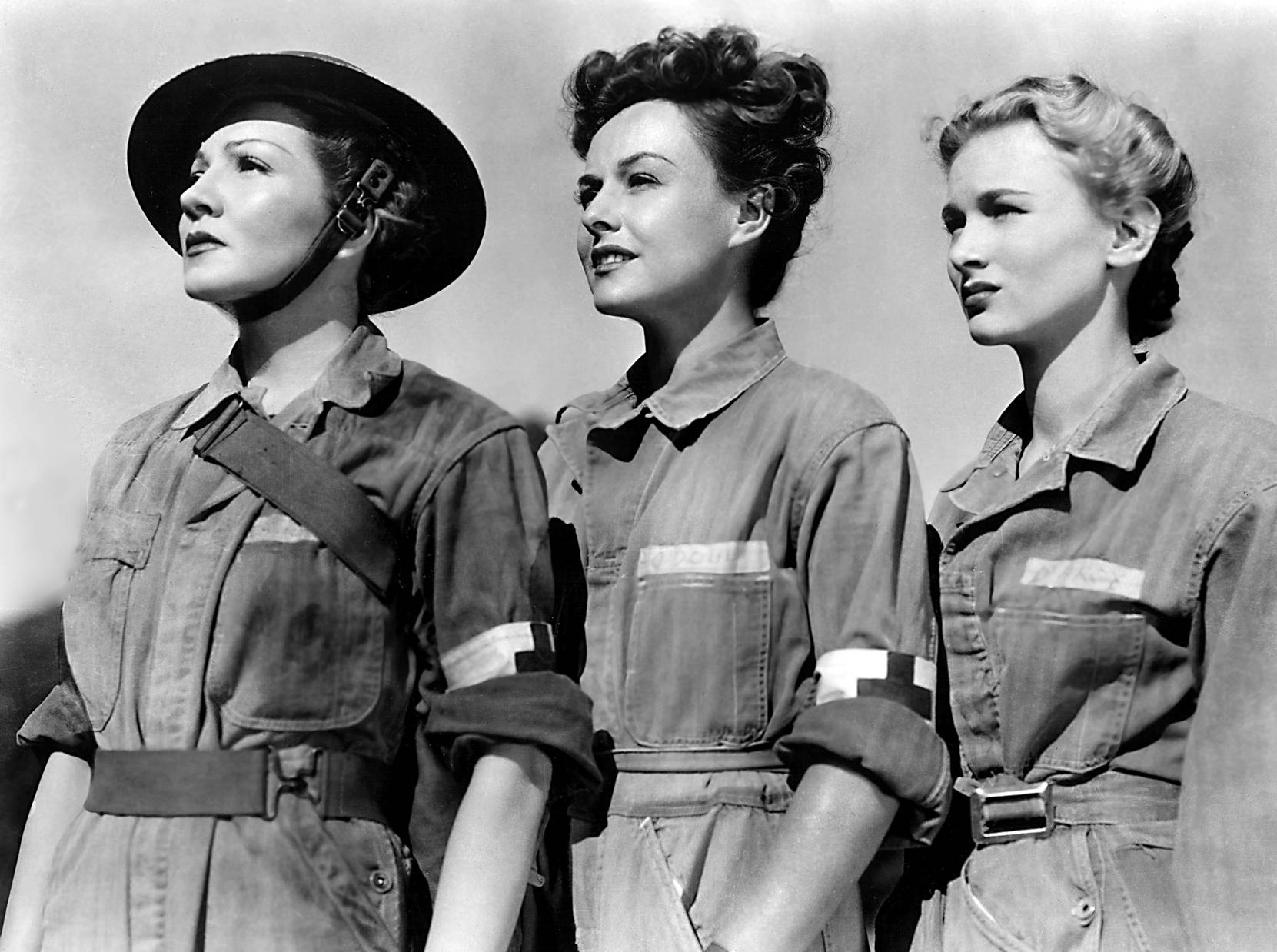
Colbert, Goddard, and Lake

                The film opens in May, 1942.  Eight nurses are in the Philippines.  Lt. Janet “Davy” Davidson (Claudette Colbert) has been wounded.  Suddenly they are on a cruise ship.  We’ve jumped to the end of the war and Davy has lost her will to live.  A doctor prescribes flash backs.  We are introduced to our trio of celebrity nurses as they sail to the Philippines.  Davy is the mother hen, Joan (Paulette Goddard) is the slutty one, and Olivia (Veronica Lake) is the vengeance –minded, Jap hating war widow.  Davy is romantically involved with Lt. Summers (George Reeves eight years before Superman) and gets to bathe him so the ladies in the audience might consider joining the nursing corps.  Meanwhile Joan is flirting with a hayseed named Kansas (Sonny Tufts).  Olivia is being unsociable, even with the other nurses.  What a bitch!  They don’t realize the Japs killed her husband.  At a Christmas party on board the ship, a Chaplain gives a speech to the audience telling them to have faith in the things America stands for. 

                When they reach Bataan, they are assigned to a hospital.  Olivia gets herself assigned to the Japanese prisoner ward.  Will she cold-bloodedly murder?  John shows up.  Unwounded. What the…?  John and Davy go on a moonlit walk and spend the night in a dugout – wink, wink.  The Japanese show up before the girls can bug out.  Olivia lets her peek-a-boo hair down and pulls a grenade out of her bra.  That is not a euphemism.


Put that hair down, put those hands up
                At the new hospital, John ( what is this guy? a hospital groupie?) gives Davy a monkey that of course is named Tojo (because they look alike).  The head nurse’s son dies after having his legs amputated.  She represents all the moms who have lost sons in the war.  The damned war keeps intruding on the romantic subplots.  “I don’t know if that’s an air raid warning or mess call.  Either way it’s a warning”.  LOL  Those bastard Japs even bomb the hospital with the huge red cross on it.  We wouldn’t do that.

                The gals are evacuated to Corregidor.  So is John, who has finally managed to get himself wounded.  A doctor removes his shrapnel (“it’s probably good American steel” – non-Greatest Generation, this is a reference to scrap iron sold to Japan before the war).  The hospital is located in the Malinta Tunnel.  There is a plug for Red Cross blood.  One nurse gets the “heebie jeebies”.  Davy and John honeymoon by a howitzer before he goes on a suicide mission to get quinine.  “I’ll be back”.  Liar.  Joan says goodbye to Kansas.  “So long, kid”.
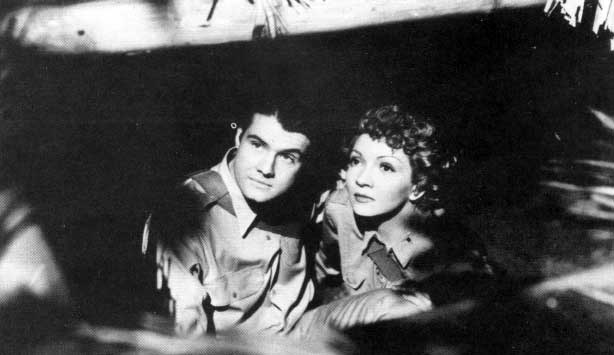

Davy and John in the Honeymoon Suite
                “So Proudly We Hail” is better than you would expect.  It is fairly realistic in depicting the lives of nurses in the Philippines.  They were in fact very sexy and had romances with soldiers.  Actually, according to the movie, two thirds of nurses had affairs and one third were married to soldiers who were killed in the war.   And they were able to keep their hair perfectly coiffed.  The movie is entertaining in a 1940s war movie aimed at females sort of way.    There is some pretty good humor and some of it is even intentional.  The dialogue is better than average for this type.  It is only occasionally schmaltzy.  The speeches did not make me throw up in my mouth.  Surprisingly, the movie deserved its visual effects nomination.  The bombing scenes are well done.  There are some effective pyrotechnics.  The acting is good and no one embarrasses themselves.  The three ladies are fine (and I do mean fine).  Goddard got a Best Supporting Actress nod.  She plays 1940s trollop well.    Colbert is her usual solid self. Lake is not much of an actress, but I don’t think anyone cared.  Excuse me, is that a grenade in your bra?  Oh, and there are some men in the cast as I recall.  One of them played Superman.

                Classic or antique?  Classic because of the recognition for the nursing corps.  This is what sets it apart from other wartime war movies.  It could have been much worse.

 
Grade =  C+

Saturday, November 1, 2014

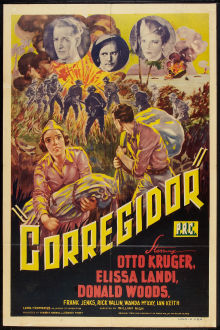
LIVE: Corregidor (1943)


I don’t recognize any of these actors.  One of the screenwriters is a woman.  It is dedicated to “the heroes of the U.S. and Philippine armed forces.”  It’s Dec. 6, 1941 in the Philippines.  Dr. Royce (a woman doctor!) arrives with a black mammy.  Her boyfriend Dr. Jan looks old enough to be her father.  He’s not the marrying type.  He brings up a love rival named Michael to put her off – fail. There is continuous terribly sappy music.  Royce and Jan get married and live happily never after.  The Jap bastards bomb the wedding ceremony!  Mammy gets killed – there goes the comic relief.  Royce and Jan embark on a 600 mile trek to Manila.  Along the way, they have several encounters with Japanese soldiers on sound stages.  Suddenly they are at Corregidor.  Michael is already there.  He’s a doctor, too.  Now our love triangle is in place.  The Japanese air force is continually bombing them.  Lots of close-ups of their pilots.  Wide variety of planes in the footage.  We are introduced to another couple – nurse Dutch and soldier Pinky.  Pinky and Sarge are on the front line.  Sarge picks up the torch of comic relief.  Lame soldier banter.  Almost every scene has two people talking.  The Japanese land and there is a big battle with the Japs shooting from the hip.  Bayonet melee.  Attack repelled.  Dutch is wounded and she and Pinky are married.  Surprise – no kiss.  Jan tries to get Michael and Royce together.  He gives a speech about life, liberty, and the pursuit of happiness.  Chuck dies.  Naval bombardment and landing craft.  Similar battle.   Sarge uses a bolo.  Some hilarious deaths.  Music blaring.  Jan is wounded while operating and dies.  This simplifies things. Royce is ordered to leave with the other women.  She doesn’t want to go, but Michael insists.  They kiss.  Pinky shoots down a Jap plane, but is killed in the process.  The final assault.  Lots of explosions.  We lose.  But we’ll be back!

This movie is definitely a curio.  It’s an Old School B-war movie.  The acting is bad, especially the no name who plays Jan.  The music is relentless.  The love triangle is weird with Jan being extremely tolerant.  The dialogue is surprisingly not terrible, just boring.  This is a noisy movie with high volume sound effects.  There are no derogatory Japanese references and the enemy are not demonized.  The movie is not laughably bad, which is a problem because at least then it would have been entertaining.

GRADE  =  F

Sunday, June 15, 2014

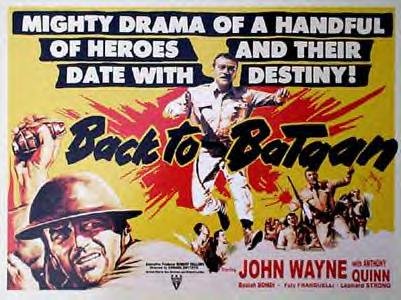
CLASSIC or ANTIQUE: Back to Bataan (1945)


       Boy, did Hollywood like to make movies about Bataan!  “Back to Bataan” was the fourth movie set on the Philippines’ peninsula made during the war.  Bataan” (1943), “So Proudly We Hail” (1944), and “They Were Expendable” (1945) were the other three.  “Back to Bataan” was directed by Edward Dmytryk (“The Caine Mutiny”) and written by Ben Barzman.  Both were communist sympathizers which made their pairing with the famously conservative John Wayne an interesting part of the production.  They appear to have gotten along well which is a testament to Wayne.  However, when Wayne insisted on doing his own stunts, the pair came up with doozies to get him to relent (including the submerging in the cold water with reeds to breathe through scene).  Wayne was game and did not use a double in the film.  That’s because he was John F’in Wayne. 

                The movie was heartily endorsed by the Office of War Information and was assisted by the Army, Navy, Marine Corps, and Coast Guard.  Since the film was shot during the liberation of the Philippines, Barzman did rewrites and add-ons to reflect changing situations.  For instance, reference to the Raid on Cabanatuan was added in to good effect.

                In fact, that reference occurs at the beginning of the film.  There is a spicy reenactment of the raid on the prison camp.  The Americans bust through the gate, mow down the Japanese guards coming out of their huts, and rescue the prisoners.  Then a guerrilla unit led by Capt. Bonifacio (Anthony Quinn) ambushes and slaughters pursuing Japanese soldiers.  A narrator introduces us to some of the actual survivors as they march into American lines.  Very nice touch, although the raid has little to do with the rest of the movie.  From here we flashback to 1942 because “this is the story of the resistance”.

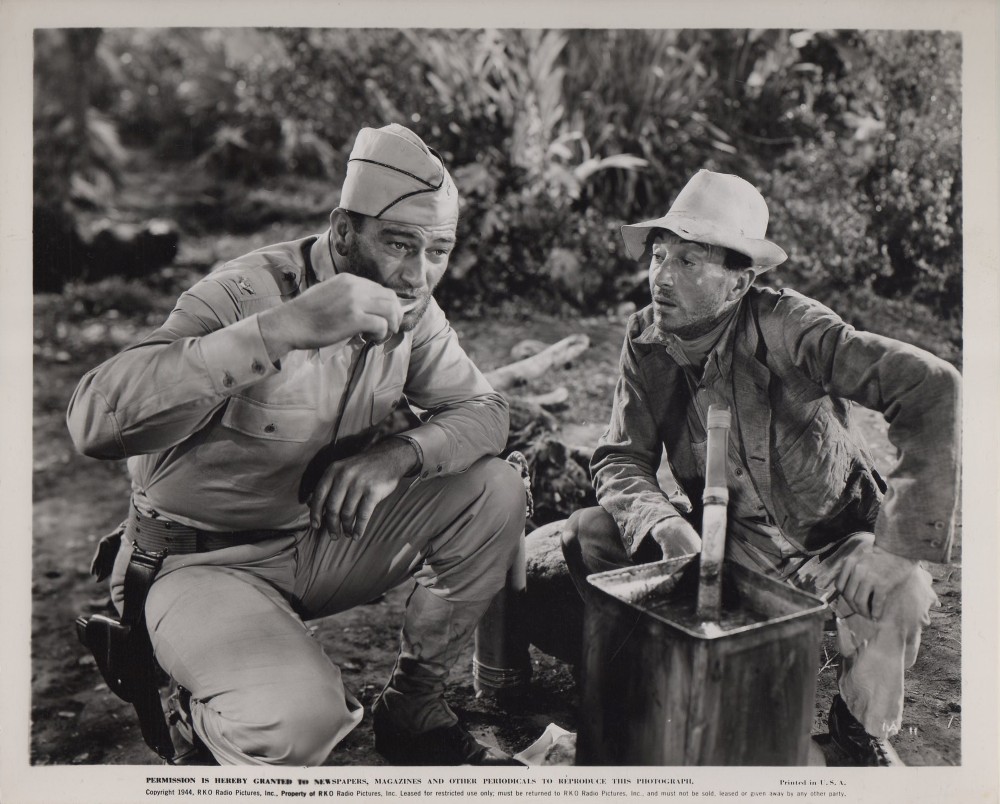
Anthony Quinn and his co-star
                Wayne plays Col. Madden who leads a unit of Philippine Scouts that includes Bonifacio.  Bonifacio is morose because his girl-friend Dalisay (Fely Franquilli) is “Manila Rose” and is broadcasting propaganda for the Japanese.  Things are not going well in Bataan and Madden’s force is attacked by the Japanese in a scene reminiscent of a WWI trench warfare scene except for fox-holes instead of trenches.  Madden reports to Corregidor where he shares Gen. Wainwright’s last cigarette (a sure sign the end is near).  Madden is ordered to take over guerrilla operations now that the fall is inevitable. His unit consists of the survivors of his old unit plus recruits.  The only other American is an ex-hobo (I kid you not) named Bindle (as in stick) played by Paul Fix.   

Where did you learn to make rat stew, Bindle?
                A slimy Gen. Homma tells the Filipino’s that they are like Japan’s nieces and nephews, but they will not be coddled.  The Filipinos in this move don’t cotton to this.  At a rural school, the principal and the school marm Mrs. Barnes (the perfectly cast Beulah Bondi) teach a mixture of Filipino nationalism (there is a positive reference to the Philippine Insurrection against American occupation) and respect for America.  When the Japanese arrive and order the principal to lower the American flag, he prefers to die.  Barnes joins Madden’s force and brings mascot-worthy Maximo.

                Madden witnesses the Bataan Death March (don’t forget who we are fighting, audience) and sees the Japanese shoot and bayonet stragglers.  They rescue Bonifacio and since he is the grandson of a Filipino hero from the insurrection against Spain, he’ll come in handy as an inspirational figure (plus we need that romantic subplot).  Madden sends him to Manila to deliver a message to an agent.  Surprise, it’s Dalisay!  She’s actually working for the good guys.  Strangely, Bonifacio does not ask her WTF. 

                Ambushes montage.  Sappy speeches.  Big set piece.  The Japanese host an “independence” ceremony at the village.  Madden’s crew attacks and puts an end to that farce.  Dalisay is rescued and she and Barnes join the unit.  Unfortunately, Maximo is captured and tortured.  He agrees to lead the Japanese to the rebel lair, but causes the truck to plunge into a ravine.  Even kids can be heroes.  Or martyrs.

Maximo realizes that the American overlords
were not such a-holes after all
                Time passes via a montage of humping through the boonies. Dalisay and Mrs. Barnes are still with them.  Madden goes off to Australia ala MacArthur and returns with a mission to block Japanese reinforcements from reaching the invasion beaches.  This calls for the capture of a Japanese-held village.  They hide in a rice paddy using reeds to breathe in a scene that strains credulity, but was fun for Dmytryk and Barzman to film.  The garrison is taken out with extreme prejudice including Bindle pulling a grenade pin with his teeth.  Footage of the landings follows.  [Spoiler alert: see below for conclusion]

                “Back to Bataan” is “based on actual incidents and people”, but don’t take that too seriously.  The raid on Cabanatuan is handled well, but “The Great Raid” is the go-to movie for that.  Still that is a commendatory, if out of place, opening to the film.  Of the “people”, I would assume only Madden is anything but loosely based on a real person.  He personifies Col. George Clarke who commanded the 57th Infantry Regiment of the Philippine Scouts during the Battle of Bataan.  Clarke served as the technical advisor for the film.  The anti-Spanish Bonifacio, for instance, did not have a grandson.  Dalisay, Barnes, Bindle, and Maximo are Hollywood stock characters.  The movie deserves some credit for depicting guerrilla warfare, but sugar-coats its brutal nature.  There are a lot of dead Japanese in this movie, but the Filipinos get off easy which certainly was not realistic.  99% of the deaths in the movie are Japanese. 


John Wayne walks
on water
                The movie is a standard 1940s WWII actioner.  It is also a typical Wayne war movie.  He is essentially playing himself and does it well.  The direction stands out given that Dmytryk was upper tier and thus the cinematography is a cut above most of its ilk.  The music by Max Steiner (who else?) is what you would expect with the added trivia that he used large chunks of his “King Kong” score.  The plot avoids many of the WWII movie clichés (see my post on WWII movie cliches).  There is a specific mission, but it does not consume the movie.  The unit is not heterogeneous.  They are all generic Filipinos except Madden and Bindle.  There is no observer, no forced leadership, no conflict within the unit, and no redemption arc.

                The acting is pretty good.  Wayne and Quinn make a charismatic pair.  They could play he-men in their sleep (or drunk).  Bondi comes off well as the feisty teacher, but Franquelli is weak and the romantic subplot feels forced (which, of course, it was).  The dialogue does not help.  It tends to be trite and too sincere.  The Japanese are hissable villains of the oriental variety which means that unlike their German counterparts in movies of this era, they are depicted as idiots.

the cameramen were forbidden to go lower
because a full body shot of Beulah would have inflamed men
                What sets the movie apart is the blend of Philippine nationalism and American patriotism.  The school principal exemplifies this duality.  The movie must have been popular in the Philippines as well as the U.S.  It is the only movie I can recall where an American and a Filipino would high five after seeing it.  It has a large Filipino cast that does well.  Remarkably it includes lines that imply the U.S forced itself on the Philippines after the Spanish-American War and that the insurrectionists were right to resist.  Madden even makes a respectful reference to their use of bolos.  By 1945 it would have been apparent that the Filipinos had done their share and earned their independence.  It’s nice that Hollywood recognized that.

                The conclusion is weak.  Having taken the village, Madden now has to hold it so Japanese reinforcements cannot reach the invasion beach.  Things look bleak as a Japanese tank (played by a Sherman) approaches menacingly, but Americans arrive in the nick of time.  More actual Cabanatuan survivors marching.  The end.

this image was on Google Images for "Back to Bataan" -
I assume it was the first movie to have "The End"
 
                Classic or antique?  Classic.  The pro-Filipino plot makes it unique and Wayne is solid, of course.

Grade =  C+    
the trailer
          
the full movie
 

Sunday, May 11, 2014

HISTORY or HOLLYWOOD: The Great Raid (2005)


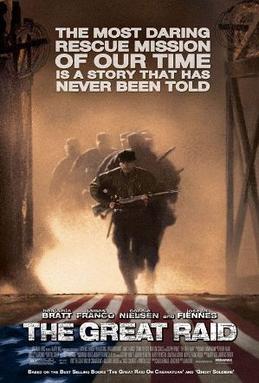
          "The Great Raid" (2005) is a sadly forgotten movie about the daring POW rescue raid on Cabanatuan in the Philippines in 1945.  The behind the lines mssion by the U.S. Rangers was one of the great adventure stories of World War II.  The plot is so incredible that you have to wonder just how true is this "true story".
GUESS WHICH OF THE PLOT ELEMENTS IN “THE GREAT RAID” ARE TRUE.
1.  American prisoners on the island of Palawan were forced into air raid shelters and then the Kampeitei poured in aviation gasoline, set it on fire, and machine gunned the survivors. 
2.  Gen. Krueger approved the mission and put Mucci in charge.  He, in turn, gave operational command to Prince. 
3.  The senior camp officer was a malaria-ridden Maj. Gibson. 
4.  Margaret Utinsky was an American nurse who worked with the Filipino Underground to smuggle drugs into Cabanatuan, among other activities. 
5.  The original camp guards left the camp and the prisoners found a large stock of food.  Later, Japanese returned and reestablished control of the camp. 
6.  The Rangers stop at the village of Balincarin and witnessed the results of a massacre of villagers for aiding the guerrillas. 
7.  Pajota suggested the raid be postponed a day because of a temporary increase in Japanese forces and originated the idea of the flyover. 
8.  Capt. Redding was caught escaping and he and ten random prisoners were shot. 
9.  The Rangers crawled 800 yards over open ground in daylight and used a flyover by a plane to get the Japanese to look up instead of out. 
10.  The raid came as a complete surprise to the Japanese and many were killed in their barracks by the intense fusillade. 
11.  A bazooka took out a Japanese tank. 
12.  The Japanese commander was killed in a duel with Sgt. Wojo. 
13.  The two American casualties were a sniper victim and the doctor who was mortally wounded by mortar shrapnel. 
14.  Pajota and his guerrillas held off a large Japanese force at a bridge near the camp. 
15.  Mucci defeated a flanking attempt by Japanese fording the river. 
History or Hollywood?

1.  American prisoners on the island of Palawan were forced into air raid shelters and then the Kampeitei poured in aviation gasoline, set it on fire, and machine gunned the survivors.  HISTORY  The incident did occur, but it was the Japanese 14th Area Army was responsible.  Survivors telling their stories directly led to the idea of the Cabanatuan raid.
2.  Gen. Krueger approved the mission and put Mucci in charge.  He, in turn, gave operational command to Prince.  HISTORY  The movie overplays disagreements between Mucci and Prince about various aspects of the plan.  It underplays Mucci’s “glory hound” reputation.  Prince did have a bad case of jungle rot on his feet.
3.  The senior camp officer was a malaria-ridden Maj. Gibson.  HOLLYWOOD  All of the prisoners are fictional
4.  Margaret Utinsky was an American nurse who worked with the Filipino Underground to smuggle drugs into Cabanatuan, among other activities.  HISTORY  Surprisingly, much of this is true.  Utinsky was the wife of an American soldier who dies in Camp O’Donnell soon after the fall of the Philippines.  She elected to stay in Manila and joined the Resistance.  She did smuggle drugs into Cabanatuan.  She was arrested and tortured by the Kampeitei, but for much longer (32 days) than in the movie.  She then spent six weeks in a hospital suffering from a gangrenous leg.  After that she escaped to the hills and joined the guerrillas.  She did meet the prisoners when they reached American lines.  She was not romantically involved with any of the prisoners.  In 1946, she was awarded the Presidential Medal of Freedom by Pres. Truman
5.  The original camp guards left the camp and the prisoners found a large stock of food.  Later, Japanese returned and reestablished control of the camp.  HISTYWOOD  The Japanese did leave the prisoners for several weeks and they did fatten up on Japanese supplies.  The Japanese who eventually reestablished control were not from the Kampeitei (Nagai is a fictional character), they were mostly retreating Japanese units who basically ignored the prisoners
6.  The Rangers stop at the village of Balincarin and witnessed the results of a massacre of villagers for aiding the guerrillas.  HOLLYWOOD  There was no mention of this incident in my research.  However, these types of atrocities did occur.
7.  Pajota suggested the raid be postponed a day because of a temporary increase in Japanese forces and originated the idea of the flyover.  HISTORY
8.  Capt. Redding was caught escaping and he and ten random prisoners were shot.  HOLLYWOOD  I found no evidence of this particular incident.  It does conform to Japanese policy and was done at the camp.  By the way, most of the time the executions were done via beheadings.
9.  The Rangers crawled 800 yards over open ground in daylight and used a flyover by a plane to get the Japanese to look up instead of out.  HISTORY  The plane was a P-61 Black Widow (the absolute perfect choice for this), but in the movie they had to use a Lockheed Hudson.  The P-61 did twenty minutes of acrobatics and faked engine trouble which allowed the Rangers to transit the field.
10.  The raid came as a complete surprise to the Japanese and many were killed in their barracks by the intense fusillade.  HISTORY  The movie gives the Japanese more of a fighting chance than the Rangers did.
11.  A bazooka took out a Japanese tank.  HISTYWOOD  A bazooka team did take out a shed that was suspected of housing tanks and blew up some trucks, but no tank.
12.  The Japanese commander was killed in a duel with Sgt. Wojo.  HOLLYWOOD
13.  The two American casualties were a sniper victim and the doctor who was mortally wounded by mortar shrapnel.  HISTYWOOD  Doctor Fisher was wounded similar to the movie.  The other death was an accidental friendly fire incident.
14.  Pajota and his guerrillas held off a large Japanese force at a bridge near the camp.  HISTORY  This scene is very accurate.
15.  Mucci defeated a flanking attempt by Japanese fording the river.  HOLLYWOOD  Mucci spent the battle observing from the rear.
 
SCORE:
History =  7
Hollywood =  5
Histywood =  3
 
RATING =  .57     

Thursday, January 27, 2011

SHOULD I READ IT? "Fires on the Plain"


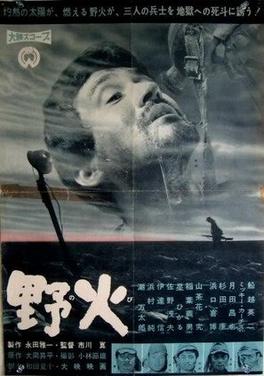
If you want to watch a horror/war movie, “Fires on the Plain” may be for you. There are other horror movies set in war, but few are based on actual events. This movie is set in the Philippines in 1945 after the American invasion. The Japanese army is on the run and in terrible shape. Director Kon Ichikawa used the novel of the same name by Shohai Ooka as his source. The book and film are meant to be surrealistically anti-war. Mission accomplished.


The movie opens with the protagonist Tamura being scolded by his commander for returning from the hospital, thus giving him another mouth to feed. Tamura is suffering from TB, but not bad enough for the doctors at the hospital. The officer orders Tamura to go back and if they won’t take him, to use a grenade to commit suicide. Tamura says “Yes, sir” and starts on his odyssey as the most pitiful Odysseus in film history.

When he reaches the hospital, the doctor throws him out again and he joins similar “not-sick-enoughs” existing nearby. The only food they have is a little rice and some yams. The actors look appropriately emaciated after preparing for the movie by eating very little and not brushing their teeth or cutting their nails for weeks. The hospital is bombed in a powerful and unforgiving scene. Tamura escapes the destruction and does not go back to see about the wounded. This is the first example of the ambiguity of his war-tested humanity.


In a surprise to American audiences, most of the Japanese soldiers we meet are not gung-ho about dying for the emperor. They are not robotic followers of orders. Most of them simply want to survive. One of them dreams of being taken captive so he can eat American corned beef. At one point, Tamura reaches a village where in a wild confrontation he bayonets a dog that jumps at him. He encounters a young couple who have come back for their hidden cache of salt. When the girl screams, Tamura (seemingly out of character) kills her in cold-blood. Some more humanity slips away. The boy escapes and Tamura gets the salt.

Tamura hooks up with three survivors from his unit. They are part of a thread-bare procession evacuating from Luzon. He shares his bag of salt. They eat the salt straight! In an iconic scene, a soldier exchanges his boots for a pair found on the trail. A series of soldiers do the same with each abandoned pair worse than the last. They have to cross a road with tragic results when tanks attack. The deaths and explosions are unrealistic, but cool.

The film’s central ickiness of cannibalism rears itself when Tamura meets an insane guy who offers for Tamura to eat him when he dies. Tamura declines, but when he links back up with buddies Yasuda and Nagamatsu they are surviving on “monkey meat”. Tamura catches Nagamatsu hunting “monkeys”. When Yasuda gets Tamura’s prized hand grenade, Nagamatsu and Tamura reason it’s them or him. They lay an ambush and kill him, but then Nagamatsu proceeds to carve up the body (thankfully off camera). Tamura shoots the bloody faced, zombie-like Nagamatsu. Alone, Tamura stumbles off toward a fire on the plains which turns out to be…

This is a fascinating movie. There are striking images throughout. The black and white is crisp. The camera angles are interesting with Achikawa using up close facial shots and also long range shots of small figures in nightmarish landscapes. The acting is good. There is some very black humor.  The most important reason to see this film is it explodes the myth that all Japanese soldiers were suicidal and refused to surrender. It was naturally controversial in Japan. Watching it will make you hungry and sad. Eat something salty, but not human.

GRADE =  B+