Showing posts with label Brad Pitt. Show all posts

Sunday, November 27, 2016

NOW SHOWING: Allied (2016)


                The third in our series of war movies for this month is “Allied” starring Brad Pitt and Marion Cotillard.  They bring their star wattage to a WWII spy movie directed by Robert Zemeckis.  This is Zemeckis’ first war movie.  It was filmed mostly in London for $85 million.  The screenplay was by Steven Knight who claims it is based on a true story that he was told when he was 21.  Take that for what it’s worth.

                The movie opens with British spy Max Vatan (Pitt) parachuting into French Morocco in 1942.  A taxi delivers his genuine spy brief case which includes passports, weapons, and a wedding ring.  The taxi takes him to Casablanca where he meets a beautiful female spy named Marianne (Cotillard) who will masquerade as his wife.  Do you really want to remind people of a little old movie named “Casablanca”?  That’s some pretty big shoes to fill.  The script forces Max and Marianne to have a rocky start in their relationship.  Like in every romance ever filmed.  She is condescending and wears the pants in the partnership.  It is established early that she is a brilliant actress.  This will be a major plot point.  The mission is the assassination of the German ambassador at a party.  To get an invitation, Max has to get past a suave Nazi (August Diehl from the bar scene in “Inglourious Basterds”).  The movie actually does the old stunt hands shuffling cards routine.  Apparently Pitt was not willing to go to poker boot camp for his role.  Before the suicidal mission, Max and Marianne consummate their made in Hollywood romance in a car in a sand storm.  Points for originality with that setting.

                The assassination scene is surprisingly lacking in suspense and is not even close to suicidal.  In the post-coitaling of the Nazi glow, Max proposes and they return to Great Britain to an idyllic life with Blitz baby Anna.  Max is back to being an RAF wing commander, having apparently been on a spy lark in Morocco.  Time passes until the phone call comes.  It seems Marianne is suspected of being a Nazi agent.  Max must help ferret her out and then execute her if it turns out to be true.  They don’t plan on interrogating her or turning her into a double agent like every other German spy discovered in Britain during WWII.  According to the movie, killing his wife is routine procedure for an “intimate betrayal”.  It’s in the manual!

                “Allied” is not a bad movie, but it is forgettable.  It is too old fashioned.  And credit to the set designer and the costume designer for the period look.  You have to credit Zemeckis for not following the recent trend of defying all logic and physics.  That does not mean the movie does not have moments and plot developments that are fodder for “what was up with that?” or “why did the screenwriter throw that in?” discussions.  The answer to those question is invariably “because the plot needed it”.  I’ve already mentioned Max being put in a position where he may have to execute his wife.  Here’s another example.  In order for Max to be able to make a trip behind enemy lines for a crucial scene, the character has to be a spy / RAF pilot.  This is the kind of credulity straining you get in movies like this.  And then there are the plot developments that make no sense even if you factor in Hollywood.  Why is Max’s sister openly lesbian?  Is that cocaine someone is doing at a house party in 1940s London?

                Considering the stars, the movie is lacking in romantic spark.  The arc from disdain to impromptu proposal is too rushed.  Then we have a similar leap to marital bliss.  It just does not feel right.  The action does not take your mind off the flawed romance.  There are two underwhelming action set pieces.  In neither do you think Max and/or Marianne are in any real danger.  I will credit the movie with introducing enough red herrings to keep you wondering.  However, when the movie is over you will realize you were being manipulated the whole time.  It is a spy movie after all.  I just expected more than the usual. 

                I get psyched to go see war movies in a theater.  I get my clip board with my legal pad and I sit on the floor in the aisle so I can use the floor lights.  It’s not the most comfortable way to enjoy a movie, but I do it for my readers – both of them.  Since war movies are rare (except this month), I don’t get to do this very often.  For that reason I can’t be too harsh with a war movie I get to see in a theater.  It is disappointing when I see a war movie with the pedigree of “Allied” and realize a lot of talent was wasted on a tired story line.  There have been hundreds of war movies made, but there are still good stories to be told.  Including many true stories of actual events and people.  It angers me that the $85 million could have been spent on a movie about a real heroic spy like Vera Leigh, for instance.


GRADE  =  C

Saturday, March 12, 2016

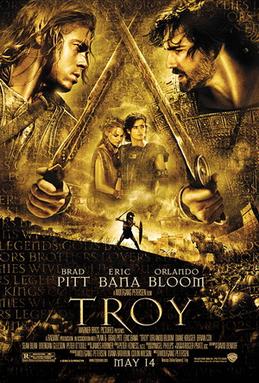
CRACKER? Troy (2004)


                I recently taught “The Iliad” for the fortieth time in my Western Civilization class, so I decided to rewatch “Troy” and review it with an eye to how close the movie retells the epic poem.   It seems appropriate that a web site that reviews war movies should examine a movie based on the first war story in Western literature.  Before you say “what took you so long?”, I want to point out that I did review the movie as part of my Best War Movie of the 21st Century Tournament.  (It defeated “The Last Samurai”, but lost to “Master and Commander”.)  This review will concentrate on the plot. So if you haven’t read “The Iliad” - spoiler alert.  And, come on, get that off your bucket list!  And, if you think watching this movie takes the place of reading Homer’s incredibly long poem, think again.  (But high school students trying to avoid reading the poem and using my review instead, you’re welcome!)

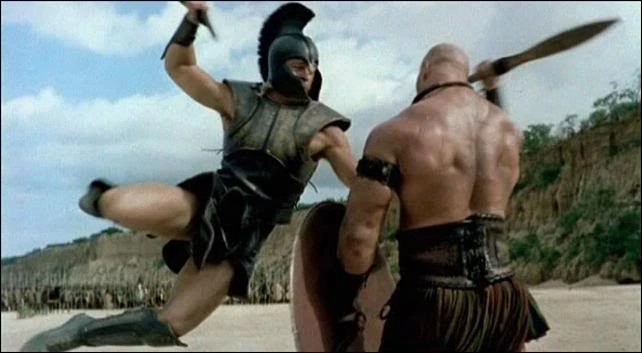
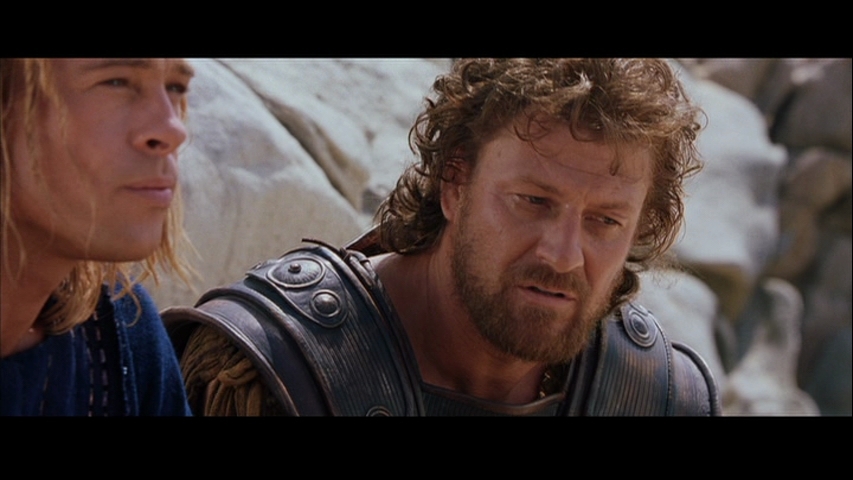
                “Troy” is actually the story of the entire Trojan War whereas “The Iliad” covers just six months in the ninth year.  A title card introduces the movie with background information pre-war.  King Agamemnon (Brian Cox) has united the Greek cities into a loose alliance, except for Thessaly. His brother Menelaus (Brendan Gleeson) is negotiating peace with Princes Hector (Eric Bana) and Paris (Orlando Bloom) of Troy. While the King of Sparta is making peace, his brother is making war with Thessaly.  Instead of a bloody battle, it is decided that each army will put up a champion for a duel.  Agamemnon’s champ is Achilles (Brad Pitt), which is awkward because they despise each other.  The duel ends with Achilles doing his signature move.  Meanwhile, back in Sparta, Menelaus’ wife Helen (Diane Kruger) is showing Paris more than the normal hospitality.  This could end up ramming (this is Ancient Greece) the peace treaty.  Especially when Helen elopes with Paris.  When Hector finds out, he decides bro and his ho before the entire population of Troy.  Menelaus goes crying to big brother, who uses the cuckolding as an excuse to conquer Troy.  If that is going to happen, the Greeks will need their main man Achilles.  Odysseus (Sean Bean) convinces Achilles to accompany the expedition in spite of it being suicidal for Achilles.  Achilles’ mother points out that it is better to die a glorious death and be remembered forever than to provide her with grandchildren.  Odysseus points out that since he is being played by Sean Bean, he is committing suicide also.
the move - as described by Homer

                Achilles leads the beach assault.  He and his Myrmidons avoid the fire arrows by getting into a testudo.  Romans, take note.  Achilles is a killing machine and the entire Trojan army retreats from him.  To add insult to injury, he desecrates the Temple of Apollo.  Hector rides to the rescue and finds out why Achilles is the J.J. Watts of the Greek army.  Achilles nobly spares Hector’s life because it is too early in the movie for that duel.  Or as Achilles puts it:  “It’s too early in the day for killing princes”.  The victory celebration is marred by Achilles and Agamemnon debating who deserves credit for the win.  Agamemnon’s argument is the king determines who gets the credit – and that would be me.  Achilles responds with:  “War is young men dying and old men talking”.  Oh, snap!  To emphasize where the power lies, Agamemnon insists on taking a beautiful captive girl named Briseis (Rose Byrne – Angelina Jolie not available?) away from Achilles and makes it clear she will not be just dusting his tent.  Achilles is so upset he says “you sack of wine!”  He’s more of a physical fighter than a verbal taunter.  Until his sex slave is returned, he will not kill any more thousands of Trojans.

                At a Trojan council meeting, Paris stops the debating by proposing a duel with Menelaus to end the war.  (The royal family rushes to place bets on Menelaus.)  The duel between the vengeance-minded brute and the wimpy, ladies-man goes as you would expect.  End of war and end of movie, right?  Except that the winner dies and the war continues with a phalanx battle.  Trojan archers from the city walls turn the tide and the Greeks retreat.  This would never have happened if Achilles were here, so Agamemnon returns Briseis who is so grateful to have that weight lifted from her chest that she falls in love with Achilles. Good sex is not enough to rekindle Achilles' blood-lust.  A night attack using fire-balls (Spartacus take note) puts the Greeks on the brink of having to accept that a semi-hot chick might not be returning with them.

                When the daylight comes, Achilles best buddy Patroclus (Garrett Hedlund) sneaks off in Achilles’ armor and leads a counterattack.  Like on a playground, everyone gathers around for the duel between the faux Achilles and Hector.  Patroclus may look like Achilles, but…  Achilles is not going to take this well.  But on the plus side, Achilles will stop his pouting and return to slaughtering.  But first, he has some unfinished business with Hector.  Achilles calls Hector out (literally) and they have the type of fight that you would expect from two superstar actors who refuse to use stuntmen and rely on robotic choreography.  The duel turns when Hector trips over the only rock located on the plain outside Troy.  In a great act of poor sportsmanship, Achilles drags the corpse back to the camp.  ( I assume this was not in the original script, but was an idea that came to the ever-competitive Pitt.)  Later, King Priam (Peter O’Toole) comes to beg his son’s body back and prove that he can still act circles around these young whippersnappers.  Patroclus is cremated in the third funeral pyre scene in the movie.  At this rate they are going to run out of coins to put on eyes.  This, by the way, is where “The Iliad” ends, but the movie goes on to conclude the war because too many theatergoers have money riding on who wins the war.
ladies, he wants you

                Odysseus (Sean Bean is still alive!) gets a bright idea for a way into the city.  The horse does look like it was built from ship timbers.  Nice prop!  Paris wants to burn it, but being the most unpopular man in Troy, no one listens.  During the night, Achilles and other sneaky Greeks initiate the sack of Troy.  Achilles is not interested in the fun stuff – looting, raping, killing.  He is on a quest to rescue Briseis.  Andromache and Helen escape, along with Aeneas – a character introduced so intellectuals can feel superior to the rest of the audience.  Google him.  Agamemnon stabs Priam in the back (literally).  And as though that does not bring enough hisses, he moves on to abusing Briseis.  She stabs him in the neck.  It’s like a gift for her boy-friend Achilles.  But before he can thank her, Paris puts an arrow in his ankle.  Lucky inaccurate shot!  The next three shots are more accurate.  Who wants to see Achilles die from an errant arrow to the ankle?  Paris and Briseis escape.  He knows a way out – he would!  Another funeral pyre.  Sean Bean survives!  Maybe there will be a sequel featuring Odysseus.  Is there a story that could be adapted into a screenplay?
a Trump rally

                My belief is that a movie should improve upon the book it is based upon.  “Troy” is a mixed bag in that respect.  It jettisons the ridiculous role played by the gods in the war, but then the screenplay changes the deaths of virtually every main character and messes with the ending in a move purely aimed at satisfying the audience.  In many ways the movie treats the audience as dummies.  This includes the simplistic theme of glory equals immortality.  This differs from Homer’s theme of “the wrath of Achilles” because Brad Pitt can’t be seen playing a jerk.  In reality, Achilles is one of the great heels in history.  The movie plays into the common ignorant belief that he was a hero.  For this reason, Pitt’s Achilles does not commit atrocities like cutting the throats of twelve prisoners at Patroclus’ funeral as he does in “The Iliad”.  The transformation of Achilles to an empathetic, lady-rescuer is laughable.   Although Achilles is not quite the brute of “The Iliad”, the other characters are spot on in their personalities.  The movie insists on making Agamemnon into a supervillain which is beyond Homer’s depiction of him as a dick.  The cast is all-star and they do a good job.  At least the men do, the female characters are weaker.  The biggest problem being the key role of Helen.  A little known Diane Kruger was cast and she is not up to playing the most beautiful woman in the Ancient World.  (Why not the modern “face that launched a thousand ships” – Jennifer Anniston?  Another case of a Pitt veto?)
she's pretty, but a thousand ships?

                “Troy” has all the strengths and weaknesses of an epic.  Director Wolfgang Petersen (“Das Boot”) knows how to make crowd-pleasing, big budget blockbusters.  He uses CGI well for the fleet and army scenes, but there are still a lot of extras in the film.  The sets are kitschy.  Basically what a modern interior designer imagined a Trojan palace would have looked like.  The dialogue matches the look.  It is pompous and heavy-handed.  “I will remember your name”.  (Because that is the theme of this movie.)  “I hate Achilles”.  (In case my scowl is not clear enough.)  The cinematography is showy.  There is a tracking shot over the beach that cribs from “The Longest Day”.  There is a sudden appearance of POV when Paris fights Menelaus.  Petersen can’t force explosions in, but he does manage to get rolling fire balls.  (Fire – the go-to effect until Alfred Noble revolutionized action movies.)  The score is what you would expect.  James Horner took over after test audiences found Gabriel Yared’s work too old-fashioned. I found Horner’s work too “Enemy at the Gates”.  Is it okay to plagiarize from yourself?  He actually was accused by some critics of stealing from several classical composers.

                As a combat film, the movie is visceral, but anachronistic.  If you read Homer, most of the fighting involves individual duels.  The movie stops to reenact the key duels, but the rest of the combat is basically a Hollywood melee.  The Greeks did not fight this way at that time.  The movie also pays lip service to the use of chariots, but in the “Iliad” every prominent warrior used a chariot to move to and retreat from the battlefield.  The role of archery is ginned up because Hollywood loves blizzards.  Hollywood also loves twists.  This explains why the Homer-challenged are fooled into thinking Hector has killed Achilles.  One good thing about the combat is it is not repetitive, like in Homer.  Each battle scene is different.  And they are spaced out so the movie does have a nice flow and no long boring stretches. 
"it's not so bad - dying, the gods know I've
done it enough times"

                “Troy” will not make my 100 Best War Movies list.  It is a great example of how Hollywood tampers with classic literature to make it more appealing to modern audiences.  I will be doing a “Homer vs. Hollywood” post in the future, but as a preview, “Troy” is far from a Cliff Notes version of “The Iliad”.  Please do not watch it and then take reading “The Iliad” off your bucket list.


GRADE  =  C   


Friday, October 17, 2014

NOW SHOWING: Fury (2014)


                “Fury” is the new WWII tank combat movie starring Brad Pitt.  It was directed and written by David Ayer.  He earlier had written “U-571”, a movie for which he had to apologize for historical inaccuracies.  This time he took on a purely fictional story of a tank in the waning days of World War II Europe.  The tank is a M4A2E8 Sherman and it is participating in the drive into Nazi Germany.  The crew is headed by Sgt. “Wardaddy” Collier (Pitt) and they have been together since North Africa.  They are part of the 2nd Armored Division (the “Hell on Wheels” division).  The movie was filmed in the English countryside and had a budget of approximately $80 million.  The producers relied on four authentic M4s and a Tiger 131 loaned by a museum.  The Tiger is the only operational one in the world and this was the first time a genuine one was used in a war movie.

                The movie opens in the aftermath of what must have been a tank melee.  The title tank is the sole survivor of its platoon, but the assistant driver was killed.  This opens the hatch for a green replacement from the secretarial pool named Norman (Logan Lerman).  He is not exactly welcomed with open arms (like all other replacements in war movie history).  Collier is determined to make a man out of him.  Actually, he is determined to make him into the type of man that they have become.  Norman will become a productive member of the crew once he learns to kill anything that moves and executes any S.S. bastard that crosses their path (because that’s what they would do to you).  The arc is initiated with Norman starting off as a reluctant warrior with some naïve morals.  He’s going to gain some testicles and lose that pesky conscience.

                The movie moves through the typical war movie flow of action followed by rest and exposition.  The combat scenes are amazing and among some of the best of recent war movies.  There is an assault across a field that features a dual with anti-tank guns.  Urban warfare of the tank versus sniper variety.  A four on one scrimmage against the Tiger which ends up accurately reflecting the odds against Shermans.  This particular encounter reflects back upon the opening title card that proclaimed that American tanks were outgunned and outmaneuvered by more advanced German tanks.  What sets Fury apart from this fact is that Brad Pitt is in command.  The final cataclysm involves the defense of a crossroads against a large S.S. infantry force.  It’s last stand time.  Surprisingly, the combat scenes are not shot in the “Band of Brothers” and “Saving Private Ryan” style.  They rely mostly on explosions and tracers with a medium amount of quick cuts.  Add to that the unique tank scenarios where you are racing to get that shot off before it’s your turret that is blown to Hell.  The action will have you on the edge of your seat, but not feeling dizzy.  You also will not need sunglasses to shade any bright colors.  This film’s predominant color is mud.  In case you don’t understand the enemy, the music is very Wagneresque. 

                Unfortunately, the rest and exposition scenes are troughs.  Some of the interactions between the crew and the maturation and acceptance of Norman are awkward.  There is a painfully forced blooding of the newbie that defies reality and is offensive toward WWII veterans.  Ayer’s attempt to show the truly horrible effects of war on the psyches of the “good guys” veers too far into the trite territory of “warfare strips away your humanity”.  There is also the equivalent of a dysfunctional family’s Thanksgiving dinner that includes the war trumps civilization theme.

                The combat scenes create enough good will from war movie lovers to overcome some curious flaws.  The film has some extended lulls between the balls to the wall (which happens to be the only graphic wounding that the movie does not depict) action scenes.  Curious partly because Ayer finds no opportunity to develop the characters.  They are all stereotypes.  Pitt plays the hardened leader who is haunted by losses (although he has apparently lost only one man in over two years of serious action).  The movie hints at some deep psychic wound, but never delivers.  It also implies that the crew blames him for something, yet they are ready to die for him with little questioning.  The crew is heterogeneous with the Bible-thumper named “Bible” (Shia LeBeouf probably not having to act too hard), the psychopathic hick named “Coon-Ass” (Jon Bernthal chewing scenery as a cracker, not a Cajun), and the obligatory minority wise-ass named “Gordo” (Michael Pena loving not having competition for audience appeal).  The acting is inconsistent.  Pitt is solid and obviously has watched film of previous actors playing the exact same role.  LeBouef is effective in leaving one to wonder if “Bible” is supposed to be a nutcase or a role model.  Depends on if you are a fundamentalist, I suppose.  Lerman is in over his head and makes the arc hard to believe.  He is cursing up a storm by the end, so there’s that.  Bernthal is the weak link.  You would be obnoxious too if you had dead meat tattooed on your fore-head.

                The movie is definitely more enjoyable if you have not seen a lot of war movies.  I found myself recognizing all the characters (Norman = Upham) and themes from previous movies.  Heck, the movie ends with a last stand, who will survive scene.  “We ain’t never run before.”  And like all fictional cinematic last stands, don’t expect reality to interfere with the carnage.  It is instructive to remind that this last stand is not based on a true story like “The Alamo” or “Zulu”.  As usual in a war movie aimed at the general public, “Fury” builds to a climax that crosses over the line of reality into the realm of ridiculous.  However, up until the end the film is a pretty good portrayal of the lives of tankers.  The tank interior is authentic and the operation is well-enacted.  The soldier talk is not jarring, although the addition of a catch phrase (“best job I ever had”) is a bit lame.

                Once again I have the dilemma of not wanting to scare off any future war movies.  They come along so seldom these days that you have to lower your expectations to not be crushed by unfulfilled anticipation.  “Fury” is a bit better than I expected.  I was skeptical about a Sherman taking on the German army by itself.  The movie confirmed my fears, but it was not laughable and it’s not like we have a lot of great tank movies for it to live up to.  I am not a big Sherman fan, but I admire the men who went into combat in them.  This movie does them justice, but to be a truly great war movie it needed a better writer than David Ayer.  With that said, he has improved since “U-571”.

GRADE  =  B-