SYNOPSIS: This is the Marx Brothers' movie about
war. Groucho is appointed ruler of Freedonia and chaos ensues. Chico and Harpo
play spies for the rival country of Sylvania. Groucho's lack of tact leads to
war with Sylvania. Zeppo is not funny.
BACK-STORY: “Duck
Soup” was the last Marx Brothers’ movie made for Paramount. It was the last film where all four
brothers starred. Zeppo gave up his fabled acting career after the film was
finished. The Marx Brothers were never funny again. The movie was released in
1933, coincidentally (and I do mean coincidentally) the year Hitler came to
power. The movie was banned in Italy because Mussolini was personally offended
(you can’t buy publicity like that) and in Germany
(as with all their films) because the brothers were Jewish. It was directed by
the only decent director that dealt with them –
Leo McCarey (who did not enjoy the experience). The movie underperformed at the
box office possibly because its irreverence did not fit the Depression-era mood
of the populace and its anti-government satire ran up against the optimistic
mood of the early New Deal. Critics were pretty brutal and the movie was not
highly thought of until a revival in the 1960s. Today it is considered to be
the Marx Brothers’ masterpiece and is ranked #60
(up from #85) on AFIs most recent list of great American movies. It is #5 on
the Comedy list.
TRIVIA: Wikipedia, imdb, TCM
1. It was Zeppo’s last movie. He finally had enough of people describing
him as the unfunny one.
2. The original name of Firefly was to be Rufus
T. Firestone.
3. The
term “duck soup” was slang for something that was easy.
4. It was not the bomb people think, but it was
a disappointment after the success of “Horse Feathers”.
5. The director Leo McCarey was by far the best
the Marx Brothers ever worked with. He
suggested the famous mirror scene based on an old vaudeville act. It was not the first time the scenario had
been played on film, however. Harold
Lloyd had done something very similar in a short called “The Marathon”. McCarey was most responsible for the anti-war
satire. The Brothers were only
interested in laughs.
6. The movie did not coin the term “This means
war!”, but it popularized it. The phrase
was often used by Daffy Duck and Bugs Bunny.
7. One of the few Marx Brothers’ movies where
Harpo does not play the harp. And Chico
does not play the piano. Some theater
owners complained that this was the reason the movie underperformed.
8. The mirror scene took only two minutes to
perform. Amazingly, Groucho does not
crack a single joke in the scene.
9. In the battle scene, Groucho switches
uniform five times: Union general,
Confederate general, Boy Scout troop leader, British Revolutionary War general,
and Davy Crockett.
Belle and Blade =
N/A
Brassey’s =
4.0
Video Hound =
N/A
War Movies =
N/A
Military History = #27
Channel 4 =
no
Film Site = yes
101 War Movies = no
Rotten Tomatoes =
no
OPINION: This is without a doubt the best Marx Brothers’ movie, in my opinion. I am not a big fan of the musical
interludes and romantic subplots that tend to bring their films to a screeching
halt. “Duck Soup”
has less of those weaknesses. The movie is manic with its mix of sight gags,
slapstick, one-liners, and puns. Many of the jokes are laugh out loud funny
which is unusual for a movie that goes back to the 1930s. Of course, you also
have a few groaners. However, the percentage of jokes that work is surprisingly
high. Many of the lines are classics. I
do not buy that the Marx Brothers intended the movie to be recognized as a
great anti-war movie. I take Groucho at his word that they were trying to make
a funny movie without a deep meaning. However,
“Duck Soup” is overrated as the 5th best comedy of all time according to
AFI, but it certainly is in the top 100 comedies. It is very funny (or
specifically, Groucho and Chico are funny). I am not sure it belongs in the 100
Greatest War Movies, especially when the much better “To Be or Not to Be” did
not make it.
BACK-STORY:“Duck Soup” was the last Marx
Brothers’ movie made for Paramount.It
was the last film where all four brothers starred.Zeppo gave up his fabled acting career after
the film was finished.The Marx Brothers
were never funny again.The movie was released in 1933,
coincidentally (and I do mean coincidentally) the year Hitler came to power.The movie was banned in Italy because
Mussolini was personally offended (you can’t buy publicity like that) and in
Germany (as with all their films) because the brothers were Jewish.It was directed by the only decent director
that dealt with them – Leo McCarey (who did not enjoy the experience).The movie underperformed at the box office
possibly because its irreverence did not fit the Depression-era mood of the
populace and its anti-government satire ran up against the optimistic mood of
the early New Deal.Critics were pretty
brutal and the movie was not highly thought of until a revival in the
1960s.Today it is considered to be the
Marx Brothers’ masterpiece and is ranked #60 (up from #85) on AFIs most recent
list of great American movies.It is #5
on the Comedy list.The title apparently
comes from a slang term meaning an easy task.
Margaret Dumont - one of the great straight ladies
OPENING:The fictitious European country of Freedonia is going
bankrupt and the governing council pleads with the wealthy Mrs. Teasdale
(Margaret Dumont) to float a loan.Teasdale inexplicably insists that Rufus T. Firefly (Groucho) be
appointed the new ruler. Meanwhile,
Ambassador Trentino (Louis Calhern) from neighboring Sylvania is plotting to
marry Teasdale and foment a war.
SUMMARY:Firefly’s personal assistant Bob Roland (Zeppo) gets
the festivities started by breaking into a song to announce the arrival of
Firefly. (Couldn’t they have at least given Zeppo a funny name?)Let the anarchy begin.Firefly arrives via a fire station pole and
the percentage of sentences coming from his mouth that are jokes is going to be
well over 90% for the rest of the movie.He reminds one of Robin Williams, but Groucho’s lines are obviously well
crafted instead of improvised.The second
song soon follows the first as the crowd sings the Freedonian National
Anthem.“Hail, hail Freedonia, land of
the brave and free”.Fortunately, the
songs will be spaced out after this.
Trentino has hired
Chicolini (Chico) and Pinky (Harpo) as spies.He meets with them and suffers verbal and physical abuse from the worst
secret agents in history and yet sends them back to keep an eye on Firefly.Harpo’s schtick includes using scissors to
snip things.Hilarious?
Firefly hosts a cabinet meeting, but shockingly takes
little interest in efficiently running the country.It looks like Teasdale has chosen
unwisely.Oh well, what woman would not
have been seduced by Groucho’s charms (and constant insults)?For example, later in the movie when he
imagines marriage to Teasdale he tells her: “I can see you
right now in the kitchen, bending over a hot stove, but I can't see the
stove."
Next
comes the famous lemonade stand scene where Chicolini and Pinky abuse the
hapless nearby lemonade stand owner played by Laurel and Hardy foil Edgar Kennedy.Classic physical comedy – vaudeville style!Just don’t ask what the Hell this has to do
with anything.Oh, that’s right, it’s an analogy for how countries treat each
other before going to war!Thank you,
critics.I would not have picked up on
that.It looked like nonsense to my
untrained eyes.
Firefly appoints Chicolini Secretary of War so
he can have humorous exchanges with him.Mission accomplished!Firefly
decides to insult Trentino out of the country so he can have Teasdale’s
millions to himself.Instead, Firefly
provokes himself into causing war with Sylvania.
Trentino, Firefly, and Teasdale
Later that night,
Dumont tries to reconcile the two men and at first Firefly is amenable.He utters one of the great WTF lines in
cinema when he says "Well, maybe I am a little headstrong, but I come by
it honestly. My father was a little headstrong, my mother was a little
armstrong. The headstrongs married the
armstrongs and that's why darkies were
born." (Before you write your congressman:My research reveals this was a reference to
the popular hit from 1931 entitled “That’s Why Darkies Were Born” sung by Kate
Smith and meant as an anti-racism song.Do not look for it on your local jukebox.)The attempt at reconciliation collapses
resulting in Firefly’s declaration “This means war!”Followed by the screamingly funny:“Go, and never darken my towels again!”Groucho rules!
The next scene is
Chicolini and Pinky sneaking into Teasdale’s house to steal the war plans.Harpo briefly (mercifully) plucks the strings of her piano in lieu of a
harp, but Chico does not play the piano.(Two reasons why this is my favorite Marx Brothers’ movie.)Both Chicolini and Pinky find reasons to
disguise themselves as Firefly and the iconic mirror scene ensues.Enjoy the extended period when Groucho does
not say a word.It must have been a
record.
Chicolini is put
on trial so the screenwriters can show off their puns.For instance:
Firefly: Chicolini, give me a number from one to ten.
Chicolini: Eleven.
Chicolini: Now I aska you one. What is it has a trunk, but no key, weighs 2,000
pounds and lives in the circus
Firefly: Right.?
Prosecutor (unwittingly supplying the correct answer): That's ir-relevant.
Chicolini: Irr-elephant? Hey, that'sa the answer! There's a whole lotta
irr-elephants in the circus.
Minister/Judge: That sort of testimony we can eliminate.
Chicolini: Thats-a fine. I'll take some.
Minister/Judge: You'll take what?
Chicolini: Eliminate. A nice, cool glass eliminate.
"all God's chillun got guns"
The trial is interrupted by news that Sylvania has declared war.This, of course, results in a big production
number aping a minstrel show.The song
is “Freedonia’s Going to War” and is one of the few moments in the film that
can clearly be determined to be purposeful satire.The number makes fun of nationalism in
general and the initial enthusiasm for war when countries reach that
stage.(This was the only musical number
in their films where all four Marx Brothers participated.)It is also theorized that the production is
satirizing the Berkeley numbers popular back then.
Firefly as Scoutmaster
CLOSING:Suddenly the war is well underway.Firefly is leading from what looks like an isolated farmhouse that is
under fire.The one-liners are flying
like the bullets and shells.Some
authentic looking soldiers are actually included, but Firefly is dressed alternatively
as a Rebel infantryman, Yankee general, British palace guard, Scoutmaster, and
Davy Crockett.Things are not looking
well until Trentino is captured leading an assault on the headquarters.Don’t ask why an ambassador is leading an
assault.The boys pelt him with fruit
until he concedes defeat.Teasdale
breaks into a victory aria and is likewise pelted.
RATINGS:
Acting -C
Action -4/10
Accuracy – are you kidding?
Realism -see above
Plot -C
Humor -A
Overall - B-
WOULD CHICKS DIG IT?It totally depends on their opinion of the Marx Brothers.This film is actually less female friendly
than their other movies.There is no
romantic subplot.Both females are
cringe-worthy.Teasdale is either
clueless about Firefly’s nonstop insults or accepts them because she is
infatuated with him.Not exactly a
feminist.Trentino’s paramour Vera (Raquel
Torres) is femme fatale lite and seems to be in the movie purely to add
cleavage.I cannot imagine very many
women under age fifty enjoying this movie.
HISTORICAL ACCURACY:The movie is a thinly disguised retelling of the Franco-Prussian War.Firefly represents Otto Von Bismarck and Teasdale
is Queen Victoria.Just kidding.
CRITIQUE:This is the best Marx Brothers’ movie, in my opinion.I am not a big fan of the musical interludes
and romantic subplots that tend to bring their films to a screeching halt.“Duck Soup” has less of those
weaknesses.The movie is manic with its
mix of sight gags, slapstick, one-liners, and puns.Many of the jokes are laugh out loud funny
which is unusual for a movie that goes back to the 1930s.Of course, you also have a few groaners.However, the percentage of jokes that work is
surprisingly high.Many of the lines are
classics.Officially the top ones
(determined by AFI) are the following:
Firefly:Remember, you're fighting for this
woman's honor, which is probably more than she ever did."
Firefly to Vera:"I could dance with you ‘til the
cows come home. On second thought, I'd rather dance with the cows ‘til
you came home."
Fierfly: "I suggest that we give
him ten years in Leavenworth, or eleven years in Twelveworth."
Chicolini: "I’ll tell you what
I’ll do. I’ll take five and ten in Woolworth."
Unfortunately, other than the fact that it is a very funny movie, it is not
a very good movie.The acting is
average.Groucho and Chico are fine, but
I always have found Harpo to be grating.You have to admire Dumont and Calhern for being able to keep a straight
face and maintain their composure.The
rest of the cast is mostly people they could have picked up off the
street.This is embarrassingly apparent
during the big musical number where it looks like it was not rehearsed
much.Speaking of which, many of the
scenes look like they were done in one take.This should not be surprising considering we are talking about the Marx
Brothers.
Technically speaking, the movie does not stand out.The cinematography is pedestrian.It is crisp black and white, but nothing
special.The score (was there one?) is
forgettable.The plot exists only to go
from one comedy premise to another.Much
of it makes no sense (imagine telling this to Groucho).A good example is that Trentino supposedly
wants war as anexcuse for conquering
Freedonia and plots throughout to accomplish this.Yet, in several instances, his character
tries to avoid war.But who expects consistency in a Marx Brothers’
movie, right?
The movie is highly rated mainly because it is considered to be a scathing
satire of government and war.This is
debatable and may have been read into the movie by later interpreters.It is telling that it was not until the 60’s
that most critics “discovered” its brilliant satire.People conveniently overlook the fact that it
was released in 1933 at a time that Hitler was barely known in America and
certainly had not revealed his villainy.As far as Mussolini, he was still in his “he makes the trains run on
time” phase where he was more praised than condemned.It is going too far to credit the Marx
Brothers with targeting fascism for satire.Groucho’s Firefly is nowhere near Chaplin’s Hynkel from “The Great
Dictator”.It is very hard to conceive
of the character as being a parody of Mussolini.Obviously, the movie has nothing to say about
World War II, but even World War I is problematical.Certainly you can make a case for the “Freedonia
Going to War” number being critical of the enthusiasm that Europeans felt for
war in 1914, but that type of nationalism is pretty generic.This would also apply to the famous line by Firefly:“There must be a war – I’ve paid a month’s
rent on the battlefield.”The strongest
connection to WWI is when Firefly sends Pinky out to the front and snidely says
that “while you’re out there risking life and limb through shot and shell, we’ll
be here thinking what a sucker you are.”If meant to be, this is as good an indictment of the misuse of European
young men as you can find.Before you
pat the Marx Brothers on the back for “sticking it to the man”, consider the
fact that when asked about the satirical nature of the film, Groucho replied
that “Duck Soup” was just “four Jews trying to get a laugh.”Sometimes it’s just that simple.By the way, did you know that “The Naked Gun”
was an indictment of the corruption of the Los Angeles Police Department?
CONCLUSION:“Duck Soup” is
overrated as the 5th best comedy of all time according to AFI, but
it certainly is in the top 100 comedies.It is very funny (or specifically, Groucho and Chico are funny). I am not sure it belongs in the 100 Greatest
War Movies.I have to assume the
Military History panel bought into the revisionist belief that it is brilliant
satire.I do not buy that the Marx
Brothers intended the movie to be recognized as a great anti-war movie.I take Groucho at his word that they were
trying to make a funny movie without a deep meaning.It is absolutely criminal that “Dr.
Strangelove” is #94 and “Duck Soup” is #27.On what planet is that justifiable?For that matter, where is the vastly superior “To Be or Not To Be”? POSTER: Good. Kudos for including Zeppo. B
the trailer
TRAILER: Gets the manic nature right, but does not give the slightest clue what the movie is about. Plus it advertises it as a musical show, which it is not. D
the mirror scene
THE WAR MOVIE BUFF’S TOP TEN WAR COMEDIES
10.Mr. Roberts
9.Good Morning, Vietnam
8.Catch-22
7.Duck Soup
6.Kelly’s Heroes
5.Stripes
4.MASH
3.To Be or Not To Be
2.Dr. Strangelove
1.Tropic Thunder
Readers might want to look
back at this year’s March Madness competition that determined that “Tropic
Thunder” is the best war comedy.Start
here:"March Madness: War Comedies"
Reminder: you can follow me on twitter - @warmoviebuff
“Dr. Strangelove” has one insane character – Gen. Ripper. He is upset that fluoridation is harming our “precious bodily fluids”. He sends a flight of B-52 bombers to bomb the Soviet Union. Gen. Turgidson is a Curtis Lemay type jingoist who wants to win a nuclear war. Dr. Strangelove is a Werner Von Braun type of ex-Nazi scientist who has trouble remembering that the President is not der Fuhrer. The rest of the characters are normal people thrust into abnormal situations.
“Duck Soup” has three outlandish characters. Groucho plays the President Rufus T. Firefly as an insult hurling cad. Chico plays Chicolini as a punning imbecile. Harpo plays Pinky as a adult brat. In other words, the same characters they always play. The other characters are all stock. The real standout is Zeppo as Bob Roland. What an incredibly complex character. Just kidding.
First half score: Strangelove - 46 Duck Soup - 40
SECOND HALF: SATIRE
“Dr. Strangelove” is considered to be one of the great satires of war and nuclear war in particular. It was so cutting that some conservatives accused it of being leftist in its condemnation of Mutually Assured Destruction. The debates in the War Room on how to handle a nuclear crisis are hilariously chilling because they anticipate the insanity of an actual crisis.
Surprisingly, “Duck Soup” has a similar theme: how a crisis can escalate into full-blown war. Of course it takes a different path to get to the explosions. The overall satirical theme is exploited for silly wordplay, sight gags, and slapstick, but in all the frantic action the point is made in a bludgeoning sort of way. Where “Strangelove” is Aristophanesesque, “Duck Soup” would make Plautus proud.
Second half score: Strangelove - 50 Duck Soup - 38
ANALYSIS:
You will laugh more at “Duck Soup”, but that does not make it a better comedy. The characters are stronger in “Strangelove” and the satire is sharper. They are very much of their time period. “Strangelove” could not have been made in the 1930s and “Duck Soup” would have flopped in the 1960s. Neither would do well today. Most moviegoers are not smart enough to get satire like “Strangelove” (note the performance of “In the Loop”) and people do not want messages with their silliness as in “Duck Soup”.
FINAL SCORE:
DR. STRANGELOVE - 96
DUCK SOUP - 78
MISTER ROBERTS (5) vs. GOOD MORNING, VIETNAM (7)
FIRST HALF: CHARACTERS
“Mister Roberts” has four main characters. Roberts is the noble warrior wannabe who cares for the crew and battles with the captain on their behalf. The captain is an incompetent martinet. The Doc is wise. Ensign Pulver is comic relief as the wolf in sheep’s clothing. The rest of the crew are comfortable stereotypes. Although all the main characters have been seen before, they fit the plot perfectly.
“Good Morning, Vietnam” has one amazing character – Cronauer. Of course, the character is actually Robin Williams playing himself, so a lot depends on if you like his schtick. Tuan is an interesting character as the Viet Cong friend. He puts a sympathetic face to the enemy. Hauk is crucial as the humor-impaired superior. Dickerman (the station manager) is a cliché of the villainous, stick in the mud officer (excuse me, non-com). The most unorthodox character is General Taylor who is not portrayed as incompetent or hide-bound. He is refreshingly open to Cronauer’s antics because it boosts morale.
First half score: Mr. Roberts - 42 Good Morning, Vietnam - 40
SECOND HALF: SATIRE
“Mister Roberts” is not really a satire, it is more of a service comedy. There is some satire of the officer class, but it is subtle and obvious. No new ground is broken, but that was not the intention of the movie. The movie does not make you squirm and it has no message to convey. It is meant to entertain and does that admirably.
“Good Morning, Vietnam” is not purely a satire, but it definitely has satirical elements. It has a martinet, old school superior (Dickerson) similar to the Captain in “Roberts”. We’ll call that a tie. GMV goes beyond MR by satirizing conservatives versus liberals and pro-war versus anti-war. Of course, the movie is clearly liberal and anti-war. When it’s not masquerading as a Williams’ stand-up act, it has some shots to take at the War, but I think most of its audience did not leave the theater thinking they had seen a satire.
Second half score: Mr. Roberts – 32 Good Morning, Vietnam - 35
ANALYSIS:
This was a tough call. The movies are so different and both do their job well. Their main characters are equally strong. It comes down to the fact that GMV is funnier than MR and has more to say about the military and war. It is not necessarily a better film, it is simply a better war comedy.
FINAL SCORE:
GOOD MORNING, VIETNAM - 75
MR. ROBERTS - 74
STRIPES (8) vs. MASH (6)
FIRST HALF: CHARACTERS
“Stripes” revolves around two screw-ups who do not adjust well to the Army. Winger (Murray) is a glib troublemaker and Ziskey (Ramis) is his smug straight-man. They remind me of Hope and Crosby. The rest of the unit are your typical heterogeously humorous mixture – the hick, the psycho, the jolly fat guy, etc. Capt. Stillman is from the officers are incompetent buffoons school. No extra points there. Sgt. Hulka is your typical Hollywood drill sergeant, but the movie deserves credit for pulling a character from a serious war movie (e.g., “Full Metal Jacket”) and not making him comical.
“MASH” has more well developed characters. Hawkeye, Trapper John, and Duke are similar in their anti-military attitudes to Winger. The supporting characters are better developed than in “Stripes”. Major Burns and “Hot Lips” are good foils for the trio. Father Mulcahy, Lt. Col. Blake, and Radar are not as strong as in the TV series, but make more of an impression than most of Winger’s comrades.
First half score: MASH - 46 Stripes – 40
SECOND HALF: SATIRE
“Stripes” is not a satirical film. It is mainly aimed at 14 year old boys and that audience is not known for getting satire. “Stripes” is low-brow humor and it is undeniably entertaining, but it has no important message to convey. With that said, it does poke fun at boot camp and incompetent officers. It also features an armored, multi-weapon RV designed for urban warfare. It is doubtful that the screenwriters meant that to be criticism of the Army’s Research and Development, however.
“MASH” is a satirical, dark comedy. It is clearly anti-military. All the “positive” characters are unhappy with rules and regulations. All the “negative” characters (Burns, Hot Lips) are military toadies. The movie treats the Army apologists brutally. The movie uses the setting of a military hospital to criticize the insanity of war. The darkness is a deep shade of red.
Second half score: MASH - 45 Stripes - 33
ANALYSIS:
You can argue that “Stripes” is a funnier movie. Of course, that depends a lot on your tolerance for Bill Murray. However, this tournament is to determine the “best” war comedy, not necessarily the funniest. It is clear that “MASH” is a better movie. It is a more important movie and that deserves some consideration. The makers of “Stripes” would probably admit that they had no message to deliver and were not trying to make the greatest war comedy of all time.
FINAL SCORE:
MASH - 91
STRIPES - 73
TO BE OR NOT TO BE (2) vs. TROPIC THUNDER (13)
FIRST HALF: CHARACTERS
“To Be Or Not To Be” has a variety of interesting characters. Josef Tura stands out as the hammy actor. His wife Maria is not exactly loyal to him, but she is bravely helping the Resistance. Sobinski is a bit boring as the Maria-infatuated pilot. Ehrhardt is the buffoonish Gestapo commander. Silitsky is appropriately slimy as the traitor.
“Tropic Thunder” goes over the top with most of its characters. Speedman is the action star who is trying to revive his stalled career and is full of actor insecurities. Lazarus is the method actor who immerses himself in his role to the point of getting his skin tinted. Portnoy is the drug addicted funny man. The list goes on. Virtually every role is a parody.
First half score: To Be or Not to Be - 42 Tropic Thunder - 47
SECOND HALF: SATIRE
“To Be or Not to Be” satirizes acting troupes and Nazis. That’s an odd combination, but it works well. Benny’s Tura pokes fun at many leading men and their enormous egos. His marriage to Maria is a satire of Hollywood marriages. The movie daringly makes fun of Nazis at a time when the Germans dominated Europe. It makes them malevolent, yet laughable.
“Tropic Thunder” is a biting satire of actors also. It takes on several stereotypes as mentioned in the character section above. It paints with broad strokes, but there must have been some actors squirming when they watched it (I’m talking to you Schwarzenegger/Willis/Stallone and Crowe/Day-Lewis). The movie also brilliantly satirizes war movies, in particular Vietnam War movies like “Platoon” and “Apocalypse Now”.
Second half score: To Be or Not to Be - 44 Tropic Thunder - 48
ANALYSIS:
This is a battle between old school satire and modern satire. “To Be or Not to Be” was actually controversial when it came out. That is hard to believe today. It appears pretty tame compared to recent satires. In comparison, “Tropic Thunder” is the most recent film in the tournament. My how far war satire has come! Your opinion on which of these movies is a better comedy will tell a lot about your sense of humor and your age. In my opinion, the characters in TT are hilariously outlandish and that is acceptable in a satire. In addition, TT is the best (only?) satire of war movies and the skewering of sacred Vietnam War movies is spot on.
“Duck Soup” is the Marx Brothers’ manic send-up of war and the governments that provoke them. It was released in 1933 and is now considered their greatest work. Groucho plays Rufus T. Firefly, the leader of Freedonia. He is more interested in getting at rich widow Mrs. Teasdale’s fortune and goading his rival, the ambassador of Sylvania. Chico and Harpo are spies employed by the ambassador. There is not much of a plot, but it leads to war.
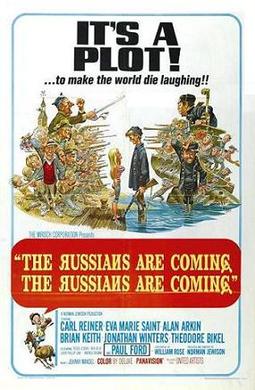
“The Russians Are Coming, the Russians Are Coming” is a Cold War comedy directed in 1966 by Norman Jewison. It is a satire of Cold War relations and small town life. A Soviet sub runs aground off an American island. Rumors spread among the rubes and the public panics. Meanwhile, the sub’s executive officer (Alan Arkin) and a squad attempt to steal a yacht to extricate the sub. There is a chaste courtship between a Russian sailor and an American girl. All the running about and shouting leads up to a tension filled Mexican stand-off that is diffused by a crisis that requires the two sides to cooperate.
FIRST HALF: ACTING
“Duck Soup” is a tale of two sets of actors. Groucho (Firefly), Chico (Chicolini), and Harpo (Pinky) are in top form. Margaret Dummont gamely recreates her usual butt of Groucho’s insults and Louis Calhern (Ambassador Trentino) is satisfactorily pompous and scheming. Everyone else is second rate (although Trentino’s vampish girlfriend is sexy, especially for a 30s movie). Zeppo is his usual wooden self playing Firefly’s aide named Bob Roland (he couldn’t even get them to give him a ridiculous name?). The whole movie depends on your tolerance for the “acting” of Groucho, Chico, and Harpo (especially).
“The Russians Are Coming…” has a cast of recognizable, but mostly unnamable character actors. The secondary cast is straight out of a 1960s Disney movie. The leads are strong. Alan Arkin as Rozanov won the Golden Globe and was nominated for the Oscar. It was a star-making turn. Carl Reiner as a writer whose family is held hostage is okay, Brian Keith is sufficiently gruff as the police chief. Jonathan Winters plays his usual character (goofily incompetent) as a deputy. The rest of the cast could best be described as comforting.
First half score: Duck Soup - 38 The Russians - 40
SECOND HALF: HUMOR
“Duck Soup” is ranked as #5 on AFIs list of 100 Greatest Comedies. That is way too high. The plot is weak and the movie is basically an excuse for Groucho’s nonstop one-liners (a very bad drinking game - drink everytime Groucho says a sentence that is not a joke), Chico’s silly wordplay and puns, and Harpo’s physical comedy. Many of the jokes fall flat, but there are so many of them that you get a lot of good laughs. The movie means to be satirical, but some of it seems to be unintentional. It is hard to believe the Marx Brothers intended for the movie to have the deeper meaning that critics attribute to it. It has some classic scenes (e.g., the mirror scene), but also some cringe-worthy song and dance numbers. The final scene in the farmhouse is a pretty hilarious, but silly lampoon of war.
“The Russians Are Coming…” is an amusing, but not funny movie. Do not fear. The poster is wrong - you should have no fear of "dying laughing". I seldom laughed. It is well-meaning and painfully liberal. This probably explains the hard to believe Academy Awards nominations for Best Picture (!), Best Actor (Arkin), and Adapted Screenplay. It won the Golden Globe for Best Musical or Comedy. It tries hard to thaw relations between the superpowers. Contrast that with the biting satire of "Dr. Strangelove" and it comes off as lame. For example, there is a running gag of the town drunk chasing a horse so he can reenact Paul Revere’s ride. Many of the characters are buffoonish small town hicks. The Russians are just like us. Why can’t we just get along? Not mirth-making material.
Second half score: Duck Soup - 38 Russians - 30
ANALYSIS:
Both of these movies are overrated. The difference is the reputation of “Duck Soup” increased after its disappointing opening run and it remains solid as a classic. ”Russians” was highly thought of when it was released because people wanted to like it. It does not hold up well except as a curio. “Duck Soup” is messier and manic, but without a doubt funnier.


.jpeg)