Showing posts with label Israel. Show all posts

Monday, May 8, 2023

Exodus (1960)


                It is based on the 1958 bestseller by Leon Uris.  Director Otto Preminger did not like the book and had screenwriter Dalton Trumbo tone down the anti-British and anti-Arab vibe of the novel.  Preminger gave the blacklisted Trumbo screen credit under his actual name and this plus the credit for writing “Spartacus” marked the end of the blacklisting era.  Uris did not like the finished product.  The movie was shot on location on Cyprus and in Israel.  It was nominated for Academy Awards for Best Supporting Actor (Sal Mineo) and Best Cinematography.  It won for Best Score (Ernest Gold).  Gold also won a Grammy.  The movie is credited with increasing support for Zionism and the nation of Israel in America.

                The British are detaining thousands of Jews in camps on Cypru in 1947s.  Many of them are survivors of the Holocaust and they want to go to Palestine to help start a new Jewish nation.  Ari Ben Canaan (Newman, who first appears shirtless) is a member of the Haganah and has a plan for over 600 Jews to escape in the old WWII transport ship called Exodus.  Ari meets an American gentile named Kitty (Eva Marie Saint) and their relationship starts off rocky, of course.  Kitty befriends a teenager named Karen (Jill Haworth).  She lost her whole family, except her father, who she is looking for.  The British won’t let the ship leave so Ari had the passengers go on a hunger strike and threatens to blow up the ship.  The Brits relent and let the ship sail.  It ends up at Haifa in Palestine.  There they find a conflict between Palestinian Arabs who do not want a Jewish state and a conflict within the Jewish community about how to achieve the Zionist dream of a Jewish nation.  Haganah is opposed by the Irgun, which is willing to use terrorism.  Dov Landau (Mineo) is a young man who survived Auschwitz by being a Sonderkommando.  He is a bomb expert.  The Irgun make use of his talents.  He and Karen fall in love and of course the same thing happens with Ari and Kitty.  If that’s not enough cliches, Ari is friends with Taha, a moderate Arab.  The movie moves on to the Acre Prison break.  Israel declares independence and the kibbutz that Kitty is helping at prepares to defend itself from Arab attack.  

                I don’t mind long movies, if there is a story to be told that deserves the length.  Most long war movies fit this qualification.  Unfortunately, “Exodus” is too long for the story it tells.  For instance, there is a long section dealing with the prison break and the payoff is weak and not worth the wait.  This is typical of a movie that teases action and seldom delivers.  So we’re left with a lot of talking and speechifying.  In fact, the movie concludes with a speech by Ari.  I’m sure no one laughed at the time when Ari predicts a day will come when Arabs and Jews will share the land.  I wonder what he would think if he were around today.  The drama interweaves with the two romances.  This must be part of the reason why the movie was popular with women.  However, there is little chemistry between Newman and Saint Marie and the romance is tepid.  Newman is otherwise strong in a role that was not a favorite of his.  The rest of the cast is not noteworthy.

                As far as the controversy, it appears that Preminger was successful in toning down the anti-British attitude of the book, but they still are villains.  What is surprising is the movie, although clearly sympathetic to the Zionists, does not demonize the Arabs.  The only significant Arab character is so friendly with Ari that he warns him of an impending Arab attack.  The movie did not fare well with British audiences and I have to assume it did worse in the Arab world.  But Americans, who had no dog in the fight, loved the movie.  Especially if they loved tear-jerkers.

None of the characters are real people, but some of the events are based on history.  Karaolos was a detention camp that was part of the system of camps on Cyprus designed to hold Holocaust victims who were determined to settle in Palestine.  SS Exodus 1947  was an old steamer that had been used off Normandy after D-Day as an accommodation ship.  It was used by over 4,000 Holocaust refugees to try to go from France to Palestine, but the Royal Navy boarded her and sailed her to Haifa where the refugees were forced to board other ships to be taken back to France.  Upon arrival at France, the French government refused to force the refugees to come ashore.  The Jews went on a 21-day hunger strike that got worldwide coverage.  Great Britain eventually relented and incredibly decided to send the ships to Hamburg, West Germany, where they were forced to disembark and were put in camps.  You can imagine what the press did with that.  Most of the refugees managed to sneak out and ended up in Palestine. Haganah was the main paramilitary organization that attempted to defy the British restrictions on Jewish migration and used sabotage on railways, bridges, and British ships attempting to deport illegal Jewish immigrants.  It became the main Jewish force in the war for independence and soon morphed into the Israeli army.  The Irgun broke away from Haganah because members felt the older organization was too moderate.  The Irgun became associated with terrorism.  One of which was the bombing of the King David Hotel that was referred to in the movie.  The Irgun believed “the end justifies the means”.  Acre Prison held a lot of Haganah and Irgun members arrested by the British.  The operation was by the Irgun and involved blowing a hole in an outside wall.  Irgun members inside the prison threw grenades smuggled in to keep the guards at bay.  In the chaos, hundreds of Arab prisoners also escaped through the hole.  As far as the kibbutz, it was fictional but represents a typical kibbutz.

GRADE  =  C

Monday, September 30, 2019

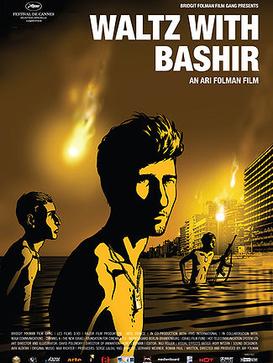
MUST-SEE: Waltz with Bashir (2008)


            The movie I am going to write about is not only a foreign film, but the best war film I have seen since I started my blog.  It reinforced my belief that modern war films can and should be superior to old school war movies, even the classics.  Technology and experience are huge advantages for modern war movie makers. “Waltz With Bashir” is an Israeli film released in 2008.  The movie blew me away because it hit several of my buttons.  It is historically accurate, I learned about an event that I knew little about, it is realistic in its depiction of the military and combat, and it is striking in its cinematography.

            Writer and director Ari Folman spent four years creating what he calls an “animated documentary”.  If not the first of this type, it is still ground-breaking.  It won numerous awards and was critically acclaimed. The film is autobiographical.  Folman takes as his theme the effects of war on memory.  The movie begins with a jaw-dropping three-dimensionally animated scene of a pack of dogs running through the streets to a man’s apartment building.  The dogs represent a memory flashback for a friend of Ari.  The friend tells Ari each dog represented the 26 dogs he sniped during the Lebanon War of 1982.  This conversation causes Ari to confront the fact that he has holes in his memory of his experiences in Lebanon.  That very night he has his first flashback which involves himself and some naked comrades coming ashore on a beach at the city of Beirut.  Another friend theorizes that people sometimes fill in gaps in their memory with fiction.  He encourages Ari to try to fill in those gaps with the truth.  Don’t fear opening those doors, “memory takes us where we want to go”.  He assures Ari he cannot get hurt by learning the truth.

            Ari goes on a quest to talk to comrades he served with and other veterans of the invasion.  Their individual stories are vignettes that powerfully depict the nature of modern war.  Several universal truths about warfare and young soldiers shine through.  The adrenalin-fueled fear in a firefight is followed by the overwhelming silence of death.  Soldiers tend to fire their weapons at nothing and nowhere when traveling through enemy territory.  Soldiers are clueless pawns of the brass and the pols.  Surviving members of a unit suffer guilt feelings.  Unlike some anti-war movies, “Waltz with Bashir” does not glamorize the appealing aspects of armed combat.

            The movie and Ari’s quest builds to the infamous Sabra and Shatila refugee camp massacre.  Ari’s unit is sent into western Beirut after the assassination of the Christian Phalange leader Bashir Gemayal.  The film takes its title from an incident in which a member of Ari’s unit waltzes with a machine gun in the middle of a Beirut street while under fire from snipers and RPGs and as Lebanese civilians spectate.  Time seems to stand still as he twirls amidst the bullet casings and ricochets.  The dance symbolizes Israel’s relationship with Bashir.

            The film concludes with the Israeli Defensive Forces allowing vengeance-minded Christian Phalange militia to enter the Muslim camps.  The individual Israeli soldiers exhibit cognitive dissonance as they are slow to grasp what is clearly taking place before their eyes, abetted by their lighting the night skies with flares.  It takes three days for an Israeli general t
o order a stop to the killings.  The movie makes it clear that the Israeli government (Defense Minister Sharon and Prime Minister Begin) was complicit in the massacre, but Folman is not on a crusade.  He lets the audience connect the dots.  The memory theme comes full circle as Ari realizes that he had filled in the black hole of his memory of being near the atrocity by imagining that he and his comrades were instead at a beach.  The movie closes with real footage of the massacre victims as though to remind the audience that although animated, the story is true.

            I love war movies because I love Military History.  I have been attracted to war stories since I was a child because of the action, but also because war brings out all the emotions and character traits in human beings.  I prefer war movies that have action and are true to human nature.  They don’t have to be historically accurate, but I insist they not be ridiculous and unrealistic.  When you have seen as many war films as I have, you also are impressed when the movie takes a different approach to telling a war story.  “Waltz with Bashir” fits this description (as do “300” and “Oh! What a Lovely War”).  Movies like these prove that although the war movie genre (starting with “Birth of a Nation”) is almost a century old, there are still new ways to tell a war story.

            “Waltz” looks very different from every other war film I have seen.  Folman uses a variety of animation.  The movie is mostly a blend of cut-out and classic animation.  It is influenced by graphic novels and has a scene reminiscent of Japanese animation.  He includes some three-dimensional scenes, but used the technique sparingly and only for spectacular shots.  His use of color varies depending on the mood of the scene.  The war scenes tend to be monochromatic.  The home front scenes are much more vibrant.  (He makes the point that although he was fighting only twenty minutes away, at home the public was unaffected by the war and life went on as usual.)  The shading and shadows are amazing.  The look is mesmerizing.  Blu-ray was made for movies like this.

            The movie is true to human nature mainly because these are real people who Ari interviewed and built the story on.  From my reading of men in combat, I have a good idea of how men behave under that stress.  For those vast majority of people who do not want to read extensively in this difficult area, movies can serve the purpose of educating civilians about what their young warriors go through.  This is important because these young men deserve to be understood.  Civilians need second-hand memory.  Undoubtedly, some Israelis were offended by what they saw in “Waltz”.  The fact is that atrocities happen on both sides in every war.  Good war movies like this show what really happens in war, but also provide the why.

            As an American, I admit to being ignorant about most modern non-American wars.  My blog experience and Caroline’s influence have opened up my eyes to several conflicts that I would have remained clueless about.  I have watched movies on the Bosnian War (“No Man’s Land”, “Pretty Village, Pretty Flame”), the First Chechan War (“Prisoner of the Mountain”), and the Lebanon War (“Beaufort”, “Lebanon”).    They are all good movies that taught me something and encouraged me to research the war.  My modus operandi when I read books is usually to read books that I can learn from.  I am not as strict with movies, but it’s an added bonus when the movie is instructive.

            In conclusion, we war movie lovers all have our reasons for loving this genre.  But don’t forget it is a genre with many fascinating subgenres.  Be willing to sample from them all, even the ones where you have to read.  And try out the newest one – animated war documentary.

GRADE  =  A+


Friday, October 24, 2014

Cast a Giant Shadow (1966)


                “Cast a Giant Shadow” is a pro-Israel movie released in 1966.  Hollywood was looking for a way to put America into the heroic story of Israel’s founding.  It found an opening with the tale of an American soldier named David “Mickey” Marcus.  The movie is based on fact.  “The major events actually happened…. The major characters actually lived.”  Take that with a grain of salt.
                Around Christmas time in 1947, Marcus (Kirk Douglas) is recruited by an Israeli to help train the new Israeli army called the Haganah.  Although Marcus insists he’s an American, he decides to go.  It will not be the first time he abandons his long-suffering wife (Angie Dickinson).  She is used to playing second fiddle to war.  Marcus led paratroopers in WWII Europe.  The movie flashes back to liberation of the Dachau concentration camp just in case you forgot what the Jews had gone through.
                When Marcus arrives in Israel, it is under attack from several Arab nations.  He is transported in an armored bus through an Arab occupied town.  He is chaperoned by a sexy Jewess named Magda (Senta Berger) who is married, but open to flirting.  They visit an Arab chieftain who is entertained by a belly dancer to contrast to the Jews who are constantly engaged in communal singing and dancing.  Marcus is viewed with suspicion by his new comrades until he helps rescue refugees coming in by ship and participates in a lame attack against a Syrian supply depot.  Is it possible to have too many explosions?  Yes.  One positive development is Magda’s husband is killed, so end of that complication.  The relationship develops as Marcus rescues Magda from an ambush.  Unfortunately, Kirk Douglas cannot rescue Senta Berger from being a really bad actress.  Marcus has to leave her when she needs him because his needy wife has had a miscarriage. 
                When Marcus returns he brings a mercenary pilot named Vince (Frank Sinatra) to be the Israeli air force.  When Egyptian tanks attack a kibbutz, Vince flies a Piper Cub and drops seltzer bottles on the Egyptian soldiers causing them to panic.  This is followed by a jeep attack which uses feigned retreat to lure the tanks into an ambush by anti-tank guns.  Marcus is promoted to be the first Israeli general and put in charge of the relief of besieged Jerusalem.  A failed attack on a fortress blocking the road to the city is fairly well-staged and enhanced by flame-throwers.  Marcus then decides to build a road around the fortress.  Teamwork.  And communal singing and dancing ensue.
                The film is a pretty good tutorial on the founding of Israel.  Naturally it is very pro-Israel, but it does not make up the basics.  Marcus did have a background with the paratroopers in WWII, but his role was enhanced for the movie.  During WWII he was a valuable member of Civil Affairs and helped with several key negotiations including the surrender of Italy.  He did parachute into Normandy and participated in some of the fighting before his superior pulled him out.  He supervised the cleaning out of the concentration camps after the war and did visit Dachau, but not in the circumstances depicted in the film.  He was approached by an Israeli official in New York in December, 1947 and asked to find Israel a military adviser to train the nascent Haganah.  When Marcus could not find anyone, he volunteered himself.  His wife was not amused.  Marcus entered Palestine under the name “Michael Stone” and did a tour to determine the needs of the Israeli forces, which were many.  He wrote a military manual based on the U.S. Army manual and gave valuable advice about strategy.  He did have to return home when his wife was ill.  Marcus did lead a force of jeeps and half-tracks against an Egyptian tank force that had invaded the Negev.  It is very unlikely a mercenary pilot dropped seltzer bottles on tanks.  After a failed attack on Latrun, Marcus was appointed the first aluf (equivalent of a Brigadier General) to unify the forces working to relieve Jerusalem.  Marcus planned a second attack which also failed and then he came up with idea of what he called the “Burma road”.  His death is accurately depicted in the movie.  He was “the last casualty before the truce".
                The movie was a worthy attempt at a biopic of a hero.  Marcus was the first soldier buried at West Point who died fighting for another country.  It also made sense to make a movie about the founding of Israel.  The movie is not “Patton” however.  It is not a warts and all portrayal.  That does not mean Marcus was a loose cannon, but it does mean the movie is very pro-Israel.  That is totally to be expected from a Hollywood movie made in the mid-sixties.  The casting lends itself to the vibe as we see cameos by actors like Sinatra who probably wanted to be supporters of the cause.  John Wayne was recruited to bring war movie gravitas. 
                The movie is technically sound.  The cinematography is adequate.  Elmer Bernstein provides a good score.  The movie has a lot of singing in it which gets to be a bit schmaltzy.  The set pieces are nothing special.  Director Melville Shavelson had never directed a war movie and it shows.  The violence is typically non-graphic for a movie of that period.  The acting tends to be hammy.  Topol as an Arab chieftain is especially embarrassing.  Sinatra is slumming.  Wayne plays Wayne.  Douglas is his usual reliable self and is obviously sincere.  The dialogue does not help the actors.  The movie is stuffed with lines that are memorably sappy.  I was forced to pay attention to catch the bon mots.  Here are my favorites:
-           “We’ve been knocking off a lot of guys who have been making soap out of my relatives.” (Marcus at Dachau)

-          “War gets you more excited than I do.”  (Mrs. Marcus)

-          “You couldn’t advise a taffy bowl without slugging somebody.”  (Wayne to Marcus)

-          “ The olive branch has not worked around here since Noah ran the Ark into a mountain.” (Marcus)

-           “This has got to be the biggest bluff since the invention of falsies.” (Vince about his air attack)

-          “Did it make sense for a guy with a steady job building pyramids to march his people into the Red Sea?” 

-          “I’ve been so angry at the world ever since I was circumcised without my permission.” (Marcus)

                The plot is themey.  It hammers away at the “war is addictive” theme.  Marcus is not the first cinematic soldier who prefers his job to his wife.  You do feel sorry for Mrs. Marcus.  Especially since the movie throws in the romance subplot with Magda.  Angie Dickinson’s role is almost a cameo.  The real “get” by the casting director must have been Senta Berger.  She was a hot sex symbol at that time (coming off of “Major Dundee”), but not exactly known for her acting ability.  The romantic subplot shoe-horns the requisite soap opera elements, but ends up leaving the audience unfulfilled in a twist that would not have been a twist in 1966.  Another theme is that of the underdog.  You certainly root for the Israelis.  You would be standing and cheering at the end if it weren’t for…

                In conclusion, “Cast a Giant Shadow” is a movie that needed to be made, but it only ended up being average.  It’s too sincere and simplistic.  It does not belong in the Best 100 War Movies list.

GRADE =  C