Showing posts with label James Clavell. Show all posts

Monday, July 18, 2016

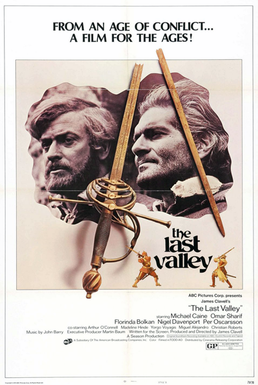
FORGOTTEN GEM? The Last Valley (1970)


                “The Last Valley” is a movie set in the Thirty Years’ War.  It was written and directed by James Clavell and is based on the novel by J. B. Pick.  It was shot in Austria.  Although you would think the public was pining for a movie about the Thirty Years’ War, the movie was a flop.  It turns out that people did not care about a complex religious war in Germany in the 17th Century.  Go figure.

                A former teacher named Vogel (Omar Sharif) escapes from a hellish landscape of raping, looting, and murder to find refuge in an isolated village in a picturesque valley that is untouched by the war.  This paradise is about to be sullied with the arrival of a mercenary band led by “the Captain” (Michael Caine).  Vogel suggests they agree to a détente with the villagers.  When one of the men questions this wimpy attitude, the Captain stabs him – end of discussion.  The villagers know the alternative to sharing their village and themselves (if they are women) is worse than any alternatives so they make the best of the situation.  Talk about dysfunction.  Throw in the religious fanaticism and you get a gooey mess.  The movie is not content to explore the obvious Catholicism versus Protestantism angle of the war.  We get a fanatical priest and a witch!  Someone (or two) are headed for a burning at the stake. 

                All this fellowship must come to an end, however.  One of the mercenaries has a dispute with the Captain and returns to the valley with another crew.  There is a mediocre battle that features uncanny accuracy from muskets.  The village sides with their thugs over these unknown thugs.  When spring approaches, it’s time for the boys to get back to work.  There is a siege going on that promises looting and killing.  This live and let live stuff has gotten old.

                I have not read the book so I cannot compare it to the screenplay.  I would hope it makes more sense than the film.  Maybe that was intended because God knows the war made little sense.  You will not learn much about the war from the movie.  You do get the accurate impression that the war was a conflict between Protestants and Catholics.  You also learn that neither religion was in the right.  The ignorant peasants are full of religious ignorance and superstition.  The mercenary nature of the warfare is also highlighted.  And the nasty nature.  At least they are using authentic weaponry.  

                This is a pretty bleak movie.  None of the characters is likeable.  I think the Captain is supposed to grow on you and he does, like a fungus.  In fact, there are several schizophrenic characters.  It does not help that the acting is poor.  Caine and Sharif are solid, but the rest of the cast is weak.  They make up for this with being incredibly well-groomed for the 17th Century.

                In conclusion, this could have been a good movie on a war that deserves at least one decent film.  Unfortunately, the movie tries to do too much and throws in too many diverse characters.  The symbolism of the idyllic valley that is eventually poisoned by the reality of human nature is a bit trite.  Hammering the theme that all religion is bad is also trite.  It also tries too hard to be anti-war.  You don’t have to try hard if you are dealing with possibly the worst war in history.

GRADE  =  D

Saturday, May 30, 2015

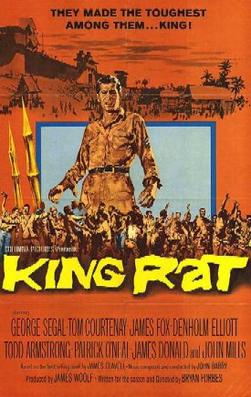
BOOK / MOVIE: King Rat (1962 / 1965)


                “King Rat” was the first novel by James Clavell.  It is set in the Changi Prison Camp in Singapore in WWII.  The camp holds British, Canadians, Australians, and a few Americans.  Clavell had been a prisoner in the camp and the Peter Marlowe character is based on him.  The book was published in 1962.  The movie was released in 1965 and was directed by Bryan Forbes.  Forbes wrote the screenplay with Clavell.  Earlier I reviewed the movie and now I am comparing the movie to the novel.

                The movie is about survival in a Japanese prison camp.  The main character is an American corporal named King (George Segal) who is not just surviving like most of the enlisted men, but is actually thriving because he is a talented black marketeer and amoral.  He is well-dressed and well-fed and has a gang of Americans in his hut on his payroll.  Everyone calls him “the King”.  He also has bribed several of the camp leaders to look the other way.  His nemesis is the Provost Marshall Lt. Grey (Tom Courtenay).  Grey is a lower class Brit that is obsessed with catching King breaking the camp rules against profiting while others are suffering.  The movie becomes something of a buddy film when King strikes up a relationship with an upper class RAF pilot named Marlowe (James Fox).  Marlowe agrees to act as King’s interpreter in his deals with the guards since he speaks Malay.  He is unlike King’s other toadies because he is not interested in the largesse that King shares with them.  He is instead attracted to the charismatic King and intrigued by his “every man for himself” philosophy.  The two develop a friendship as Marlowe is corrupted by the unadulterated American capitalism of King.  King is intrigued by a man who is not interested in his money and has an upper class sheen to him.  At one point he even saves Marlowe’s life, although it is unclear what his motives are.  Meanwhile, Grey is in hot pursuit of both of them and the Japanese are hunting for clandestine radios.  We also learn that while King uses his talents to his advantage, some of the British Majors and Colonels are using their status to their advantage.

                The movie tracks the book very closely and much of the dialogue in the book appears in the film.  All the characters in the movie appear in the book and the roles are untampered with.  All of the major incidents in the movie are straight from the novel.  Nothing significant was added in the movie.  Naturally the novel has some subplots and characters that the movie does not include partly because of time constraints.  For instance, the book has a subplot involving a friend of Marlowe’s named Sean who has found his calling as a transvestite actor in the camp plays.  He comes to believe that he is a girl.  (I wonder why that subplot was left out of the movie.  lol)  Also, in the book, King and Marlowe sneak out of the camp and visit a local village to conduct some business.  There are even some women involved.  (The movie does not have a single woman in it.)

                The book differs from the movie mainly in depth.  The movie confines itself mainly to the King character and Marlowe’s reactions to him.  Although the movie delves into whether King has any redeeming virtues, he is more multi-dimensional in the book.  The friendship is much more developed in the book.  There is a strong bond between the two.  In the book it is clearer that King saves Marlowe’s life because he cares for him.  The book is also less enigmatic about the effects King has on Marlowe.  There is a key passage in the book where Marlowe justifies to himself making a profit on a solo deal.

                The novel spends more time highlighting the social distinctions within the camp in general and the British army in particular.  Grey despises Marlowe because of who he is more than who he is associated with.  He is embittered by England’s rigid class structure.  The novel also has the luxury to spend more time focusing in on the corruption of the brass.  It seems clear that Clavell knew someone like King when he was a prisoner.  But it is also clear that he had some anger towards the upper officers.  Both the movie and the book ask the question whether King or the brass were more evil.  It could be argued that the hypocrisy of the camp leadership made them more loathsome.  One thing you can say about King, he did not hide his avarice.  Another aspect that the book pushes is the difference between American culture and British culture.  Clavell’s King represents American capitalism at its worst.  Or best.  If you are a Republican, King is a hero.

                My theory is that a movie should be better than the book it is based on.  The movie makers have the advantage of making improvements on the source material.  In this case, it is not clear that the movie is an improvement.  What we have is the symbiotic relationship that can exist between a movie and its source material.      The movie does not have the time or desire to cover all of the themes in the book.  What the screenwriter retains is very close to the book and seeing a stellar cast bring life to the characters is neat.  “King Rat” works best if you watch the movie first and not vice versa.  The book fills in some of the gaps and explains little details that might go unnoticed in the film.  For instance, you learn why the doctor seems too rude towards his aide.

                In conclusion, in this case I will say that the book is superior to the movie.  The reason for this opinion is you get the plot and characters from the movie plus more.  More is usually better.

BOOK  =  B

MOVIE  =  B-

Thursday, May 26, 2011

FORGOTTEN GEM? "King Rat"


      “King Rat” is a WWII prisoner of war movie released in 1965. It was based on the novel by James Clavell. The film is set in the infamous Changi Prison Camp on the island of Singapore in 1945. It is a tale of survival, not escape. The main character is an American in a mostly British camp. He is Corporal King (George Segal) and he unofficially runs the camp because he is the go-to guy for anything a prisoner might want – at a price. He is amoral and enjoys it. Because he has profited from his acquisition “skills” he looks spic and span and eats well. Most of the inmates resent him, especially the Provost Marshall, Lt. Grey (Thomas Courtney). Grey is an officious British officer who is obsessed with bringing King to justice. He is having a hard time catching the King red-handed, however.


     King develops a dysfunctional relationship with the suave, upper class Brit Peter Marlowe (James Fox). He wants him to act as an interpreter (he speaks Malay) and tries to put him on the payroll by offering him an egg. Marlowe cannot be bribed, but he is intrigued by the charismatic King and takes the job.

     King has a posse, which includes toady Sgt. Max (Patrick O’ Neal), that he lords over. They come up with a scheme to breed rats and sell the meat as mouse deer. Meanwhile, Grey discovers corruption in the food distribution. When he brings the accusation to Col. Smedley-Taylor (John Mills), he finds out the brass are involved and is told he should ignore it. He is incensed, but the offer of a promotion calms him down. So who is worse – King or the camp leaders?

     King is a strange character. When he is almost caught with money gained from trading with the Japanese, he gets Marlowe to hide the evidence and then gets expensive medicine to save Marlowe’s gangrenous arm from being amputated. Is he doing this out of friendship or because only Marlowe knows where he buried the money? It is unclear because King is such a dislikable person.

     The British officers are called in and the commandant shocks them with news that the war is over. Everyone in the camp celebrates except King who realizes that not only are his salad days over, but the sword of justice now hangs over his head. He barely survives a fit by the seething Max. When a single British paratrooper (Richard Dawson!) arrives to liberate the camp, he pointedly asks King why he looks a lot fitter than the other prisoners. The hand-writing is on the wall for King. Marlowe defends King’s actions to Grey by pointing out that hatred of King is what kept Grey alive. However, King turns his back on Marlowe’s attempt to part on good terms. Is King trying to save Marlowe from guilt by association?

    At the end of the film, King is leaving with the other Americans in a truck. He stands in the back of the truck with his arms out like Christ on the crucifix – an image that, if planned by the director, does not fit his character at all.

     This is a pretty bleak movie, although it has its moments of black humor. It does accurately reflect conditions in a Japanese prison camp. We can assume this because James Clavell spent three years in Chongi. The conditions are not exaggerated in part because Chongi was actually one of the better run Japanese camps. What’s bleak is the men themselves. The prisoners are gaunt and they sweat a lot. Only King is not a scarecrow. They also smoke cigarettes whenever they can get them which makes butts a type of currency in the camp. This is a movie that will make some non-smokers and all vegetarians sick. The camp brings out the worst in some men. There probably were men like King in every camp, but you do not see them in most POW movies.

     Some of the movie strains credulity a bit. King does not hold sway because of physical intimidation. He is in the distinct minority as an American and is disliked by the vast majority, including members of his entourage. Realistically, he would have been killed for his stash (which his posse knows the location of).

     The movie is well respected in the prisoner of war genre. It contrasts well with the more up-beat and optimistic ones like “The Great Escape” or “The Colditz Story”. It is interesting to note that TGE came out in 1963 before the 60s cynicism hit Hollywood and KR came out in 1965 about the time that cynicism begins to be felt. To see what I mean, compare the scrounger in TGE (Hendley – James Garner) to King. Being more realistically depressing does not make it a better movie than TGE and it is probably a bit overrated. But you have to give it credit for showing survival over escape. It came as a surprise to me that it was nominated for two Academy Awards (cinematography and art direction). The acting is good, especially Segal who has to be unlikable (Paul Newman and Steve McQueen turned down the role). Watch it if you want a different point of view on prison life.

Rating – 7/10