Showing posts with label Leslie Howard. Show all posts

Wednesday, October 3, 2018

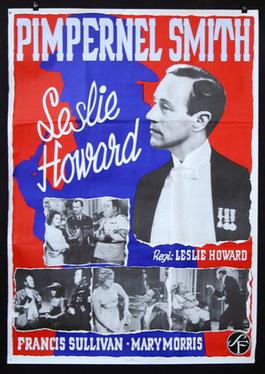
CLASSIC OR ANTIQUE? Pimpernel Smith (1941)


                In 1934, Leslie Howard made a classic movie called “The Scarlet Pimpernel”.  It was the tale of a British aristocrat who used his quick wits and disguises to rescue Frenchmen during the Reign of Terror of the French Revolution.  Seven years later, he revisited the premise and applied it to the situation in Europe right before the outbreak of WWII.  Howard was inspired by the story of the rescue of an anti-Nazi Hungarian leader.  He worked on the project for three years and ended up producing and directing.  The film was a big hit in Great Britain.  It was released in America as “Mister V” (I have no idea why they renamed it).  Churchill chose to show it to the officers of the HMS Prince of Wales on his way to meeting FDR for the conference that resulted in the Atlantic Charter.  When Raoul Wallenberg saw it in Sweden, it inspired him to rescue numerous Jews from the Holocaust.  The movie has some major street cred.  The movie claims to be a fantasy based on real people and events, but you should view it as preposterously entertaining propaganda.

                Howard plays Horatio Smith.  Smith is a professor of antiquities at Cambridge University.  He is absent-minded and anti-female.  No one would guess he is the daring “shadow” who has been sneaking Nazi targets out of Germany.  The mission portrayed in the movie is to rescue a German pianist who is anti-Nazi.  He plans to do this via a Nazi approved archeological dig that he tells them will prove the German civilization has Aryan beginnings.  So, if you’re wondering how a British professor has the opportunity to be rescuing right under Nazi noses, there you have it.  Don’t overthink.  The professor takes six of his students with him, including a brash American (I know that is redundant) named David (Hugh McDermott).   They will piece things together (the clue comes from a wound Smith gets while masquerading as a scarecrow!) and end up teaming up with their prof.  Smith’s nemesis is a Goering-like Gestapo chief named von Graum (Francis Sullivan).  He is pompous, but not buffoonish.  However, he does not get snark well.  He suspects Smith and their interplay is the highlight of the movie.  The movie has a running joke about von Graum’s claim that Shakespeare was German.  At the end of one of their exchanges, Smith says “Parting is such sweet sorrow.”  When Von Graum asks “what is that?”, Smith responds with “One of the most famous lines in German literature”.  To show the level of intelligence of the script, Smith refers to the theory that the Earl of Oxford wrote Shakespeare’s plays.  Von Graum sics  Ludmilla (Mary Morris) to flirt the truth out of the Professor and provide us with romance. 

                “Pimpernel Smith” is an entertaining propaganda piece from WWII Britain.  It is a showcase for the wonderful Leslie Howard.  He made it because he felt he needed to weigh in on the Nazi threat and show Brits what they were fighting for.  It was one of the first movies to reference the concentration camps, although the scene in one of them is ludicrous and far from showing the horrors of the Holocaust.  The movie’s theme is more of a fist in the face of the Nazis.  The movie closes with the obligatory speech by Smith which concludes with him promising Von Graum:  “I shall be back.  We should all be back.”  That is a bit trite, but most of the dialogue is crisp and there are some humorous lines.  Smith describing a skeleton uncovered at their dig:  “Buried with all his weapons, you see, presumably, in the belief that there might be a rearmament program in the hereafter, eh, Mr. Spencer? An ancient Teuton.”  Howard dominates the movie.  He has a bravura scene where he goes to Gestapo headquarters in disguise and snarks the hell out of them.  (The scene reminds of “To Be or Not to Be”.)  The rest of the cast is average, except Sullivan who makes Von Graum a worthy adversary.  He is atypical for a comedy Nazi.  Otherwise the movie is predictable, but you expect that.

                “Pimpernel Smith” is available on You Tube and is well worth a watch.  Although not particularly well known, it is a classic and it stands the test of time well because the dialogue is intelligent.  The words balance the silliness and Howard moves it to a B.

GRADE  =  B

Sunday, August 7, 2016

FORGOTTEN GEM? The First of the Few (1942)


                “The First of the Few” is a biopic about the man who designed the Spitfire fighter plane.  It was produced and directed by Leslie Howard.  He plays R.J. Mitchell and this was his last role as the airliner he was flying in was shot down one year later.  The movie costars David Niven who was loaned by Samuel Goldwyn in exchange for American distribution rights.  When Goldwyn learned that Niven was not the lead, he angrily cut 40 minutes from the American release.  The movie was renamed “Spitfire” in America (which, if you think about it, is a better title).

                The movie opens during the Battle of Britain in 1940.  A narrator explains the expansion of Germany accompanied by black spreading across the map of Europe.  Quotes by Hitler, Goebbels, and Goering illicit boos from the audience.  A group of real RAF fighter pilots is waiting to be scrambled.  Squadron Leader Quentin Crisp (Niven) shows up to raise the acting level and initiate a flashback.  In 1922 Mitchell has the idea for a radical new plane.  Crisp comes on board as the test pilot.  The plane will use the secrets of the birds with no struts or wires.  Only Crisp and Mitchell’s supportive wife think he’s on to something.  A series of air races chronicles the development of the plane and leads us to the question:  Did people actually spectate at these races?  In 1933, he goes to Germany.  At a party with German military officials, Mitchell is told that the Germans are violating the Versailles Treaty and suck on it.  The arrogance of Willi Messerchmitt motivates Mitchell to create a fighter plane that will be able to compete with the Germans.  This being a biopic, there has to be a wrench thrown in.  Mitchell is diagnosed with some disease and told he can either take some time off and live or save England and die.  Guess which he chooses?

                “The First of the Few” is your standard 1940s biopic.  Mitchell is a saint and his wife is the stereotypical supportive spouse.  There are no villains other than the entire nation of Germany.  The movie is definitely propaganda, but it’s not the gag-inducing kind.  Speaking of gags, the movie is very British especially in its humor.  All of which is provided by Crisp as a ladies’ man and a wise-cracker.  It is likely the movie would be pretty boring without his character.  The acting is fine by Howard and Niven, but the rest of the cast is average.  Most of the film takes place on sound stages so it has an artificial look to it.  The cinematography and music are meh.  The movie does take off in the test flight scene and the dogfight at the end.  The movie finishes strong.

                The movie is generally accurate, but simplifies and sanitizes things.  (Try to imagine Howard as a boss from hell, which is what Mitchell actually was.)   He was a brilliant aircraft designer who developed twenty four aircraft from 1920-1936.  Much of the effort was part of competition in air races like the Schneider Cup.  The biggest bit of artistic license is the meeting with Messerchmitt.  In reality, Mitchell never visited Germany.  The Crisp character is fictional, but a composite of two test pilots named Jeffrey Quill and “Mutt” Summers.  Summers was the pilot who tested the plane in battle and shot down three German planes.  The real Summers flew a Spitfire in the film.  The movie implies that Mitchell died of tuberculosis, but he had rectal cancer and worked through the pain.  His work did not hasten his death.  The movie also dramatically has him dying right after the first test flight when he actually died fifteen months after the prototype was first flown.  In a more trivial note, Mitchell did not name the plane and felt the name was silly when he learned what the RAF wanted to call it.

                In conclusion, this is a must-see if you are British.  It’s probably the law.  If you are American, you should see it if you are a war movie buff.  Bucket list – check.

GRADE  =  B-