Showing posts with label Middle Ages. Show all posts

Friday, April 12, 2019

STREAMING: Sword of Vengeance (2015)


                “Sword of Vengeance” is a film by the esteemed Jim Weedon.  It was released in 2015 to less than universal acclaim.  Instead of standing in the long lines at the theater, you can now stream it on Netflix.  Thank God for Netflix!  The movie is historical fiction (heavy emphasis on the fiction) set in the time after the Norman Conquest.  William the Conqueror has sent an army to northern England to carry out a campaign of “furious destruction”.  This is known as the Harrowing.  William’s most feared war lord Earl Devant is responsible for killing 100,000 Saxons.  Boy were his arms tired!  He now rules with his sons Artus (Gianni Giardinelli) and Romain (Edward Akrout).  They are both good boys.  Just kidding.

                In an ominous development, the movie goes to slo-mo in the first minute.  And an amputated hand within two minutes.  A mysterious cloaked stranger called the Shadow Walker (Stanley Weber) has an encounter with some lackeys with predictable results.  It’s very graphic, naturally.  Two men are dead before the severed hand hits the ground.  The Shadow Walker then walks (slow motion) through the woods.  There will be a lot of walking in this movie.

                Artus and Romain don’t get along.  Artus is a bully.  He sends Romain to bring back Shadow Walker’s  head.  The encounter does not go well for Romain who loses an eye.  That’s better than the heads three of his men lose.  Shadow Walker hooks up with a woman named Anna.  They have a slo-mo bonding scene.  This movie would be half as long without the slow motion.  Artus begins a scorched earth program because in the Middle Ages if someone offends you, the peasants have to pay.  A blood spraying melee ensues and Artus is captured.  Romain arrives to negotiate, but the Shadow Walker is not the talkative type.  It looks like daddy will need to get involved.  Defensive preps montage.  In slo-mo.  Bare-chested sword honing.  Flashback – it turns out Durand killed Shadow Walker’s father right in front of him (is there any other way in movies like this?)  Slo-mo sally from the fort.  Durand has brought six berserkers with him just so he can say “release Hell!”  Shadow Walker has to take on four baddies.  Lucky for him, they nicely take him on one at a time.  These prelims lead to the main bout with Durand.  Clang and woosh go the double swords and double axes.  Post script:  the village is being assaulted.  This looks like a job for Shadow Walker.  Handing out weapons and gearing up montage.  They have plenty of time because the enemy is coming in slo-mo.

                “Sword of Vengeance” is slow-moving.  Get it?  In fact, it would be better titled “The Slow Walker”.  It is poorly acted and the characters are all cliché.  The central hero is a dud and so is the main hero.  The dialogue does not help the actors.  If you took a drink every time the Shadow Walker speaks, you’d have only a slight buzz.  If you drank every time he said something intelligible, you’d be completely sober.  There is a butch chick (Anna) who adds some girl power.  It would have been nice if the director had added some color.  The film is close to being black and white.  Does it cost more to be more colorful?  There is a lot of blood splattering, but it’s drab.  All the throat cuttings don’t redden the screen much.  Speaking of which, there is not a lot of variety in the deaths.  Usually in a movie like this the director has a check list of various decapitations and amputations.  Weedon’s list was not long.  The fights are blah, including the climactic duel.  In other words, the movie should have been entertainingly bad.  Instead, it’s just bad.

GRADE  =  D

Sunday, July 24, 2016

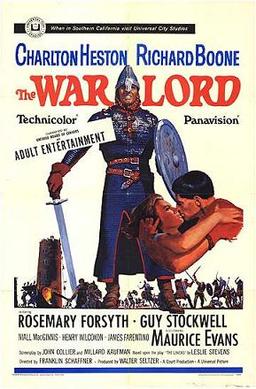
The War Lord (1965)


                “The War Lord” is a different type of medieval movie.  It was a personal project for Charleston Heston who optioned the play “The Lovers” by Leslie Stevens.  He got Franklin Shaffner to direct it.  This was three years before he teamed up again with Heston for “Planet of the Apes” and five years before “Patton”.  The film was an attempt to bring a more authentically gritty view of the Middle Ages.  It is one of the rare medieval movies that are not epic in scope.  This might partly explain why it did not do well at the box office.

                Orson Welles narrates that in 11th Century Normandy powerful dukes ruled their lands and provided protection from Viking-like raiders called Frisians.  A knight named Chrysagon (Heston), fresh from a Crusade, has been given charge of a Druid village.  He and his band of knights-errant arrive just in time to kick some Frisian ass.  Chrysagon duels with the Frisian leader, but he gets away.  Chrysagon is less than thrilled with his task.  He and his men, including his brother Draco (Dean Stockwell) and his bro Bors (Richard Boone), look down on the Druids because of their pagan beliefs and the fact that they are peasants.  The knights occupy the keep that overlooks the village.  Small scale tale, small scale castle.

                Chrysagon meets the village hottie Bronwyn (Rosemary Forsyth) and he is so confused about his feelings for her that he does not rape her.  When her betrothed Marc comes to him for the customary permission to marry, Chrysagon reluctantly agrees.  Draco reminds Chrysagon of the “droit de seigneur” which gives nobles the right to sleep with a virgin bride first.  He thinks that is a good idea and promises to return her at dawn.  When the sun comes up and she does not come out, Chrysagon has a rebellious village on his hands.  A rebellious village that makes an alliance with the Frisians.  A rousing siege of the keep ensues.  Ladies, you get to watch Charleston Heston fight in his loin cloth!  Although anachronistic explosions are eschewed, we still get lots of fire. 

                This is a strange movie, especially for a movie that was made before the modern era of realism.  Chrysagon is not an anti-hero, but it is hard to tell whether we are supposed to view him as a hero.  Is it admirable that he refuses to rape a peasant girl?  Is he rewarded with her because of his restraint?  The romance that the movie is framed around is different, but not necessarily more realistic than in most medieval movies.  I am sure the movie does not want Bromwyn to be viewed as the villain, but she turns her back on a man that she seemingly was in love with and then betrays the entire village.  Both the central characters show little concern for the consequences of their actions.  This is justified by way of the common movie trope of “love conquers all”.

                There’s a lot to like in the movie.  The acting trio of Heston, Stockwell, and Boone is strong.  Less can be said for Forsyth.  She is in over her head and does little other than look lovely.  There is some interesting cinematography with some deep focus for the interior scenes and quite a bit of stationary camera scenes.  The music is almost continuous, but not pompous.  The action is what sets the movie on a higher plane than your typical medieval romance.  I was surprised to find that the movie does clearly fit into the war movie genre.  The assault on the tower is well done and shifts the movie into a higher gear midway through.  The stunt work is noteworthy.  There are a lot of falls in the film.  The deaths are not laughable and some are special.  One character is impaled by a tree!

                As far as accuracy, the movie deserves some kudos.  The interiors of the keep are authentically sparse.  The clothing is appropriate for the time period.   The knights wear chain mail, open-faced helmets, and carry kite shaped shields.  The siege tactics fit the scenario.  The besiegers use a battering ram and a siege tower.  The defenders respond with boiling oil.  There is a bit more use of bows by the defenders than would be common and the catapult hurling fire balls is pure Hollywood, but these can be forgiven.  The biggest groaner is the use of droit de seigneur to catalyze the drama.  It tosses in the qualification that the girl must be returned by dawn.  Not that this is the first or last time a movie will use this disproved myth to defame the nobility.  At least in 1965, the knowledge of this falsehood was not well-known, unlike the egregious “Braveheart” of 1995.  Other slurs on history include the fact that there would not have been a Druid village in France by  this time.  But then we would not get to see what Hollywood imagined a Druid wedding celebration was like. Lots of dancing, drinking, and wanton sex.  Basically a frat party.  The Frisians were no longer raiding France in the 11th Century, but at least they don’t have horns on their helmets.

                Although the movie has a mixed record on historical facts, it gets a lot of credit for the bigger picture of medieval life.  It goes out of its way to be realistic on some aspects of the feudal system.  It clearly depicts the gap between the nobility (even lowly knights) and the peasants.   More rare is the noble family dynamics that are dramatized.  (The movie is not in a league with “The Lion in Winter”, but what movie is?)  Draco is seething with resentment toward his older brother because being the eldest gave you all the advantages.  In general, the movie does a fair job of showing how unglamorous the time was.  Seamy in a 1965 allowable way, of course.

                Does it end up on my 100 Best War Movies list?  Possibly.  It certainly belongs on a list of the Top Ten Medieval War Movies.  Not that there is a lot of competition.


GRADE  =  B-