BACK-STORY: The full title is “Dr. Strangelove or: How I Learned to Stop Worrying and Learned to Love the Bomb”. It was released in 1964 at the height of the Cold War. The director was the esteemed Stanley Kubrick using a screenplay adapting the thriller
Red Alert . The movie was originally meant to be serious, but Kubrick transformed it into a black comedy. The production revolved around Peter Sellers (the film was done in England because Sellers could not leave due to divorce proceedings) as Columbia Pictures insisted on him playing four roles. Sellers was removed from the Kong role because of a fortuitous sprained ankle (he was uncomfortable with the Southern accent and did not want to play it). The movie is a satire of real Cold War personalities and paranoia. The U.S. Air Force did not cooperate with the production because of the screenplay.
OPENING SCENE: The movie opens with a disclaimer from the USAF stating that safeguards would prevent the events shown in the film (true). A narrator tells us that the Russians are rumored to be working on a “doomsday device”. We see a B-52 bomber refueling to the strains of soothing music. At an air base, Gen. Ripper (Sterling Hayden) has his men on red alert claiming a shooting war has begun. He sends a message in code to the orbiting B-52 force initiating their flight into Russian to nuclear bomb strategic targets.
SUMMARY: A British liaison named Mandrake (Sellers) is appalled to find the clearly mad Ripper bent on starting a nuclear war. Ripper rants about the fluoridation of water as a Communist plot to contaminate our “bodily fluids”. He pulls a gun on Mandrake and holds him hostage.
 |
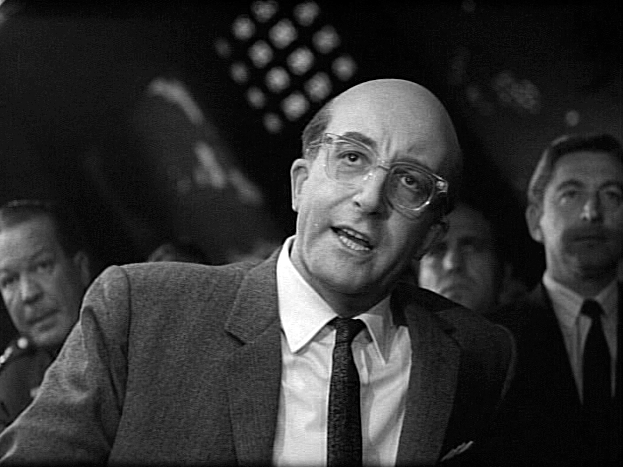
| Pres. Muffley |
In the “War Room” in Washington, Gen. Turgidson (George C. Scott) explains the situation to Pres. Muffley (Sellers). It seems that an obscure war plan allows a commander such as Ripper to initiate a nuclear attack on his own initiative. Turgidson argues that now that the plan has been put into effect the U.S. should go all in and destroy Russia. “I’m not saying we won’t get our hair mussed – at most 10-15 million deaths. Tops – depending on the breaks”. Muffley is portrayed as a typical pacifist, liberal, Democrat. He is appalled at Turgidson’s proposal. Instead he orders the Army to assault Ripper’s base to get the recall code from him and then calls Russian Premier Kissoff via the “Hot Line” to apologize and help diffuse the situation by coordinating the shooting down of the bombers. The ensuing phone conversation is one of the funniest in film history.
 |
| Dr. Strangelove |
The Russian ambassador arrives to inform Muffley about the Russian Doomsday Machine which is designed to end life on Earth for the next 93 years if Russia comes under nuclear attack. This was developed because of a perceived doomsday device gap. Dr. Strangelove (Sellers) is called in for his expertise on nuclear strategy. He is obviously an ex-Nazi who has trouble controlling his right arm (it sometimes does the Nazi salute or tries to strangle him). This results in some funny physical comedy. Strangelove, in his heavy German accent, explains the deterrence of the Doomsday Machine.
 |
| Turgidson |
Meanwhile, the Army assaults Ripper’s base. The scene has a documentary look to it as hand held cameras were used. Some of it looks like footage from Vietnam which would have been prescient given the future. Ripper fires a machine gun through his window and then commits suicide.
 |
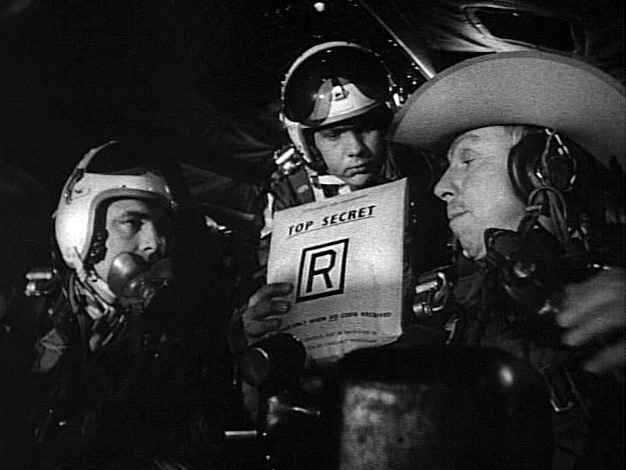
| the bomber crew |
After passing its “fail safe” position, the B-52 “Leper Colony” piloted by Maj. Kong (Slim Pickens) survives a Russian anti-aircraft missile which knocks out its communications so it cannot receive the recall order. The plane looks fake on the outside, but realistic on the inside. “Johnny Comes Marching Home” plays in the background as Kong switches to an alternate target that is undefended thus circumventing the President/Premier defense cooperation. To make matters more suspenseful, the bomb bay doors won’t open, forcing Kong to open them manually. This results in the iconic bomb-riding scene that is justifiably famous. “Wahoo!”
FINAL SCENE: In the War Room, word arrives that one of the bombers has detonated a bomb on a Russian target thus supposedly triggering the Doomsday Machine. Dr. Strangelove suggests putting 100,000 people in mine shafts to ride out the radioactivity and repopulate America. He recommends 10 nubile females for every young, healthy male. Sellers does a screamingly funny battle with his evil arm. Turgidson pipes in that we have to avoid a “mine shaft gap”. Suddenly the Doomsday Machine activates resulting in a montage of atomic test footage to the song “We’ll Meet Again”. Amazingly, Kubrick thought about ending the movie with a pie-fight in the War Room!
RATINGS:
Action - 5 the battle at the air base is pretty intense
Acting – 10 especially the multi-talented Sellers
Accuracy - 7
Realism - 7
Plot - 10
Overall - 9
WOULD CHICKS DIG IT? There is only one female character (Turgidson’s girlfriend) and she is not there for the female audience, if you get my drift. However, the movie is not your standard macho war movie so it appeals to a broader audience. The humor is black and intellectual so factor that in. I feel most intelligent women would enjoy this movie. It is a masterpiece that everyone should see.
CRITIQUE: Once again we have an all-time great movie (like “The Manchurian Candidate”) that does not fit comfortably into the war movie category. If it did, it would be ranked higher than #84 because it truly is a masterpiece. It is better classified as a political satire set in the Cold War. It taps in skillfully to the paranoia of the early 60s. Keep in mind that the Cuban Missile Crisis occurred just a year before filming began. Somewhat surprisingly, considering that it was set and produced in a thankfully bygone era, it holds up very well for modern audiences. It is still very funny. It has some of the greatest lines in movie history including President Muffley quelling a scuffle by saying “Gentlemen, you can’t fight here. This is a war room.” It also has several famous scenes including Keenan Wynn’s assault on a Coke machine.
The acting is great. Seller’s performances are a tour-de-farce. He ad-libbed many of his lines as well as the evil arm stuff. It is unbelievable that he lost the Oscar to Rex Harrison of “My Fair Lady”! The cast is uniformly grand in its ability to keep a straight face throughout (the same could not be said for the crew, from what I have read). The directing is outstanding, as is to be expected from Kubrick.
ACCURACY: The screenplay is based on a novel and thus is not based on any incident from the Cold War. As far as we know, there was never any accidental launch of a nuclear attack. Plus the scenario that exists in the movie with a rogue general ordering bombers to proceed into Russia was impossible because of safeguards put in by the civilian-controlled government. Only the President could give launch orders. There were some scary moments, but they were due to technology errors, not human errors. The Hot Line was only used once, and not because of a nuclear incident.
The movie is realistic in many aspects. Mutually Assured Destruction was the policy of both the U.S. and the U.S.S.R., so a single nuclear strike even by accident could have triggered a massive retaliation that would have ended life as we know it. Although there was no “Doomsday Machine”, there were literally thousands of ICBMs that would have brought doom, including 100 megaton behemoths in the Soviet arsenal.
We did have B-52s on alert throughout the 60s including some that were always airborne just in case. By the way, although the Air Force understandably gave no assistance to Kubrick, he was able to create a mock-up of the inside of a B-52 that was quite accurate. The idea that they would have been sent on a preemptive strike is far-fetched, but the probable reaction of the President (especially a Democrat) is spot on. I can envision the President using the “Hot Line” to apologize and help shoot down our own planes. Having the military leadership argue for taking advantage of the situation also seems logical, albeit stereotypical.
Since the movie was released there has been an ongoing debate about who each of the main characters is based on. Dr. Strangelove appears to be an amalgam of Nazi scientist Werner Von Braun who helped develop our space program and Edward Teller who is considered to be the Father of the Hydrogen Bomb and was not totally against its use. Pres. Muffley behaves like you would have expected an Adlai Stevenson to have behaved under similar circumstances. Scott could be channeling Curtis Lemay in his portrayal of Turgidson.
Two seemingly made up ideas in the movie are actually accurate. The John Birch Society of the 1960s pushed the idea of fluoridation of water being a Communist plot. Believe it or not, there actually is a condition called “alien hand syndrome” (sometimes called “Dr. Strangelove syndrome”) that causes a person to lose control of their right arm!
CONCLUSION: It will be tough to determine a place for “Dr. Strangelove” on my amended list because although it is an unquestioned classic, it is not truly a war movie as I define them. Apparently the panel put together by Military History magazine had this same conundrum. How else do you explain classifying it as a war movie and then ranking it behind lesser movies like “Guadalcanal Diary”?
The other question is: is it the funniest war movie of all time? It has competition from others on the “Greatest” list like “Hail the Conquering Hero”, “The General”, “MASH”, and “Duck Soup”. It seems unlikely that those others will induce the laughs that “Strangelove” brought out. Plus, unlike many dated comedies that are not funny today, Kubrick’s humor still seems fresh. It is also a movie that bears repeated viewings. Certainly, every movie fan and every war movie buff should see it at least once.
NEXT UP: #83 - "Sahara"